
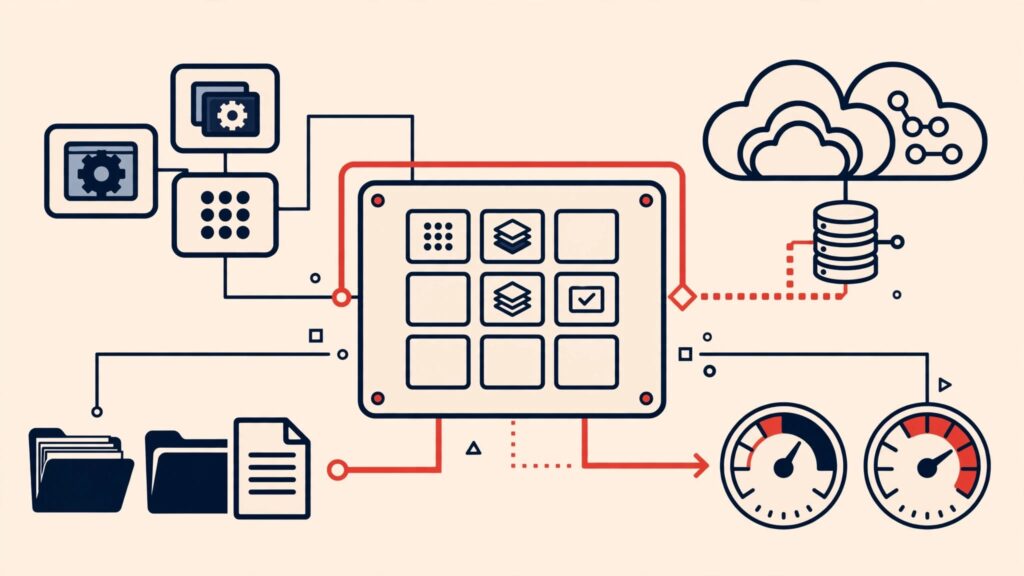
Budget season exposes every technology decision you have avoided. Costs rise, renewal dates arrive, and leaders need a portfolio review before budgets lock.
A focused application portfolio assessment gives you a clearer answer and connects technology costs to business goals. This is about enterprise software, not a creative portfolio. You’re reviewing a digital portfolio of software applications that run finance, sales, operations, customer service, data, and internal work.
Done well, the application portfolio assessment turns a messy software list into a smaller set of decisions leaders can defend.
Key takeaways
- Start with the business goals you need to achieve over the next 12 to 18 months, then use an application portfolio assessment to guide software decisions.
- Build one application inventory leaders can trust, with ownership, cost, contracts, usage, data, and dependencies.
- Score each system by business value, risk, effort, and strategic fit, so the portfolio review supports clear funding choices.
- Before retiring a system, use an application portfolio assessment to connect its spend and risk to business outcomes. Confirm what breaks around it first.
- End with named owners, clear funding decisions, and an executable technology roadmap.
Run an Application Portfolio Review Around Business Decisions
An application portfolio assessment is not an IT housekeeping project. It is a leadership decision process.
Portfolio management is the operating discipline behind an application portfolio assessment. It connects software applications to enterprise architecture dependencies and capabilities. Orbus Software’s overview of application portfolio management makes the point clearly: the work is about optimizing applications, not collecting a longer software list.
Set the business outcomes before opening the inventory
Start with three to five outcomes tied to your business goals. Revenue growth. Margin improvement. Faster customer onboarding. Better reporting. Lower cyber exposure. A cleaner acquisition story.
Those outcomes become your test. If an application cannot support one of them, its business value and funding case get weaker.
Your broader technology strategy and prioritization guide should already point to the same outcomes. The application portfolio assessment checks whether your software estate supports that direction. It helps shape optimization strategies, including investment, repair, consolidation, or retirement.
Choose a scope you can finish
Don’t try to assess every application in the company during your first application portfolio assessment. Start with the systems tied to core operations, material spend, sensitive data, or customer experience.
Require stakeholder involvement from business leaders, Finance, Operations, and the accountable technology owner. Vendors can provide facts. They should not define the priorities.
A software inventory without business context is a procurement list. It cannot tell you what deserves investment.
Build One Application Inventory Leaders Can Trust
An application portfolio assessment often starts with several versions of the truth. Finance has invoices. IT has a ticketing system. Departments have spreadsheets. Employees have tools nobody formally approved.
Pull those lists together into one application inventory leaders can trust. Ardoq describes organizations rationalizing disconnected application lists held in SharePoint, Excel, and technology catalogs. That is a familiar starting point, especially where technical debt and legacy applications have accumulated across years of local decisions.
For the application portfolio assessment, use one working inventory with fields that affect budget and risk decisions:
| Review field | What you need to know |
|---|---|
| Business capability | What job the application supports, which business goals it advances, and who owns that outcome |
| Business value | Why the application matters and how usage supports the expected outcome |
| Annual cost | License, support, implementation, integration, and internal labor |
| Contract position | Vendor, renewal date, term, exit rights, and price changes |
| Adoption | Active users, critical users, and evidence of actual use |
| Data and access | Sensitive data handled, key integrations, dependencies, security vulnerabilities, and access concerns |
| Lifecycle condition and technical health | Stable, painful, unsupported, fragile, or nearing replacement |
Don’t guess at total cost. An application portfolio assessment goes beyond the license invoice. Total cost of ownership also includes maintenance costs, support work, integration burden, workarounds, and internal time the system creates.
This is often where an application portfolio assessment finds duplicate subscriptions, shadow IT, and tools purchased to compensate for weak core systems. You can reduce unnecessary software and technology costs only after you know who uses each system and why.
Score Value, Technical Health, and Risk in Plain Terms
You do not need precision math. An application portfolio assessment needs a shared view that stops the loudest sponsor from deciding the budget.
A simple 1-to-5 scale works well for a portfolio review and gives an application portfolio assessment a consistent structure. Sparx Systems’ application portfolio guidance also frames the work around aligning cost, value, and risk. Require evidence and an accountable owner for each score, so portfolio analysis covers value, risk, cost, and strategic fit without false precision.
Score business value with real questions
Start the application portfolio assessment with business goals. Ask whether the application can improve revenue, margin, customer experience, reliability, or staff capacity within the next one to three years.
Can you measure business value within 12 months? Does it remove manual work? Does it prevent a known cost from growing? Is there a clear line of sight to a financial KPI?
A score of 1 or 2 fits when the value is vague. A 4 or 5 requires a credible, measurable business case. “People like it” is not a business case.
Bring risk out of technical language
Next, use the application portfolio assessment for a structured risk assessment. Cover cybersecurity and data privacy, delivery risk, and disruption to operations.
Ask what happens if the system fails during a busy period. Ask whether the vendor can meet its commitments, whether the application has security vulnerabilities, or whether it holds sensitive data. Check whether one person knows how it works.
Unsupported software, brittle integrations, poor data quality, and missing recovery tests may not be visible in a quarterly budget file. They still create technology risk management issues that leadership must fund, tolerate, or remove. Taken together, these scores make the application portfolio assessment useful for funding choices.
Rationalize Overlap Without Breaking Operations
Application rationalization means making deliberate calls on systems that overlap, underperform, or create more drag than value. An application portfolio assessment helps leaders make those calls, rather than cutting tools because a spreadsheet says they look similar.
Info-Tech’s rationalization guidance offers a practical foundation for application portfolio management: establish the core inventory, compare redundancies, and build a modernization roadmap.
Look for duplicate capabilities, not duplicate names
An application portfolio assessment should focus on business capabilities, not application names.
You may find three tools used for project management, two platforms handling customer communications, or separate reporting tools producing competing numbers.
Start with the business capability and the business goals it supports. Compare adoption, cost, data quality, integration needs, security exposure, and vendor terms.
Comparing capabilities is the core of application rationalization, guiding consolidation, replacement, or retirement. Sometimes consolidation is right, but a cheaper application may not support a critical workflow or deliver the same business value.
Map dependencies before you retire anything
Legacy applications may look like dead weight until you discover they feed invoices, customer records, compliance reporting, or an essential integration.
For every retirement, replacement, or cloud migration decision, create a dependency map. Record upstream and downstream systems, data flows, users, contracts, and vendor offboarding requirements. Include fallback plans, integration rebuild costs, and security vulnerabilities.
An application portfolio assessment shows how technical debt affects margins when staff work around fragile systems and rising maintenance costs. It also reveals the business cost of a technology leadership gap when nobody owns the architecture, vendor footprint, or decision path.
Turn Findings Into Budget Decisions
A portfolio review should end with choices, not just an application inventory. The inventory is an input, while an application portfolio assessment turns findings into budget decisions.

Make five clear calls for every material application
Use the application portfolio assessment to classify each system:
- Invest when its business value supports a priority outcome and has a credible business case. Budget the next stage, assign an executive sponsor, and approve the first milestone.
- Repair when the capability matters but technical health, reliability, data, security, or ownership is weak. Reserve remediation funds, assign a service owner, and set a fix deadline.
- Consolidate when overlapping tools create unnecessary cost and confusion. Treat this as application rationalization, budget migration and change costs, assign a business owner, and confirm the target platform.
- Retire when its value is low and dependencies can be removed safely. Stop renewal funding, assign a retirement owner, and schedule data migration and shutdown.
- Tolerate when replacement costs more than the risk warrants this year. Fund essential run costs only, assign a risk owner, and set a review date.
This application portfolio assessment gives Finance a cleaner view of technology ROI. It also stops the budget from becoming a collection of vendor renewals and urgent exceptions.
Separate 90-day work from the 12-month strategic roadmap
Use the application portfolio assessment to separate 90-day work from larger initiatives.
Prioritize actions tied to upcoming renewals, access issues, ownership gaps, or vendor due diligence. Cancel unused licenses, close duplicate accounts, clarify a contract owner, and complete vendor due diligence. Fix high-risk access issues and renegotiate contracts when they support cost reduction.
Other work belongs in the 12-month plan. An ERP decision, data cleanup, application modernization, major integration, or operating-model change needs sequencing and funding gates.
Don’t fund every problem at once. Fund the work that best advances business goals for growth, control, customer experience, or risk visibility.
Choose Tools Only After You Know the Decisions
A spreadsheet is enough when the portfolio is manageable, with reliable data quality and clear ownership. Leaders can then run a focused application portfolio assessment before budget season.
Use a simple working model first
For many growing companies, a shared spreadsheet with clear ownership is more useful than a complex platform nobody updates. It can support an application portfolio assessment, keeping the inventory, scores, decisions, and next actions in one view.
The test is simple: can your executive team see the cost, business value, risk, owner, and next decision for each material application?
Consider an APM platform when complexity demands it
Larger portfolios may justify application portfolio management tools when data quality is hard to maintain. They may also need them when ownership spans teams, decisions are frequent, or dependencies cross many software applications.
A neutral comparison may include market labels such as leanix enterprise architecture, bizzdesign suite, ServiceNow APM, Mendix, Ardoq, or CAST Highlight. A platform can organize information. It can’t create optimization strategies or fix unclear decision rights, weak vendor management, missing ownership, or an absent business strategy. Get the leadership questions right before comparing any tool, including leanix enterprise architecture.
Keep the Portfolio Review Alive After Budget Season
A one-time application portfolio assessment helps. A recurring technology operating rhythm gives you control throughout the year.
Use stakeholder involvement to name an executive sponsor, business owners, Finance, Operations, and technology leadership. An application portfolio assessment should name an owner for every material application. Clarify who approves spend, manages vendors, accepts risk, and escalates problems. Give enterprise architecture responsibility for system dependencies and design decisions.
Manage blockers and near-term risks weekly when needed. Review spend, vendor issues, application health, and roadmap movement monthly. Use the portfolio review to reset priorities and major dependencies each quarter against business goals. That technology governance and reporting cadence keeps decisions close to the business.
Board-ready reporting should show business value, major investments, material risks, vendor dependencies, savings realized, and decisions needing leadership attention. An application portfolio assessment should use the maintained application inventory to report spend, risk, and dependencies. Set thresholds, owners, and actions, including escalation for security vulnerabilities. Without them, a dashboard is decoration.
Frequently Asked Questions
How does an application portfolio review reduce IT costs?
An application portfolio assessment identifies duplicate tools, unused licenses, unnecessary integrations, weak contract terms, and applications with low business value. Savings come from better decisions grounded in business value, not blind cost cutting. You may retire, consolidate, renegotiate, or stop expanding systems that no longer earn their place.
What belongs in an enterprise application inventory?
An application portfolio assessment should include the business purpose, accountable owner, annual cost, vendor and renewal date, users, data handled, integrations, technical condition, and known risks. The inventory should also show whether the application is strategic, stable, fragile, redundant, or nearing retirement.
Should you replace all legacy applications?
No. A legacy system can remain in place when it is stable, secure enough for its use, well understood, and cheaper to maintain than replace. Replace or modernize it when its operational drag, cyber exposure, support burden, dependency risk, or maintenance costs outweigh the cost of change.
Clearer Software Decisions Before the Budget Locks
The goal of an application portfolio assessment isn’t a perfect catalog. It’s a budget you can explain with confidence.
When an application portfolio assessment shows each material application’s cost, value, risk, and dependencies, you can make better tradeoffs. You can stop funding confusion and put money toward technology that supports growth.
If the application portfolio assessment feels scattered or vendor-led, confirm material applications, assign owners, and validate renewal and dependency risks. Then use Get an Executive Technology Clarity Check to turn the portfolio review into budget actions and roadmap funding before next year’s budget locks.