

A technology decision can solve today’s problem and make tomorrow’s growth harder. You feel that constraint when a new market, acquisition, or pricing change requires an expensive rebuild.
Your technology architecture determines how easily the business can change direction. Rising change costs and dependencies can expose constraints, so ask whether they’re deliberate or could limit future growth by accident. You don’t need to inspect the code, but you do need clearer visibility into your technical architecture, ownership, and change costs.
Start by asking which options a decision preserves for your business goals, and which it closes off.
Key Takeaways
- Technology architecture connects systems, data, infrastructure, and controls to your business strategy.
- Warning signs include difficult vendor exits, fragile integrations, unclear ownership, and routine changes that require broad rework.
- Before approving a major commitment, ask for its dependencies, recovery requirements, total cost, and exit path.
- Keep executive governance focused on decisions and tradeoffs. Give boards visibility into material exposure, accountability, and outcomes.
What Technology Architecture Decides for Your Business
Its design defines how the hardware, software, and infrastructure supporting your business strategy meet business requirements.
The Gartner definition of IT architecture emphasizes principles and rules for acquiring, building, modifying, and connecting IT resources, including data integration. Those rules influence what your company can do next.
Three architecture scopes, different responsibilities
Enterprise architecture connects company-wide business processes, information, applications, and technology.
The technical scope sets standards for the technology components that support that broader plan. Solution architecture addresses a specific project within those guidelines. A technical architect applies the standards to project decisions, while IT architects help maintain consistency across teams.
You should expect consistency across all three scopes. A project can meet its immediate requirements while creating dependencies that conflict with your growth strategy.
The components your leadership team should see
A complete view covers ten areas: hardware infrastructure, software infrastructure, networks, cloud services, data architecture, application architecture, security architecture, integration architecture, compliance and governance, and disaster recovery and business continuity.
You don’t need ten separate presentations. You need to understand how these areas interact.
A cheaper application may require brittle, expensive integrations. A convenient hosting arrangement may complicate recovery. A reporting improvement may introduce another unmanaged copy of customer data.
Warning Signs Your Architecture Is Limiting Future Options
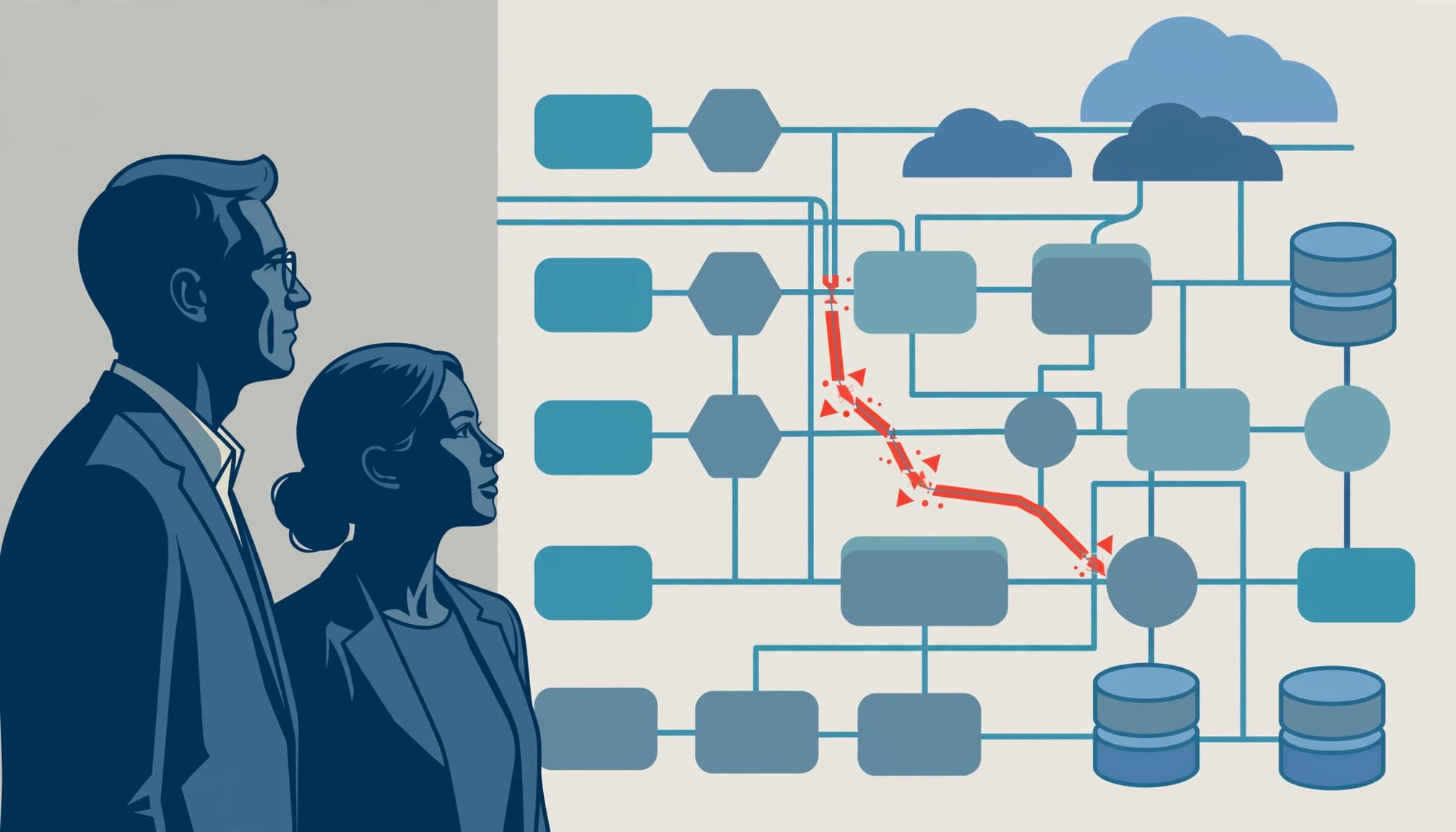
The warning signs of technology architecture problems show up in operating performance. Look for more rework, slower releases, rising support costs, and spreadsheet workarounds when systems can’t support the workflow.
Routine changes require widespread rework
Pay attention when changing a customer field, adding a sales channel, or updating pricing requires coordinated changes across several systems.
That can indicate tight coupling or brittle integrations: one component cannot change without disturbing others. Your technical debt is now affecting execution.
Ask your technology leader to explain the dependency, its business impact, and your exit options. These are often the technology decisions that become costly at scale, especially when growth exposes assumptions made years earlier.
Vendors or individuals control your ability to change
Vendor lock-in and key-person dependency become material when only one vendor can access your data, one contractor understands an integration, or one employee can release software.
Documentation debt makes maintenance harder. Weak vendor management makes negotiations harder. Together, they narrow your choices during growth or transition.
Platform sprawl and unsupported technology add lifecycle risk. A target architecture should show what stays, what changes, and what gets retired.
Age alone proves little. A documented, supported COBOL application may be easier to manage than newer software built around undocumented scripts.
Ask About Reversal, Failure, and Ownership Before Approval
A technology architecture proposal should explain more than implementation cost and delivery timing. It should show what happens when assumptions change.
What would it take to reverse this decision?
Ask whether your technical architecture lets you export usable data, replace the vendor, separate a business unit, or move an application without rebuilding everything around it.
Vendor due diligence should cover contract termination, data formats, intellectual property, integration dependencies, and vendor offboarding. Third-party risk management belongs in the approval conversation.
An exit path doesn’t need to be effortless. It needs to be understood and affordable relative to the business exposure.
Data export alone doesn’t establish an exit path. Your workflows, permissions, integrations, and operating knowledge must also survive the move.
What happens when a dependency fails?
Ask which customer commitments stop if the platform, identity service, network, or vendor becomes unavailable.
Business continuity planning and disaster recovery planning should specify acceptable downtime, acceptable data loss, recovery ownership, and evidence from testing.
Your cyber risk appetite should shape those decisions. A vendor incident response plan should name escalation contacts and responsibilities.
If nobody can explain who accepts the tradeoff, you have a technology leadership gap that architecture diagrams cannot resolve.
Map Dependencies Before Approving a Technology Decision
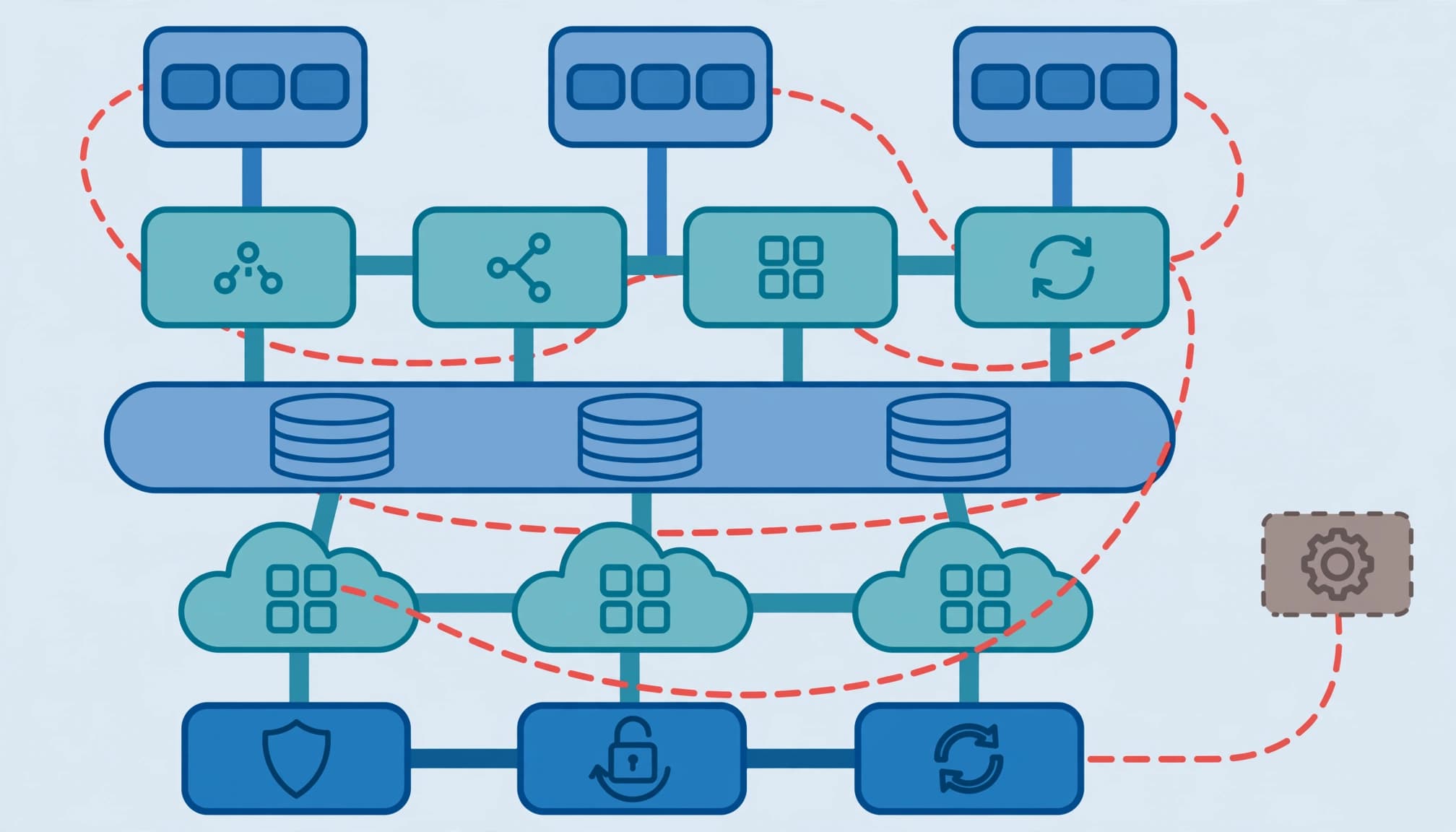
A useful diagram starts with business requirements. It should show constraints without turning your leadership meeting into a technical workshop.
- Name the business capability, such as order fulfillment, customer onboarding, or financial reporting.
- Map the applications, vendors, infrastructure, and data that support it.
- Draw the connections and identify systems of record, shared services, manual transfers, and critical dependencies.
- Add owners, support status, recovery requirements, and the proposed target architecture.
The executive view should show critical dependencies and owners. Keep a detailed technical version beneath it, and use your systems inventory to support both.
Follow the data through four layers
For business intelligence, map data sources, data warehousing, information access and data integration, and business intelligence and analytics.
Then look beyond reporting. A narrow BI view can leave operational silos untouched, with inconsistent information, lower productivity, higher costs, and weaker technology ROI. Tracing data integration from sources to reports can reveal fragile handoffs.
Research on data integration connects that work to decision support. A dashboard can’t repair inconsistent definitions or unclear data ownership.
Mark where change becomes expensive
Highlight custom interfaces, shared databases, unsupported components, and manual reconciliation. Also flag platform sprawl, where duplicated systems add migration and integration work.
That evidence supports systems inventory and technical debt planning. It also improves acquisition readiness by exposing hidden rebuilds before post-merger technology integration begins.
Judge Cloud and AI Choices by the Options They Preserve
Modern technology can create new dependencies as easily as it removes old ones. Apply the same business discipline to cloud and AI commitments.
Cloud maturity doesn’t guarantee portability
Oracle’s cloud maturity model has six levels: Level 0 Legacy, Basic, Predictable, Structured, Consistent, and Level 5 Optimized.
Oracle describes hybrid and multi-cloud strategies as routes to flexibility, reliability, security, performance, cost optimization, and reduced vendor lock-in. These are potential benefits, not automatic results.
Your team still needs to explain data movement, proprietary services, identity dependencies, operating skills, and recovery across environments. Multiple clouds can increase complexity and platform sprawl without providing practical portability or an exit path.
Microservices, serverless computing, Kubernetes, cloud-native design, and DevOps with CI/CD deserve the same scrutiny. Edge computing, sustainability, and cybersecurity requirements also need a business case.
Ask where edge computing processes data, who operates that environment, and how recovery works.
AI needs boundaries around data and workflow
Business requirements should identify the workflow problem and desired outcome for an AI adoption strategy. The strategy should name who owns the result and where human approval remains necessary.
AI vendor due diligence should address data privacy, retention, access, model changes, and replacement options. Responsible AI requires clear accountability when output is wrong.
If business rules and knowledge exist only inside one vendor’s prompts or configuration, replacement becomes harder.
Keep AI governance connected to your data governance framework and business technology strategy. Separate approvals create gaps between operating responsibility and risk acceptance.
Put Decision Rights and Costs Into Your Technology Roadmap
Architecture choices become manageable when someone owns the tradeoff and leadership can see its consequences.
Management decides; boards oversee
Technology governance for CEOs should define who recommends, approves, funds, executes, and escalates major decisions. A decision rights map prevents informal approvals from becoming permanent commitments.
Technology governance for boards has a different job. Directors need visibility into material choices, thresholds, accountability, and management’s response.
Escalate based on exposure as well as price. A small subscription can create a difficult vendor dependency or expose sensitive data.
A board-ready risk summary should show what is stable, what is exposed, who owns the next move, and when intervention is required.
Connect spending to business outcomes
Your 12-month technology roadmap should distinguish growth investment, operational reliability, and risk reduction. Each commitment needs an outcome, owner, cost, timing, and consequence of delay.
Use cost-per-outcome reporting rather than ticket counts. Technology dashboards should show trends in delivery, operating cost, service performance, and exposure.
A business-focused technology roadmap also makes tool sprawl and duplicated platforms easier to challenge.
IT cost optimization should remove wasted spend without removing capabilities the business needs. Application portfolio rationalization should account for retirement, migration, retraining, and integration costs.
Give Architecture Decisions an Executive Owner
Your technical architect should explain technical choices, dependencies, standards, and implementation consequences. Your executive technology leader should connect those choices to strategy, funding, operating performance, and risk.
That division matters when a technically sound recommendation conflicts with commercial priorities. The executive owner decides whether the tradeoff fits the business. Project-level solution architecture should align with company priorities.
IT architecture hiring also requires context. IT architect education and salary guidance reports Payscale’s average annual salary of $122,780 as of November 2022. That’s historical context, not a current hiring benchmark.
Most IT architects need a relevant bachelor’s degree. Some employers prefer a master’s degree and five or more years of experience. For IT architects, qualifications don’t replace evidence of business judgment.
If you lack executive ownership, a fractional CTO can lead ongoing strategic technology planning. An interim CTO can provide continuity during a leadership transition.
Our fractional CTO services connect strategy, roadmaps, vendor decisions, and executive reporting. You should expect stronger ownership and decisions you can defend, without adding another layer of advisory noise.
Frequently Asked Questions
Should you replace older systems to gain flexibility?
Replace them when their constraints justify the cost and disruption. Supportability, documentation, security, integration capability, and business performance matter more than age.
Technical debt management should prioritize revenue constraints, operational fragility, and material exposure. A broad rewrite can consume capacity without improving the options you need.
How much flexibility should you pay for?
Pay for options connected to credible business plans. Acquisition, geographic expansion, new sales channels, and changing customer requirements can justify additional investment.
Ask your team to separate flexibility you need soon from possibilities with no commercial basis. Document any accepted constraint, its owner, and the event that would trigger reconsideration.
Keep Your Next Business Move Available
Good technology architecture makes the cost of change visible before you commit. You can accept constraints when the benefit is clear and the consequences are understood.
Bring one pending platform or vendor decision to your next leadership meeting. Ask for its dependencies, exit path, recovery evidence, and accountable owner.
If those answers remain scattered, Get an Executive Technology Clarity Check. Start with a clearer picture of what the business is committing to, and what it needs to keep possible.