
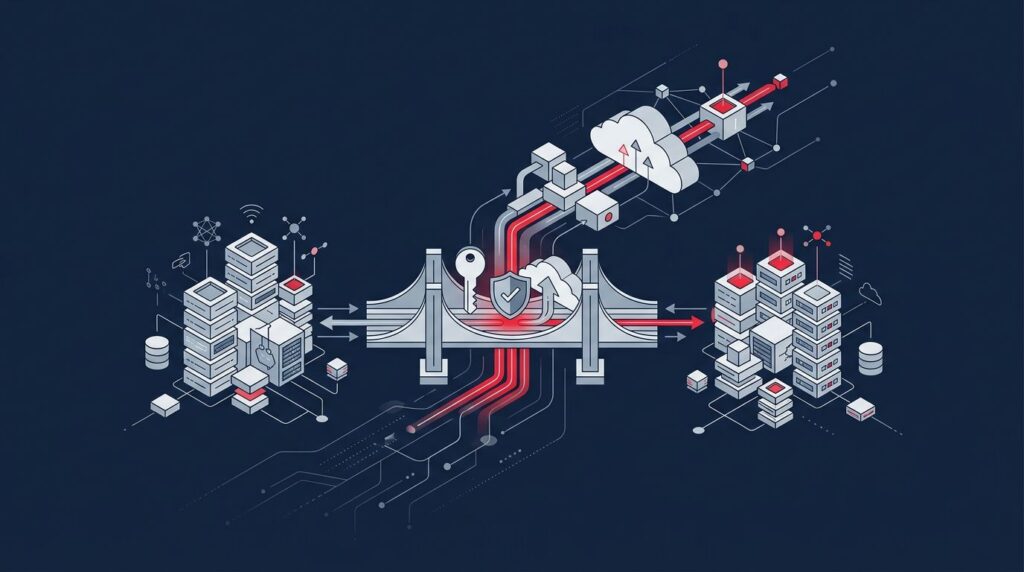
In middle market leveraged buyouts, an add-on acquisition can look small in a purchase model. It can still create a large technology problem. When you combine a target with a platform company, identity, data, vendors, and cybersecurity must work together. Decision rights must also be clear before the promised EBITDA improvement shows up.
Private equity firms pursuing platform acquisitions need more than a purchase price and a value creation plan. Deals from proprietary sourcing often start differently than intermediary-led deals. Both need a repeatable integration playbook. That playbook connects deal logic, technology reviews, operating decisions, and board visibility. Dakota counted 587 add-on deals among 1,084 private equity transactions in Q1 2026. Those deals represented 54.2% of total activity amid changing interest rates. The strategy is common. The integration discipline is not.
Add-on acquisitions: key takeaways for PE platforms
- Platform acquisitions establish the operating base before add-ons are absorbed.
- Valuation differences can improve the value story, but they don’t replace operating performance or integration discipline.
- Technology review should identify purchase price risks, integration costs, cyber exposure, vendor dependence, and systems that cannot scale.
- The first 100 days should have named owners, stage gates, and decisions about what to integrate, preserve, replace, or delay.
- A fractional CTO, interim CTO, fractional CIO, or fractional CISO can provide executive technology leadership when the platform lacks the right permanent owner.
- The board needs reporting on value, risk, timing, and decisions. It doesn’t need a project diary full of technical detail.
What add-on acquisitions mean inside a PE platform
A platform acquisition is the initial investment that gives private equity firms their operating base. The platform company usually has the management team, financing structure, core systems, and first operating plan.
An add-on acquisition is a smaller target company purchased by that platform. It may operate in the same market or an adjacent one, adding customers, products, talent, capacity, specialized technology, geographic expansion, or market share. Acquisition selection should consider strategic fit and cultural alignment, not only products or geography.
The distinction matters because the technology burden is different.
Platform acquisitions set the operating foundation
When you buy the platform, you’re assessing the entire operating model. You need to understand its technology strategy, leadership capacity, cybersecurity, applications, data, vendors, and technical debt.
The platform then becomes the environment that absorbs future targets. If its identity controls are weak, reporting is unreliable, or nobody owns technology decisions, every later add-on inherits that weakness.
A useful one-sentence definition appears in Wall Street Prep’s add-on overview. It explains that the platform buys and integrates the smaller target rather than treating it as an unrelated portfolio company.
Add-ons repeat the work, but not always the same way
Add-ons, also called bolt-on acquisitions, can repeat the work without always repeating the same approach.
A buy-and-build strategy is particularly useful in fragmented markets. It can accelerate inorganic growth faster than waiting for the platform to expand alone. Proprietary sourcing can improve the speed and quality of acquisition targets.
It can also create scale and operational efficiencies across procurement, finance, sales, service delivery, data, and technology.
The risk is repetition without learning. If every acquisition starts with a new spreadsheet, a new systems map, and a new debate about ownership, integration costs rise and the platform loses speed.
Dakota’s Q1 2026 report described add-ons as a structural response to constrained financing conditions. Interest rates remain part of that financing context. Smaller targets can require less capital than a large platform deal, but that doesn’t make them simple. A series of small integration failures can create one large portfolio problem.

How add-on acquisitions create value
The value case usually depends on several drivers working together. A platform company needs operating capabilities that make value creation repeatable, with platform acquisitions driving inorganic growth in fragmented markets. You may buy at a lower valuation multiple, use proprietary sourcing for bolt-on acquisitions, improve the target’s performance, reduce duplicated cost, increase revenue, and build a larger company that attracts a stronger exit valuation.
None of those outcomes happen automatically.
Multiple arbitrage is a possibility, not a plan
Assume a platform produces $20 million of EBITDA and was purchased at a 10x EBITDA multiple. Its implied enterprise value is $200 million.
Now assume the platform buys a target producing $5 million of EBITDA at 5 times EBITDA. The target purchase price is $25 million. Before integration costs or synergies, the combined business produces $25 million of EBITDA. At a 10x valuation, that business could be valued at $250 million.
The $25 million difference is the basic multiple arbitrage effect. It is not the same as investor return. Debt, fees, taxes, capital spending, working capital, management incentives, and integration costs all affect cash flows. Interest rates can also change financing costs.
If the target adds $3 million of recurring EBITDA through operational efficiencies and market share gains, combined EBITDA rises to $28 million. At a 10x valuation, the implied value becomes $280 million. If the exit multiple falls to 8 times, the same business is worth $224 million.
That is why you should not build a deal around a permanent valuation assumption. A lower purchase multiple helps, but operational improvement protects the value case.
Bain’s buy-and-build report provides useful context on how valuation differentials fit into a broader buy-and-build strategy.
Synergies need owners and evidence
Cost synergies may come from duplicated software, overlapping finance work, facilities, insurance, procurement, hosting, or external vendors. Revenue synergies may come from cross-selling, geographic expansion, a larger product set, or access to the platform’s customer base.
Technology often supports both categories. A shared CRM can improve account visibility. Consolidated identity and collaboration tools can reduce cost. Better data can help sales teams find cross-sell opportunities.
The mistake is to record those benefits as a line in the model without assigning anyone responsibility. Each synergy should have:
- A baseline showing the current cost or revenue.
- A named owner.
- A delivery date.
- A one-time implementation cost.
- A measure that finance can verify.
A target’s systems may also support revenue in ways that are hard to see during diligence. Replacing them too quickly can damage customer experience, reporting, or retention. Integration decisions need commercial judgment, not only an application inventory.
Build the add-on model before signing
Your Excel model for add-on acquisitions should show what the deal must accomplish, not just its potential value. For private equity firms, separate assumptions should cover the target, platform, financing, integration, and exit. The model should also show how platform acquisitions support the broader transaction strategy.
| Model component | Questions to answer |
|---|---|
| Purchase price | What EBITDA multiple are you paying, and what adjustments and proprietary sourcing costs are supported? |
| Target earnings | Which add-backs are real, recurring, and defensible across acquisition targets? |
| Integration cost | What will systems, people, migration, legal, and vendor changes cost? |
| Synergies | Who owns the cost synergies and revenue synergies, and when does each benefit appear in EBITDA? |
| Financing | How do debt financing, interest rates, and cash flows affect debt capacity and covenants? |
| Exit case | What happens if the exit multiple stays flat, expands, or contracts? |
Run a base case, downside case, and upside case. Add sensitivity tables for purchase multiple, valuation multiple, time-to-integration, synergy realization, customer retention, and debt paydown.
Time-to-integration belongs in the return model
A delayed integration can reduce returns even when the purchase price is attractive. If the target runs separate systems for 18 months, you may carry duplicate software, support, security, and reporting costs. Higher interest rates on debt financing can magnify those costs. If a data migration delays billing or customer service, revenue may suffer and cash flows may tighten.
Model the timing. Treat one-time costs separately from recurring savings. Show the month in which each synergy begins. If a benefit depends on a new CRM, ERP, data warehouse, or shared service process, include the work required to make it real.
The model should also track MOIC, IRR, and LBO returns under different integration outcomes. Financial Edge’s modeling guide explains how multiple arbitrage and add-on assumptions affect private equity return analysis.
Start with technology due diligence, not Day 1 improvisation
For platform acquisitions, technology due diligence on add-on acquisitions must answer one practical question. Can the integration process proceed without unacceptable cost, risk, or disruption?
That requires more than checking whether the target company uses cloud software. Proprietary sourcing doesn’t replace evidence about systems and risk, including ownership, dependencies, security, contracts, data, and operating reality.
Build a systems and dependency picture
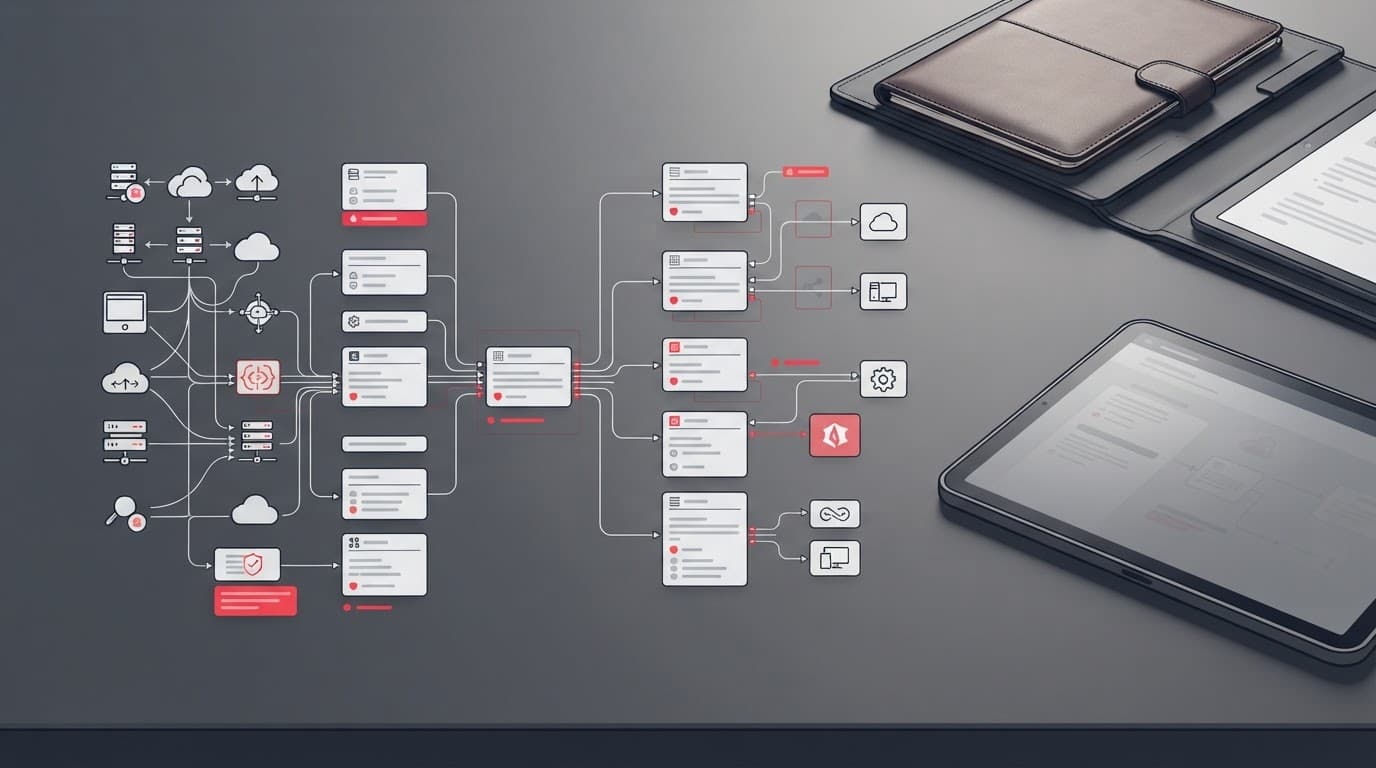
Start with a systems inventory. Identify applications, infrastructure, endpoints, integrations, data stores, custom code, support arrangements, and critical business processes.
Then ask:
- Which systems run revenue, payroll, finance, service delivery, and customer communication?
- Who owns each system?
- Which applications contain regulated or sensitive data?
- What breaks if a vendor, administrator, or integration disappears?
- Which contracts restrict assignment, migration, or geographic use?
- How much technical debt is hidden inside custom code and manual workarounds?
This is where tool sprawl, shadow IT, unsupported software, and duplicate data usually appear. Application portfolio rationalization and technical debt management should become deal decisions. Apply a reusable assessment template to acquisition targets, rather than assigning cleanup to an unnamed team after closing.
If the transaction includes an AI product or AI-enabled workflow, examine model ownership, training data rights, privacy obligations, AI vendor due diligence, and claims about performance. An AI adoption strategy is not a substitute for AI governance or responsible AI controls.
Test cyber, data, vendors, and cross-border exposure
Cybersecurity review should cover identity controls, privileged access, multifactor authentication, endpoint protection, patching, vulnerability management, backups, recovery testing, incident history, cyber insurance, and third-party access.
You also need to understand the target’s data strategy and data quality. A data governance framework should cover ownership, retention, access, data privacy, and information governance. Poor data quality can turn a planned migration into a customer, financial, or compliance problem.
Vendor review should include renewal dates, termination rights, price increases, service levels, concentration risk, data return obligations, vendor offboarding, and the vendor incident response plan.
Cross-border deals add more questions. Check data residency, international data transfers, local privacy rules, employment requirements, language and time-zone coverage, export controls, sanctions, tax treatment, and tariffs that could affect hardware, hosting, or imported equipment. Bring legal, tax, procurement, and security leaders into the review before the purchase price is final.
A strong diligence report should identify risks that may affect price, escrow, representations, integration budget, or cash flows, while interest rates may also affect financing capacity. CohnReznick’s integration analysis also stresses the need for platform discipline and rapid integration.
Run a 100-day integration playbook
For add-on acquisitions, the integration process should prioritize stability and measurable value, not become a long list of projects. A repeatable playbook for platform acquisitions should define stability needs, key decisions, and work that creates measurable value. A fast-moving deal may reflect proprietary sourcing, but sourcing speed shouldn’t bypass integration preparation.
Days 1 through 30: protect the business
On Day 1, confirm access, communication, ownership, and continuity between the platform company and the incoming business. Do not shut down systems simply because they look duplicative. First understand what they do and who depends on them.
Set up a decision rights map. Name who recommends, approves, executes, and accepts risk for each major technology decision. Confirm the executive sponsor, integration lead, security owner, finance owner, and business process owners.
The first month should include:
- A current systems inventory and dependency map.
- Privileged account review and MFA coverage.
- Backup verification and recovery priorities.
- An incident response contact tree.
- A review of critical vendors and contracts.
- A list of high-risk changes to freeze or control.
- A plan for employee and customer communication.
- A baseline for cost, service performance, risk, and revenue operations.
The goal is not to make every system uniform. The goal is to prevent avoidable disruption while establishing facts.
Days 31 through 100: make and execute the hard choices
By the second month, you should know which systems will be retained, integrated, replaced, or left separate for a defined period. Document the reason for each decision.
Use stage gates for design approval, build completion, mock migration, user acceptance, security readiness, cutover approval, and post-close review. Each gate needs an owner and a decision record.
Typical work includes identity federation, email and collaboration changes, finance consolidation, CRM integration, data migration, endpoint protection, backup standardization, vendor renegotiation, and management reporting. These changes should produce operational efficiencies, strengthen control, and improve management visibility.
Do not force a single stack for convenience. A platform may need to preserve a specialized application when its strategic fit is tied to a customer promise or regulated process. Integration should improve control and economics without damaging the capability that made the target valuable.
Make the technology strategy business-aligned
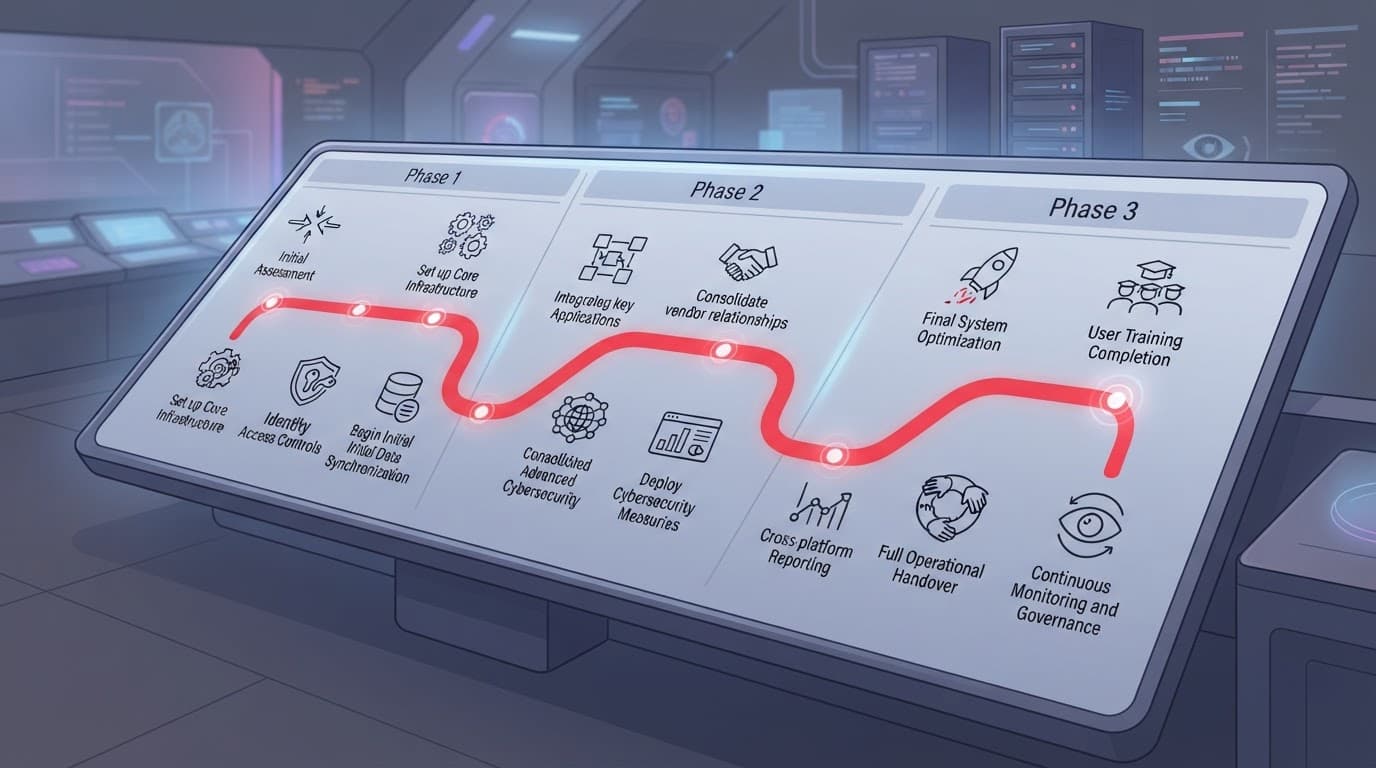
Integration work gets lost when it becomes a technical workstream with no connection to the investment thesis. Your technology roadmap should show how systems, people, vendors, data, and risk support the platform’s business priorities.
Use one plan with clear decision rights
A useful business technology strategy can fit on a one-page technology strategy document for executive discussion. It should show the deal thesis, current constraints, major risks, priority decisions, investment needs, and expected business outcomes.
Then expand it into a 12-month technology roadmap. The roadmap should connect technology choices to the investment thesis and include:
- Stabilizing identity and cybersecurity.
- Consolidating overlapping applications.
- Improving data quality and reporting.
- Reducing vendor dependence.
- Addressing technical debt that blocks scale.
- Supporting a new product, market, or service model.
- Establishing technology governance for CEOs and technology governance for boards.
A technology roadmap template can help organize the work, but it cannot make the tradeoffs. The CEO, COO, CFO, and technology leader still need to decide what can wait.
That is the difference between an IT strategy and a business-aligned technology strategy. The second one connects technology work to value creation. It tells leadership what the business gets, what it costs, what could go wrong, and who owns the result.
Treat people and culture as integration work
Founder-led businesses often depend on informal knowledge, trusted relationships, and fast decisions. A platform may bring stronger controls, but it can also slow the target if every decision becomes centralized.
Build cultural alignment by explaining what will change, what will remain local, and how employees can raise risks. Preserve the knowledge that makes the target work. Transfer key-person knowledge before changing systems. Give local leaders a clear escalation path.
Technology leadership for middle market companies often means managing this tension. You need stronger control without creating enough friction that customers or employees feel the acquisition immediately.
Make the deal visible in board-ready terms
Board reporting should connect technology work to value, risk, timing, and decisions. It should not make directors interpret a list of technical tasks.
Track a small set of operating measures
Useful technology dashboards may include:
- Integration milestones completed and at risk.
- One-time integration spending versus budget.
- Recurring savings captured versus plan.
- Critical systems migrated or still separate.
- Cybersecurity control coverage and open high-risk findings.
- Vendor concentration and contract exposure.
- Customer or employee disruption.
- Data quality issues affecting finance or operations.
- Technology ROI and cost-per-outcome reporting.
Technology spend optimization is easier when finance can see what each investment protects or improves. The board should also see how spending affects cash flows, liquidity, margin, and operating continuity, especially when interest rates change.
The board should be able to ask whether spending supports growth, reduces risk, improves margin, or keeps a legacy problem alive.
This is also where IT cost optimization and IT cost reduction need different treatment. Cutting a security tool may lower cost while increasing exposure. Removing a duplicate application may lower cost while improving control. The business outcome matters more than the size of the budget line.
Report cyber risk in business terms
Cyber risk reporting to the board should show the exposure, the business impact, the owner, the treatment plan, and the decision threshold. A board-ready risk summary might cover ransomware readiness, recovery time, privileged access, third-party exposure, insurance requirements, and incident response readiness.
The board should set or approve cyber risk appetite. Management should own daily execution. That separation supports technology governance without turning directors into system administrators.
For each major risk, answer four questions:
- What could happen?
- What would the business lose?
- What is being done now?
- What decision or funding is required?

Choose the right technology leadership model
Many private equity firms have technical managers, developers, MSPs, or software vendors. That doesn’t mean they have executive technology ownership.
The right model depends on the problem, the urgency, and how long the work will last.
| Situation | Leadership model that may fit | Primary responsibility |
|---|---|---|
| Ongoing strategy without a permanent executive seat | Fractional CTO or part-time CTO | Roadmap, vendors, technology ROI, priorities, and executive reporting |
| Vacant seat or urgent stabilization | Interim CTO and interim CTO services | Immediate ownership, recovery, transition, and decision control |
| Enterprise systems, data, and operations | Fractional CIO | Business systems, data governance, operating model, and information risk |
| Cybersecurity is the immediate pressure point | Fractional CISO, virtual CISO, or interim CISO | Cyber risk appetite, controls, incident readiness, and board reporting |
| Narrow assessment with limited follow-through | Technology consultant | Defined recommendation or project deliverable |
Use fractional leadership when the need is ongoing
A fractional CTO can provide continuing judgment while you decide whether a full-time role is justified. Fractional CTO services may include technology strategy consulting, vendor management, technical due diligence, technology roadmap ownership, technical debt management, and board-ready technology reporting.
An outsourced CTO, virtual CTO, or part-time CTO can fit when the work is remote and the decision cadence is clear. The point isn’t the title. It’s having someone who connects the platform’s business goals, systems, vendors, risk, spend, and execution.
Use interim leadership when the situation is urgent
Interim CTO services make more sense when the leadership seat is open or trust has broken down. They also fit when a major integration is slipping or stabilization comes before a permanent hire.
If the main issue is cyber risk, a virtual CISO or interim CISO may be the better complement. If the problem reaches across finance, operations, data, and enterprise systems, a fractional CIO may be a better fit.
Don’t hire a title before you understand the job. Start with the technology leadership gap. Is it weak reporting, vendor dependence, stalled integration, technical debt, or unclear ownership?
An executive technology leader can turn proprietary sourcing into a prepared, governable transaction. Before the next milestone, Prepare Technology for Diligence or Transition can help organize the roadmap, systems, vendors, and reporting around the deal.
FAQs about add-on technology integration
What is the biggest technology risk in an add-on acquisition?
The biggest risk is usually not one outdated application. It is unclear ownership combined with incomplete information. If nobody can explain which systems run the business, who controls privileged access, how data moves, or what a vendor failure would cause, the business cannot make sound technology decisions.
Should you integrate systems immediately after closing?
Not always. Integrate quickly where shared control reduces risk, such as identity, privileged access, backups, incident response, and executive reporting. Preserve systems temporarily when they support a specialized customer process or when migration evidence is incomplete.
How should you calculate LBO returns?
Model the purchase price, normalized EBITDA, debt financing, one-time integration costs, recurring synergies, timing, debt paydown, taxes, interest rates, and exit assumptions. Then test downside cases for delayed integration, lower retention, reduced synergy capture, and exit multiple compression. Review both MOIC and IRR.
When should a PE platform hire a fractional CTO?
Use a fractional CTO when you need ongoing executive technology judgment but don’t yet have a clear mandate or sustained workload for a full-time CTO. The role can establish a technology assessment, 90-day technology plan, 12-month roadmap, vendor controls, board reporting, and integration ownership.
When is an interim CTO the better choice?
An interim CTO fits a vacancy, leadership failure, urgent stabilization period, or high-stakes transition. The role usually has a defined period and a direct mandate to restore control, protect delivery, and prepare the business for a permanent leadership decision.
Conclusion
Add-on acquisitions create value when the platform can absorb new businesses without losing control of cost, customers, data, security, or execution. The purchase multiple matters. So do the systems inventory, decision rights map, integration budget, cyber controls, vendor plan, and board reporting.
A repeatable technology playbook gives you a better answer than optimism or urgency. It shows what must happen before close, what needs attention in the first 100 days, and which leadership model can own the work.
A small acquisition should not create a large surprise, even with an opportunity generated through proprietary sourcing. Clear technology ownership, integration decisions, and board visibility keep the deal tied to the value thesis.