
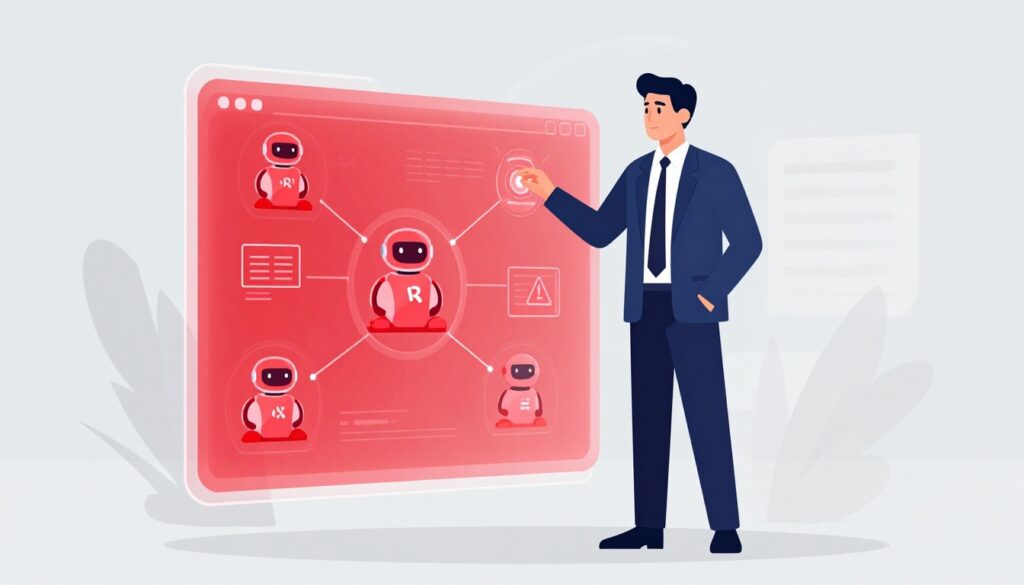
AI is moving past answering questions. It can now review invoices, update customer records, route work, open tickets, recommend purchases, and deploy autonomous AI agents to execute agentic workflows across systems with limited human input.
That shift creates agentic ai risks for business leaders that are operational, financial, and reputational. You don’t need to learn how to build an AI agent. You do need to know what it can touch, who owns the outcome, and how quickly you can stop it when something goes wrong.
CTO Input helps leadership teams bring clearer ownership and stronger visibility to technology decisions before they become expensive surprises.
Key Takeaways for Managing Agentic AI Risk
- Unlike standard chatbots, autonomous AI agents create more risk because they can take action, not only generate content.
- Start with low-impact, reversible work. Don’t begin with payments, customer commitments, or security administration.
- Use a human in the loop setup to set approval points before an agent can change records, spend money, or contact customers.
- Limit every agent’s system access to protect data privacy and security, because broad permissions turn a useful tool into a wider business exposure.
- Name one accountable business owner, monitor agentic workflows, and keep a tested rollback plan that includes a kill switch mechanism.
- Faster automation has no value if it creates uncontrolled privacy, customer, financial, security, or compliance risk.
If your team needs clearer oversight before rolling out AI, fractional CTO services can give you senior judgment without rushing into a full-time hire.
What Agentic AI Can Do Inside Your Business
An AI agent is not the same as standard generative AI chatbots or a rigid workflow rule. Traditional generative AI chatbots answer questions, and a workflow follows a fixed instruction. In contrast, autonomous AI agents receive a goal, look at available information, choose a next step, use a connected tool via the model context protocol, check the result, and continue.
That can be useful. Autonomous AI agents might review incoming invoices for missing details, schedule staff around demand, update a customer record, open a support ticket, or prepare a purchase recommendation. These decision-making systems may complete in minutes what once required several handoffs across agentic workflows.

The difference matters because the agent is no longer sitting beside the process. It is inside the process.
| Type of technology | What it does | Main leadership concern |
|---|---|---|
| Human-led automation | Runs defined steps | Did you define the rule correctly? |
| Generative AI | Produces text, images, or analysis | Is the output accurate and appropriate? |
| Agentic AI | Chooses steps and acts through systems | What can it do, and who owns the result? |
Agentic AI can reduce manual work. It can also make a poor decision at machine speed. The question is not whether the demo looks impressive. The question is whether the authority you give it matches the risk you can accept.
Agentic AI Risks for Business Leaders: Where the Real Exposure Begins
The main risks are rarely about model science. They are about business consequences.
When deploying autonomous AI agents, you are effectively introducing digital insiders into your environment. An agent that approves an incorrect transaction can lose money. An agent with broad access to customer information can expose private data, creating severe risks for data privacy and security. An agent that follows a manipulated instruction can create a security problem. An agent working from old or incomplete data can make a bad choice repeatedly.
Customer harm can be harder to unwind. A wrong refund, misleading message, cancelled booking, or poor service decision can spread faster than your team can correct it. Contracts, employment rules, privacy obligations, and industry requirements still apply when an AI agent takes the action, making regulatory compliance an ongoing priority.
Risk rises sharply when an agent can access multiple systems, act without approval, affect customers or money, and operate at high volume.
The Permission Problem: What Can the Agent See and Change?
Think of permissions as keys. You would not hand a new employee one key that opens finance, HR, customer data, and system administration. Don’t do it with an AI agent.
Inventory what each agent can see and change. That includes records, payment tools, employee data, customer data, shared drives, email accounts, and administrative settings. Then limit access to the smallest set needed for its job through proper non-human identity management.
Without strict boundaries, autonomous AI agents face severe threats like privilege escalation, where an attacker exploits permissions to gain unauthorized control. Attackers can also leverage indirect prompt injection through emails or web pages to hijack workflows, leading to chained vulnerabilities across your interconnected systems via tools like the model context protocol.
Use separate accounts for agents. Set approval thresholds. Keep activity logs. Review access regularly, especially after a workflow changes.
An agent with broad access does not need to be malicious to create harm. It only needs to be wrong once in the wrong place.
The Judgment Problem: Who Owns the Outcome When AI Is Wrong?
“Human in the loop” sounds reassuring. It is not enough on its own.
A reviewer needs enough context, time, authority, and a clear reason to challenge the agent. If your team is expected to approve hundreds of AI recommendations before lunch, the review becomes rubber-stamping.
Relying solely on a human in the loop can fail if operators lack the time to catch subtle unintended consequences. Give every agent a named business owner. That person should understand the workflow, the authority limits, the expected outcome, and the escalation path. Define when approval is required, who receives incident reports, and who can stop the agent.
This is a leadership issue. Your board does not need a technical briefing on prompts. It needs a clear view of material exposure, ownership, thresholds, and decisions that require oversight.
The Trust Problem: How Small Errors Become Large Operational Damage
A person can make a poor decision. An AI agent can make the same poor decision across thousands of records before anyone notices.
Weak source data is one cause. So are misleading instructions, manipulated inputs, broken integrations, and silent failures where the system appears to run but does the wrong thing. When deploying agents for autonomous transactions, an agent may optimize for a narrow target while damaging a wider customer or operational outcome.
Track business signals, not only uptime. Implement behavioral monitoring to watch for unusual refunds, rising complaints, strange access patterns, missed service targets, higher rework, and unexplained cost increases.
If your reporting only says the agent completed 10,000 tasks, you are measuring activity. You are not measuring whether those tasks helped the business.
How to Govern Agentic AI Without Slowing Your Business
You don’t need a large AI department or a thick policy binder to start. You need a simple risk management framework that matches your exposure.
Keep a central inventory of AI agents. Record the purpose, business owner, systems accessed, data used, vendor, approval points, and rollback method. Give each use case a simple risk rating based on impact, reversibility, data sensitivity, and financial or customer exposure.

Your approach to artificial intelligence governance should support business goals. If an agent improves cycle time but causes more customer rework, it is not helping. If it reduces labor but adds unmanageable vendor dependence, the savings may not hold.
Technology leadership services can help when ownership, reporting, and risk decisions are scattered across IT, operations, finance, and vendors.
Start With Low-Risk Workflows and Clear Stop Rules
Begin with internal work that is easy to reverse. Good early uses include summarizing requests, routing work, preparing drafts, checking records for missing fields, and suggesting next actions. When scaling toward autonomous agentic workflows, it helps to strengthen your AI security posture management and apply runtime reasoning governance.
Avoid autonomous payments, employee termination decisions, medical or legal judgments, security administration, and customer actions you cannot easily reverse.
Set clear boundaries before launch, including enterprise security controls to protect sensitive data:
- Spending caps and transaction limits
- Approval gates for exceptions
- Time limits for unattended activity
- Rules for unusual requests or missing data
- A kill switch mechanism that people know how to use to prevent operational disruption
A limited pilot tells you more than a large rollout built on optimism.
Measure Business Results, Not AI Activity
Define success before deployment. Measure cycle time, error rates, rework, customer satisfaction, cost per transaction, staff capacity, incident count, and revenue impact where appropriate.
Set a baseline. Set a target. Name the owner. Choose a short review date.
Then make a decision: expand, change, pause, or stop. Usage counts and polished demonstrations do not prove value. A useful agent should improve a business result you can see and explain.
Control Vendors, Data, and Tool Sprawl Before They Control You
Ask vendors direct questions. Where does your data go? Is it retained or used for training? Which subcontractors have access? What audit logs exist? How are model changes handled? When will you be notified of an incident? Can you delete your data and leave cleanly?
Buying several AI tools without a shared view creates shadow AI sprawl, leading to duplicate access, inconsistent records, unclear ownership, and more vendor risk. Third-party integrations also require careful review to ensure your standards apply across all connections. Each tool should support a real business outcome, utilizing standardized protocols like the model context protocol where applicable. If it doesn’t, it is another cost and another place for risk to hide.
A 90-Day Action Plan for Your First Agentic AI Risk Review
In the first 30 days, identify current and planned autonomous AI agents. List the workflow, owner, vendor, data, permissions, systems touched, and reasonable worst-case outcome while establishing proper non-human identity management to secure digital insiders against indirect prompt injection and chained vulnerabilities.
During days 31 through 60, rank each use case by impact and reversibility. Document approval points, test access controls, establish monitoring, and confirm how you will stop the agent alongside verifying audit traceability, regulatory compliance, and a tested incident response plan for cross-agent task escalation.
In days 61 through 90, run one limited pilot. Review the results with leadership. Update the risk view based on what happened, then decide whether to expand.
This approach gives you a better operating picture before an acquisition, leadership change, or investor review. If those pressures are already present, Prepare Technology for Diligence or Transition before AI-related decisions become another unanswered question.
Questions to Put in Front of Your Leadership Team and Board
Ask the questions that expose weak assumptions early:
- What business problem are we solving?
- What can the agent do without approval?
- What data and systems can it access?
- Who owns the outcome?
- What is the worst reasonable failure?
- How will we detect it, and how fast can we stop it?
- What evidence will show value?
- What vendor terms and board decisions matter for agentic workflows?
Present the answers in business terms: impact, trend, owner, threshold, and decision required. That is reporting leaders can trust.
Frequently Asked Questions About Agentic AI Risks for Business Leaders
Is agentic AI the same as generative AI?
No. Generative AI chatbots create content or analysis. Autonomous AI agents can use tools and take actions toward a goal.
Can a mid-market company use agentic AI safely?
Yes, if you begin with limited authority, clear ownership, narrow access, and monitoring. Data privacy and security are critical here, as size does not remove risk. It can make weak oversight more visible.
Does a human in the loop remove the risk?
No. A human in the loop helps only when the reviewer has context, authority, and time to make a real decision. Regulatory compliance also demands more than a superficial review step.
What should you do if an agent makes a harmful decision?
Stop the workflow, contain the impact, preserve the activity record, notify the right owners, correct the affected records, and execute an incident response plan to review why controls failed.
Who should own agentic AI governance?
A business owner should own each use case, while artificial intelligence governance is driven by executive leadership to maintain the wider inventory, standards, reporting, and risk view.
Should you wait for a formal AI policy before testing?
No. Start with a controlled, low-risk pilot that respects data privacy and security. Document the rules you need, then improve them as you learn.
The Decision Is About Control, Not Hype
Agentic AI can improve speed and capacity. It also turns technology choices into operating decisions with real consequences. Implementing a robust risk management framework ensures that your decision-making systems remain accountable as you deploy autonomous AI agents across the organization.
You don’t need to reject AI or automate everything at once. Start with a clear purpose, limited authority, visible ownership, measurable outcomes, and a reliable way to stop or reverse the work. By maintaining human in the loop oversight and enforcing a strong risk management framework, you protect data privacy and security while scaling operations.
If technology decisions feel scattered, risky, or too dependent on the wrong people, Get an Executive Technology Clarity Check. You will leave with sharper priorities, clearer ownership, and a practical next step.