
df
Meta Title: Aligning IT With Business Strategy: A Practical Guide for Justice-Focused Organizations
Meta Description: Discover how justice-focused nonprofits can start aligning IT with business strategy, reduce manual work, and free up staff time in 90 days.
Slug: aligning-it-with-business-strategy
Primary keyword: aligning it with business strategy
Secondary keywords: IT governance for nonprofits, technology roadmap for justice organizations
Imagine your operations team buried in spreadsheets. Impact reports miss deadlines. Sensitive data sits in tools that don’t talk. Funders want answers yesterday. Your staff is exhausted.
Sarah, a COO at a national legal network, faced this. She had three case management tools, scattered data, and zero integration. Every quarter, her analysts spent 120 hours stitching spreadsheets just to report. Funders lost faith. Board questions piled up.
This is a problem of aligning it with business strategy. When tech drifts, chaos follows. But there’s a simple path forward. In the next 90 days, you can deliver two quick wins and free up 10% of staff time. Over 12–24 months, you’ll build an ROI-driven roadmap that turns IT into a trusted strategic partner.
Key Takeaways
- Every tech project must tie directly to mission goals.
- Quick wins build credibility and unlock capacity.
- A 3-phase plan (0–3, 4–12, 12–24 months) keeps IT aligned with business priorities.
- Governance and live metrics defend your roadmap to boards and funders.
- Early action prevents reputational risk and budget overruns.
High-Level IT Business Strategy Alignment Blueprint
This 3-phase plan shows you how to start aligning it with business strategy, defend budgets, and prove value fast.
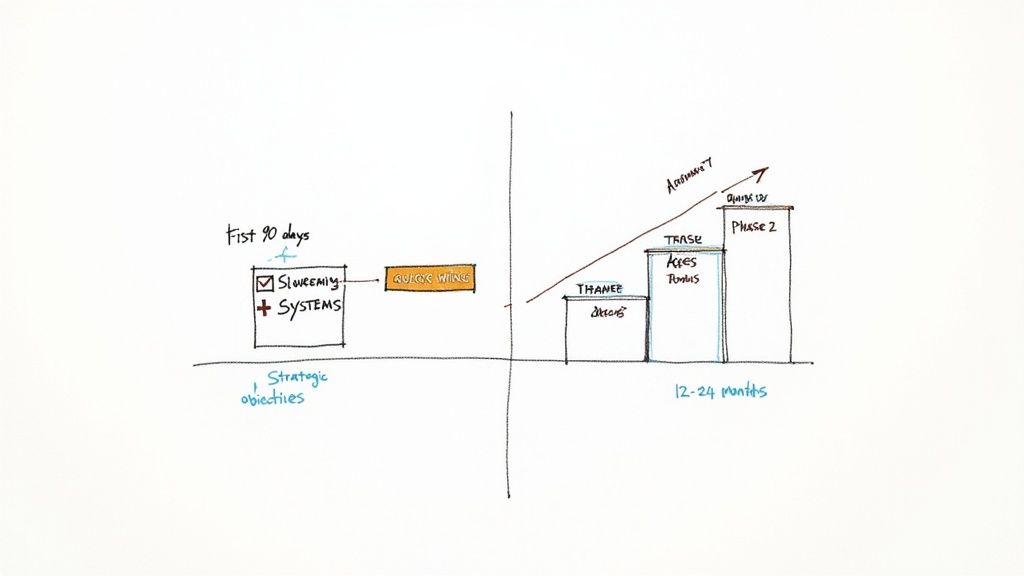
- Map strategic goals to current systems and processes
- Launch a light governance forum for fast prioritization
- Deliver two high-impact fixes (for example, automated reports)
- Free up 10% of staff time within the next quarter
- Define ROI metrics so value is visible at every milestone
| Step | Timeframe | Outcome |
|---|---|---|
| Map Objectives and Governance | 0–3 months | Faster reporting and reduced risk |
| Medium-Effort Projects | 4–12 months | Improved integration and control |
| System Consolidation and Analytics | 12–24 months | IT as strategic enabler |
Understanding The Impact Of Misalignment
Six months ago, a law school clinic rolled out a new case tool without talking to their program leads. Data lived in spreadsheets. Impact reports dragged in late. Staff chased errors instead of serving clients. Funders voiced concerns. Trust eroded.
Misalignment shows up as:
- Data scattered across unconnected systems
- Manual work piling up in spreadsheets
- Delayed reports undermining credibility
- Frustrated staff diverted from mission
- Board questions going unanswered
These signs point to a bigger issue: your technology isn’t driving your goals. Catch them early to save months of wasted effort and avoid compliance risks.
Signs Of Misaligned IT
“Misalignment turns IT into a cost center instead of an enabler.”
- Repeated scope changes that stall progress
- Budget overruns blamed on vague requirements
- No single owner for technology decisions
- Untracked risks showing up in audits
Surveys show 20–24% of organizations cite digital transformation barriers as misalignment between IT and business goals. That’s duplicated work, slow cycles, and wasted budget.
Case Study Of Siloed Systems
An immigration network used three separate tools for intake, case notes, and outcome tracking. Quarterly reporting ate up 200 hours of analyst time. No live data meant no real-time insights for strategy.
Hidden Costs On Mission
Misaligned tech can drain budgets and lengthen decision cycles. Redundant licenses alone can cost thousands.
- Overlapping software fees
- Overtime on manual report merging
- Fines from compliance gaps
| Impact Area | Aligned IT | Misaligned IT |
|---|---|---|
| Reporting Speed | Minutes per report | Days or weeks |
| Budget Efficiency | Optimized spend | Hidden or duplicate costs |
| Staff Productivity | Focused on high-value work | Stuck on manual chores |
Performing Discovery And Gap Analysis
Begin with a focused discovery session. Gather operations, finance, program leads, and IT. Observe real workflows. This isn’t an inventory of tools. It’s a search for friction points.
- Host targeted interviews to map workflows
- Shadow users for “ride-alongs” and note workarounds
- Log data repositories, manual steps, and compliance gaps
That clarity feeds a gap matrix—your visual roadmap for investments.
“A gap matrix turns abstract issues into a clear, defensible plan.”
Creating Your Gap Matrix
Columns to include:
- Process name
- Tools in use
- Effort score
- Risk level
Use color or numerical scores to highlight high-impact fixes. This snapshot guides where to focus resources first.
Turning Analysis Into Priorities
Label each gap as a quick win, mid-term project, or long-term initiative. Quick wins reclaim 10% of your team’s time by automating one report. Map out your 12–24 month plan around mid-term and long-term items, with owners, decision points, and KPIs like hours saved and incidents avoided.
Circulate the matrix in your leadership briefing. Then lock in governance review dates and KPI check-ins.
Building A Prioritization And ROI Roadmap
With your gap matrix in hand, score each item by impact, effort, and risk.
- Impact: hours saved, cost reduced, or risk lowered
- Effort: budget, timelines, and change management needs
- Risk: data sensitivity and compliance exposure
A privacy workflow automation, for example, often delivers high impact at low effort—an ideal early win. Merging two major databases usually demands more time and emerges later.
CIOs who use outcome-driven roadmaps report 56% of tech investments exceed expectations, per KPMG research.
Roadmap Phases And ROI Metrics
| Phase | Objective | ROI Metric |
|---|---|---|
| Quick Wins | Months 0–3 Automate reports and retire tools | Staff hours saved; license fees cut |
| Medium | Months 4–12 Integrate systems and launch dashboards | Faster decision cycles; error reduction |
| Long Term | Months 12–24 Consolidation and advanced analytics | Revenue growth impact; risk reduction |
Check out how a fractional CTO refines these phases in our guide on strategic IT consulting services.
“Quick wins build trust and free capacity.”
Establishing Governance And Measuring Success
Good governance prevents roadmap derailment. Form a steering committee with executive sponsors, program leads, finance reps, and IT heads.
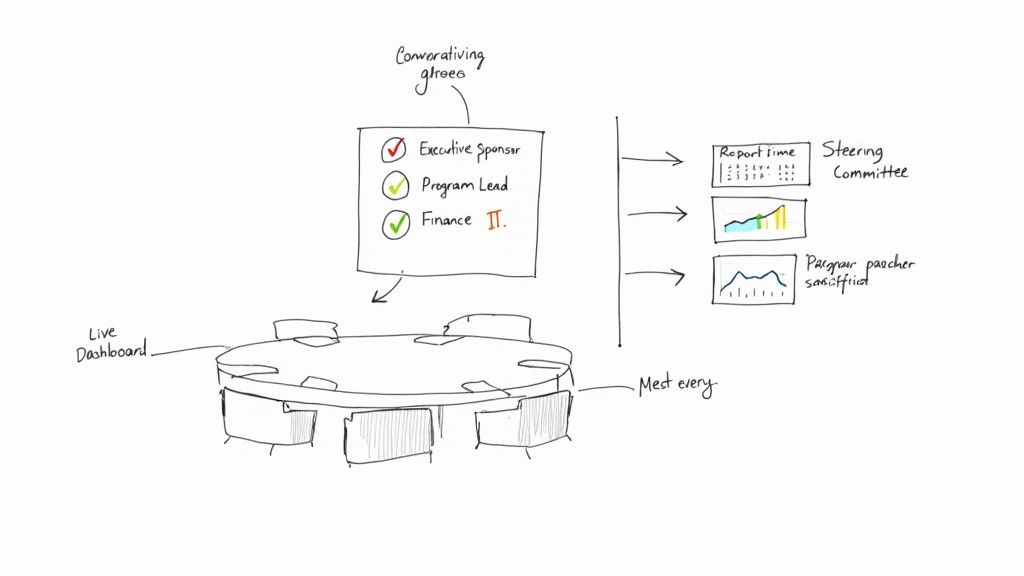
Define decision rights for scope, budgets, and integrations. Meet every six weeks with a focused agenda:
- Status check on initiatives
- Budget vs. actual review
- Dashboard walkthrough
- Action items and decision log update
“Regular check points cut chaos and free up staff time.”
Defining Key Metrics
Pick two to three KPIs per project, like report prep time, error rates, or partner satisfaction. Live dashboards beat static slides. They spot trends, flag risks, and keep priorities clear.
Learn more in our guide on best practices for IT governance.
Realizing Quick Wins And Sustained Execution
In the first 90 days, focus on two high-impact, low-effort wins. Socialize them widely.
- Automate a routine funding report: saves 120 hours per year
- Tighten access controls: cuts compliance alerts by 30%
Next, tackle medium-scale projects in months 4–12: integrate systems, pilot dashboards, and refine workflows. Map data flows, roll out prototypes, and validate metrics with power users.
Finally, in months 12–24, consolidate platforms, layer in analytics, and bake governance into quarterly cycles. Rotate user champions and schedule data-cleanup sessions.
“After two years, your tech backbone supports every mission priority with confidence.”
| Metric | Month 0 | Month 24 |
|---|---|---|
| Report Prep Time | Days | Minutes |
| Staff Time on Spreadsheets | 20% | 2% |
| Compliance Incidents | 5/year | 0–1/year |
Frequently Asked Questions
What Are The Most Common Alignment Challenges?
- Undefined objectives stall decisions
- No executive sponsor delays approvals
- Missing governance leads to firefighting
A focused discovery phase and concise roadmap clear the path.
How Should We Measure Success?
Link initiatives to two to three KPIs—time saved, cost avoided, error reduction. Then track them on live dashboards.
What If We Lack In-House Expertise?
A fractional CTO or CISO brings mission-aligned expertise. They lead discovery, establish governance, and mentor your team.
How Do We Keep The Pace?
Embed governance check-ins into your quarterly rhythm. Publish impact reports and celebrate quick wins.
Next Steps
Schedule a 30-minute call with CTO Input to map your first quick wins and start aligning IT with business strategy.