

Your audit committee meetings feel like a recurring nightmare. Smart people present complicated slides, but the core questions remain unanswered: Are we secure? How do we know? This isn't a failure of your team. It’s an operating system problem. When technology and security are misaligned, they create a constant state of fire drills and surprise risks. You keep paying for new software, but the chaos persists because ownership is implied, not explicit, and proof of control is missing.
The real problem is that even with smart people and good tools, ambiguity about ownership and decision rights creates delays, rework, and hidden risk. The constant firefighting consumes all available energy, leaving no room to build a calm, inspectable system. The cost is immense: delayed projects, burned-out teams, and the persistent, low-grade anxiety that a major incident is just around the corner.
The decision leaders must make is to stop accepting ambiguous updates and start demanding inspectable proof. This requires a shift from discussing activities to reviewing outcomes. The good news is there is a calmer, faster way to run. It starts by asking the right audit committee cybersecurity oversight questions that force clarity on ownership, risk, and evidence.
1. What is our current cyber risk posture compared to our risk appetite?
This is the foundational question. It moves the conversation beyond compliance checklists and into a frank discussion about actual business risk. Without a clear answer, the committee is flying blind, unable to distinguish managed risk from an unmanaged, potentially catastrophic surprise. This question forces the leadership team to define what ‘secure enough’ means for your specific business.

Answering it requires a credible, current assessment of your cybersecurity posture mapped against a board-approved risk appetite. It is not just about technical vulnerabilities. It is about connecting those weaknesses to specific business consequences like revenue loss, operational disruption, or regulatory fines. This is a core part of the audit committee's role in providing defensible oversight and is a clear example of translating a technical reality into a governance decision.
Expected Evidence
Your technology leader must present a clear, quantifiable risk assessment. This documentation should include:
- Risk Register: A prioritized list of cyber risks, quantified in business terms (e.g., potential financial impact).
- Industry Benchmarks: Data comparing your security controls to peers, often using frameworks like NIST CSF or ISO 27001. A useful start can be a well-structured cybersecurity risk assessment template.
- Gap Analysis: A report showing where your current security posture falls short of your stated risk appetite.
- Remediation Roadmap: A plan with a single owner, deadlines, and a budget to close the identified gaps.
Common Red Flags
- Vague Answers: Responses that rely on compliance scores ("We are 95% compliant") without context on what the remaining 5% represents.
- Technical Jargon: Explanations focused on vulnerabilities without translating them into potential business impact.
- Outdated Assessments: Relying on a risk assessment that is more than 12 months old.
Suggested Follow-Up
If the answer is weak, direct management to conduct a formal, independent risk assessment within 90 days. Assign a single owner responsible for presenting this plan, ensuring it connects security initiatives directly to the reduction of specific, quantified business risks. This establishes the baseline for all future cybersecurity oversight.
2. Who has the authority to make risk decisions, and how do we escalate?
This question targets the operational ambiguity that breeds chaos during a crisis. Smart teams fail in ambiguous systems. Many organizations have policies, but when a vulnerability is found or a breach occurs, nobody knows who has the authority to make critical decisions. This question forces the organization to define who is in charge, what they can decide, and when they must escalate to senior leadership.
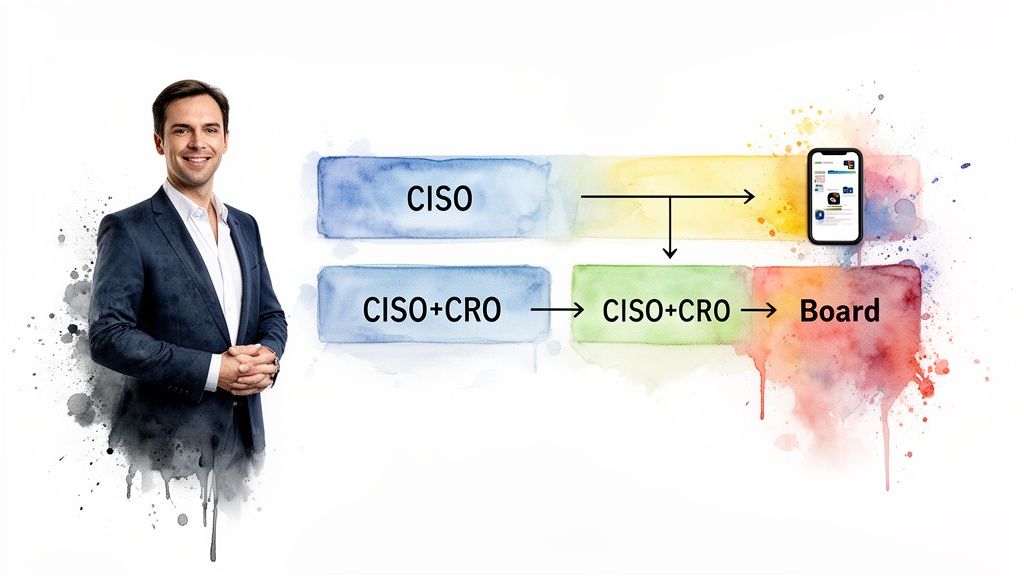
Without this clarity, security work competes with product deadlines, and it almost always loses. With it, security becomes a functional guardrail that enables speed and safety at the same time. For an audit committee, confirming clear ownership is fundamental to defensible governance. It shows the board has established and delegated authority, a core principle of good corporate governance.
Expected Evidence
The technology leader must present simple, clear documentation that a non-technical person can understand.
- Decision Rights Matrix: A one-page document showing who makes what decisions (e.g., CISO decides on system patching, CEO decides on public breach notification).
- Incident Response Plan: A practical playbook that names the one incident commander and core team members.
- Escalation Ladder: A visual chart showing the exact path for resolving conflicts, such as a security requirement clashing with a project timeline. The path must lead to a business authority, like the COO or CEO.
- Tabletop Exercise Reports: Summaries from recent incident response tests (at least twice per year) detailing what was tested, who participated, and what decisions were made.
Common Red Flags
- "The Committee Owns It": Stating that a group owns security decisions is a sign of no true ownership. One name, not a committee.
- No Tested Plan: The organization has an incident response plan that has never been tested through a tabletop exercise.
- Complex Matrices: Overly detailed decision-making charts that are impossible to follow during a real crisis.
Suggested Follow-Up
If ownership is fuzzy, direct management to produce a clear decision rights matrix and escalation ladder within 30 days. Assign the COO or CEO the task of presenting this. The committee should also mandate quarterly tabletop exercises to test these roles, with a summary report delivered to the committee after each exercise. This makes governance real and inspectable.
3. What evidence shows our critical security controls are working?
This question separates governance theater from reality. Many organizations have policies and tools, but few can prove their controls work under pressure. Answering this moves the conversation from "Do we have a firewall?" to "Can you prove our firewall is blocking malicious traffic, and how was that last verified?" This is how you confirm that money spent on security is actually buying down risk.

A backup policy is useless if no one has ever successfully restored data from a backup. The committee’s job is to demand evidence that the most critical controls, those protecting the organization’s crown jewels, are validated independently and regularly. This is how you move from ambiguous updates to inspectable outcomes.
Expected Evidence
Management must provide concrete proof that controls are functioning as designed. This requires auditable logs, test results, and independent reports.
- Control Matrix: A list of material security controls, their owners, testing frequency, and the last validation date.
- Independent Test Results: Reports from penetration tests and vulnerability assessments conducted by third parties.
- Remediation Verification: Proof that vulnerabilities found during testing were fixed and that the fixes were re-tested to confirm they work.
- Operational Logs: Evidence from operational activities, such as logs showing a successful data restore from backups within the last 90 days.
Common Red Flags
- Self-Validation: The team that implemented a control is the only team that validates it. This lacks independence.
- Conflating Test Types: Management presents a vulnerability scan report as if it were a penetration test. Each test validates different things.
- "We Took Care of It": A verbal assurance that findings were addressed, with no documented proof of remediation or re-testing.
Suggested Follow-Up
If management cannot provide concrete evidence, direct them to engage an independent third party to test the top five most critical controls within 90 days. The CISO should be tasked with creating a control validation schedule for all material controls, ensuring a rhythm of testing and validation.
4. Have we tested our incident response plan in the last six months?
When a security incident happens, the first hours are critical. A documented incident response plan that sits on a shelf is not enough. This question forces the organization to prove its preparedness, moving the conversation from theoretical readiness to demonstrated capability. For audit committees, this is a core test of operational resilience.

An untested plan is just a theory. The committee must demand proof that the response team can execute under realistic conditions, from technical containment to legal notifications. Testing reveals the hidden gaps in processes and decision-making authority that only appear during a crisis. Running a cyber resilience tabletop exercise is a practical way to find and fix these gaps before a real event.
Expected Evidence
The designated incident commander should provide a summary of the incident response plan and clear evidence of its testing.
- Incident Response Plan: The current, approved plan detailing roles, responsibilities, and decision-making authority.
- Test Results Report: A summary of the most recent tabletop exercise, including the date, scenario tested, key participants, and major findings.
- Gap Remediation Tracker: A list of weaknesses discovered during the test, along with assigned owners and deadlines for each fix.
- Breach Notification Playbook: Specific procedures for determining if an incident constitutes a notifiable breach under relevant regulations (e.g., SEC rules).
Common Red Flags
- No Recent Test: An admission that the plan has not been tested via a tabletop exercise within the last six months.
- Plan is "Being Updated": Using a perpetual state of revision as a reason for not having a testable plan.
- Lack of Business Integration: The plan is purely technical, with no clear involvement from Legal, Communications, or executive leadership.
Suggested Follow-Up
If the plan is untested, the committee must direct management to conduct a tabletop exercise within the next quarter. Specify that the exercise must include participants from beyond IT, including legal and communications leaders. The required output is a formal post-action report detailing findings and a remediation plan, to be presented at the following committee meeting.
5. How do we manage third-party and vendor cybersecurity risk?
Your organization's security is only as strong as its weakest vendor. Most businesses rely on dozens of third parties for critical functions. Each one represents a potential entry point for an attack. Without a clear system for managing this risk, the board is accepting a massive, unmeasured liability. This question forces a shift from blind trust to active governance.
High-profile breaches like the SolarWinds and MOVEit incidents demonstrated that a single compromised vendor can trigger catastrophic consequences. The central decision is whether you will treat vendor security as an afterthought or as a critical risk managed with the same rigor as your own. A structured approach to third-party and vendor risk management is no longer optional.
Expected Evidence
The risk owner must provide clear proof of a systematic process for vendor risk management.
- Tiered Vendor Inventory: A complete list of vendors, tiered by their access to critical data and systems.
- Risk Assessment Records: Documentation from due diligence for critical vendors, including SOC 2 Type II reports and evidence of remediation for any identified control gaps.
- Contractual Protections: Examples of contract clauses for critical vendors that mandate security standards and grant the "right to audit."
- Ongoing Monitoring Process: A defined cadence for reassessing vendors and a dashboard showing the risk status of the most critical third parties.
Common Red Flags
- "We Get a SOC 2 Report": Relying on a certificate's existence without analyzing its scope, date, and exceptions.
- No Vendor Tiers: Treating the vendor for office snacks with the same scrutiny as your cloud infrastructure provider.
- No Central Ownership: Vendor risk is scattered across departments with no single owner accountable for the overall risk picture.
Suggested Follow-Up
If the organization lacks a formal vendor risk program, direct management to establish one. The first move is to task a specific owner with creating a tiered inventory of all vendors within 60 days, focusing first on those with access to sensitive data. Direct the owner to conduct fresh risk assessments for all Tier 1 vendors and present a risk dashboard to the committee quarterly.
6. Where does our sensitive data actually live?
A data protection policy is a promise, not proof. This question cuts through the policy documents to verify the reality. Many organizations have policies mandating data encryption, yet have no verifiable inventory of where that data actually resides. For an audit committee, the distinction between "we have a policy" and "we control our sensitive data" is the difference between defensible oversight and a future breach headline.
This question forces management to provide a concrete inventory. Where is our most sensitive data? Is it encrypted? Who has access, and when was that access last reviewed? Answering these questions addresses a common attack pattern where adversaries simply find an unprotected copy and walk out the digital door. Strong access controls are vital; modern strategies can be found by researching Security Identity Modernization.
Expected Evidence
Your CISO or data privacy officer must demonstrate that data protection is an active operational practice.
- Data Classification Standard: A simple document defining data tiers (e.g., Public, Confidential, Restricted).
- Sensitive Data Inventory: A list of systems confirmed to hold sensitive data.
- Encryption Status Report: A dashboard showing the percentage of sensitive data repositories that are encrypted, with a clear list of any exceptions.
- Access Review Records: Logs showing that access to sensitive data is reviewed quarterly for privileged users.
Common Red Flags
- Policy Without Inventory: Presenting the data classification policy as evidence of control, without a corresponding map of where that data actually lives.
- "We Encrypt Everything": A blanket statement that is rarely true in practice.
- Stale Access Lists: An inability to produce records of recent access reviews for critical systems.
Suggested Follow-Up
If the organization cannot prove it knows where its sensitive data is, direct management to initiate a data discovery project. Task the CISO with delivering a 90-day plan to inventory the top ten systems containing regulated or mission-critical data. The output must be an inventory, a gap analysis against the encryption policy, and a remediation plan.
7. How does our security investment roadmap align with our top risks?
This question forces management to connect budget to outcomes. Many organizations suffer from "tool sprawl," accumulating security products without a coherent strategy. This leads to wasted resources, operational complexity, and security gaps. For an audit committee, asking for a multi-year roadmap ensures that spending is a deliberate plan to reduce specific, high-priority business risks.
A well-defined roadmap translates abstract security goals into a sequence of concrete projects with clear ownership and timelines. It prevents the "everything is urgent, nothing gets done" trap. This provides defensible proof that the board is overseeing a managed, risk-based security program, a key element of effective governance and one of the most critical audit committee cybersecurity oversight questions.
Expected Evidence
The CISO or CIO should present a multi-year plan that treats cybersecurity as a business capability, not just an IT cost center.
- Prioritized Risk Alignment: A document showing the top 3-5 business risks and how each planned investment directly reduces one of them.
- Multi-Year Roadmap: A visual timeline for the next 2-3 years, detailing major initiatives and planned outcomes.
- Integrated Budget: A budget that includes not just software licenses but also implementation costs, training, and necessary headcount.
- Success Metrics: For each major initiative, a defined key performance indicator (KPI) to measure its success (e.g., reduce time to detect a breach from 18 hours to 2 hours).
Common Red Flags
- Vendor-Driven Roadmap: A plan that looks suspiciously like a sales pitch for a single vendor's product suite.
- "Tool Sprawl" Budgeting: A list of tool renewals without a clear narrative on how they work together or what problems they solve.
- No Headcount Planning: A budget that allocates funds for new technology but ignores the people needed to manage it.
Suggested Follow-Up
If the roadmap is weak, direct management to create one anchored to the top risks from the organization's cyber risk assessment. Assign the CISO responsibility for presenting a 24-month roadmap within 90 days. The plan must justify each investment based on risk reduction.
8. What three numbers prove we are getting safer?
Boards are tired of seeing spreadsheets filled with technical data that do not answer the fundamental question: are we safer this quarter than last? This question forces management to graduate from raw operational telemetry to business-relevant key performance indicators (KPIs) that show whether security investments are actually reducing risk. Without meaningful metrics, the committee cannot provide defensible oversight.
Effective reporting establishes a clear, auditable connection between security activities and business outcomes. It demonstrates that the security program is managed with the same rigor as any other business unit. For the audit committee, this is a critical component of their governance role, ensuring that capital allocated to security produces a measurable return in risk reduction.
Expected Evidence
Your CISO should present a concise, board-level dashboard that translates security performance into business context. The metrics should be outcome-focused and show trends over time.
- Board-Level Metrics Dashboard: A curated set of 3-5 key metrics showing trends. Examples include Mean Time to Detect (MTTD) for critical alerts, percentage of critical assets patched within policy, and time to produce audit evidence.
- Metric Definition Document: A simple document defining each metric, its data source, the owner responsible for its accuracy, and the target range.
- Risk-Weighted Context: Metrics that are weighted by business risk. For example, instead of "10,000 vulnerabilities," a better metric is "Number of internet-facing critical vulnerabilities on systems containing patient data."
- Narrative and Action Plans: For any metric that is out of its target range, there should be a brief explanation and a documented action plan with an owner and a deadline.
Common Red Flags
- Vanity Metrics: Reporting on large numbers that sound impressive but have no business context, like "billions of threats blocked." This is operational noise.
- Too Many Metrics: A dashboard with 20+ metrics that overwhelm the committee and obscure the most important signals.
- Activity vs. Outcome: Metrics that measure effort instead of results (e.g., "number of phishing simulations run" instead of "percentage of users reporting simulated phishing emails").
- No Trend Lines: Presenting data for only the current quarter makes it impossible to know if performance is improving or degrading.
Suggested Follow-Up
If reporting is weak, direct management to develop a board-level cybersecurity metrics package within 60 days. The CISO should be tasked with proposing no more than five key metrics, each with a clear definition, target, and trend line. This action transforms cybersecurity from a technical black box into a governable part of the business.
From Questions to Control: Your 30-Day Move
Asking these audit committee cybersecurity oversight questions is the first step. The next is to install an operating system that produces clear answers, inspectable proof, and faster fixes. Moving from chaos to control is not about finding a magic software platform. It is about changing how you operate, shifting from ambiguous accountability to explicit ownership.
For the Trust Governor on the board, these questions are the foundation of defensible oversight. You are no longer just asking, "Are we secure?" You are asking, "Can you prove our critical controls worked this week?" and "Who is the single owner accountable for our incident response readiness?" This shift moves the conversation from aspiration to attestation.
For the Calm Operator, the CEO or COO tired of recurring crises, these questions force the messy reality of your technology into a clean decision-making framework. The answers reveal who owns what and what trade-offs must be made. This is how you stop paying the coordination tax, where smart people waste time trying to figure out who is supposed to do what, and instead start shipping fixes that reduce real risk.
Your 30-Day Move to Restore Control
Your team is likely overwhelmed. They feel the pressure but lack the clear mandate to fix root causes. Here is a practical, 30-day plan to translate this article's questions into tangible action and build the foundation for your new operating rhythm.
- Week 1. Name the Owner and Define the Outcome. Designate one person as the single point of accountability for producing the first "Proof Pack" draft—a one-page Red/Yellow/Green status for each oversight question. This is one name, not a committee.
- Week 2. Map the Handoffs and Define Done. The owner's job is not to solve everything but to find the truth. They will map where the evidence for each answer currently lives, identifying the specific gaps between the questions you are asking and the proof you can provide today.
- Week 3. Remove One Major Blocker and Ship One Visible Fix. To build momentum, close one high-impact gap. This could be formally naming an Incident Commander, performing a full recovery test on one critical system, or decommissioning three unused vendors with access to your data.
- Week 4. Start the Weekly Cadence and Publish Proof. The owner will schedule and run the first 30-minute weekly meeting to review progress on the Proof Pack. The output is an updated one-page summary for leadership. This is the start of a reliable operating rhythm that produces consistent, inspectable proof.
This 30-day cycle is how you turn abstract audit committee cybersecurity oversight questions into concrete operational control. You prove to your board, your insurers, and yourselves that you are governed and ready for scrutiny.
Are you ready to replace fire drills with confident oversight? Book a clarity call to see how CTO Input can help you answer your board's toughest questions with confidence.