
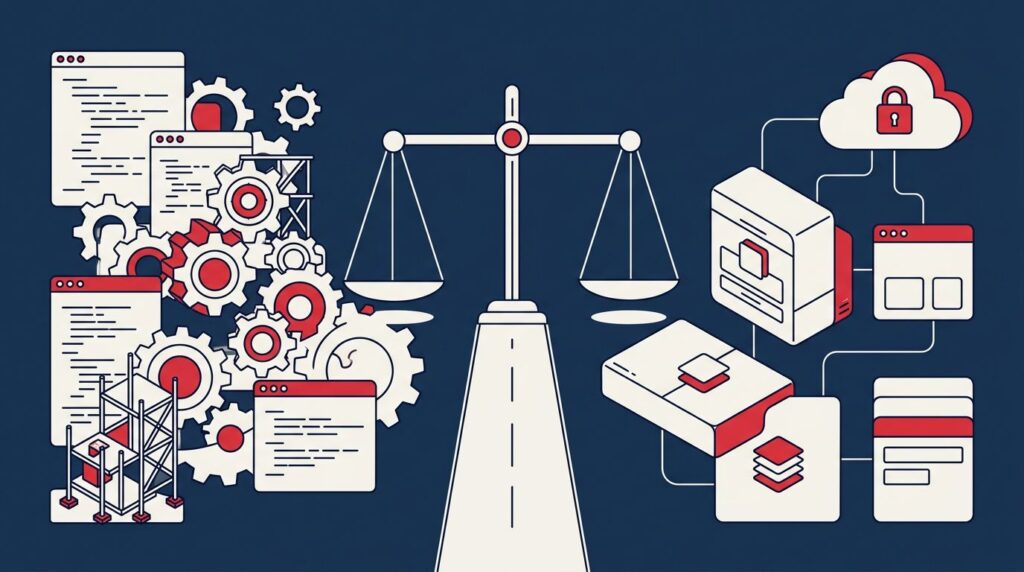
Most build vs buy software debates start with the wrong question: “Can we build this?” The better question is whether the capability should become part of your business, or whether you should rent it from someone else.
A build vs buy software decision affects cash, speed, risk, engineering capacity, vendor dependence, and your ability to change direction later. The answer may be build, buy, or wait. A clear decision requires more than comparing a development estimate with a SaaS subscription.
Key takeaways
- Buy common capabilities when speed, reliability, and predictable implementation matter most.
- Build when software creates a real competitive advantage that commercial products cannot match.
- Wait when the problem, ownership, requirements, or economics remain unclear.
- Compare five-year total cost of ownership, not just the first invoice.
- Treat vendor exit rights, data ownership, security, and price increases as part of the purchase decision.
- Give every major decision a business owner, technology owner, approval path, and measurable outcome.
Build vs buy software starts with the business outcome
Before comparing platforms or asking engineers for estimates, define the business outcome your software solution must produce.
Are you trying to improve gross margin? Increase operational efficiency? Launch a new revenue stream? Meet a customer requirement? Improve reporting? Reduce operational risk? Support an acquisition?
A software project without a clear business outcome becomes a technical project by default. Technical teams then optimize for features, architecture, or completion. Leadership is left asking why the company spent money without becoming faster, safer, or more profitable.
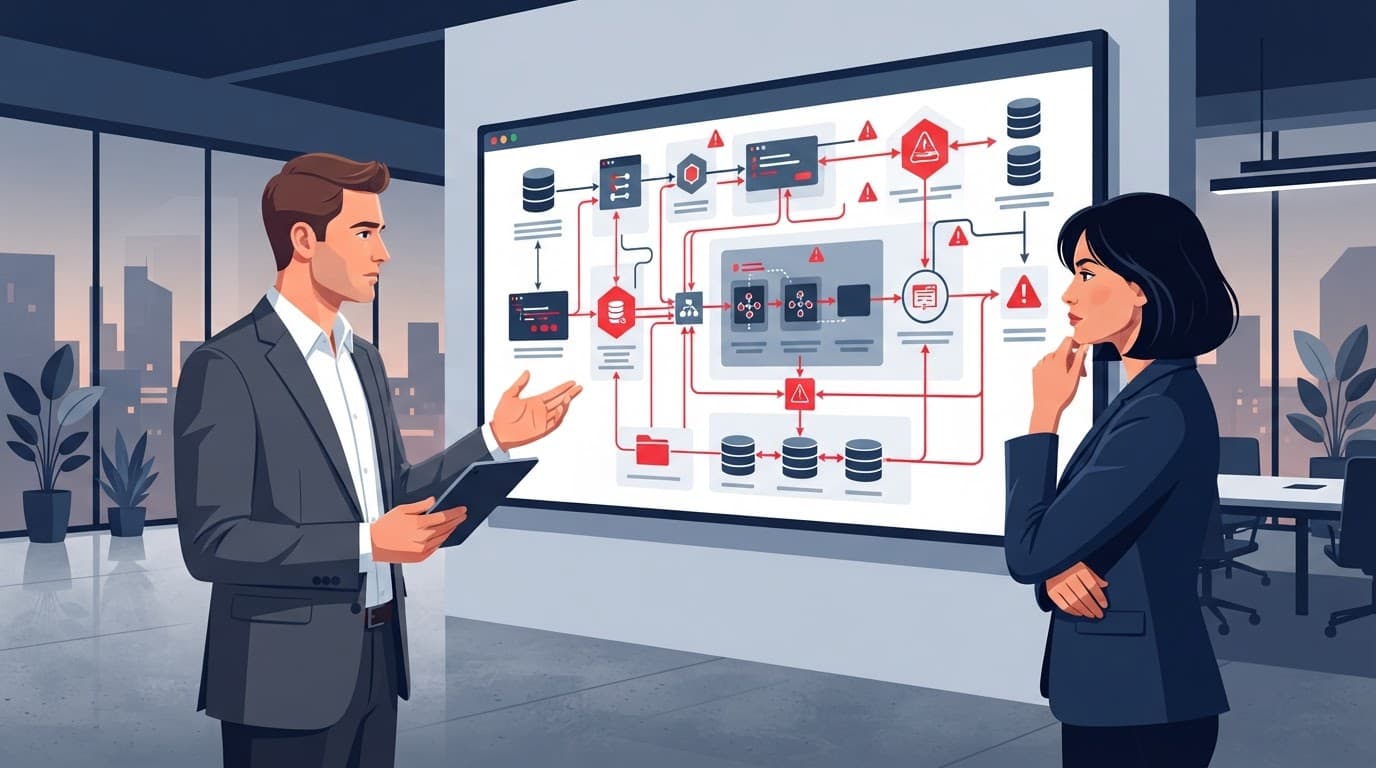
Your first step is a short decision brief. Keep it to one page. State:
- The business problem and the affected process.
- The measurable outcome you need.
- The users and teams involved, plus essential software requirements separate from preferences.
- The decision deadline.
- The cost of delay.
- The risks you are unwilling to accept.
- The person accountable for the result.
This is part of a broader technology strategy as an execution system. Your software decision should support the core business and fit the operating plan, budget, risk posture, and technology roadmap. It shouldn’t become a separate initiative that consumes engineering attention without a clear connection to the business.
If nobody can explain what success looks like in business terms, don’t approve build or buy yet. Clarify the problem first.
Use application layers to decide what belongs in-house
Gartner’s Pace-Layered Application Strategy gives CEOs a useful way to sort software decisions. It separates applications into three broad categories: systems of record, systems of differentiation, and systems of innovation.
A practical overview of the framework appears in this guide to build versus buy software decisions. The model isn’t a command to buy everything below and build everything above. It is a way to ask better questions.
Systems of record
These applications support standard business functions. Established enterprise software platforms commonly cover accounting, payroll, human resources, identity management, email, customer relationship management, and basic collaboration.
You usually buy these capabilities. Integrated platforms provide broad support, while proven point solutions can serve narrowly defined standard functions. The processes are common, and established vendors support them.
The cost of building and maintaining these systems rarely creates a meaningful advantage. The exception is a business with unusual regulatory, operational, or data requirements.
Even then, buying a core platform and extending it may be wiser than rebuilding the entire system.
Systems of differentiation
These applications support the way your company wins. They may manage a unique service model, pricing process, customer workflow, logistics method, underwriting process, or operational model.
This is where custom software development can make sense. The question is not whether the workflow is unusual. The question is whether it materially affects revenue, margin, customer loyalty, speed, or control.
You may build the part that creates differentiation while buying the underlying infrastructure. That hybrid approach often produces a better result than a completely custom platform.
Systems of innovation
These are experiments, prototypes, new data products, and emerging capabilities. Artificial intelligence projects often begin here.
The right approach is usually small, reversible, and time-boxed. A no-code platform, low-code tool, API, or purchased service may help you test demand before committing to a larger build.
The three layers help you avoid a common mistake: treating every software decision as if it deserves the same level of investment.
Calculate total cost of ownership beyond the sticker price
The first-year price is rarely the real price.
For a build decision, estimate:
Build cost = development cost + product and design cost + security and compliance cost + infrastructure + support + maintenance + opportunity cost
Development cost should use a fully loaded rate. Include salary, benefits, recruiting, management, tools, contractors, and the cost of pulling people away from other work.
Maintenance costs are often estimated at roughly 20% to 40% of initial development cost each year. That is not a law, but it is a useful planning range. Your estimate should also include testing, documentation, upgrades, vulnerability remediation, monitoring, backups, and incident response.
The largest hidden cost may be engineering opportunity cost. Assigning engineers to the build is also a resource allocation decision. If your best engineers spend eighteen months building an internal workflow tool, what customer-facing product, reliability work, or revenue initiative won’t happen?
For a buy decision, estimate:
Buy cost = subscriptions + implementation + integration + migration + training + administration + premium modules + price increases + exit costs
Include the time your team spends managing the SaaS vendor. A purchased platform still requires configuration, access reviews, data quality work, contract management, and user support.
For a wait decision, estimate:
Wait cost = lost benefit + operating friction + risk exposure + delay cost
Waiting can be cheaper than building the wrong thing. It can also be expensive when the current system is causing lost revenue, customer complaints, compliance exposure, or repeated manual work.

Use a three-year and five-year view. Document the vendor’s pricing model before modeling at least three subscription scenarios, including higher renewal pricing. Ask the vendor for price protections, but model the outcome if those protections expire.
| Decision | Costs people often miss | Main financial question |
|---|---|---|
| Build | Maintenance, security, documentation, support, engineering opportunity cost | What business value will this create that the team could not create elsewhere? |
| Buy | Integration, administration, renewals, premium features, migration, price increases | Does the time saved and risk avoided justify the lifetime cost? |
| Wait | Lost productivity, delay, risk exposure, temporary workarounds | What evidence will change the decision, and when will you review it? |
Your finance team should also separate one-time implementation costs from ongoing operating costs. Capitalized development, implementation expenses, and software subscriptions may affect the financial story differently. Do not promise savings you cannot trace to evidence.
The strongest business case uses cost-per-outcome reporting. Instead of saying, “We spent $400,000 on the platform,” show what the investment changed. Did it reduce processing time, increase capacity, lower error rates, improve conversion, or reduce expected loss?
Build when software is part of your advantage
Custom software earns its cost when it creates a defensible competitive advantage.
Building is more defensible when:
- The workflow directly supports revenue, margin, or customer retention.
- The process is central to how you compete.
- Available products force expensive workarounds.
- Your data, rules, or operating model create proprietary value.
- You need control over performance, security, or deployment.
- The expected value is large enough to support a permanent product and engineering capability.
- You can maintain the system for years, not only launch it.
A custom solution is not automatically proprietary value. It can keep differentiated logic in-house while using point solutions for commodity capabilities. A company can still spend heavily recreating a standard function that other businesses buy for a fraction of the cost.
Ask what you will own after the build. Will you own reusable intellectual property, better operating data, a faster customer process, or a capability that supports expansion? Or will you own another application that requires constant care?
A detailed comparison of custom software and off-the-shelf options can help frame the tradeoffs, but your answer still depends on your business model, talent, and operating discipline.
AI-assisted development can reduce the development lift required to produce a working prototype. A small team may now move from idea to prototype much faster than before. That does not remove the need for product decisions, security review, testing, data governance, support, or long-term ownership.
AI can reduce the cost of producing code. It cannot decide whether the code should exist.
Your AI adoption strategy should also cover AI governance, responsible AI, access controls, data handling, acceptable use, and AI vendor due diligence. A fast prototype can create a slow compliance problem if nobody establishes boundaries.
Buy when the capability is common, urgent, or well-supported
Buying off-the-shelf software is usually the better decision when the capability is common and the business needs it quickly.
Buy when:
- The process is not a source of competitive advantage.
- The market has mature enterprise software options and proven point solutions.
- Implementation time matters more than complete customization.
- You lack the engineering capacity to support another product.
- The vendor has strong security, reliability, integration, and support practices.
- Your requirements and scalability needs fit the product without major workarounds.
- You need predictable access to system updates.
COTS software can reduce technical debt, but a disconnected collection of point solutions can create tool sprawl. You benefit from a product with a large customer base, established release processes, and support that doesn’t depend on one employee.
That does not mean the buying decision is low risk. A SaaS vendor can raise prices, remove features, change its roadmap, limit access to data, or become difficult to replace. Vendor lock-in grows when the product becomes embedded in your workflows without clear export options or contract protections.
Before signing, review:
- Data ownership and usable export formats.
- API access, integration capabilities, and integration limits.
- Renewal terms, the pricing model, and price increase caps.
- Service levels and support response.
- Security compliance obligations and breach notification.
- Subprocessors and data locations.
- Contract termination rights.
- Transition support and vendor offboarding.
- What happens if the product is acquired or discontinued.
A useful list of software decision factors can support your evaluation. Your own technology vendor selection process should add business impact, data sensitivity, contract exposure, and exit cost.
Don’t let a SaaS vendor drive your technology roadmap. Buy the capability, but retain the decision rights.
Wait when the evidence is weak or the problem is moving
“Wait” is not the same as ignoring the problem. A controlled wait has an owner, a deadline, a short discovery plan, and a condition that will trigger a decision.
Wait before building or buying when:
- Stakeholders disagree about the problem.
- Requirements change every week.
- The current process hasn’t been measured.
- No business executive owns the outcome.
- Your technology team cannot estimate support requirements.
- A merger, acquisition, restructuring, or major system change is underway.
- The vendor market is changing faster than your decision cycle.
- The proposed solution depends on untested AI claims.
Use the waiting period to complete a systems inventory, interview users, map the workflow, review data quality, and identify manual workarounds. A 90-day technology plan is often enough to replace opinions with facts.
You may discover that the real issue is not missing software. It may be tool sprawl, shadow IT, weak process ownership, poor data governance, or technical debt. Adding more point solutions can make each of those problems worse.
Set a decision date. If the evidence is still incomplete on that date, extend the discovery with a stated reason. Do not allow “we’re still evaluating” to become a permanent operating model.
Use a CEO decision matrix, not a loudest-voice debate
A practical decision-making framework scores the options against the same criteria. Use a one-to-five scale, with five representing the strongest reason to choose that path.
Score build, buy, and wait on:
- Strategic differentiation. Does this capability help the business win?
- Time to market. How costly is a delay?
- Product fit. Can an integrated product support the process better than a collection of point solutions, without harmful workarounds?
- Total cost of ownership. What will the option cost over three to five years?
- Talent and ownership. Can you support the capability after launch?
- Risk and control. What are the security, privacy, compliance, and continuity implications?
- Reversibility. How difficult will it be to change course?
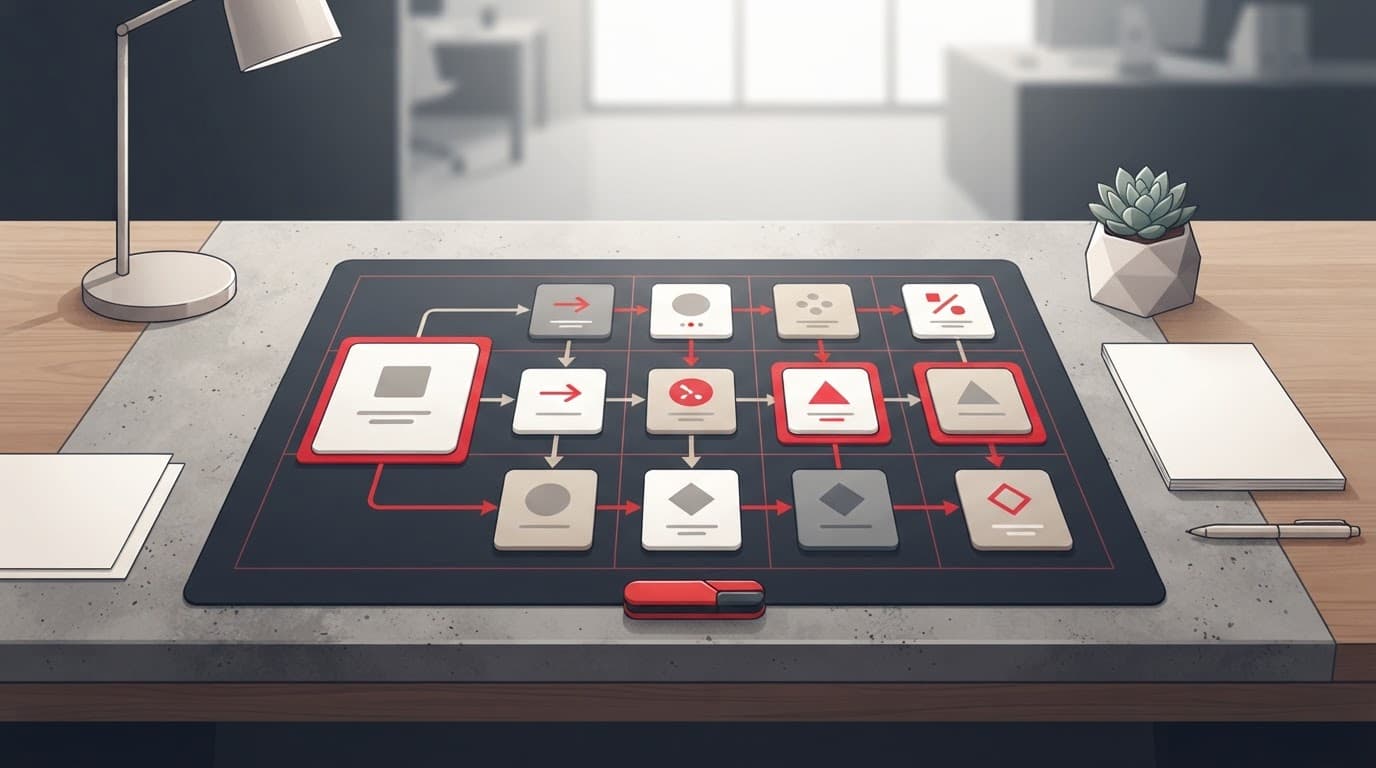
The scores do not make the decision for you. They make hidden disagreements visible.
A finance leader may prioritize predictable cost. Engineering may prioritize control. Operations may prioritize adoption. The CEO may prioritize speed. Those concerns are all legitimate, but they need to sit in the same decision.
Name the business sponsor, technology owner, finance reviewer, security reviewer, and final approver. Create a decision rights map that states who recommends, who approves, who funds, who executes, and who is informed.
Then place the decision on a practical business-aligned technology strategy. The supporting plan may be a one-page technology strategy, a 12-month technology roadmap, or an IT strategy and roadmap with milestones, dependencies, owners, and review dates.
Your approval should include a stop condition. A pilot that fails to meet adoption, performance, or outcome targets should end. A purchased platform that creates unacceptable risk should not renew. A build that keeps expanding beyond its original business case needs a reset.
Govern the decision after the contract or code ships
The build versus buy decision is not complete at launch.
For a build, review product ownership, technical debt, release quality, security findings, support demand, and business outcomes. For a saas vendor, review adoption, performance, spend, data quality, access, incidents, and renewal exposure.
Create a monthly technology operating rhythm. Keep it short. Review:
- Progress against business outcomes.
- Spend against the approved case.
- Delivery risks and decisions needed.
- Vendor performance and upcoming renewals.
- Security and continuity issues.
- Adoption and user friction.
- Changes to the technology roadmap.
Board reporting should focus on decisions, thresholds, ownership, and business impact. Board-ready technology reporting is not a list of tickets or technical milestones. It should help directors understand technology risk oversight, cyber risk appetite, resilience, material commitments, and the tradeoffs management is making.
If leadership has technical managers and outside vendors but still lacks confidence, you may have a technology leadership gap. A fractional CTO, part-time CTO, virtual CTO, or outsourced CTO can provide executive technology leadership without creating a full-time seat too early. Fractional CTO services can cover technology strategy consulting, software platform evaluation, vendor management, roadmap ownership, and executive reporting.
An interim CTO and interim CTO services are a better fit when the seat is open, trust has broken down, or a transition requires immediate ownership. A fractional CIO may fit when enterprise systems, data, and operations are the larger concern. A fractional CISO, virtual CISO, or interim CISO may be appropriate when cybersecurity oversight and technology risk are the immediate pressure points.
If the facts are scattered, Get an Executive Technology Clarity Check before approving another major platform or custom build.
Conclusion
The right answer is rarely “always build” or “always buy.” Buy the capabilities that are common. Build the capabilities that create a measurable competitive advantage. Wait when the problem, economics, or ownership are not clear enough to defend.
A good decision protects more than the budget. It protects engineering capacity, customer experience, operating speed, risk posture, and leadership attention. Your goal is not to own more software. It is to make a confident decision about what the business should own, what it should rent, and what it should leave alone for now.
FAQs about build, buy, and wait decisions
What are the main factors in a build versus buy decision?
Start with business differentiation, time to market, product fit, five-year cost, available talent, security, data control, scalability, and reversibility. Also consider the opportunity cost of using internal engineering capacity.
Does AI make custom software development the better choice?
Not by itself. AI-assisted development can reduce prototype time and help smaller teams produce working software. It doesn’t remove product ownership, testing, security, documentation, support, or compliance work. AI changes the cost and speed assumptions, but you still need a business case and clear ownership.
How should you handle disagreement between finance, engineering, and operations?
Use one decision matrix and require each group to state its assumptions. Finance should show lifetime cost. Engineering should show capacity and support requirements. Operations should show process impact and adoption needs. The CEO should resolve tradeoffs against business priorities, risk, and timing.
When should you involve a fractional CTO?
Consider fractional technology leadership when you have technical people or vendors but lack executive ownership. It fits when reporting is weak, priorities drift, vendor dependence is rising, or major technology choices feel difficult to trust. You may need an interim CTO instead when the leadership seat is vacant or the business needs rapid stabilization.
What should happen before a major software purchase?
Complete a technology health check, confirm the business outcome, compare total cost of ownership, review security and data obligations, negotiate exit rights, identify the accountable owner, and define success measures. A short technology audit or 90-day technology plan can prevent a rushed commitment that becomes expensive to unwind.