

How do you get your arms around security, data, and systems risk without turning into an IT specialist?
If you are a growth-minded CEO, COO, or founder, you probably feel the squeeze. Boards ask about ransomware and AI misuse. Customers ask about data protection. Your team throws acronyms at you. Tech feels too expensive, too risky, and too disconnected from the growth plan.
This guide is for you. The CEO’s Ultimate Guide to Managing Tech Risk Without Becoming A Geek gives you a simple way to see your risk, ask sharp questions, and hold your team accountable without learning firewall settings. By the end, you will have a clear mental model and a short action list you can take into your next leadership or board meeting with confidence.
See Cyber and Technology Risk Like a CEO, Not an IT Expert
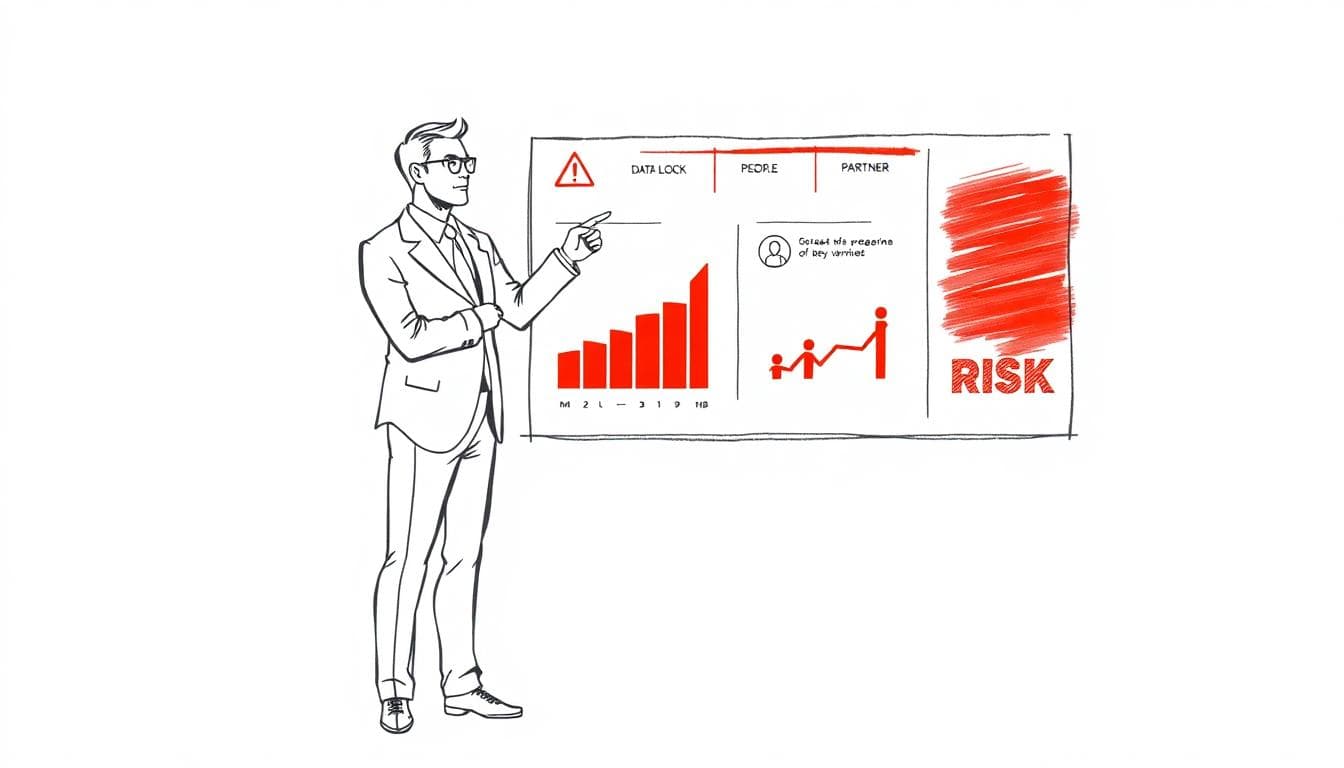
A CEO reviews a simple dashboard of data, systems, people, and partner risks, illustrated in a minimalist editorial line-art style. Image created with AI.
Most security conversations get lost in tools and threats. That is why many executives quietly tune out.
You do not need another lecture on malware or cloud misconfigurations. You need a business view of risk.
At its core, cyber and technology risk is about four things you already care about every day:
- Revenue
- Reputation
- Operations
- Compliance and contracts
When ransomware hits a mid-market company, it is not a “technical incident.” It is lost revenue because orders cannot be processed. It is overtime cost while teams scramble. It is a nervous board asking what else is exposed. Recent research on CEO-level cybersecurity priorities, like BCG’s CEO guide to cybersecurity, makes the same point: this is strategy, not just IT.
Translate “Tech Risk” Into Business Risk You Actually Care About
Think of cyber and tech risk as a set of “bad stories” you never want to tell your board or your customers.
A few examples that land:
- Lost revenue: A ransomware attack hits your ERP, so no invoices go out and no payments come in for three days. Sales leaders are on the phone explaining delays instead of closing deals.
- Damaged reputation: A vendor system holding your customer data gets breached. Even if it is “their” fault, your logo is in the headlines and you are the one apologizing.
- Operational disruption: Your cloud CRM slows to a crawl twice a week. It is not a full outage, but sales and support lose hours and morale every time.
- Regulatory or contract trouble: A data leak means you must notify a regulator and key clients. You risk fines, plus angry partners who now question whether you can meet your SLAs.
Ransomware, stolen passwords, and AI-driven phishing are technical on the surface, but the impact is painfully simple: cash is blocked, trust is shaken, and people cannot do their jobs.
When you frame risk in business language, your team has to answer the real question: “What could break our revenue, our reputation, or our ability to run the business?”
Use a Simple 4-Box Model: Data, Systems, People, and Partners
You do not need a NIST framework in your head. You need four buckets.
Think of your risk in this simple 4-box model:
- Data
What you must protect: customer records, pricing, trade secrets, financials.- What can go wrong: A misconfigured cloud bucket leaks customer data, or an AI tool stores sensitive uploads.
- How it shows up: A board member asks, “Exactly whose data was exposed, and how will this affect renewals?”
- Systems
The apps and platforms the business runs on.- What can go wrong: Your order system or core banking platform goes offline for a day.
- How it shows up: Key customers ask for penalty credits, and your COO has to explain why there was no fallback.
- People
Staff behavior, training, and basic process discipline.- What can go wrong: A finance staffer gets tricked by a very real-looking AI voice that sounds like you and wires funds to a fraudster.
- How it shows up: Your audit committee demands to know why there was no second check on large transfers.
- Partners
Vendors, cloud providers, outsourced teams, SaaS platforms.- What can go wrong: Your payment processor is down for 48 hours, or your outsourced dev shop gets hacked.
- How it shows up: The board asks, “Why was there no backup plan if this one provider failed?”
You do not need to understand encryption. You need to know which data, systems, people, and partners are critical, and what happens to the business if something hits them.
Ask Five Plain-English Questions To Control Cyber and Tech Risk
Once you have the 4-box model in mind, you can run better meetings.
You do not need technical questions. You need tight, plain-English questions that map to real 2025 risks like ransomware, AI fraud, and supply chain attacks. Resources that track those threats, such as this CEO-focused summary of top 2025 cyber risks, confirm how exposed mid-market firms really are.
Use these five questions in your next session with IT, your MSP, or your outside advisors.
Question 1: What are the 5 to 10 systems and data sets we simply cannot afford to lose?
Do not start with every app in the stack. Ask for a short list.
Focus on what runs:
- Revenue and orders
- Cash and payments
- Operations and logistics
- Core customer experience
Then ask, in plain language, for each item:
- “What happens if this is down for a day? For a week?”
- “How fast can we bring it back, for real, not on paper?”
This one question quietly forces clarity about backups, recovery, and resilience, without you saying those words.
Question 2: If ransomware or a major outage hit tonight, what would actually happen tomorrow morning?
Picture walking into the office and finding key systems locked or broken.
Ask your team to talk you through it step by step:
- Who notices first?
- Who decides what to shut down or disconnect?
- How are customers and partners told, and by whom?
- How do we decide whether to pay or not pay a ransom?
- How long until we are operating at 80 percent again?
You are testing readiness, roles, and decision paths, not the names of technical tools. If the story is fuzzy or full of “we would probably,” you have found a gap.
Question 3: Where are our biggest “people risks,” and how are we helping our team avoid mistakes?
Most serious incidents start with people, not firewalls.
Ask:
- “Which roles are most targeted: finance, executives, support, operations?”
- “What simple guardrails do those teams use before they move money, change bank details, or share sensitive data?”
You are looking for habits like:
- Call-backs for big payment changes
- Dual approval on large transfers
- Short, frequent phishing and AI-fraud awareness training
Better habits often cut risk faster than another piece of software.
Question 4: Which vendors and partners could hurt us if they get hacked or go down?
Your risk is linked to your supply chain and SaaS stack.
Ask for a list of the handful of vendors where a failure would hit revenue or customers inside a few days. Then ask:
- “If this partner is offline for three days, what breaks here?”
- “Do we have a plan B, even if it is manual, to keep serving customers?”
- “Who checks that these partners meet basic security and uptime standards?”
This is not a technical integration review. It is a continuity and contract review.
Question 5: How are we measuring cyber and technology risk in a way the board can understand?
Finally, you need a simple way to see trend, not just anecdotes.
Ask for a one-page, non-technical view that covers:
- A short risk heat map for data, systems, people, and partners
- Three to five metrics, such as:
- Uptime for the top critical systems
- Time to restore from backup in recent tests
- Results of phishing simulations
- Status of security reviews for top vendors
Your goal, and the goal of The CEO’s Ultimate Guide to Managing Cyber and Technology Risk Without Speaking Geek, is to turn noise into a small set of clear numbers you can discuss with your board and investors. Guidance on executive dashboards from firms like KPMG’s cybersecurity considerations for 2025 can help shape what “simple but serious” looks like.
Turn Insight Into Action: A 30-Day Plan to Get Control Without Learning “Geek Speak”
You do not need a 12-month program to start. You can get meaningful control in 30 days with a focused, business-first plan.
Week 1: Map Your Critical Data and Systems in One Page
Ask your team for a single-page view that shows:
- The 5 to 10 systems and data sets you cannot lose
- The business owner for each one (not just IT)
- What happens to the business if it is down for a day
Then add a simple traffic light:
- Green: confident in backups, security, and vendor
- Yellow: some doubts or known issues
- Red: if this breaks, it is chaos
You now have a clear, executive snapshot of your real exposure.
Weeks 2–3: Run the “What if?” Drill and Fix the Obvious Gaps
Schedule a 60- to 90-minute tabletop discussion, not a fire drill.
Pick one scenario, such as a ransomware hit on a core system or a key SaaS vendor outage. Ask the team to walk through what happens, from first alert to customer updates and recovery.
Listen for:
- Confusion about who decides what
- Assumptions like “IT will figure it out”
- Missing basics, such as tested backups or clear customer messaging
From that conversation, pick three to five no-regret moves. For example:
- Test restore of backups for the top three systems
- Tighten approval steps for large payments
- Clarify who talks to customers and the board during an incident
These are the quick wins that reduce real risk within a month.
Week 4: Set a Simple Rhythm for Ongoing Cyber and Tech Oversight
In week four, lock in a simple cadence.
Set a brief monthly or quarterly review where your leadership team looks at:
- The 4-box model: data, systems, people, partners
- The one-page risk view and key metrics
- Progress on a short list of improvements
Many mid-market companies use a seasoned outside advisor or fractional CTO/CIO/CISO to prepare this view and keep conversation in business terms. Independent guidance, like the kind discussed in executive-focused resources on aligning cyber and financial risk such as CEO threat briefings for 2025, can help leadership stay focused on strategy, cost, and outcomes, instead of technical detail.
Conclusion: Confidence Over Complexity
You do not have to become an IT expert to manage cyber and technology risk well. You need a clear, business-first view of what matters, a few sharp questions, and a simple rhythm of review that your board can trust.
The CEO’s Ultimate Guide to Managing Cyber and Technology Risk Without Speaking Geek is really about confidence. Use the 4-box model of data, systems, people, and partners, pair it with the five questions, and you will be able to answer tough questions from investors, lenders, and customers with calm clarity.
If you want someone sitting on your side of the table, translating complexity into options, explore how fractional technology leadership works at https://www.ctoinput.com. To go deeper on topics like AI risk, modernization, and tech ROI, keep reading on the CTO Input blog at https://blog.ctoinput.com. Turn technology, security, and data into an advantage instead of a source of anxiety.