
Does this sound familiar? Your customer spreadsheet has morphed into a complex CRM that no one trusts. Your team is scattered everywhere, accessing company data from personal devices. You’re finally landing bigger clients, but their security questionnaires feel like a final exam you didn’t know you had to study for.
This is the messy middle ground of growth. It’s where technology stops being a simple tool and becomes a major source of both opportunity and risk. You know you need leadership, but the alphabet soup of titles—CIO, CISO, CTO—is a blur.
Hiring the wrong executive isn’t just a costly mistake; it’s a strategic misstep that can slam the brakes on your growth, open the door to a devastating breach, or burn a year building things that don’t move the needle. This is your guide to making the right call without getting bogged down in jargon. We’ll cut through the noise of the CISO vs CIO debate and give you a clear framework to decide who you need, when you need them, and what to expect when they’re on board.

To start, let’s clarify the fundamental difference. One leader builds your business engine; the other makes sure it doesn’t get hijacked.
CISO vs. CIO at a Glance
| Dimension | Chief Information Officer (CIO) | Chief Information Security Officer (CISO) |
|---|---|---|
| Primary Mission | Enable business growth and efficiency through technology. | Protect company data, assets, and reputation from threats. |
| Core Question | “How can our technology make us faster and more competitive?” | “What are our biggest risks, and how do we defend against them?” |
| Focus Area | Business systems, infrastructure, IT operations, project delivery. | Risk management, compliance, incident response, data privacy. |
| Measures of Success | System uptime, project ROI, operational efficiency, user adoption. | Reduced incidents, audit success, faster threat detection, resilience. |
The CIO builds the systems that create value. The CISO protects that value from being destroyed. Both are essential, but the one you need right now depends entirely on your company’s most urgent pain.
The Architect vs. The Guardian: Defining Their Missions
The simplest way to settle the CISO vs. CIO debate is to think of them as an architect and a guardian. While they must work together, their missions are fundamentally different.
The Chief Information Officer (CIO) is your company’s technology architect. Their job is to design and run the entire tech engine that keeps your business moving forward. They’re constantly asking, “How can technology make us faster, more efficient, and more innovative?” It’s all about enabling growth and sharpening your competitive edge.

On the other side is the Chief Information Security Officer (CISO)—your digital guardian. Their focus is protecting everything you’ve built. They wake up thinking, “What could take us down today, and how do we stop it?” Their world revolves around identifying, managing, and mitigating risk.
The CIO’s Mission: Building Value
A CIO’s work is tangible and forward-looking. They spearhead initiatives you can see and feel across the business.
- They implement a new ERP system to give you a single, clear view of operations.
- They lead the charge to the cloud, allowing the business to scale without pouring money into hardware.
- They ensure the core systems that sales, finance, and operations depend on are stable, effective, and actually work.
Think of it this way: the CIO builds the superhighway that lets your business travel farther, faster. Their success is measured by the performance of that highway.
The core tension is this: The CIO is paid to enable the business to go faster, while the CISO is paid to ensure it doesn’t crash along the way. Both are essential for a successful journey.
The CISO’s Mission: Protecting Value
The CISO, in contrast, is obsessed with protecting what the company has already created. This isn’t just about firewalls and antivirus software; that’s just tactics. The role is deeply strategic.
A CISO’s job is about:
- Safeguarding sensitive customer data from a breach that could destroy your reputation.
- Protecting your intellectual property—the secret sauce of your business—from theft.
- Ensuring the business can actually survive and recover from a major cyberattack.
If the CIO builds the highway, the CISO installs the guardrails, deploys emergency response crews, and staffs security checkpoints. They are focused on resilience and defense.
This difference in focus is often reflected right in the org chart. Research shows that about 47% of CISOs report to CIOs, while only 18% report directly to the CEO. This common structure nests security within IT but highlights the debate about where the “guardian” should sit to have the most impact. You can read the full research on these reporting structures.
What Do They Actually Do? Daily Priorities and Business Impact
Beyond the org chart, what does a CISO or CIO actually do on a typical Tuesday? Looking at their calendars reveals the real, practical differences between them.
A CIO’s day is about forward momentum. They’re pushing the business ahead by evaluating new software to boost sales, negotiating with vendors to drive down costs, or planning the IT budget to squeeze the most value from every dollar. Their world revolves around project plans, system integrations, and resource allocation.
The CISO lives in a different world—one of proactive defense and constant vigilance. Their morning might be spent drafting a new data handling policy, the afternoon running vulnerability scans on critical applications, and the evening refining the company’s response plan for a data breach that hasn’t happened yet.
How Success Is Measured
The scorecards for a CIO and a CISO couldn’t be more different. Each is held accountable for outcomes that reflect their core mission.
A CIO is measured on enablement and efficiency. You see their success in metrics like:
- System Uptime: Are core business systems, like your ERP and CRM, consistently available?
- Project Delivery: Are tech projects getting done on time, on budget, and delivering the promised value?
- ROI of Technology: Is the investment in software, hardware, and staff generating a clear return by increasing revenue or cutting costs?
A CISO is measured on risk reduction and resilience. Their performance is tied to preventing bad things from happening. Key metrics include:
- Mean Time to Detect (MTTD): How fast can the security team spot a potential threat? The lower, the better.
- Compliance Audit Success: Passing a SOC 2 or HIPAA audit isn’t just a checkbox; it’s a direct reflection of a well-run security program. To learn more, check out our guide on IT compliance services.
- Reduction in Security Incidents: Is security awareness training working? A drop in successful phishing attacks is a clear sign of progress.
This tension is natural and healthy. A CIO might push for a new AI-powered sales tool, while the CISO pumps the brakes to conduct a thorough security review. Neither is wrong; they’re looking at the same decision through different, equally important lenses.
CISO vs. CIO: A Practical Comparison
This table breaks down what each executive actually does.
| Aspect | Chief Information Officer (CIO) | Chief Information Security Officer (CISO) |
|---|---|---|
| Daily Focus | Managing IT budgets, vendor relationships, system performance. | Monitoring threat intelligence, managing security tools, policy enforcement. |
| Typical Projects | Cloud migration, new ERP implementation, business intelligence dashboards. | Incident response planning, employee security training, vulnerability management. |
| Primary Language | ROI, efficiency, scalability, integration, business process. | Risk, compliance, threat, vulnerability, incident, data protection. |
| Business Impact | Drives operational leverage and enables new business capabilities. | Protects revenue, customer trust, and brand reputation. |
It’s simple. The CIO works to make the business run better, faster, and smarter. The CISO works to make sure the business is still running tomorrow.
Solving the Reporting Structure Puzzle
Figuring out where your CISO and CIO sit on the org chart is more than drawing boxes. It’s a statement about what your company values. Get it right, and you create natural alignment. Get it wrong, and you sign up for internal friction and dangerous blind spots.
The traditional setup has the CISO reporting to the CIO. This can work well, forcing close collaboration between IT and security when you’re building foundational systems.
But this model comes with a built-in conflict of interest.
The person in charge of building and running all the systems (the CIO) is also managing the person whose job is to find flaws in them (the CISO). It’s like having your lead architect also be the final building inspector—it might be fine, but the potential for problems is obvious.
Giving Security an Independent Voice
As a company matures or faces heavy regulation, a different structure usually makes more sense. In this model, the CISO reports directly to the CEO or a board-level risk committee. This instantly elevates security from an “IT thing” to a core business priority.
When the CISO is a peer to the CIO, security gets an unfiltered voice at the executive table. It sends a clear message that managing risk is just as important as operational efficiency. This structure becomes non-negotiable when you’re dealing with sensitive data, operating in industries like finance or healthcare, or when your brand’s reputation is everything. The dynamic is similar to other C-suite relationships, like the one needed to build a shared tech strategy between CIOs and CMOs.
How Company Size Changes the Equation
The right reporting line often changes as you scale. The data is clear: the CISO-CIO relationship shifts as companies get bigger. In small firms (under 250 employees), it’s rare for a CISO to report to a CIO—only about 2% do. In large enterprises (over 5,000 employees), that number skyrockets to 43%. This tells us that as complexity grows, many companies fold security into the broader IT organization to keep governance tight. You can discover more insights in the full security leadership survey.
So, which path should you take?
- Go with the CISO-reports-to-CIO model if: Your main goal is getting basic IT systems built, stable, and secured.
- Opt for the peer model (CISO-reports-to-CEO) if: Your business is drowning in compliance requirements, handles high-stakes data, or customers are demanding iron-clad security.
Don’t let this happen by default. Making a conscious choice here is a strategic move that defines how your company balances moving fast and staying secure.
The 3-Step Plan to Your First Hire
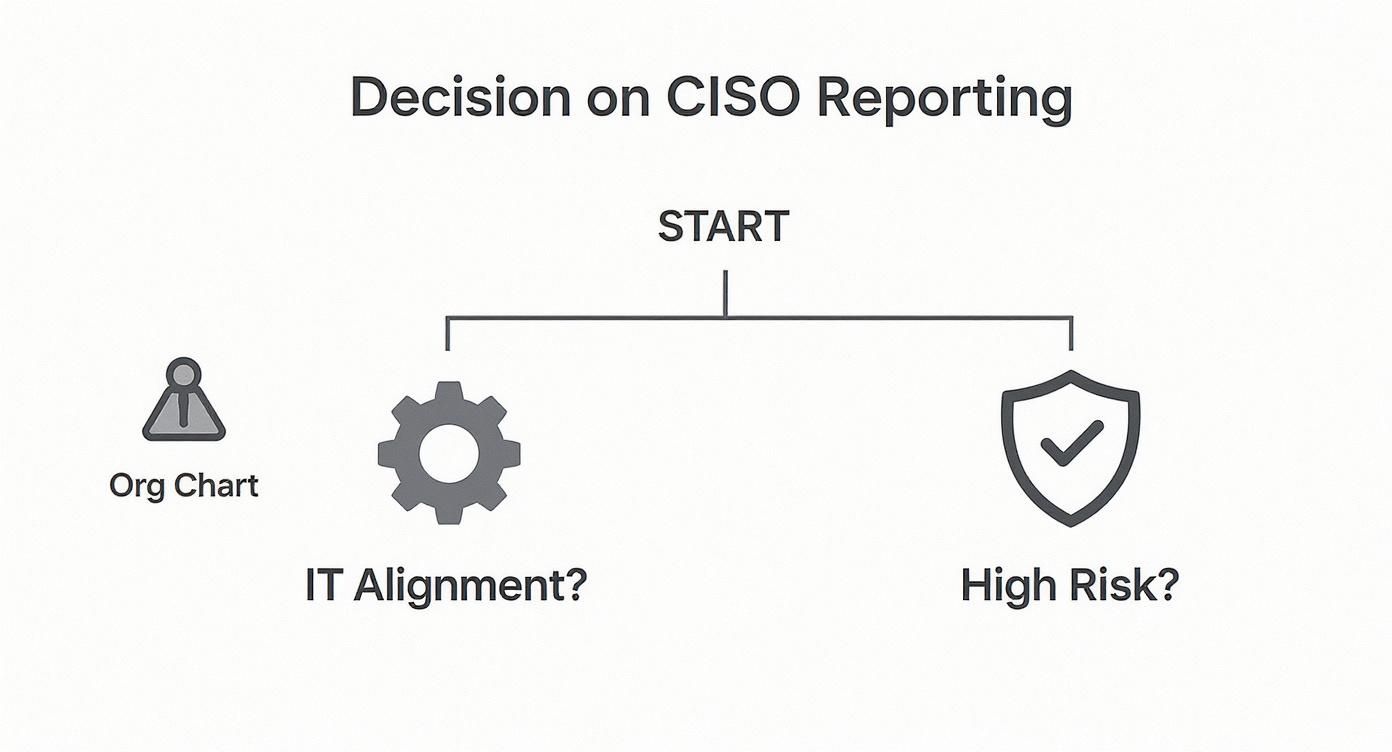
You likely can’t afford both a full-time CIO and CISO right away. So, how do you choose? It’s not about picking the better title. It’s about diagnosing your most urgent business pain: are you battling internal chaos or external risk? One slows you down; the other can take you out entirely.
Step 1: Diagnose Your Primary Pain
Is your biggest problem operational chaos or unacceptable risk?
Hire a CIO first if your primary pain is operational chaos. Your days are filled with inefficiency, manual workarounds, and stalled projects. Conversations sound like this:
- “Our systems don’t talk to each other. Sales and finance are constantly working from different data.”
- “My team wastes hours every week on manual processes that software should handle.”
- “We can’t launch our new service because our tech stack can’t support it. It’s holding the entire business back.”
Your technology is a direct barrier to revenue and scale. You need a CIO to create a clear technology roadmap and build the systems that will let your company grow.
Hire a CISO first if your primary pain is unacceptable risk. The thought of a data breach, a failed audit, or a compliance penalty keeps you up at night. Conversations sound more like this:
- “We’re handling thousands of sensitive customer records, and I have no confidence we’re protecting them properly.”
- “Our biggest client just sent over a massive security questionnaire, and we can’t answer most of their questions.”
- “We’re expanding into a regulated industry and have no idea what compliance looks like.”
Here, the danger isn’t just inefficiency; it’s a catastrophic event. You need a CISO to assess your exposure, build a defensible security program, and ensure your business can stand up to scrutiny.
Step 2: Choose the Right Model (Full-Time vs. Fractional)
For many growing businesses, the truth is you feel both pains at once. The good news? You don’t have to pick one and completely ignore the other. The most capital-efficient solution is often a hybrid model.
A fractional executive gives you access to C-suite-level strategy and experience for a fraction of the cost of a full-time hire. It’s the perfect way to address both your operational and security needs without breaking your budget.
This approach involves hiring a hands-on IT Manager to handle day-to-day operational fires, supported by strategic guidance from a fractional (part-time) CIO or CISO.
This setup lets you build your foundation and your defenses simultaneously. Your IT Manager keeps the lights on, while your fractional CISO develops security policies and your fractional CIO ensures the tech roadmap aligns with your five-year plan.
Step 3: Act with Confidence
Use this framework to have a frank, focused conversation with your leadership team. Get to the root of the problem. Answering that one question—chaos or risk?—cuts through the noise. It gives you the clarity to make the right hire and secure your company’s future.
Understanding the Cost of Leadership
Hiring any executive is a major investment. Both CIO and CISO roles come with hefty price tags, but their compensation packages are built differently, telling you how the business world values their contributions.
A CIO’s compensation is almost always tied to business performance. Did that new ERP system hit its ROI target? Did the cloud migration come in under budget? Their bonus often hinges on tangible wins that improve operations or enable growth.
A CISO’s pay structure has shifted dramatically. It’s now heavily influenced by risk and equity. With cybersecurity on the board’s agenda, CISO compensation has skyrocketed. Equity has become a standard component, a clear signal they’re valued for their long-term role in protecting the company from existential threats.
How the Market Values Security
The market no longer treats the CISO as a niche technical expert. They’re a critical member of the executive risk management team, and you can see this in their paychecks.
Demand for seasoned security leadership is intense. Average CISO compensation is projected to jump by 6.7% in 2025, a rate outpacing security budget increases. This surge is driven more by equity than cash, showing how much faith companies put in a CISO’s long-term strategic value. The numbers can be staggering: the top 1% of CISOs now pull in over $3.2 million annually. This isn’t just an IT role; it’s a premier business leadership position. You can learn more about these CISO compensation findings.
The message is clear: top-tier security leadership is a strategic asset, not just an IT budget line item.
Making the Investment Affordable
For a mid-market company, those numbers are intimidating. A full-time, six-figure CISO salary can feel out of reach.
Don’t mistake the high cost of a full-time CISO as a reason to do nothing. The cost of a breach is always higher. The real question is how to get the right level of expertise for your current stage of growth.
This is why so many companies start with a fractional CISO. It’s a way to build a solid security foundation at a cost that makes sense. This model gives you an experienced executive who can put the core security pillars in place:
- Developing essential security policies that give everyone clear rules to follow.
- Conducting a thorough risk assessment to pinpoint your biggest vulnerabilities.
- Building a compliance roadmap to get you ready for audits like SOC 2 or HIPAA.
By leveraging a part-time CISO, you get the strategic guidance to manage risk effectively without the full-time executive salary. It’s a capital-efficient strategy to protect the business you’ve worked so hard to create.
The Stakes: Success vs. Failure
You’ve seen the tension at the heart of the CISO vs. CIO decision. It’s about diagnosing what your business needs most, right now. But let’s be clear: doing nothing is the most dangerous choice you can make.
Failure: If you continue to operate with underdeveloped IT, your growth will hit a wall of inefficiency. Your teams will get bogged down, your systems won’t scale, and competitors will leave you behind. The cost isn’t just frustration; it’s lost revenue. Ignoring security is an even bigger gamble. You’re one careless click away from a breach that shatters customer trust, triggers massive fines, and permanently tarnishes your brand.
Success: When you make the right leadership choice, technology becomes your greatest strategic asset. Operations run smoothly, freeing your team to innovate. You win bigger deals because you can confidently prove your security posture. You sleep better at night knowing you have a plan to handle both growth and risk. The business doesn’t just survive; it thrives.
The path forward requires a deliberate choice. The risk of inaction far outweighs the cost of making a decisive move.
Frequently Asked Questions
When it comes to the CISO vs. CIO debate, I often hear the same questions from CEOs. Let’s tackle them with straight answers.
Can one person be both CIO and CISO?
Early on, a single person often has to juggle both. But that’s a temporary fix, not a strategy. The roles have a built-in, healthy conflict of interest. The CIO pushes for speed and innovation; the CISO applies the brakes to ensure safety. Keeping the roles separate gives risk management the independent voice it needs.
At what revenue stage should we hire a CISO?
Forget revenue. The right time is dictated by business triggers, not your top line. The need becomes critical when you hit certain milestones:
- You’re handling sensitive data: You’ve started collecting significant amounts of customer PII or patient PHI.
- You’re entering regulated industries: You’re expanding into finance, healthcare, or government contracting where compliance isn’t optional.
- Your customers demand it: Big clients are asking for security audits and certifications like SOC 2 before they’ll sign a contract.
If you’re nodding along to any of these, you probably needed security leadership yesterday.
What is a fractional CIO or CISO?
A fractional executive is a seasoned, part-time leader you bring on for high-level strategy without the full-time price tag. It’s the ideal solution when you need C-suite expertise but don’t have the budget or workload to justify a full-time hire. A fractional CIO can architect your tech stack. A fractional CISO can build your security program from the ground up. It’s the most capital-efficient way to get the strategic oversight you need to grow without stumbling.
Choosing between a CISO and a CIO is a pivotal decision for any growing company. If you’re ready to transform technology from a source of chaos into a true business advantage, CTO Input is here to guide you. We provide the fractional executive leadership to bring clarity, minimize risk, and fuel your growth with confidence.
Schedule a no-pressure discovery call today to build your technology roadmap.