
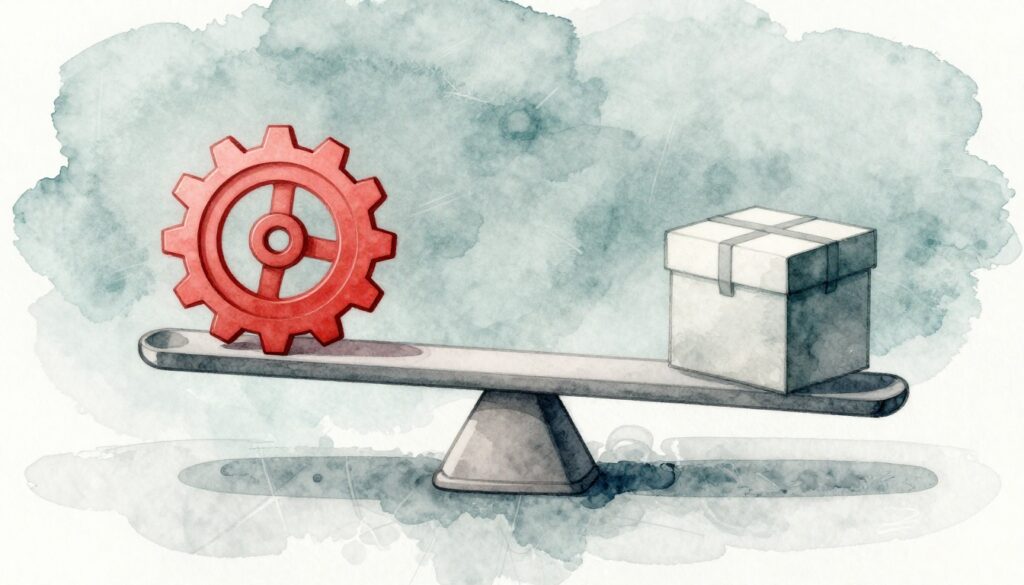
Custom software gets blamed for a lot, and sometimes it deserves it. A bad build can burn money, slow teams down, and add a new mess where there was already enough noise.
But the opposite is true too. When off-the-shelf tools force workarounds, hide data, or box in growth, custom software can be the smarter move. The real question is not whether building sounds impressive. It is whether it gives you better ownership, lower risk, faster execution, and a cost structure you can live with.
If you are deciding whether to build or buy, judge it on the business problem, not the novelty. Ownership, risk, speed, differentiation, and long-term cost are the filters that matter.
Key takeaways: Start with the pain you need to remove. Build only when the software creates clear value that your current tools cannot match. If it adds complexity without changing the business outcome, keep looking.
Start with the real problem you are trying to solve
You should not begin with, “we need custom software.” You should begin with, “what is slowing us down, breaking trust, or forcing bad workarounds?” That usually points to growth strain, manual work, messy data flow, customer friction, compliance pressure, or a process your current tools do not support well.
If the problem is really a process problem, fix the process first. If a better off-the-shelf tool solves it cleanly, take the cheaper path. A custom wrapper over a bad process is still a bad process.

Are you solving a unique workflow or just a messy process?
A messy process looks complicated because it has grown sideways. A unique workflow is different. It sits at the center of how you compete, deliver, or serve customers.
If the only reason you want custom code is that your team never fixed the old process, you are probably buying a new shell around an old problem. Custom software earns its keep when the workflow is part of your business model.
Maybe it is how you onboard customers. Maybe it is how you route work, price service, or manage regulated steps. If the process is central, the software can be too.
Is the software tied to revenue, speed, or customer trust?
That is the cleaner test. If the software shortens cycle time, reduces errors, supports revenue, or protects trust, you can defend it. If it only makes one team happier to use, the case is weaker.
Good custom software supports a measurable outcome. Faster onboarding. Fewer manual handoffs. Cleaner reporting. Better retention. Less risk. If you cannot name the business result in plain language, you are not ready to build.
Compare the full cost of building versus buying
The sticker price is the easiest number to see and the least useful one. You need to think about development, maintenance, security, upgrades, staff time, vendor dependence, and the cost of delay. A custom build can look cheaper at the start, then become the expensive choice because nobody owns the whole thing well.
| Cost factor | Custom software | Off-the-shelf tool |
|---|---|---|
| Upfront spend | Higher build cost | Lower subscription cost |
| Ongoing work | You own fixes, upgrades, support | Vendor owns the core product |
| Fit to your process | Can be exact | Usually generic |
| Hidden cost | Internal ownership, security, docs | Workarounds, manual entry, weak reporting |
| Risk if priorities change | Higher if ownership is fuzzy | Higher if tool shape is wrong |
The table keeps the tradeoffs plain. A lower monthly fee does not mean a lower total cost.
What does ownership really cost over time?
Custom software is not a purchase, it’s a responsibility. Someone has to own product decisions, bug fixes, testing, documentation, support, and steady improvement. If nobody can keep that rhythm for years, the build will drift.
Before you commit, ask who will make tradeoffs after launch. If the answer is “the vendor” or “the developer,” you do not really own the product. You rent the outcome.
When a cheaper tool is actually the more expensive choice
Off-the-shelf tools can be cheap on paper and expensive in practice. You feel it in duplicate data entry, broken reporting, clumsy handoffs, and constant workarounds. Your team spends time translating the tool instead of using it.
A cheaper tool is not cheaper if your team keeps paying for it in labor.
If the software slows the business, the monthly subscription is the smallest part of the bill. The real cost is drag.
Know when custom software becomes the lower-risk option
Custom software is worth serious attention when the business depends on a special workflow, when vendor products create lock-in, or when you need tighter control over data, reporting, or process. That is when the decision stops being “build or buy” and becomes “what gives us the most control with the least pain over time?”
If you need a clearer executive view before you decide, Get an Executive Technology Clarity Check can help you turn the technical mess into a business decision. And if acquisition, leadership change, or diligence is part of the picture, Prepare Technology for Diligence or Transition is the cleaner next step.
When off-the-shelf tools are holding you back
The signs are usually easy to spot. Too many workarounds. Weak integrations. Repeated gaps that nobody can close. Tool sprawl that keeps growing because every new problem gets a new subscription. That is not a software strategy. That is a drawer full of half-fixes.
When the market gives you a bad fit, another app usually makes it worse. You either need a custom build, or you need to take a harder look at your technology strategy.
When control matters more than convenience
Sometimes the point is not convenience. It is control. You may need control over the roadmap, the data, the security model, the user experience, or who gets to make decisions.
That matters most when third-party tools start driving business choices for you. Once a vendor starts shaping your priorities, your process, and your reporting, you have lost more than time. You have lost decision rights. Custom software can reduce that dependency, but only if you can own it well.
Test whether your business is ready to support a custom build
Before you write a check, make sure you can support the thing after launch. Custom software needs a clear owner, a defined use case, enough budget for support, and a realistic timeline. If you cannot answer who owns the product or what success looks like, the project is too risky right now.
A quick readiness check should feel blunt:
- One business owner can name the outcome.
- The use case is narrow enough to launch well.
- Budget covers support after go-live.
- Success is measurable in 90 days.
Do you have a clear business owner, not just a technical request?
Every useful software project needs a business owner who can make tradeoffs and keep priorities steady. Without that person, the project drifts. The code can be solid and the result can still fail.
If the request came from IT, finance, operations, or sales, that is fine. It still needs a business owner who can say what matters most and what can wait. Otherwise, the software becomes everybody’s idea and nobody’s job.
Can you measure success in plain business terms?
You should be able to say what better looks like. Faster onboarding. Fewer errors. Cleaner reporting. Lower operating cost. Less manual work. If you cannot measure the result, you will not know whether the build was worth it.
Good software decisions are not built on hope. They are built on a result you can see.
Use a simple decision filter before you invest
Before you approve a build, ask four questions.
- Is this problem strategic?
- Does the business need control here?
- Will the build pay back in a reasonable time?
- Can your team support it after launch?
If the answer is yes to all four, custom software may be the right call. If you keep getting no or “maybe” answers, the safer move is usually to pause and fix the bigger issue first. If you need a clearer read on what is slowing growth and where the real cost sits, Find What Technology Is Costing Your Growth is a sensible next conversation.
Custom software is not about impressing anyone. It is about solving a problem you cannot solve cleanly any other way.
Conclusion
Custom software is still worth it when the business problem is real, the outcome is measurable, and the control it gives you is worth the ownership it creates. If it improves speed, trust, or risk in a way your current tools cannot match, the case gets stronger fast.
If it only adds complexity, another subscription, or a new pile of maintenance, it is probably not the answer. The clean decision is not about what sounds advanced. It is about what helps you run the business better with less guesswork.
FAQs
When is custom software worth it for a small business?
It is worth it when the workflow is central, the pain repeats, and off-the-shelf tools keep forcing workarounds.
Is off-the-shelf software always cheaper?
No. Lower subscription costs can hide labor, reporting, integration, and ownership costs.
What is the biggest mistake people make?
They start with the build instead of the business problem.