
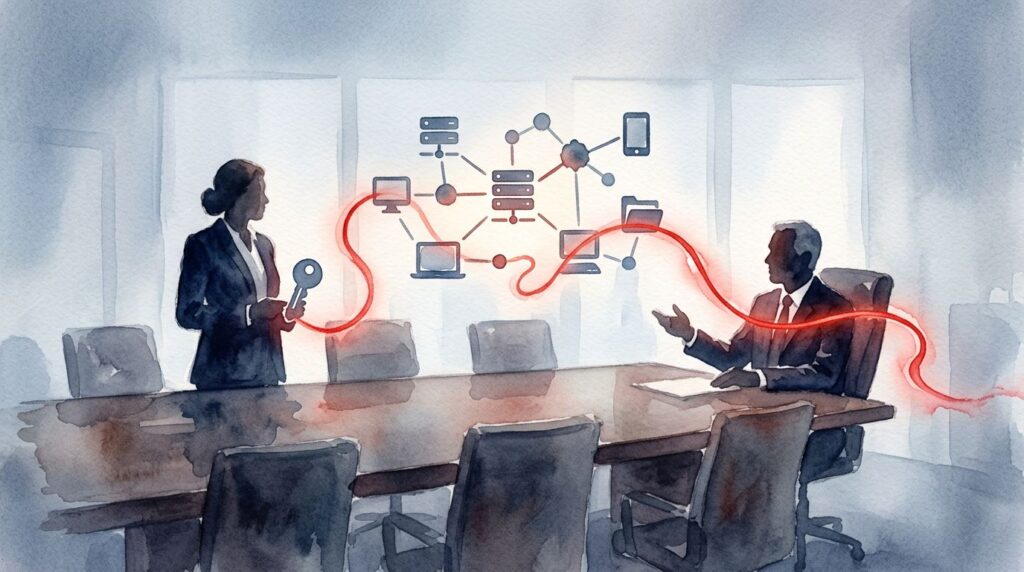
You can learn more from one board question than from a stack of security slides: who owns cyber risk after this meeting?
If the answer sounds foggy, you do not have a reporting issue alone. You have a cybersecurity ownership problem, and it usually means decision rights, escalation, and accountability are still loose.
Boards do not need a fear speech. They need a clean chain of ownership they can trust. That is where the real test starts for the board of directors.
Key takeaways
- If the board cannot name the specific person responsible, the company does not have clear cybersecurity ownership.
- A good answer names one executive, one decision path, and one escalation route.
- Cyber ownership also shows up in your technology leadership, security strategy, board-ready reporting, vendor control, and risk appetite.
- If your answer changes every quarter, the problem is bigger than cyber. It reaches technology strategy and governance, ultimately undermining your ability to meet core business objectives.
The board question that matters
The question is not, “Are we secure?”
That is too broad. It invites comfort answers and vague promises. As companies undergo digital transformation, the complexity of risk management increases, making it harder to identify who is truly accountable. The better question is sharper:
“Who owns cyber risk, what can they decide, and what gets escalated to the board?”
That version cuts through the noise fast. It tells you whether leadership knows which security leaders carry the ball, who has the final authority, and who speaks when things go wrong. It also shows whether cyber risk is being managed as a core business issue or left as an IT problem with a nicer title. The answer should clearly reflect the current security posture of the organization.

If you want a clean benchmark, the UK NCSC’s questions for boards on cyber security is a solid reference point. It pushes the same idea, asking for ownership instead of theater.
If no one can name the owner, no one really owns it.
That is the point boards miss when the conversation stays stuck in patch counts, scan results, and incident totals. Those numbers matter, but they do not answer the fundamental ownership question.
What a clear answer sounds like
A weak answer sounds busy. A clear answer sounds specific.
| Board question | Weak answer | Clear answer |
|---|---|---|
| Who owns cyber risk? | IT, security, and vendors all help | One executive, such as the chief information officer or chief information security officer, owns it, with named support and escalation |
| What happens after this meeting? | We will review it next quarter | The owner has deadlines, thresholds, and follow-up dates |
| How do we govern it? | We have a dashboard | We have board-ready reporting tied to risk appetite and action |
A good answer also connects to defining ownership in cyber risk reporting and assigning ownership to cybersecurity metrics. If your reporting cannot show who owns what and demonstrate a clear return on investment for security spend, it is not board-ready reporting. It is paperwork.
The same goes for the framework for board-ready technology metrics. The board should see the risk, the owner, the due date, and the decision needed. Anything less leaves room for drift.
When titles hide the real gap
A title can make people feel safe when they should not.
You may have a fractional CTO, interim CTO, outsourced CTO, virtual CTO, or part-time CTO in the picture. You may even have a fractional chief information officer, a virtual chief information security officer, or an interim CISO. That still does not mean cyber ownership is clear. Often, this lack of ownership stems from an organizational culture that treats security as a silo rather than a shared responsibility.
The title is not the point. The operating model is.
This is where many companies get stuck in the middle. They have enough technology leadership to keep things moving, but not enough executive technology leadership to make hard calls cleanly. That is the technology leadership gap. It shows up in mid-market technology leadership, growth-stage technology leadership, and scaling technology leadership all the time.
If you are deciding how to hire a CTO, when to hire a fractional CTO, or whether you need a fractional CTO vs full-time CTO, start with ownership. The same is true when comparing a fractional CTO vs IT consultant. If the role does not control decisions, reporting, and escalation, it is not solving the real issue.
That is why a technology leader for growing companies has to do more than run projects. You need someone who can connect CEO technology decisions, COO technology strategy, and founder-led technology decisions to business-aligned technology strategy. Otherwise, your business has activity, not direction.
The operating model behind ownership
Cyber ownership should sit inside a real operating model, not inside memory or habit.
That means you can explain your technology governance for CEOs and your technology governance for boards in plain language. You know who sets priorities, who approves risk, who manages vendors, and who reports up. You have a decision rights map, a technology operating rhythm, and stakeholder alignment. A clear operating rhythm is especially vital for security leaders, as it ensures that regulatory compliance remains a consistent focus rather than a reactive scramble.
You also have a plan that people can read without a decoder ring. That plan may be a one-page technology strategy, an IT strategy and roadmap, a 12-month technology roadmap, or a board-ready tech roadmap. The format matters less than the discipline behind it.
If the board needs a cleaner path, pair the strategy with technology strategy consulting that ties business goals to execution. If the company is under pressure, start with Get an Executive Technology Clarity Check. A short, honest review is better than another quarter of guessing.
A useful test is simple. Can you say, in one minute, who owns:
- the roadmap
- the budget and the total cost of ownership
- the cyber risk appetite
- the board report
- the escalation path
If not, the ownership map is still incomplete.
Risk, vendors, and data tell the same story
Cyber ownership also shows up in the messy places.
Third-party risk management is one of them. So is vendor management, vendor due diligence, vendor offboarding, and the vendor incident response plan. If a vendor can create business risk, but no one owns the relationship end to end, that is not governance. That is drift.
The same pattern shows up in cybersecurity oversight and technology risk oversight. You need a technology risk management framework that includes cyber risk reporting to the board, a clear cyber risk appetite, and a board cybersecurity reporting cadence that leadership can trust. If the board sees the problem late, the ownership model is weak.
The NCSC board guidance and most serious board playbooks point to the same thing. Ask for risk ownership, not activity. Do not confuse high-level ownership with technical tasks like vulnerability remediation or automated remediation, which are execution functions, not strategic accountability.
Ownership also touches business continuity planning, disaster recovery planning, incident response readiness, ransomware readiness, cyber insurance renewal, and the executive incident response checklist. If nobody owns the business continuity plan, the plan will not survive contact with a real event.
It extends into data too. Access control best practices, data governance framework, data ownership, data strategy, data quality, data privacy, and information governance all need named owners. So does your systems inventory and network infrastructure. If you do not know what you have, you cannot own it. Poor oversight often leads to data breaches resulting from weak identity security or mismanaged multi-cloud access.
And yes, the same standard applies to AI governance, AI adoption strategy, AI transformation strategy, responsible AI, AI acceptable use policy, AI vendor due diligence, and AI opportunity assessment. If AI is being used in the business, someone should own the rules and the risk.
For leaders who need a stronger view before the next board meeting, Build a Board-Ready Technology Risk View is the right next conversation.
Why unclear ownership drains money
Unclear ownership costs more than nerves. It creates significant indirect costs, such as plummeting staff productivity and a measurable decline in overall operational efficiency.
It drives technology spend optimization in the wrong direction. It weakens technology ROI and tech spending ROI because money keeps flowing into tools, contractors, and workarounds without a clean business case. It also pushes IT cost optimization and IT cost reduction into reaction mode instead of strategic mode.
That is where tool sprawl, shadow IT, technical debt, and technology debt start stacking up. The stack gets bigger, but the business does not get clearer. You end up with more dashboards and less control. More alerts and less judgment. More meetings and less movement.
It also makes application portfolio rationalization significantly harder because clear asset owners are not identified to manage the lifecycle of these tools. Software platform evaluation gets sloppy, and technology vendor selection becomes political. Technology due diligence and technical due diligence get rushed. In this environment, cybersecurity ownership becomes murky, which is a major risk factor during acquisitions. Consequently, acquisition readiness suffers, along with the results of your cybersecurity due diligence, the acquisition due diligence checklist, the CTO transition plan, and post-merger technology integration.
If you are preparing for diligence or transition, Prepare Technology for Diligence or Transition can help you get the ownership story in order before someone else asks the hard questions.
The real cost is not only waste. It is lost confidence. If your board has to keep asking the same ownership question, it means the business has not fully answered it yet.
A simple technology audit or technology health check often reveals that the issue is not a lack of effort. It is a lack of clarity. A 90-day technology plan is far more useful than another round of guesses.
Conclusion
The best board question is also the simplest one. It tells you whether cybersecurity ownership is real or just assumed.
It is important to remember that this ownership is not about a single person doing all the work. Instead, it is about maintaining shared responsibility under clear leadership. If one executive owns the risk, the board can govern it effectively. If everyone owns it, no one does, and that creates the difference between total control and organizational drift.
When the answer is clear, the rest of your strategic initiatives become easier to manage. Board-ready reporting improves, vendor decisions become cleaner, and risk stops hiding in the gaps. Ultimately, defining who is in charge strengthens the security posture of the entire organization.
FAQs
What board question best reveals cyber ownership?
Ask, “Who owns cyber risk after this meeting, what can they decide, and what gets escalated to us?” If that answer is vague, then cyber ownership is vague.
Does a fractional CTO or fractional CISO change ownership?
It only changes ownership if the role has real authority, clear decision rights, and a defined reporting line. Whether you employ a fractional chief information security officer or a fractional chief information officer, a title alone does not fix broken cyber ownership.
What should the board receive each quarter?
The board should receive a board-ready risk summary that includes the designated owner, the current risk level, the trend, the specific decisions needed, the escalation path, and relevant security awareness training metrics. Reporting on activity alone is not enough to demonstrate true oversight.
How do you know the ownership model is working?
You will stop hearing the same confusion every quarter. Reporting becomes clearer, and organizational decisions move faster. Ultimately, the board will be able to see who owns what without needing a long explanation.