
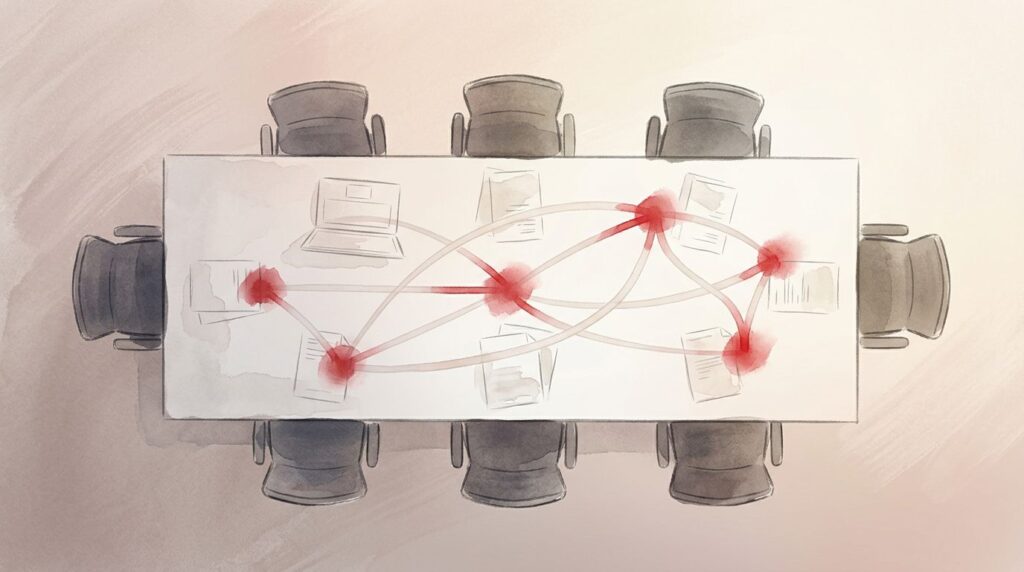
A cyber tabletop exercise is only useful if it changes how you think. If the discussion ends with everyone satisfied that it went well, you probably missed the point.
What you want is not applause for the scenario. You want answers about ownership, timing, recovery, and whether your leadership team can make hard calls without stalling. By focusing on these critical areas, the board can gain a true measure of the organization’s cybersecurity preparedness rather than simply going through the motions. A board that skips those questions is still flying blind.
Key takeaways for boards after a cyber tabletop exercise
- The exercise is a test of decision-making under pressure, not a performance review.
- Ask who on the incident response team owned each call, where delay showed up, and what business impact was most exposed.
- Weak reporting, fuzzy ownership, and vague escalation are governance problems, not just cyber problems.
- Use the session as a primary source for identifying organizational lessons learned to improve future resilience.
What the tabletop is really testing
A tabletop is a simulation that acts as a stress test for your operating model. It reveals whether your incident response plan, business continuity, and cybersecurity oversight hold up when people lose the comfort of a slide deck. By aligning these activities with the NIST Cybersecurity Framework, you ensure that the exercise measures actual resilience rather than just operational habits.
Your board should want to know whether the team knew three things fast: who was in charge, who could make the call, and what the business would do if a key system had to go dark. If those answers were fuzzy, the problem is bigger than the scenario. It is a technology governance problem, and often a technology leadership problem too.
This is not about turning the board into a security team. It is about technology governance for boards. You need to know whether the business can act during a real-world cyber incident, not whether the room sounds confident.
For a board-level benchmark, NACD’s guidance on the board’s role in cyber incident response is a useful reference. You do not need more jargon. You need clearer ownership, better escalation, and a straight answer on who speaks for the business.
This is where technology risk oversight stops being a board buzz phrase and starts becoming real work.

Questions that separate readiness from theater during tabletop exercise scenarios
The board should ask questions that force the team to show its thinking rather than its confidence. These threat scenarios are essential tools for testing organizational readiness against real-world pressure.
- What decision did you make first, and who made it?
- Which step took longer than it should have?
- What did the team wait on that should have been pre-approved?
- Where did you depend on one person, one vendor, or one system?
- What would break first if this were real at 2 a.m.?
- Which part of your response plan still feels untested?
- What business loss showed up first, such as customer access, revenue, payroll, or compliance impact following a ransomware attack or data breach?
- What is still unclear about our cyber risk appetite?
You are looking for patterns. If the same names, systems, or approvals show up every time, you have a fragile structure. If the answers drift into vague talk about coordination and alignment, push harder. You need a decision rights map, not a mood report.
If you want a broader set of board prompts, audit committee cybersecurity oversight questions gives you a sharper lens for the next conversation.
A strong tabletop should leave you with a shorter list of unknowns. If it leaves you with more, that is still useful. It means you now know where the gap lives.
Recovery, vendors, and the first 24 hours
The hard part of a cyber tabletop exercise is not the headline scenario. It is the messy middle. That is where weak recovery planning, vendor dependence, and bad assumptions show up.
Ask what happens to identity, backups, communications, and core services in the first hour as your team works to detect respond and recover from the threat. Ask who can isolate a vendor, cut access, or shift traffic without waiting for a committee. Ask whether your third-party risk management process can actually support vendor offboarding if a supply chain attack makes a supplier part of the problem.
If the answer is “we would figure it out,” you do not have a plan. You have hope.
This is also where business continuity planning and disaster recovery planning stop being static documents and start being proof of effective risk management and incident response guidelines. The board should hear, in plain English, what business functions fail first and what gets restored second. Customer service, payroll, billing, and clinical or operational workflows each carry different risk.
You should also ask what the business can tolerate. That means asking about cyber risk appetite in specific terms. How long can a system stay down? Which data can be exposed briefly without triggering a major crisis? Which vendor failure crosses the line?
Those are not IT trivia questions. They are business questions. They belong in board cybersecurity reporting, not buried in a technical appendix.
Turning the exercise into board-ready reporting
What the board needs after the exercise is a short, honest after action report. Do not look for a heroic story.
Ask management to show you five things in plain English: what was tested, what failed, what decisions were made, what the impact would be in a real event, and what gets fixed by when. This report should stem from a data-driven hot wash session, which marks the difference between board-ready reporting and a stack of notes no one can use.
If the report cannot answer who owns each risk, what changed since the last review, and what action follows, the reporting itself is part of the problem. That is why board-ready risk reporting questions matter. They keep the board focused on ownership and next steps, not theater.
You should also expect a simple technology roadmap. One page is enough if it is honest. It should show the next 90 days, the next 12 months, and the owners attached to each move, while also highlighting key metrics for communication and coordination as well as stakeholder engagement. If the exercise exposed weak ownership or a stalled response program, it may point to a technology leadership gap, not just a cyber gap.
That is where a fractional CTO, virtual CTO, part-time CTO, or outsourced CTO can help. If the problem is broader technology governance, a fractional CIO may fit better. If the real pain is security ownership, a fractional CISO, virtual CISO, or interim CISO may be the right call. The title matters less than whether someone can own the work and speak plainly to the board.
If you need to turn a messy tabletop into a cleaner next step, Build a Board-Ready Technology Risk View is the right move when the exercise exposed too many loose ends.
FAQs boards ask after the exercise
How soon should the board review the results?
The board should review the results within the next board cycle while the details remain fresh. This review should include a summary of the specific injects used during the session, as these provide the necessary context to understand how the team performed. If you wait too long, the follow up turns into a status update rather than effective oversight.
Should the board attend the tabletop?
Not always. The board chair, audit committee chair, or a smaller group may be sufficient. The bigger issue is whether the board receives a clear readout and understands which decisions require their direct oversight.
Who should act as the facilitator for the session?
The facilitator should ideally be an objective third party or a senior leader who is not responsible for the direct execution of the response plan. An independent facilitator ensures that the exercise remains focused on strategic decision making rather than getting lost in technical minutiae.
What common threats should we test?
Your exercises should be grounded in the most relevant risks to your organization. At a minimum, consider testing a sophisticated phishing attack to assess human response, as well as insider threats to evaluate how your internal controls handle unauthorized access or malicious activity.
What if the exercise exposed vendor weakness more than cyber weakness?
Treat that as a governance issue. Third party risk management, vendor management, and contract exit steps matter just as much as the scenario itself. A weak vendor posture can create the same business damage as a direct attack on your own infrastructure.
Conclusion
A cyber tabletop exercise should function as a vital discussion-based activity that leaves you with fewer illusions and better questions. If it fails to do so, a real incident will surely provide the answers for you. To be truly effective, the exercise should test everything from a zero-day exploit to physical security gaps and vulnerability detection failures.
Your job on the board is simple. You need to know who owns the risk, what has changed, what breaks first, and what decisions you are making now. When those answers are clear, technology governance gets stronger, the business remains calmer, and you build the necessary cyber resilience to withstand future threats.