
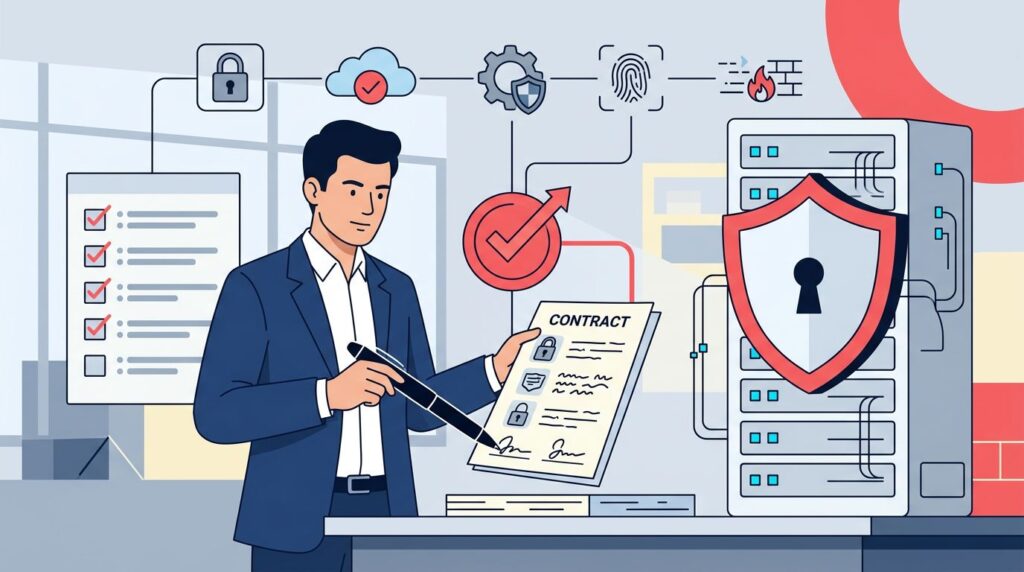
Your signature can turn a broad security promise into a business obligation your team can’t support. Before signing, cybersecurity commitments need clear scope, accountable ownership, measurable controls, and workable terms when something goes wrong.
You may be approving a customer’s security requirements or accepting a vendor’s promise to protect your data. Either way, unclear language leaves you carrying risk you can’t see.
Start with what the commitment requires, who delivers it, and what evidence supports it.
Key Takeaways Before You Sign
- Cybersecurity commitments should define protected systems, required controls, incident deadlines, and remedies.
- A management commitment requires leaders to fund security work, oversee it, and accept its risks, even when vendors operate systems.
- Reimbursement promises can exclude substantial losses and depend on strict reporting deadlines.
- Vendor agreements need recovery duties, audit rights, data portability, and a workable exit.
- Board reporting should show business exposure, accountable owners, and decisions required.
What Cybersecurity Commitments Need to Promise
A commitment can take three forms: a public customer pledge, a contractual obligation, or an internal management commitment. They have different consequences.
A public pledge describes what customers can expect. A contract defines duties and remedies between parties. A management commitment establishes how your organization directs security work.

For each, you need the protected data, systems, accounts, and services named. You also need exclusions, customer responsibilities, reporting triggers, and consequences for failure.
If you’re signing a customer’s security addendum, compare its requirements with your actual operating practices. A promise about every system is dangerous when your systems inventory is incomplete.
A vendor’s certification doesn’t expand the protections in your contract. The agreement still needs to name the duties you’re relying on.
Put Management Accountability Behind the Promise
Define the scope and governing standards
Your management team decides which frameworks guide security work. It also sets the information security management system’s scope and records that decision in the system description.
The management system’s boundaries should reflect how your organization operates. Its scope should identify business units, locations, systems, data, and relevant third parties. Otherwise, a reassuring assessment may cover less than the customer contract requires.
Use a technology risk management framework that fits your operations. Then map requirements to the environments you run. Cloud applications, industrial equipment, and customer-facing platforms need different implementation decisions.
Fund delivery and review results
Leadership must determine the required resources, communicate security’s importance, oversee results, and promote continuous improvement. That includes resolving conflicts between delivery speed, customer requirements, and acceptable risk.
A management commitment includes assigning an executive owner and a delivery lead, with funding, decision rights, and deadlines.
A fractional CTO can connect these duties to your business technology strategy. A fractional CISO leads security-specific work and reports progress to management. Neither arrangement removes your management team’s accountability.
Our guidance on managing technology risk as a CEO keeps that oversight focused on business consequences.
Use CISA’s Baseline Without Overstating Compliance
What CPG 2.0 changes
CISA’s Cross-Sector Cybersecurity Performance Goals are a voluntary subset of practices that help small and medium-sized organizations prioritize essential actions, particularly across critical infrastructure.
CPG 2.0 aligns with the NIST Cybersecurity Framework (CSF) 2.0. Its GOVERN function adds leadership accountability, oversight, governance, and risk management to the baseline.
Compared with version 1.0.1, it removes three duplicative goals based on practical usage and practitioner feedback. The CPG 2.0 Report adds Cost, Impact, and Ease of Implementation ratings for each goal.
Those ratings help you prioritize work. They don’t prove your controls operate effectively.
Turn frameworks into evidence
CISA originally scheduled a CPG 2.0 CSET assessment module for Q1 2026, alongside an updated checklist. CSET 13.0, released October 6, 2026, includes a CPG v2.0 assessment.
For organizations affected by NIS2, the NIS Cooperation Group’s Article 21 reference document maps obligations to ISO/IEC 27001, IEC 62443, NIST CSF 2.0, and CyFun. It organizes NIS2 obligations around governance, technical controls, operational resilience, and incident management.
Organizations covered by NIS2 can use ENISA’s technical implementation guidance for additional implementation detail. ENISA’s NIS2 guidance provides implementation details for covered digital-infrastructure entities.
Framework alignment helps organize evidence within a management system. It doesn’t replace documented implementation, establish legal compliance, or fulfill a customer contract.
Read Reimbursement Terms as Carefully as Security Claims
Which losses are covered?
Raymond James’s cybersecurity commitment reimburses direct losses in covered domestic fee-based or commission-based accounts caused by unauthorized online access to its systems.
It excludes taxes, legal fees, investment losses, and other consequential damages.
That distinction matters when you evaluate any reimbursement pledge. The amount taken from an account and the total business damage are different numbers.
Ask what triggers coverage, which accounts qualify, and whether business interruption, investigation costs, or customer claims are excluded. Don’t treat reimbursement language as protection against every consequence of a breach.
When does the reporting clock start?
Raymond James requires clients to report unauthorized account access no more than 60 days after the firm notified them of the transaction. It reserves the right to deny reimbursement for non-compliance.
The trigger matters as much as the deadline. Notification, discovery, and confirmation are different events.
Your own commitment should make the clock unmistakable. Assign someone to receive notices and escalate them during absences.
Client duties also belong in plain sight. Customers need to understand what actions preserve eligibility, rather than discover those conditions during a reimbursement dispute.
Make Vendor Contracts Work During an Incident
The Mastagni Holstedt case shows why contract detail matters. After a February 2023 Black Basta ransomware attack, the law firm sued managed service provider LanTech, seeking more than $1 million in damages. The claims were allegations, not proof of liability.

Your agreement should define these responsibilities before your operations depend on the provider.
| Contract area | Terms to define |
|---|---|
| Security responsibilities | Required controls, covered systems, customer duties, and subcontractor obligations. |
| Performance and SLAs | Service availability, response times, escalation, and remedies for failure. |
| Incident response | Notification trigger, deadline, initial facts, updates, and cooperation. |
| Audit rights | Independent reports, review rights, findings, and remediation obligations. |
| Liability | Indemnification, liability caps, exclusions, and insurance expectations. |
| Backups and recovery | Backup ownership, protection, retention, restore testing, and recovery targets. |
| Termination and exit | Data ownership, usable exports, transition support, access removal, and deletion evidence. |
For material providers, define the incident response notification trigger and set a deadline of 24 hours after discovery, followed by regular updates. That’s a proposed contractual target, not a universal legal deadline.
An uptime SLA doesn’t prove recovery readiness. Require tests of important backups and evidence that services can be restored.
For AI vendors, state whether your data may train models and what happens to retained data after termination. AI vendor due diligence belongs within third-party risk management.
Our approach to practical vendor security oversight connects contract terms with ongoing accountability.
Test Access Controls and Customer Safeguards
Trusted insiders need controls too. Security staff shouldn’t receive unrestricted access simply because they manage protection.
Apply least privilege to security teams. Separate access administration from monitoring. Monitor privileged accounts, require dual approval for high-risk actions, and retain audit trails that monitored staff can’t modify.
These access control practices reduce dependence on personal trust. They also support investigations when accounts are misused or compromised.
Before onboarding a vendor, complete the security review, define named accounts and access duration, and identify an after-hours incident response contact. Review a SOC 2 report’s scope, period, and exceptions. SOC 2 is an attestation report, not a blanket security certification.
Customer safeguards include multi-factor authentication (MFA) and unique, strong passwords with uppercase and lowercase letters, numbers, and special characters. Use a password manager, install software updates, and avoid suspicious message links.
Cybersecurity Awareness Month, launched in 2004 and led by the National Cybersecurity Alliance and CISA, promotes four steps: store credentials securely, enable MFA, recognize and report scams, and install patches.
Give customers a clear reporting route. Advice to avoid suspicious messages is less useful when nobody knows where to report one.
Give the Board a View It Can Govern
A signed agreement needs an operating rhythm afterward. Review critical vendors annually. Repeat the review after material changes, such as breaches, acquisitions, staffing reductions, or new subcontractors, as part of a third-party risk review.
Maintain a systems inventory and a vendor inventory ranked by business dependence. A payroll provider and a low-risk design tool don’t warrant identical scrutiny.
Your board cybersecurity reporting should identify customer obligations at risk, likely business impact, accountable owners, overdue remediation, and decisions required. Include results from tested backups and incident response readiness. The CISO can prepare the report, while the board retains oversight.
Connect those findings to your cyber risk appetite. When leadership accepts a gap, record the reason, compensating controls, and review date.
Board-level vendor risk reporting should explain operational dependence, rather than repeat service-ticket statistics.
Use a 90-day technology plan for urgent gaps. Put larger improvements into a funded 12-month technology roadmap. That gives leadership a credible delivery sequence.
Security spending then has a business purpose: meeting customer obligations, protecting revenue, or reducing recovery time. It also strengthens cybersecurity due diligence during an acquisition or leadership transition.
FAQs About Cybersecurity Commitments
Does a security framework guarantee protection after a breach?
No framework guarantees that you won’t experience a breach. CPG 2.0 and NIST CSF 2.0 organize security work. Your contract or public pledge defines the protection customers can claim, including coverage, exclusions, deadlines, and remedies.
What if your vendor can’t meet the customer commitment?
You retain the obligation you signed. Resolve the mismatch through stronger vendor terms, internal controls, a different provider, or a narrower customer promise. Put any accepted exception into the approval record, with an owner and remediation deadline.
Who should review the commitment before you sign?
Your business owner, technology or security lead, and legal counsel should review it together. Finance should assess potential exposure, liability caps, and remediation costs. One person needs authority to resolve disagreements before the document reaches your signature.
Make the Signature a Leadership Decision
A defensible commitment connects the promise to evidence, ownership, and recovery. Your signature should follow that connection, rather than substitute for it.
Bring legal, operations, and technology leadership together around the obligations you can’t yet support. Decide which gaps need action before signing and which risks require explicit acceptance.
If that picture is still scattered, Get an Executive Technology Clarity Check. We help you identify sharper priorities, clearer ownership, and a practical next step.