
You have the certificate on the wall. That SOC 2 or ISO 27001 report, the result of months of effort and a significant investment, is filed away. Your team assures you you’re “compliant.”
So why doesn’t it feel like you’re actually protected?
This is a feeling many business leaders know well. You get a report packed with technical jargon that provides some assurance but no real peace of mind. A nagging thought lingers: if we got hit by a real breach tomorrow, would that certificate be a shield or just an expensive piece of paper?
This is the central problem for growing companies. You’re told compliance is non-negotiable for winning bigger deals and protecting the business, but the process feels like an expensive, time-consuming distraction from what you’d rather be doing: growing the company.
Is Your Compliance Program Just an Expensive Alibi?
The heart of the problem is the dangerous gap between passing an audit and building a truly resilient business. An audit is a snapshot in time—a test you study for. Real security, on the other hand, is a constant state of readiness woven into your company’s daily operations and culture.

Too many businesses treat compliance as a finish line. The moment the report is delivered, they slide back into old habits, reopening the very vulnerabilities the audit was meant to close. This creates a false sense of security that is far more dangerous than having no compliance program at all. It becomes an expensive alibi, not a real defense.
A compliance certificate proves you had the right answers on test day. A strong security posture proves you can handle a real-world crisis any day of the week.
Shifting Compliance from a Cost Center to a Growth Engine
Viewing compliance as just another IT expense is a fundamental error in judgment. It’s time to change the conversation. Effective cybersecurity compliance services aren’t about ticking boxes; they are a strategic investment in trust, reputation, and the long-term value of your company.
When you approach it correctly, compliance becomes a powerful business enabler. It’s the key that unlocks doors to opportunities that were previously closed:
- Winning Enterprise Deals: Major customers won’t even talk to vendors who can’t show proof of compliance like SOC 2 or ISO 27001.
- Building Customer Trust: Demonstrating you’re serious about protecting data becomes a major competitive advantage.
- Increasing Company Valuation: A mature security and compliance program reduces risk, making your business far more appealing to investors and potential acquirers.
This guide is built to help you move beyond the checklist. We’ll translate the technical minutiae of compliance into clear business outcomes, showing you how to turn a painful cost center into a strategic asset that actually drives growth.
What Do You Actually Get with Cybersecurity Compliance Services?
When you hear “cybersecurity compliance services,” it’s easy to imagine a mountain of paperwork or some complex, faceless software. Let’s cut through the jargon. You aren’t just buying another tool; you’re bringing in an expert guide to help you navigate a set of non-negotiable business rules.
Think of it this way: you’d never build a new office without an architect who understands local building codes. They don’t just give you a blueprint; they make sure every wire, pipe, and beam is up to standard. This prevents fines, expensive rework, or a structural failure that puts your operation on hold. A compliance partner does the same thing for your digital infrastructure.
The Core Deliverables You Should Expect
Solid cybersecurity compliance services go beyond a simple check-the-box audit. They deliver a structured, defensible program built on four key pillars.
- A True Risk Assessment: This isn’t just a vulnerability scan. A good partner starts by digging into your business model, customer contracts, and growth plans to figure out which regulations actually matter to you. They pinpoint where your most valuable data is and map out the specific financial and reputational damage a breach would cause. The output is a clear, prioritized list of what to fix first.
- Practical, Usable Policies: Your team gets clear, easy-to-follow rules of the road. This means straightforward policies for everything from who can access sensitive data to what to do if a breach happens. These are practical playbooks written for your team, not dense legal documents for your lawyers.
- Hands-On Security Implementation: This is where the plan becomes reality. Your compliance partner works alongside your team to put the right protections in place. That might involve reconfiguring systems, rolling out multi-factor authentication, or ensuring customer data is properly encrypted—all prioritized by the risks identified in step one.
- Ongoing Monitoring and Reporting: Compliance isn’t a one-and-done project. Your partner sets up a rhythm of continuous checks to ensure security controls are working as intended. They deliver clear, business-focused reports for board meetings or client questionnaires, giving you tangible proof that your defenses are active. Our guide on IT compliance services digs deeper into building this kind of sustainable oversight.
Making Sense of the Alphabet Soup of Regulations
The compliance world is swimming in acronyms, but behind each one is a real-world business risk. The key is to understand the “why” behind them.
For a growing business, compliance is no longer an optional extra; it’s a core requirement for earning and keeping trust. The question isn’t whether to comply, but how to do it in a way that supports your strategy instead of slowing it down.
This isn’t just for giant corporations. With 144 countries now enforcing data protection laws, it’s a global standard. In fact, 52% of organizations list compliance as a top-three priority, and almost 70% of service providers juggle six or more frameworks to keep customers happy. You can learn more about how compliance became a key business driver on brightdefense.com.
Here’s what a few of the big ones mean in practical terms:
- HIPAA (Health Insurance Portability and Accountability Act): If your business touches patient health information, this is non-negotiable. A violation leads to crippling fines and destroys your reputation in the healthcare market.
- PCI DSS (Payment Card Industry Data Security Standard): Anyone who processes credit card payments must follow these rules. A breach could bring massive penalties and get your ability to accept payments shut down.
- GDPR (General Data Protection Regulation): If you have even one customer in the European Union, this applies. The fines are notoriously steep—up to 4% of global revenue—making it a serious risk that gets board-level attention.
Choosing Your Compliance Partner: The Three Models
Once you decide you need help, you’ll find that not all cybersecurity compliance services are created equal. Picking the right partner is less about fancy software and more about finding the right operational fit. It’s a decision that directly impacts your budget, your team’s workload, and whether you actually get the results you’re paying for.
Think of it like hiring a general contractor for a home renovation. You could go with a massive, brand-name firm, a smaller boutique builder, or try to manage subcontractors yourself with a project management app. Each path has trade-offs in cost, your time commitment, and the expertise you get.
Understanding Your Options
For a mid-market company, the options usually boil down to three models. Each approaches the compliance problem from a different angle, and the “best” choice depends on your internal resources, growth stage, and risk appetite. There’s no single right answer, only what’s right for you now.
- The Large Consulting Firm: These are the big, household names. They bring brand recognition that can look great to your board or investors, but that prestige comes at a premium price.
- The Technology-Driven Platform: These are often software-as-a-service (SaaS) tools, sometimes bundled with access to a virtual CISO (vCISO). Their promise is an efficient, automated path to compliance at an attractive price point.
- The Fractional Advisory Partner: This model gives you a dedicated, senior-level expert who becomes part of your leadership team on a part-time basis. The focus is on strategic guidance and hands-on execution support shaped around your specific business.
This infographic shows how the core pieces of compliance—risk, policy, and controls—work together to form a protective shield.
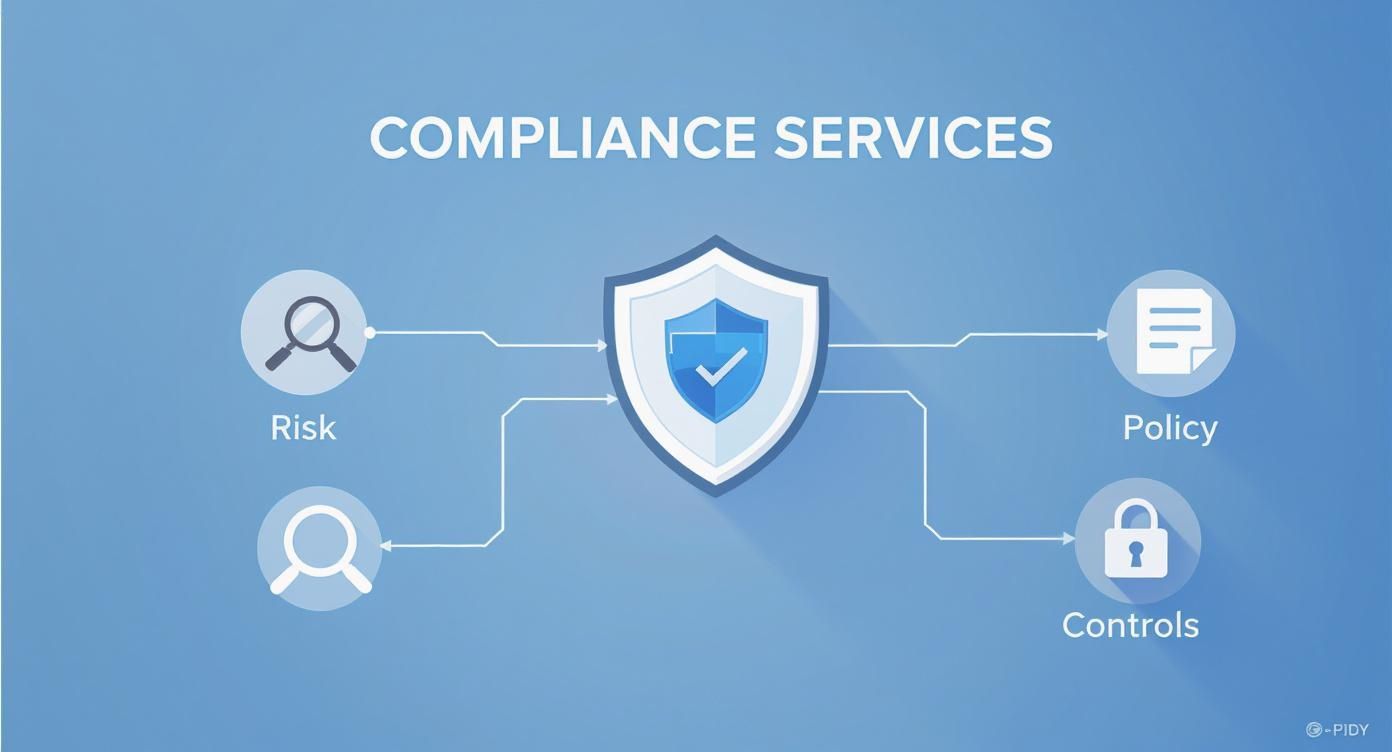
The key takeaway is how interconnected these elements are. A weak policy, for instance, directly undermines your security controls and your entire risk management effort.
A Plain-English Comparison of Compliance Service Models
To make a smart decision, you need to lay out the trade-offs in business terms. The right choice aligns with your company’s culture, budget, and the amount of work your internal team can realistically take on.
| Model | Best For | Typical Cost | Key Trade-Off |
|---|---|---|---|
| Large Consulting Firm | Fortune 500s or companies needing a big brand name for an IPO or major acquisition. | $300k – $1M+ | Cost vs. Experience: You pay top dollar but often get junior analysts doing the day-to-day work. The strategy is often disconnected from your operational reality. |
| Technology Platform | Companies with a strong internal IT team that just needs a framework and automation. | $25k – $75k annually | Price vs. Effort: The low cost is tempting, but it demands significant internal time to manage the software and implement its findings. It’s a tool, not a solution. |
| Fractional Advisory Partner | Growth-focused firms needing senior expertise without the full-time executive salary. | $60k – $180k annually | Expertise vs. Bandwidth: You get C-level strategic guidance, but they aren’t a full-time employee. Ideal for strategy, oversight, and guiding your team. |
A decision that feels right on paper can be a disaster if it doesn’t match how your team actually operates.
Making the Right Business Decision
The biggest mistake you can make is choosing based on price alone. A cheap software platform that your team is too busy to implement is wasted money. On the other hand, a giant consulting firm might deliver a perfect plan that is too complex and expensive for your company to maintain.
The goal isn’t just to buy a compliance report; it’s to build a sustainable compliance program. That requires a partner who understands your business reality, not just an audit checklist.
The fractional partner model was designed for the mid-market leader who needs serious strategic direction but must run a lean team. It bridges the gap between a pure software approach and an overpriced consulting project. This is exactly how a Fractional CISO can turn cyber risk into a strategic advantage, giving you board-level guidance that connects security efforts directly to business goals.
Your choice of partner dictates how compliance gets woven into your company. Will it be an outside project run by consultants, an internal chore managed by a tool, or a strategic function guided by a seasoned leader? The answer determines whether compliance becomes a frustrating cost center or a genuine asset that helps you win.
A Simple 3-Step Plan for Real Compliance
Getting compliance right feels complex, but the strategy behind it can be surprisingly straightforward. This isn’t a technical checklist for your IT team; it’s a simple, 3-step framework you can steer from the leadership table. It’s how you turn the chaotic scramble for compliance into a predictable, well-oiled business function.
This is how you stop just checking a box and start building a genuinely resilient company.

Step 1: Map Your Risk Landscape
Before you spend a dollar on a tool or an audit, you have to get brutally honest about one question: which rules actually matter to our business, and why? I’ve seen countless companies waste staggering amounts of time and money chasing compliance frameworks their customers don’t care about or that do nothing to address their biggest threats.
A proper risk mapping process ties every ounce of compliance effort back to a specific business outcome.
- Pinpoint Your Data: Where does your most sensitive customer, financial, or intellectual property live? Who has access to it, and who shouldn’t?
- Dissect Your Contracts: What specific security and compliance requirements are your largest customers demanding? A single missed clause can stall a seven-figure deal.
- Scout Your Market: Are you planning to expand into Europe, triggering GDPR? Or the healthcare space, which means HIPAA is on the horizon? Compliance should pave the way for your growth strategy, not trip you up later.
The goal here is laser focus. Instead of trying to boil the ocean, you’re zeroing in on the 2-3 compliance goals that will directly protect revenue and open up new opportunities.
Step 2: Build Your Compliance Foundation
Once you know what matters, the next step is to build foundational policies and controls. This isn’t about rushing to buy expensive software. It’s about establishing clear, practical rules for how your company operates safely and consistently.
Think of it as creating the operational playbook that turns your high-level goals into day-to-day reality. This is where a partner specializing in cybersecurity compliance services provides enormous value—they translate dense regulations into simple, actionable steps.
Your policies are the promises you make to your customers about protecting their data. Your security controls are the proof that you keep those promises.
For instance, a mid-market SaaS company gunning for SOC 2 to land enterprise clients would focus on a foundation that includes:
- Access Control Policy: A straightforward document defining who gets access to production servers and customer data—and, just as importantly, who doesn’t.
- Incident Response Plan: A clear, step-by-step guide for what the team must do when a security incident occurs, so no one is improvising during a crisis.
- Vendor Management Process: A formal process to vet the security of your key software vendors, ensuring their weaknesses don’t become your next breach.
Step 3: Implement Continuous Oversight
This final step is the most critical. It’s about shifting from the frantic, one-time audit mindset to a state of continuous readiness. An audit is a snapshot in time, but your risk is constant. Continuous oversight means you are always prepared—for the next audit, the next big customer questionnaire, or an unexpected security event.
This doesn’t mean non-stop meetings or burying your team in reports. It means building a simple rhythm of checks and balances that ensures your foundation remains strong. This operational cadence makes compliance a predictable, low-drama part of doing business.
Getting this right is becoming more urgent. The global cybersecurity consulting services market was valued at USD 21.8 billion in 2025 and is projected to skyrocket to USD 119.1 billion by 2034, driven by these regulatory pressures. You can see the research driving this growth on dimensionmarketresearch.com. Investing in a sustainable program now puts you way ahead of the curve.
Following this process transforms compliance from a painful event into a powerful strategic asset—a proven system that builds trust, speeds up sales cycles, and makes your company fundamentally more valuable.
The Stakes: Two Futures for Your Business
Choosing how to approach cybersecurity compliance services isn’t a technology decision. It’s a strategic choice between two very different futures for your business. One path is paved with predictable growth and trust. The other is a high-stakes gamble with your reputation and your revenue.
Inaction feels easier in the short term. You save budget, and your team sidesteps another project. But this path is riddled with hidden landmines that go off at the worst moments—a huge enterprise deal stalls during security due diligence, a surprise audit uncovers expensive gaps, or a preventable breach shatters years of customer trust overnight.

What Failure and Success Look Like
Imagine two companies chasing the same massive contract. The first treats compliance like a chore. When the prospect’s security team sends their questionnaire, the sales cycle screeches to a halt. It takes weeks for their team to scramble, find the right answers, and pull together documentation. By then, the prospect’s confidence has evaporated, and the deal is lost to a more prepared competitor. This is the “failure” scenario: lost deals, reactive panic, and a constant feeling of being behind.
Now, picture the “success” scenario. The second company invested in a strategic compliance program months ago. When they get that same questionnaire, they respond in 24 hours with a comprehensive SOC 2 report and organized documentation. They don’t just win the deal; they win it faster and build a foundation of trust that leads to future business. This is the real-world ROI of compliance: it becomes a sales accelerator.
Success isn’t the certificate you hang on the wall. It’s the ability to confidently enter new markets, win larger contracts, and command a higher valuation because your business is fundamentally trustworthy.
A Real-World Example of Compliance as a Growth Engine
We saw this happen with a mid-market SaaS firm that was consistently losing out to larger players. Their product was fantastic, but they kept getting stonewalled at the security review stage. They were stuck.
We partnered with them to achieve SOC 2 compliance, but our goal was bigger than just passing an audit. We helped them build the internal processes and documentation that screamed “mature security posture.” The result? Within six months of getting their certification, they landed a major partnership that was previously impossible, adding over $2M in annual recurring revenue. You can get a better sense of the investment needed for such outcomes in our guide on understanding SOC 2 certification costs.
On the flip side, the penalties for neglect are severe.
- Lost Deals: Your sales team keeps hitting the same wall. Larger customers simply won’t partner with a vendor that can’t prove its security.
- Crippling Fines: A single GDPR or HIPAA violation can trigger fines that wipe out an entire year’s profit.
- Reputation Damage: A public breach destroys the trust you’ve spent years building. The financial cost of cleanup is often a drop in the bucket compared to the long-term revenue lost from customers who leave and never return.
With an estimated 3.5 million unfilled cybersecurity roles globally, trying to manage this in-house is a losing battle. This talent gap is why the cybersecurity services market is projected to soar past USD 500 billion by 2030. You can discover more insights about these market trends on globenewswire.com. Investing in a compliance partner isn’t just buying expertise; it’s buying a more secure and profitable future.
Your Next Step: From Confusion to Clarity
Navigating compliance can feel like a frustrating, endless cycle. You’ve seen how easy it is to treat it like a reactive, box-ticking chore instead of a strategic advantage.
But you’ve also seen the difference between a company that squeaks by an audit and one that builds a truly resilient operation.
The main takeaway is simple but powerful: cybersecurity compliance is not an IT problem to be solved. It’s a fundamental business strategy. When you get it right, you build a more valuable company—the kind that enterprise customers want to partner with and investors are eager to back. It’s the framework that lets you move faster, with less risk, and with more confidence.
This shift turns a grudging expense into a proactive investment in your company’s future. It transforms a source of anxiety into a tool that can accelerate your sales cycle and strengthen your brand. You stop asking, “What’s the bare minimum we have to do?” and start asking, “How can we use this to win?”
The ultimate goal isn’t just to be compliant; it’s to be trusted. In today’s market, trust is the most valuable currency you have.
This guide gave you a map for turning that idea into reality. The next move is to take the first step. Reading about a plan is one thing; putting it into motion is another. The gap between knowing what to do and doing it is where most companies get stuck.
That’s why the single most effective next step is a focused conversation with an expert who has guided businesses just like yours through this process. You don’t need another sales pitch. You need clarity. You need a straightforward discussion that connects your business goals—like landing that next big contract—to a practical compliance roadmap.
If you’re ready to stop worrying about compliance and start using it as a tool for growth, we should talk.
Schedule your complimentary Compliance Clarity Call with CTO Input today.
Frequently Asked Questions
Even with a solid plan, it’s natural to have a few final questions. Here are straight-to-the-point answers to what we hear most often about bringing in cybersecurity compliance services.
How Much Should We Budget for Cybersecurity Compliance Services?
This comes down to your industry, size, and specific goals—getting ready for a HIPAA audit is a completely different project than a SOC 2 certification.
For a typical mid-market company, a readiness project to build the initial compliance foundation usually lands between $30,000 and $100,000+. Ongoing advisory and monitoring support is often in the $5,000 to $20,000 per month range.
The key is to think of this as an investment, not a cost. It unlocks big enterprise contracts and helps you sidestep fines that could easily wipe out your budget. A good partner won’t just hand you a bill; they’ll give you a phased plan that respects your cash flow and tackles the most important wins first.
Can My Internal IT Team Handle Compliance?
Your IT team is crucial for implementing technical controls, but they are almost never compliance specialists. That’s a different skill set. True compliance work demands a deep and constantly updated understanding of legal frameworks, formal risk assessments, and the audit process.
Relying only on your internal IT team for compliance creates serious blind spots. More importantly, it often won’t satisfy auditors or major clients who are looking for objective, third-party validation. A compliance service brings that specialized, unbiased expertise to the table.
What Is the Difference Between Being Secure and Being Compliant?
This is a critical question. Think of it this way: compliance is the minimum standard you’re required to meet, like a building code. Security is how well your business can actually withstand a real-world threat, like a fire or a hurricane.
You can be compliant by checking boxes, but that doesn’t mean you’re actually secure. The flip side is that a genuinely strong security program makes achieving and maintaining compliance certifications much easier and more meaningful. The goal isn’t to choose one or the other; it’s to build a truly secure organization where meeting compliance obligations becomes a natural byproduct of being well-protected.
At CTO Input, our job is to cut through the noise of cybersecurity compliance and give you a clear, strategic path forward. We focus on building a resilient business that earns customer trust and helps you close bigger deals, faster.
If you’re ready to turn compliance from a headache into a real competitive edge, let’s have a simple conversation.