

You are not crazy if cybersecurity feels noisy, technical, and hard to pin down. Most growth-minded CEOs, COOs, and founders know it matters, yet feel a step behind the questions from boards, lenders, and large customers.
The good news is that you do not need to become a security engineer. You need a clear story, a few sharp questions, and some non‑negotiable habits.
In 2025, attacks on small and mid-size businesses are constant and expensive. One 2025 study found that small firms are hit so often that incidents now occur roughly every 11 seconds, with average losses around $120,000 per breach, according to recent small business cyberattack statistics.
This guide, Cybersecurity for Non-Technical Leaders. Plain-English steps to protect your business, gives you simple language and concrete actions so you can protect revenue, answer hard questions, and lead with confidence.
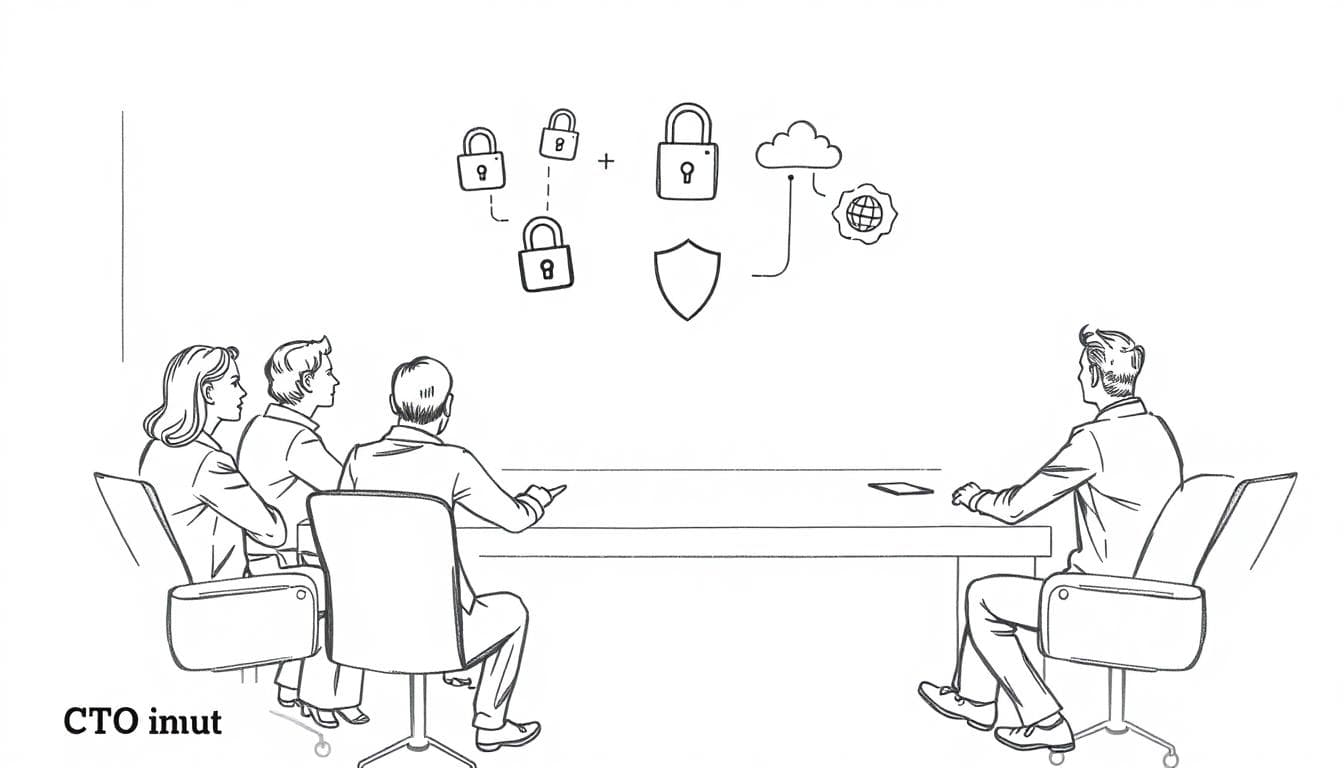
Minimalist illustration of business leaders reviewing cybersecurity risks and protections around a table. Image created with AI.
Why Cybersecurity Matters For Non-Technical Leaders In 2025
Cybersecurity is no longer “the IT team’s problem.” It is a revenue, trust, and survival problem.
If systems go down, you cannot ship, bill, or support customers. If customer data leaks, you do not just pay for cleanup, you risk losing key accounts and new deals. If you stumble in a due diligence call, a lender or partner may slow or block the transaction.
Recent research on small business cyber risk shows that many owners fear a serious attack could end their company, and a large share say they could not keep operating after a major ransomware hit, as summarized in these 2025 small business cybersecurity statistics. That is not an IT issue. That is a strategy issue.
Boards and investors now ask direct questions about cyber risk. Large customers expect to see controls, policies, and a clear incident plan. If you cannot answer in plain English, someone else will shape the story for you, often with a bias toward fear and extra spend.
Treating security as a core part of the growth plan gives you something different: cleaner operations, more reliable systems, and a story that builds trust instead of panic.
The hard reality: small and mid-size companies are prime targets
Attackers like companies your size. You hold valuable data, but you usually do not have a full-time CISO or an in‑house security team.
Phishing emails, fake login pages, and password theft are the front door. These are low-tech tricks that prey on busy people. Public reports show that phishing is one of the top causes of breaches for small firms, and that most incidents start with a human mistake rather than a technical flaw, as highlighted in several 2025 SMB threat summaries.
Ransomware is the “business outage” version of this problem. An employee clicks the wrong link on Monday. By Tuesday morning, your key systems are locked, and someone is demanding payment in crypto.
What is actually at risk: cash flow, customers, and your reputation
Think about risk in business terms, not in acronyms.
- Your billing system is locked for a week after ransomware. Cash collection slows, you miss payroll, and your team scrambles with spreadsheets.
- A major customer asks for your security controls. Your team cannot answer clearly. The deal stalls, or they insert harsh terms that move liability to you.
- A vendor breach exposes your customer list. You spend weeks explaining what happened, juggling legal advice, and trying to calm key accounts.
Studies of cyber incidents show that a large portion of small companies that suffer a major attack shut down within six months, as reported in must-know small business cybersecurity data. For most leaders, the deeper fear is not headlines, it is losing the company they spent years building.
If you connect security to cash flow, contract value, and brand trust, the decisions about time and budget become much clearer.
Talk About Cybersecurity In Plain English With Your Team

Photo by Antoni Shkraba Studio
You do not need the jargon to lead a strong conversation. You need a shared picture.
When you switch the language from “zero trust” and “EDR” to doors, keys, and backup copies, people across the business start to pull in the same direction.
Use simple analogies instead of jargon
Try these analogies in your next leadership or board meeting:
- Passwords and multi-factor authentication: Think of this as a front door key plus an ID badge. A password alone is a simple key. Adding a code on your phone is like asking someone to show a badge as well.
- Backups: Backups are your fireproof safe. If the office burns down, you still have copies of your most important documents somewhere else.
- Patching and updates: This is car maintenance. You change the oil and check the brakes to avoid a breakdown on the highway.
- Least-privilege access: Only give keys to the rooms people actually need for their job. No one gets a master key “just in case.”
When your IT team explains a control, ask them which analogy fits. It forces clarity and makes it easier to bring operations, finance, and technology into the same conversation.
Five plain-English questions to ask your IT or vendor
You do not have to guess what to ask. Start with these:
- “What are the top three ways someone could stop us from serving customers, and what are we doing about each one?”
Listen for clear scenarios (email outage, payment system down, warehouse system locked) and specific actions, not tool names. - “If ransomware hit tonight, how would we recover and how long would it take?”
Ask for hours or days, not vague “as fast as possible” answers. Follow up with, “When was the last time we tested that?” - “How do we train people to spot fake emails and scams?”
Look for short, regular training, simple examples, and a way to report suspicious messages easily. - “Which systems and vendors hold our most sensitive data, and how do we know they are secure?”
You want a list, not a shrug. Ask how often they review vendor risk and what proof they collect. - “What are the three most important cyber tasks we must never skip?”
Typical answers include backups, system updates, and user access reviews. Ask how you can help make these non‑negotiable.
If answers are full of acronyms, respond with, “Can you say that in business terms?” That is not a sign of weakness. It is leadership.
Set clear roles so security is not “that IT thing”
Security works when roles are clear.
- You and your leadership team own the risk and priorities. You decide what matters most to protect.
- Managers own processes. They build checklists and habits into daily work.
- IT staff or vendors own the tools. They run systems, monitor alerts, and implement controls.
- Every employee owns daily behavior. They use strong passwords, pause before clicking, and report issues.
If you do not have in‑house expertise, appoint one accountable owner, even fractional, to coordinate efforts and report to you in simple language. That may be a trusted advisor like a fractional CISO or CTO who can connect security actions to your growth and cost plans.
Create a one-page cybersecurity story for your board and partners
Your goal is a single page that a smart non‑technical person can read in two minutes and understand.
Structure it like this:
- Biggest business risks in plain English. For example, “Cannot bill customers for a week” or “Key customer cancels due to data breach.”
- Key protections in place. Backups, multi-factor authentication, employee training, vendor checks.
- Recent improvements and near-term priorities. What changed in the last quarter, and what you will change in the next two.
- Support or budget needed. Simple asks tied to outcomes, not tools.
This same one-pager works for board decks, lender reviews, and large-customer security questionnaires. It turns a stressful Q&A into a confident story.
Plain-English Steps To Protect Your Business Today
You do not need a 200-page program to make real progress in 30 to 90 days. Focus on a few basics you can verify.
Start with the basics: passwords, MFA, and backups
Three items give you a lot of risk reduction:
- Strong, unique passwords managed by a password manager. Ask, “Do all staff use a password manager for work accounts?”
- Multi-factor authentication (MFA) on email, banking, payroll, CRM, and any system with sensitive data. Ask, “Which important systems still do not have MFA turned on?”
- Automatic, tested backups for core systems and shared files. Ask, “If we lost our main system, what is the recovery point and recovery time?”
Have your team show you, not just tell you. A short screen-share to prove MFA and backup status is worth more than another policy document.
Train people to spot scams and make it safe to speak up
Most attacks still start with someone rushing through email.
Set a simple standard:
- Short, plain-language training for everyone at least once a quarter.
- Clear rules of thumb, such as “Pause before clicking,” “Verify any money or data request with a call,” and “If it feels odd, report it.”
- A “no blame” culture. When someone reports a mistake early, they are helping protect the business.
Studies of small business incidents show that human error drives most breaches, and that phishing is a leading attack type, as seen in several mid‑year reports on rising small business cyberattacks. You reduce that risk by making people feel supported, not ashamed.
Check your vendors and write down a simple incident plan
You are only as strong as the partners who hold your data.
Ask your team for a list of vendors that:
- Store customer or payment data
- Connect directly into your systems
- Run critical operations, like logistics or billing
For each, ask for plain-proof of basic protections. That might include their security summary, independent audits, or clear statements about backups and incident response.
Then create a short, written incident plan in normal language:
- Who do we call first if we suspect an attack?
- Who can decide to shut systems down?
- How will we communicate with staff, customers, and partners?
- When will we review and test this plan?
You want a calm checklist you can grab on a bad day, not a binder no one reads.
Conclusion: You Can Lead Security Without Being “The Tech Person”
You do not need deep technical skills to lead on cybersecurity for your business. You need clear language, a few sharp questions, and a simple set of non‑negotiable steps.
Cybersecurity for Non-Technical Leaders. Plain-English steps to protect your business is really about protecting customers, cash flow, and reputation. When you shift the focus from tools to outcomes, you get faster decisions, better vendor conversations, and a story that holds up under board and partner scrutiny.
If you want seasoned, neutral guidance on where to focus next, visit https://www.ctoinput.com to see how fractional technology and security leaders can sit on your side of the table. For more practical, plain-English articles like this one, explore the CTO Input blog at https://blog.ctoinput.com.