
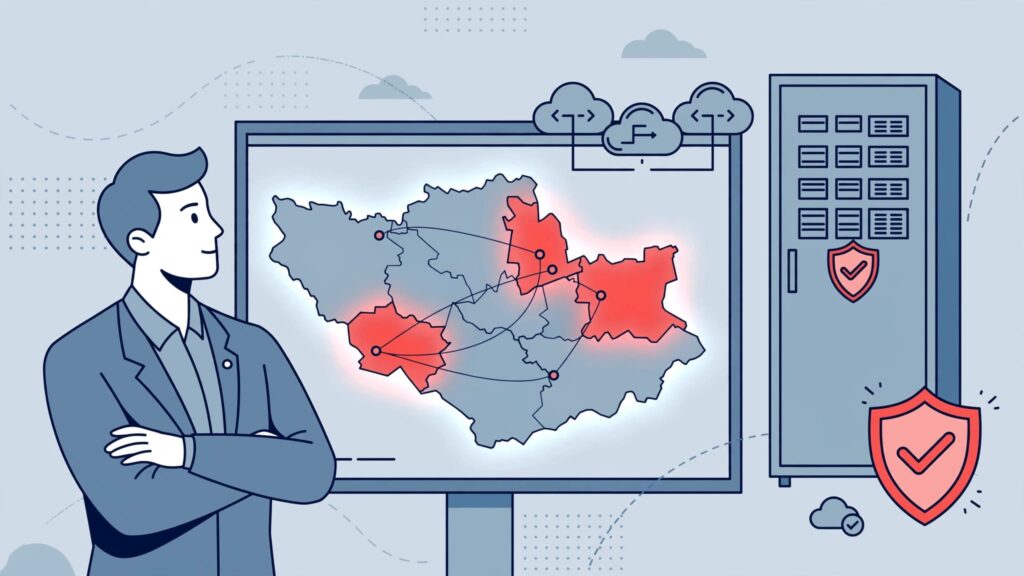
You should assess data residency requests as business commitments with legal, operating, and financial consequences. Before you promise a location, establish what must stay there, why the customer requires it, and whether you can prove the boundary holds.
An enterprise deal can make a regional hosting request feel urgent. The expensive mistake is accepting language your systems and vendors can’t support.
Start with the scope of the promise, then decide whether the opportunity supports the obligation.
Data Residency Key Takeaways
- Separate legal requirements from customer policy and procurement preferences. Each creates a different negotiation.
- Include backups, logs, support access, and downstream processing in your assessment.
- Price the continuing operating burden, not only the initial deployment.
- Approve commitments only when you have a named owner, supporting evidence, and a workable recovery plan.
Define the Request Before You Price It

Separate location from legal authority
Data sovereignty vs. data residency comes down to authority and location: residency describes where data is stored and processed, while sovereignty concerns whose laws govern it and who can compel access. Data localization is a legal requirement to keep specified data or processing within a territory.
These boundaries overlap. A European server doesn’t remove every foreign legal obligation. Scholarship on the GDPR’s third-country protection problem examines that tension.
UNCTAD’s tracker has reported data protection and privacy legislation in 155 of 194 countries. That doesn’t mean 155 countries require domestic hosting.
Ask what the customer requires
Translate the data residency requirements into precise language. Do they cover personal data, all customer content, metadata, or everything associated with the account? Does “EU-only” include processing and administrator access?
Ask whether the requirement comes from legislation, a regulator, an existing contract, or internal policy. Involve qualified local counsel early when legal obligations drive it.
Privacy laws can apply because of whom you serve and how you engage with them. Server location alone doesn’t determine the legal jurisdiction or which laws apply.
GDPR Restricts Transfers, Not All Overseas Storage
Identify the lawful transfer route
GDPR doesn’t require EU personal data to remain stored in the EU. It restricts transfers outside the European Economic Area.
For cross-border transfers, document the applicable mechanism for each international transfer: an adequacy decision, appropriate safeguards such as standard contractual clauses, or a limited Article 49 derogation. Derogations are narrow exceptions, not a routine operating model.
The Court of Justice invalidated the EU-US Privacy Shield in July 2020 through Schrems II. The Commission adopted the EU-US Data Privacy Framework adequacy decision on 10 July 2023. That framework supports qualifying transfers to participating US organizations, not every US recipient.
Treat access as part of the assessment
An EU cloud region doesn’t settle the transfer question. Overseas support access, subprocessors, and analytics pipelines can create additional transfer obligations. For GDPR compliance, confirm each mechanism matches the recipient and actual access and processing arrangements.
Ireland’s Data Protection Commission fined Meta EUR 1.2 billion in May 2023 over continued EU-US transfers. That international transfer enforcement illustrates why your legal mechanism and operating controls must agree.
Your assessment also needs processing purposes, retention rules, processor agreements, and procedures for access and deletion requests. Regional hosting doesn’t replace those responsibilities.
China and Russia Require Tighter Localization Decisions
China combines domestic storage with export controls
PIPL Article 40 requires critical information infrastructure operators and processors reaching prescribed volume thresholds to store personal information collected in China domestically.
The CAC’s cross-border rules took effect on 22 March 2024. Subject to applicable exemptions, non-CIIO processors need a security assessment when exporting important data, non-sensitive personal information concerning at least 1 million people, or sensitive personal information concerning at least 10,000 people.
For non-sensitive exports covering at least 100,000 but fewer than 1 million people, standard contracts or certification generally apply. Exports of sensitive data below the assessment threshold still face separate requirements.
These are export thresholds, not a simple customer-record count.
Russia restricts specified processing outside its borders
Russia’s Law 152-FZ localization requirements have applied to citizens’ personal data since 1 September 2015. An amendment effective 1 July 2025 prohibits using foreign databases for listed processing operations when collecting that data, subject to statutory exceptions.
LinkedIn was blocked in Russia in 2016 following localization enforcement.
A regional replica alone may therefore leave your collection and processing design outside the permitted boundary. Your business model, legal obligations, and architecture need one coordinated decision.
Sector Rules Change the Answer Elsewhere
Use the data category and customer activity to identify the rule.
| Jurisdiction | What matters for your decision |
|---|---|
| India | The RBI’s April 2018 circular requires payment system operators to store entire payment-system data only in India. Special provisions address foreign transaction components. The Digital Personal Data Protection Act 2023 uses a negative-list approach to transfers, rather than universal localization. |
| Saudi Arabia | The Personal Data Protection Law came into force on 14 September 2023. Its transfer regulation permits transfers subject to conditions and safeguards; it doesn’t impose general in-Kingdom storage. |
| Australia | Section 77 of the My Health Records Act 2012 prohibits holding or processing covered records outside Australia. Breach is a criminal offence. This concerns the My Health Record system, not every Australian health dataset. |
| United States | IRS Publication 1075 restricts offshore handling of federal tax information. DFARS 252.239-7010 requires US storage of covered government cloud data unless authorized otherwise in writing. ITAR regulates exports of controlled technical data. HIPAA doesn’t require US storage. |
The takeaway is straightforward: apply the rule to the covered data, not to the country name alone.
For US requirements, location can be only part of the answer. Export controls may also turn on who can access technical data. A customer contract can impose stricter restrictions than the underlying law.
Prove Every Copy Stays Inside the Promised Boundary

Your systems inventory needs to map each data processing path across normal operations, support, recovery, and exit.
- Map customer data in production, staging, and test environments, plus replicas, backup copies, disaster recovery sites, logs, telemetry, CDN caches, analytics, and AI processing.
- Identify subprocessors, cloud providers, support locations, and access controls for privileged and emergency access. Record what each party can see or export.
- Gather deployment configurations, provider location commitments, audit trails, replication settings, and restore-test results. Link each promised boundary to a control, owner, and test for data residency compliance.
- Assemble an audit evidence pack with dated records, contractual exceptions, remediation deadlines, and deletion evidence.
A cloud-region screenshot proves little about a separate logging service. A SOC 2 report helps only where its scope and controls support the particular claim.
Encryption protects confidentiality. Encrypted data abroad is still data abroad under localization rules. Tokenization can reduce exposure, but it doesn’t change where the underlying data is stored or processed. Assess the token vault and re-identification path too. For a jurisdiction-bound design, keep encryption keys and their administration within the same jurisdictional controls.
A residency boundary establishes location, but it doesn’t settle data sovereignty. Applicable law and who may compel access still matter.
Include retention, archive retrieval, export formats, and deletion schedules in vendor offboarding. Backups may expire on a different timetable than live records.
For AI features, your vendor contract requirements should address downstream processing and training use. An unapproved AI integration can create a new data path after the original architecture was approved.
Make the Economics and Ownership Explicit
Price the continuing obligation
Your financial assessment should include regional infrastructure, engineering, monitoring, support coverage, vendor charges, recovery capacity, and recurring evidence work. Separate reusable capability from customer-specific customization.
Compare that burden with expected gross profit and credible demand from other customers. Revenue alone won’t show whether the commitment makes sense.
Regulatory exposure also sits outside a simple hosting-cost calculation. GDPR Article 83(5) allows fines up to EUR 20 million or 4% of worldwide annual turnover, whichever is higher.
Approve a supportable commitment with sound economics. Negotiate narrower scope when exclusions solve the problem. Decline when you can’t deliver or defend the promise.
Name the executive owner
Give legal ownership of interpretation, engineering ownership of controls, security ownership of access and evidence, and commercial leadership ownership of approved representations.
Your data governance rules should define data ownership decision rights and escalation paths. Sales shouldn’t create an architectural obligation through an unchecked contract edit.
A fractional CTO or interim CTO can coordinate the work when you have a technology leadership gap. Accountability still belongs inside your business.
Put approved changes into your technology roadmap. Give leadership a board-ready risk summary showing commitments, unresolved exceptions, cost, owner, and decision deadline.
Review it when vendors, regions, recovery arrangements, or customer terms change.
Questions CEOs Ask About Data Residency
Can you accept a customer policy that’s stricter than the law?
Yes. You can accept a stricter commercial obligation when it’s lawful, achievable, and worth its cost.
Write the boundary precisely. Define covered data, permitted processing, support access, subprocessors, recovery arrangements, exceptions, and remedies. Avoid broad promises such as “all data always remains local” unless your operating model supports every word.
Does the CLOUD Act defeat European hosting?
European hosting doesn’t by itself eliminate potential US legal access. The CLOUD Act can require providers subject to US jurisdiction to produce data within their possession, custody, or control, including data stored abroad.
That isn’t unrestricted access to every dataset. Your assessment needs provider jurisdiction, applicable legal protections, contractual commitments, and key control alongside physical location.
Make a Promise Your Business Can Defend
A sound decision connects data residency requirements to a defined boundary, operating evidence, and sustainable economics. Your strongest position is a precise commitment with clear ownership and a clear understanding of data sovereignty vs. data residency.
Before the next contract, bring commercial, legal, security, and technology leaders together to agree on the decision and its data residency compliance requirements.
If ownership is scattered, Get an Executive Technology Clarity Check to establish sharper priorities and a practical next step.