

If your team is busy but key initiatives keep stalling, the problem may not be your people. It might be a fundamental confusion between policies and procedures. When leaders can't distinguish between the two, they create operational drag that burns out teams, slows growth, and weakens control.
This isn't a minor HR issue. It's a critical business bottleneck. The ambiguity creates a "coordination tax" that your business pays every day in wasted time, duplicated effort, and decision paralysis. It's the reason teams get stuck in endless meetings debating how to do something that should be routine. It’s why different departments solve the same problem in conflicting ways.
This friction doesn't just slow things down. It exposes your business to real risk and puts a hard ceiling on your ability to scale.

Why This Gap Matters to Leadership
The problem runs much deeper than just wasted time. When there's no clear difference between policy and procedure, your business is exposed to serious vulnerabilities.
- Profitability suffers when you pay for expensive rework and absorb the costs of inefficient processes.
- Speed is lost every time a team has to pause and wait for guidance on what should be a routine task.
- Control is weakened when undocumented, "tribal knowledge" becomes your default operating system, leaving you unable to prove compliance or guarantee consistency.
- Board confidence erodes when leaders can’t give clear, defensible answers about how the business actually operates day-to-day.
An organization that can’t distinguish between its policies and its procedures is relying on hope as a strategy. It signals to auditors, investors, and the board that operational control is weak and unpredictable. This ambiguity creates a fragile system that depends on individual heroics rather than reliable processes. The first step toward building an organization that can scale without breaking is to restore absolute clarity.
Policy vs. Procedure: The Real Difference
Getting this right isn't about semantics. It's fundamental to building a company that can operate reliably. The distinction is straightforward.
A policy is the “why.” It’s a high-level statement that defines a rule, sets a boundary, or aligns the organization with a strategic goal. Policies are the guardrails that keep the business on track and within its risk appetite.
A procedure is the “how.” It’s the detailed, step-by-step instruction manual for completing a specific task. Procedures are the roadmaps your teams follow to get the work done correctly and consistently while staying within the policy's guardrails.
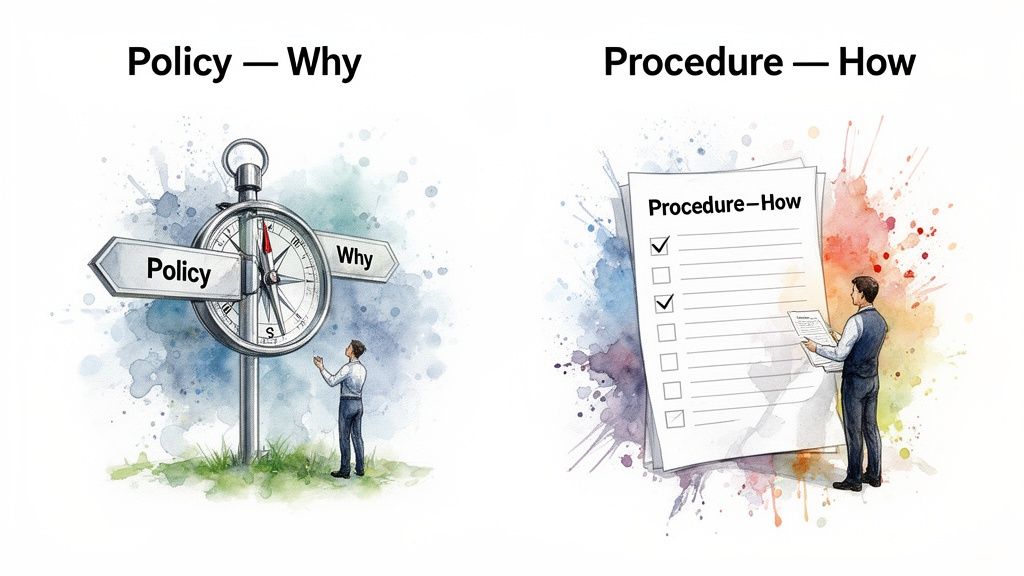
For example, a policy might state, “All company data must be secured and regularly backed up to prevent data loss.” That's the rule. The corresponding procedure would be a detailed document for the IT team outlining which backup software to use, the exact schedule for backups, and how to test and store them.
A policy gives your team the destination and the rules of the road. A procedure gives them the turn-by-turn directions to get there safely and efficiently. One without the other leads to getting lost.
A Framework for Clarity
Leaders often create documents that are either too vague to be actionable (a policy trying to be a procedure) or too rigid and detailed to guide strategy (a procedure trying to be a policy). Use this table to diagnose your own documents and enforce clarity.
| Attribute | Policy (The 'Why') | Procedure (The 'How') |
|---|---|---|
| Purpose | To guide decisions and set broad organizational rules. | To provide step-by-step instructions for a specific task. |
| Scope | Broad, applying to the entire organization or a major function. | Narrow, applying to a specific task or team. |
| Audience | All employees, management, and relevant stakeholders. | Employees and managers directly involved in the task. |
| Ownership | Senior leadership or a governing body. | Department managers or process owners close to the work. |
| Lifespan | Stable and long-term, updated only when strategy shifts. | Dynamic, updated as processes and tools improve. |
| Evidence | Shows strategic intent and establishes governance. | Proves that a policy is being followed in practice. |
To see how this works in the real world, take a look at these social media policy examples. Each one sets high-level rules about brand voice or employee conduct online. But to actually implement them, you'd need separate procedures detailing how a marketing manager schedules posts or how a customer service rep responds to negative comments.
For more on the operational impact, read the findings on policy and procedure alignment.
What Leaders Often Miss
I've seen it time and again: a leadership team believes their governance is airtight because they have a glossy HR handbook and a few IT policies. This is one of the most dangerous assumptions a growing company can make. What seems like a small process gap today quietly becomes an operational failure down the road.
This oversight usually comes from two classic mistakes.
Assuming Handbooks Are Enough
An employee handbook is a great tool for setting cultural tone and outlining broad rules. But it is not an operational governance system. A handbook will state the vacation policy, but it won’t tell your finance department how to process payroll, approve an invoice, or close the books at the end of the month.
When you lean on a handbook as your sole source of governance, you create a massive false sense of security. You’re leaving your most critical business functions undocumented and unmanaged.
Ignoring Vendor-Driven Procedures
Another huge blind spot is how vendors operate inside your business. When you outsource a key function—whether it’s IT support, marketing, or payroll—you're often inheriting that vendor's standard operating procedures. If you don't actively review and align their methods with your company's policies, that vendor is effectively setting your internal processes for you.
Their "how" quietly bulldozes your "why," creating risks you never formally accepted. You can learn more about aligning strategy and execution with a solid decision-making framework.
Relying on a key person "who knows how things get done" is not a business process. It is a massive, unacknowledged risk that makes the business fragile and difficult to scale. A solid governance framework is non-negotiable for predictable execution. For a deeper look, check out our guide on the best practices for IT governance.
A Practical Path to Restore Control
Tackling operational chaos can feel overwhelming, but the solution isn't a massive, disruptive overhaul. The secret is to start small and build momentum. You can untangle the mess and show your team that progress is possible with a simple, three-step framework. Pick one high-impact area and get to work.
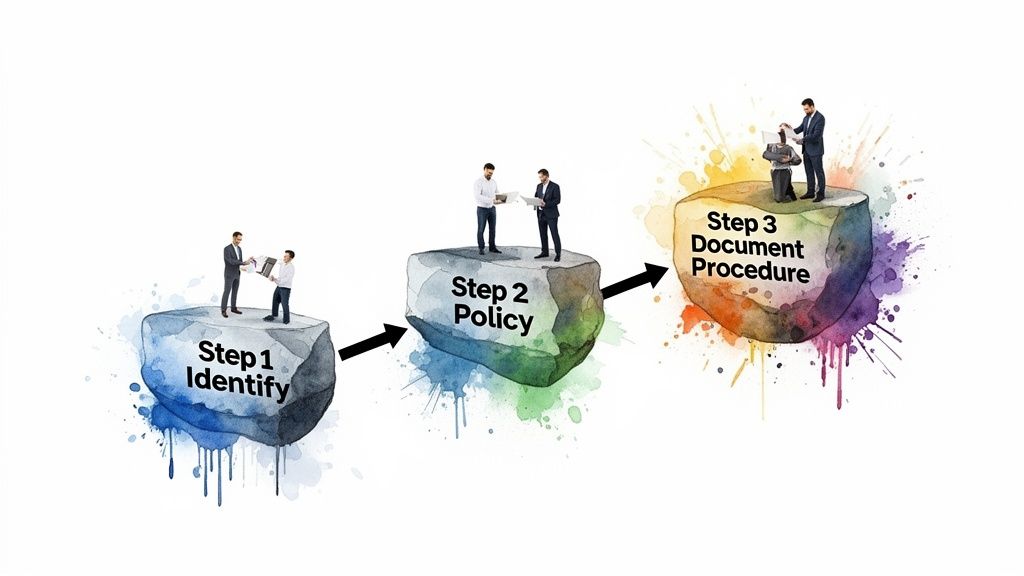
Step 1: Identify a Single Pain Point
First, pick one process that's causing real friction or risk. Don't try to solve everything at once. Zero in on a workflow where ambiguity is creating headaches you can see and feel, like customer onboarding, vendor procurement, or expense reporting. By focusing on one problem, you make the scope manageable.
Step 2: Articulate the Governing Policy
Next, write the policy. This is the high-level "why," articulated in a few clear sentences. Think of it as the guardrails. For instance, a vendor procurement policy might be: “All new vendor agreements exceeding $5,000 must be reviewed by Finance and Legal to ensure fiscal responsibility and mitigate contractual risk.” This statement establishes the non-negotiable rule and its purpose.
Step 3: Document the Current Procedure
Finally, ask the process owner to document the existing procedure. Their job is to write down the "how": the exact steps, tools, and handoffs people are using right now. This exercise almost always reveals a gap between the policy’s intent and the day-to-day reality. The goal here isn't to create a perfect procedure from scratch. It’s about making the current reality visible so you can improve it. For more on navigating those gaps, see our guide on effective policy exception management.
This small-scale cycle builds immediate momentum and gives you a repeatable model for restoring control one process at a time. Rolling this out requires great mastering prioritization, delegation, and assignment.
What Better Looks Like: From Chaos to Control

When the difference between policy and procedure is clear, the entire feel of the business changes. The constant hum of urgency is replaced by a sense of calm control. Decisions get made with confidence because the guardrails are known.
This newfound clarity and predictability are what set the stage for scaling.
- New hires ramp up in days, not months. They get a clear playbook instead of hunting down a busy teammate for "tribal knowledge."
- Operational risk goes down. You can prove that work is being done correctly and in compliance, which is a huge relief during an audit.
- Innovation gets a chance. When your best people aren't reinventing the wheel on basic tasks, they can focus on high-value work that pushes the business forward.
When you clarify the difference between policy and procedure, you stop managing personalities and start managing the system. Your company becomes resilient, able to handle pressure not through individual heroics, but through a calm, repeatable rhythm. It frees everyone to stop putting out operational fires and start building a more stable, profitable, and scalable company.
If your business is paying a high coordination tax and you need to restore predictable execution, CTO Input can help. A Clarity Call is the fastest way to get a clear picture of what’s broken and what to do next.