
If running your business feels like steering a plane through clouds, you are not alone. This is the reality of digital transformation for many organizations today.
Costs keep rising, systems do not talk to each other, Artificial Intelligence (AI) and Cloud Computing projects pile up, and every board meeting includes a new warning about cybersecurity or compliance. Technology feels like a risk, not a growth engine.
A digital transformation expert is the guide who stands between all that chaos and a simpler, safer, more profitable way to run your company. They connect organizational goals and change to the right technology, help you spend smarter, and reduce risk while keeping control in your hands.
In this post, you will see what these experts actually do, how they reduce cost and risk, how they work in a 2025 world of AI, cloud, and rising cyber threats, and why a fractional or on-demand expert (like the services described at https://ctoinput.com/the-solution) can be safer and cheaper than hiring a full-time executive.
Feature Image: A Clear Path From Confusing Tech To Smart, Simple Systems

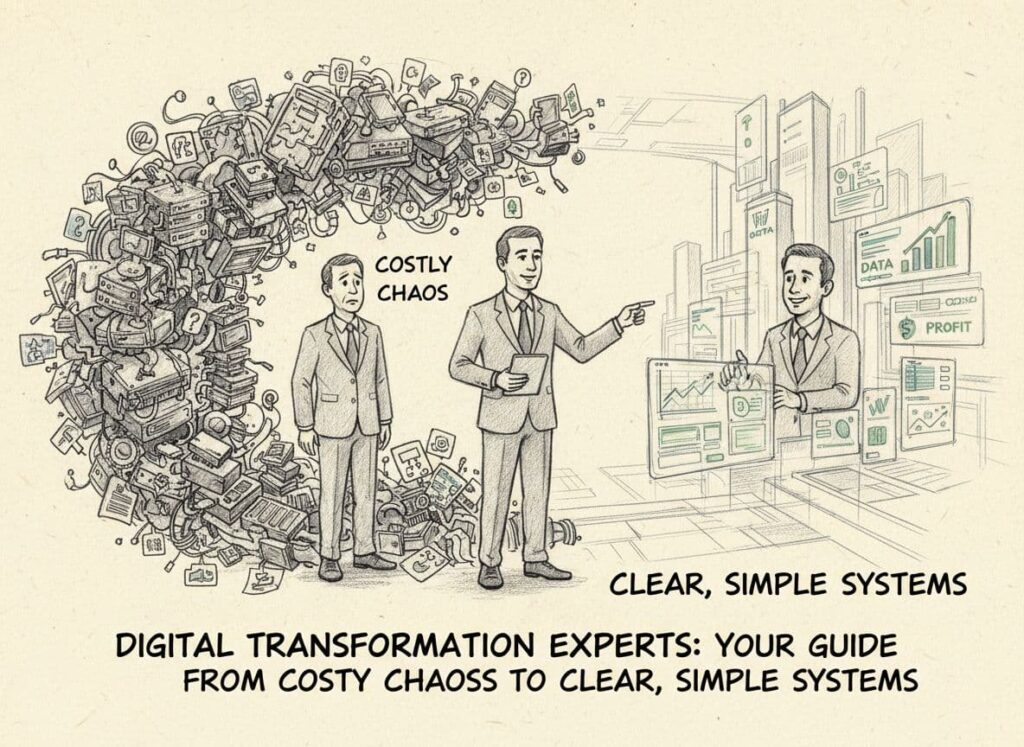
Sketch of a CEO guided by a Digital Transformation Specialist from chaotic systems to clear dashboards. Image created with AI.
The ideal feature image for this post shows a CEO or founder standing at the edge of a messy maze. On the left, tangled wires, old servers, and random app icons show confusion and risk. On the right, a clean digital control panel with simple charts and dashboards shows clarity and control.
In the middle stands a Digital Transformation Specialist, pointing toward the clear side, guiding the path to successful Digital Transformation. Colors are calm and professional, with deep blue, white, and soft green to signal trust, clarity, and security. The mood is hopeful and confident, not chaotic.
What Are Digital Transformation Experts And What Do They Actually Do?
A lot of leaders hear the terms CIO, CTO, IT director, and consultant and tune out. It all sounds the same.
A Digital Transformation Specialist is different. They look at the whole business first, then choose and organize technology to support the plan. They combine strategy, process, people, and tools into one clear picture, driving digital transformation across operations.
They are not there to sell you software, they are there to help you reach revenue, cost, and risk goals with the simplest tech stack that will work.
A simple definition any business leader can understand
A Digital Transformation Specialist is a trusted advisor who helps your company use modern technology to cut costs, reduce risk, and grow.
They are not just software installers. They:
- Connect business goals to tech choices
- Design a practical plan, not a buzzword vision
- Guide change across the whole company, not only in IT
If you think of your business as a building, they are the architect and project supervisor in one. They make sure the wiring, security, rooms, and exits all work together, so people can do their jobs safely and efficiently.
Key roles and responsibilities: strategist, tech advisor, project leader, and change coach
In 2025, strong digital transformation experts wear several hats, often at the same time.
Strategic planner:
They work with you on business strategy to decide where technology should help first. For example, they might build a roadmap to cut order processing time by 40 percent and improve customer response speed.
Tech advisor:
They help pick digital solutions like Cloud Computing systems, Artificial Intelligence (AI) features, automation platforms, and analytics tools. For example, they might compare CRM options and explain which one fits your sales model and budget.
Project leader:
They apply project management skills to run key projects from idea to launch. For example, they may lead your move from spreadsheets to a modern ERP, keeping scope tight so the project finishes on time and within budget.
Change manager and coach:
They help people adapt. For example, they design training so your customer service team feels confident using a new AI-assisted help desk, instead of feeling replaced by it.
Data analyst:
They help your team set up useful dashboards. For example, they build a simple weekly margin and pipeline report that you and the board can trust.
Security and compliance checker:
They bring data security and privacy into every project. For example, they check that a new cloud tool has proper access controls and audit logs, so your risk officer can sleep at night.
Each of these roles feeds the same result: leaders can move faster, spend less, and worry less.
How they differ from your IT team, vendors, and full-time tech executives
Your in-house IT team keeps systems running. They fix outages, manage laptops, and respond to tickets. You need them.
Software vendors sell you their platforms. They talk about features and upgrades. Some are helpful, some oversell.
A digital transformation expert sits above all that. They look across the whole business and answer questions like:
- Which systems do we actually need?
- Where are we wasting money?
- How do we reduce risk and still move faster?
They do not represent a single vendor. They design the bigger picture, then guide IT staff and vendors to fit into it.
In many companies, this guidance comes from a fractional or external expert, similar to the services listed at https://ctoinput.com/menu-of-products. This gives you executive-level judgment without the cost and commitment of a full-time CIO or CTO.
Why Companies With High Costs And Tech Chaos Turn To Digital Transformation Specialists
When operations feel bloated and tech feels messy, most leaders try one of two moves.
They either keep spending on more tools and projects, or they freeze and do nothing because every option feels risky.
A digital transformation specialist offers a third path. They help you slow down, see the whole picture, and make a focused plan that cuts waste, simplifies systems, and addresses cyber and compliance risk early, especially in a world of AI, remote work, and constant change.
Common warning signs your business is ready for a digital transformation specialist
Some clear signals show up before leaders reach out for help:
- Rising operating costs with flat revenue
You spend more on staff, tools, and support, but growth stalls. A specialist starts by finding duplicate systems, manual work, and low-value tasks that can be automated or removed. - Teams use many disconnected tools and spreadsheets
Sales, finance, and ops all track numbers in different places to manage business processes. A specialist maps the tools and designs a plan to connect or consolidate them. - Slow, manual processes that depend on “hero” employees
One or two people know “how things really work” in these business processes. A specialist documents key processes and looks for simple automation. - Regular system outages or constant “IT fire drills”
People lose time when systems crash. A specialist checks reliability, backup, and support models, and helps you pick more stable platforms if needed. - Fear of audits, data breaches, or regulator questions
Your team is not sure where data lives or who has access. A specialist works with security and compliance early to reduce exposure. - Leadership does not trust the numbers
Reports conflict, and board packs spark arguments about data quality. A specialist reviews data sources and builds a single, trusted view. - AI and automation talk, but few results
You hear constant talk about emerging technologies like AI and the Internet of Things (IoT), but real impact is missing. A specialist picks one or two focused use cases to prove value.
These signs do not mean you failed. They mean you grew faster than your systems, which is common.
How digital transformation experts cut operating costs without hurting growth
Cost cuts often scare leaders because they fear impact on growth. A smart digital transformation specialist cuts dead weight, not muscle, to drive operational efficiency.
Common moves include:
- Removing duplicate tools that do the same job
- Automating manual tasks like data entry or approvals
- Simplifying the tech stack so you support fewer systems
- Moving the right systems to the cloud to reduce hardware and maintenance costs
For example:
- In finance, they might automate invoice processing, cutting processing time from days to hours and reducing errors.
- In operations, they might link warehouse systems to sales data, so stock levels update in real time and you avoid over-ordering.
- In customer service, they might add a smart self-service portal and simple AI triage, so agents focus on higher value cases and enhance customer experience (CX).
The goal is clear: free up cash and people for growth projects, instead of burning both on avoidable waste.
Taming complexity: turning a messy tech stack into a simple, reliable system
Most companies grow their tech stack like weeds, not like a garden. A tool for this team, a workaround for that group, a legacy system nobody wants to touch.
A digital transformation specialist brings order to this chaos through process transformation.
They:
- Map your current systems, data flows, and key processes
- Spot overlaps, blind spots, and fragile “spaghetti” integrations
- Design a simpler, more standard setup that your teams can understand
They may use integration platforms, shared data models, and standard platforms, but the language stays simple: fewer systems, fewer handoffs, fewer ways for things to break.
This often follows a clear, multi-step digital transformation approach, similar in spirit to the kind of structured framework explained at https://ctoinput.com/our-process, even if the exact method is tailored to your company.
The result is a stack that feels boring in the best way: stable, clear, and predictable.
Reducing cybersecurity and compliance risk before there is a crisis

Two cybersecurity experts study live data to protect company systems. Photo by Tima Miroshnichenko
In 2025, cyber risk and compliance pressure keep getting louder. Ransomware, phishing, regulatory checks, and angry customers do not wait.
A strong digital transformation specialist treats security and compliance as part of the plan from day one.
Picture a mid-sized company that stored customer data in several systems. Access was based on old spreadsheets. Reports for auditors were manual and late.
A specialist came in and:
- Centralized key data or linked it in a controlled way
- Cleaned up user access, so people had only the rights they needed
- Added multi-factor authentication and better password rules
- Set up basic monitoring and alerts
- Automated key compliance reports
They did not turn the company into a bank. They raised the floor to a safer, more defensible level.
The payoff: lower chance of fines, fewer late nights for IT, and less risk of a headline-grabbing breach that scares customers and the board.
Inside The Toolkit: Skills And Methods The Best Digital Transformation Experts Use
The best Digital Transformation Specialists combine business sense with technical insight and demonstrate exceptional Problem Solving Skills. As a Digital Transformation Specialist, they can talk in your language, then talk to your IT team, and keep both conversations aligned.
Here is what that looks like day to day.
Business-first thinking: starting with goals, not gadgets
Strong Digital Transformation Specialists never start with “We should use AI” or “We should move everything to the cloud.”
They start with questions like:
- Where do you want to grow?
- Which costs hurt the most?
- What risks keep you up at night?
- What do customers complain about most?
From there, they shape a clear roadmap for Strategy Implementation that ties technology work to:
- Revenue growth
- Margin improvement
- Risk reduction
This often looks like a step-by-step Digital Transformation roadmap, similar to the style of plans described at https://ctoinput.com/the-solution. The key is that the roadmap matches your budget, capacity, and risk tolerance.
Modern tech knowledge: AI, cloud, automation, and data analytics made simple
You do not need to become an AI or cloud expert. Your Digital Transformation Specialist does that for you and keeps the language simple.
Here is how they frame common tools, drawing on their Technical Skills:
- AI: Helps analyze patterns, predict demand, or answer routine questions so people focus on higher value work.
- Automation: Handles repetitive tasks, reduces errors, and speeds up workflows like approvals or notifications.
- Cloud: Lets you run systems with less hardware, easier updates, and better access for remote teams.
- Data Analytics: Turns raw data into clear reports and dashboards so you can make faster, better decisions.
- Cybersecurity tools: Protect critical systems and data, reduce breach risk, and support compliance.
Their job is to translate these options into simple tradeoffs: cost, time, risk, and expected benefit.
Project and Change Management: getting real results, not half-finished projects
Most tech failures are not really tech failures. They are planning and people failures.
A Digital Transformation Specialist plans and runs projects with Leadership Skills to guide teams effectively, including:
- Clear scope and milestones
- Named owners and decision makers
- Realistic timelines and budgets
- Training and support plans for staff
Change Management is a fancy term for helping people understand, accept, and use new ways of working.
For example, one company rolled out a new CRM after several failed attempts. This time, the Digital Transformation Specialist:
- Involved sales managers in the design phase
- Tested with a small pilot group before full rollout
- Scheduled short, focused training sessions
- Set simple rules, like “If it is not in the CRM, it is not in the forecast”
- Gave managers clear reports that made their lives easier
Adoption jumped, reports improved, and the system stuck. Not because the software was magic, but because people were brought along.
Measuring impact: how digital transformation experts prove value with data, not buzzwords
Good Digital Transformation Specialists do not ask you to trust them on faith. They define success in numbers before work starts.
Common metrics include:
- Processing time for a key workflow
- Error or rework rates
- Customer satisfaction scores
- On-time delivery
- System uptime and incident counts
- Compliance findings or audit results
They then help set up simple dashboards or reports that show progress over time. You can check results in minutes, not dig through long slide decks.
This closes the loop. You see whether projects deliver, and can adjust or stop if they do not.
How To Choose The Right Digital Transformation Specialists For Your Business
In this digital era, if you have been burned by past consulting firms or half-finished tech projects, caution makes sense.
You do not need a perfect specialist. You need someone with a clear process, relevant experience, and the humility to listen.
Here is how to sort signal from noise.
Questions smart CEOs and boards ask before they hire a specialist
Use these questions in interviews or early calls:
- What business outcomes have you delivered for companies like ours?
- Can you share an example where you cut costs without hurting growth?
- How do you think about cybersecurity and compliance in your projects?
- How do you work with our existing IT team or vendors?
- What will the first 90 days look like if we work together?
- How do you explain complex topics to non-technical leaders?
- How do you handle staff who resist change or fear automation?
- How do you decide which projects to do first?
- How do you measure success for your work?
- What happens if a project is off track? How do you handle it?
You want clear, concrete answers, not vague promises.
What to look for in experience, track record, and approach
Look for:
- Education and experience with similar company sizes, industries, or regulatory rules
- Case studies or stories with clear before and after states
- References you can speak with
- Sample roadmaps or example plans
Pay close attention to their method. A good specialist has a structured approach, like the kind of staged process you can see described at high level on pages such as https://ctoinput.com/our-process.
You are buying judgment and process, not just technical knowledge.
Fractional, on-demand, or full-time: choosing the right engagement model
These options can align with your business model in different ways. You have three main choices:
- Full-time executive hire
Best if you are large, stable, and know you need a permanent leader. Highest cost, but strong for long-term ownership. - Fractional or part-time executive
Ideal for growing companies that need senior guidance but cannot justify a full-time CIO or CTO yet. You get access to experience at a smaller, more flexible cost. - Project-based consultant
Good for targeted work like an assessment, roadmap, or specific rollout. Useful to test fit before expanding the relationship.
Many companies start with a fractional or project-based leader, similar to what you might see in the offerings at https://ctoinput.com/legal-nonprofit-technology-products-and-services. This reduces risk and gives time to confirm fit before making bigger commitments.
Red flags that signal the specialist may not be a good fit
Watch out for:
- Talking only about tools or platforms, not business outcomes
- Refusing to work with your existing IT team or vendors
- Huge promises without clear milestones or measures
- Dodging questions about cybersecurity or compliance
- Overcomplicated jargon that clouds simple questions
- Pressure to sign large, long contracts upfront
If these show up, it is better to walk away early than deal with an expensive, failed project later.
A Simple First Step: How To Start Working With A Digital Transformation Specialist
Your first move does not need to be a big bet. You can start small, learn fast, and keep control.
A low-risk starting point often includes a short assessment, a discovery workshop, or a roadmap project.
Map your biggest problems and quick wins in a short discovery phase
Most good experts begin with a focused discovery phase. This usually includes:
- Interviews with key leaders and team leads to gauge organizational culture
- A review of current systems and business processes
- A quick scan of costs, pain points, and risks
The outcome is a short, clear summary that answers:
- What is working
- What is broken
- Where the biggest risks live
- Where the easiest wins sit
This kind of honest framing is similar in spirit to the way https://ctoinput.com/the-problem lays out core issues before jumping into solutions. The goal is clarity, not a 200-page report.
Build a practical, 6 to 12 month roadmap you can actually execute
Next comes a plan you can act on.
A strong expert helps you build a 6 to 12 month roadmap that:
- Fits your budget and staff capacity
- Balances quick wins with foundation work like security, data, and software development
- Prioritizes projects by impact and risk
- Keeps steps short, clear, and visual
You should be able to review the plan in a single meeting and explain it to your board without a translator.
Start small, prove value fast, then scale what works
From there, you pick one or two projects that can show results in under 90 days. Common examples:
- Automating a key manual process that slows revenue
- Cleaning up and centralizing key data for better reporting
- Reducing customer response time with better tools and workflows
Early wins build trust with staff and the board. They show that change is possible and useful.
Many advisors, including those you can reach for a consultation at https://ctoinput.com/schedule-a-call, use this “start small, prove value, then scale” model. It keeps risk low and confirms fit before you scale up work.
Conclusion: Turn Messy Tech Into A Clear Engine For Growth
Technology does not have to feel like a high-cost gamble.
The right digital transformation expert helps you achieve a successful digital transformation by turning messy, fragile systems into a clear, cost-effective engine for growth. They reduce operating costs, simplify your stack, strengthen security and compliance, and give you better data so you and your staff can make faster, calmer decisions that fuel career growth.
If you are a CEO, COO, founder, or board member who is tired of tech chaos, high bills, and vague promises, your best next step might be a short, honest conversation. Visit https://www.ctoinput.com to explore how this could look for your company. A simple call can give you clarity on options without any big commitment, and might be the safest move you make this year.
If you want more practical, plain language guidance on aligning technology, risk, and growth, spend a few minutes exploring more of the articles on the CTO Input blog. You can find them here: https://blog.ctoinput.com