
A security program can look busy for years and still leave you exposed. Tickets close. Tools renew. Vendors send reports. Then a customer, insurer, buyer, or board member asks a plain question: “What could hurt the business, and who owns the response?” Modern organizations need ongoing cybersecurity leadership to strengthen their overall security posture against evolving threats.
A fractional CISO engagement should produce more than a risk register and a slide deck. When you bring in a fractional CISO, you gain access to executive-level guidance that helps you navigate complex compliance hurdles. In 90 days, you should have a clearer operating picture, a short list of decisions, named owners, and a plan that leadership can govern. Utilizing a fractional CISO also provides cost-effective security for growing teams that need experienced oversight without the overhead of a full-time hire.
The goal isn’t to make your company look more technical. It’s to make technology risk easier to see and easier to manage.
Key Takeaways
- A 90-day engagement with a fractional CISO should identify the risks that could affect revenue, operations, customers, or a transaction.
- Your leadership team needs clear ownership, not another vendor report nobody acts on, to improve overall cyber risk management.
- A useful cyber roadmap separates urgent fixes from work that can wait while aligning with your broader security strategy.
- Board cybersecurity reporting should show business impact, risk thresholds, owners, and decisions required to keep your security program on track.
- Security work holds up better when it is tied to your business technology strategy, daily operations, and incident response readiness, all overseen by an experienced fractional CISO as part of your ongoing security strategy and cyber risk management initiatives.
What a 90-Day Fractional CISO Engagement Should Produce
The first outcome is clarity about the real problem.
You may start with a cyber concern, but the underlying issue is often broader. Access is poorly controlled. A critical vendor has never faced real vendor due diligence. Backups exist, but nobody can confirm recovery testing. The technology leader reports activity, but not business exposure. When you bring in valuable cybersecurity expertise through a virtual CISO or fractional CISO, you can uncover hidden information security gaps before they derail operations.
A fractional CISO, virtual CISO, or interim CISO should sort those issues into a usable view. That means looking at systems, data, identities, vendors, policies, incident history, insurance requirements, and business dependencies.

You should not get a long catalog of technical weaknesses with no context. Your virtual CISO engagement should give you answers to questions such as:
- Which risks could interrupt operations, trigger a damaging data breach, or erode customer trust?
- Which systems, vendors, and people create the most exposure against active cyber threats?
- Which existing security controls are already being handled well?
- What must be fixed now, and what can wait?
- Who has authority to accept, reduce, transfer, or escalate risk?
A good cybersecurity risk assessment starts with the business impact of failure. Whether you call on a fractional CISO or conduct a formal risk assessment, the goal is to evaluate your information security posture. That is the difference between a technical inventory and technology risk management leaders can use, especially when guided by dedicated cybersecurity expertise and strong security controls.
The first 90 days should reduce uncertainty. If you have more documents but no clearer decisions, the engagement missed the point.
Days 1 Through 30: Establish the Facts Before You Fund Fixes
The opening month is about listening, testing assumptions, and finding where the story does not match reality.
You may have an MSP, internal IT team, outside counsel, cloud providers, and managed service providers. Each group may be working hard, yet nobody may own the full security picture. That is common in growing companies.
The work should begin with a focused technology assessment. Review the systems inventory, privileged access, backup and disaster recovery planning, endpoint protection, cloud accounts, key data flows, current contracts, and known incidents. Ask whether the incident response plan is real, current, and understood by people who would need to use it. At the same time, evaluate existing security policies to see where they match day-to-day operations.
The CISO should also identify where security is affecting commercial or operational decisions. A weak control may delay a customer security review. An unsupported system may create an acquisition readiness issue. A loose offboarding process as part of broader vendor risk management may leave former employees or contractors with access. Furthermore, leadership must understand how these gaps affect regulatory compliance, especially when preparing for annual audits or external reviews.
This is where a comprehensive risk assessment becomes useful to management. It should name the business consequence, not merely the control gap.
You also need a baseline for cyber risk appetite. Leadership may accept some exposure because speed matters, but it may not accept exposure that threatens payroll, customer data, a major contract, or insurance coverage. Those distinctions need to be explicit.
Without that discussion, every security request looks equally urgent. That leads to wasted spend and poor decisions.
Days 31 Through 60: Turn Findings Into a Defensible Cyber Roadmap
By the second month, the facts need to become choices as part of your broader strategic planning.
A security roadmap should not attempt to fix every issue at once. Your business has limited money, attention, and delivery capacity. The harder question is which three to five outcomes deserve those resources now.
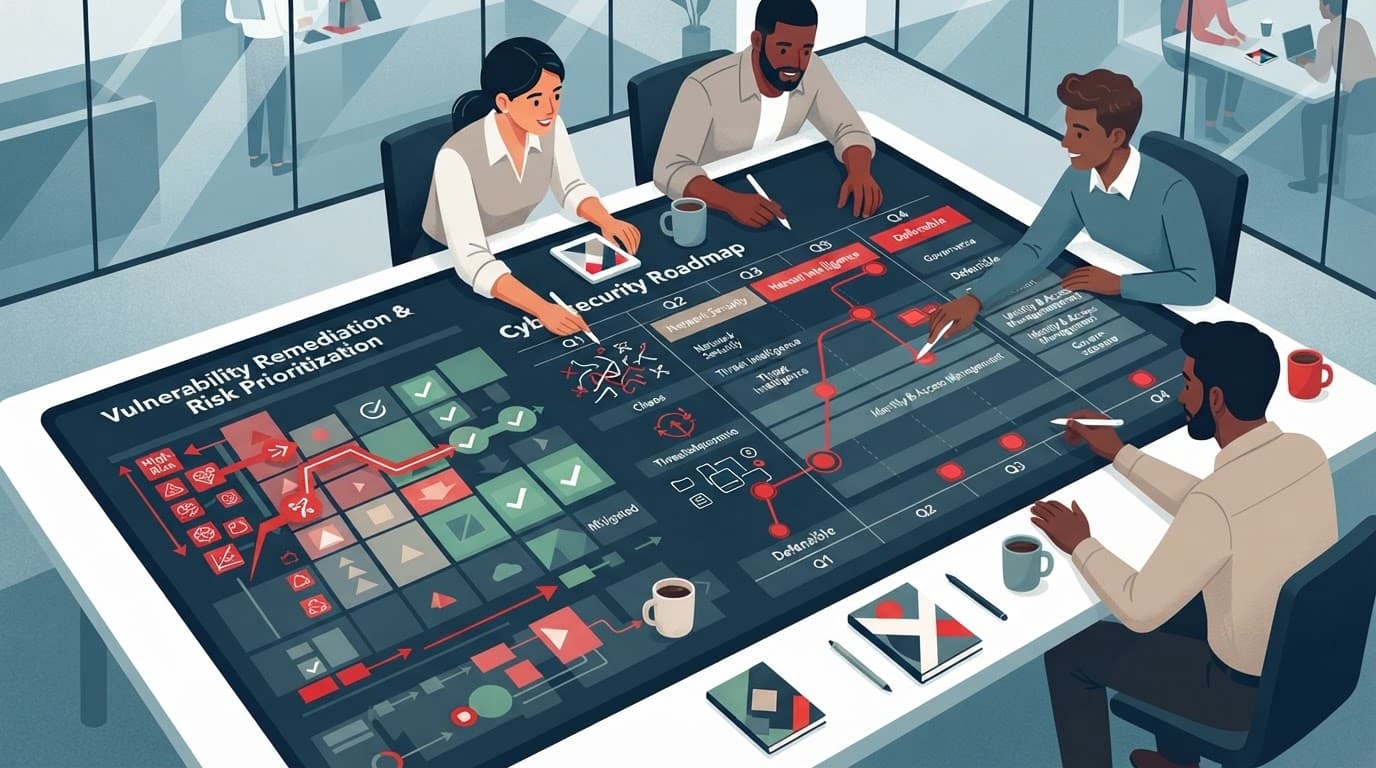
A practical 12-month technology roadmap might group work into four areas:
| Priority area | What leadership needs to decide |
|---|---|
| Identity and access | Who gets access, how elevated access is approved, and how quickly access is removed |
| Recovery readiness | Which systems must recover first, what recovery testing proves, and who owns the result |
| Third-party risk management | Which vendors require deeper review, contract changes, or contingency plans |
| Incident response readiness | Who makes decisions during an event, who communicates, and when the board is notified |
This is also where technical debt management matters. An aging server, poorly integrated application, or unsupported platform is not only an IT inconvenience. It may increase outage risk, recovery time, third-party risk, and the cost of every future change while impacting business continuity.
The roadmap should show cost, owner, timing, expected risk reduction, and what happens if you delay. That makes it part of a business-aligned security strategy, not a security wish list.
A virtual CISO can work beside a fractional CTO or fractional CIO when the issue crosses security, operations, data quality, and technology spend optimization. Bringing in a virtual CISO provides cost-effective security leadership without the immediate overhead of hiring a full-time CISO, helping you shape a comprehensive security strategy and promote security awareness across your teams.
A standalone cyber plan will fail if the underlying systems, decision rights, and vendor management remain unclear. Engaging in ongoing strategic planning helps ensure that a full-time CISO or fractional advisor keeps leadership aligned.
This is also the point to stop vendors from driving your roadmap. A new tool may help. It is not automatically the answer. The decision should start with the business risk, then test whether process, ownership, configuration, or technology changes are required to support your overarching security strategy.
Days 61 Through 90: Give Leadership Reporting It Can Govern
The final month should create a steady management rhythm, supporting effective cyber risk management across the enterprise.
You need board-ready reporting that does not bury directors in technical detail. A board technology report should show the top risks, business impact, current trend, risk owner, mitigation status, third-party exposure, major incidents, and decisions required. Delivering this clarity relies on strong cybersecurity leadership and expert executive-level guidance.
That is the foundation for cyber risk reporting to the board.
A useful report might state that recovery testing for a revenue-critical platform failed, name the executive owner, show the interim control, and request funding or a decision on timing. It should not lead with a list of firewall settings. To satisfy ongoing regulatory compliance and prepare for upcoming compliance audits, leadership needs this streamlined view rather than raw data.
The same discipline applies to technology dashboards. Track a small number of measures that point to real exposure:
- Critical access reviews completed on time
- Recovery tests passed for priority systems
- High-risk vendor reviews completed
- Material incidents and corrective actions
- Security work that is blocked by a business decision
This is technology governance for boards, not board involvement in daily operations. Directors should oversee risk, tradeoffs, and accountability. They should not run the remediation plan. Maintaining visibility into how security controls perform under operational stress is essential for robust cyber risk management.
A clear operating rhythm also prevents cyber work from fading after the initial push. Monthly executive reviews can address delivery, spend, exceptions, and vendor performance. Quarterly board reporting can focus on material changes, regulatory compliance updates, and strategic decisions that benefit from ongoing executive-level guidance and steady cybersecurity leadership.
What the Engagement Did Not Produce
A credible 90-day engagement with a fractional CISO does not promise that cyber risk disappears overnight.
It does not turn a company with weak ownership, unmanaged tool sprawl, years of technology debt, and inconsistent data governance into a mature information security organization in one quarter. A virtual CISO should not pretend otherwise.
What it can produce is a truthful starting point for your security program. You know where the exposure sits, which risks deserve action first, and who owns the outcome. You have a plan that leadership can challenge and fund, whether you decide to maintain fractional CISO oversight or eventually hire a full-time CISO.
That matters because the alternative is familiar. Your team keeps reacting, your vendors keep selling, and your board keeps asking the same questions. Technology spend rises, but confidence in your information security and cybersecurity expertise does not.
If security pressure exposed a wider leadership gap, you may need executive support beyond your initial security program. Organizations often lean on a virtual CISO or evaluate when to transition from fractional cybersecurity expertise to a full-time CISO. Executive technology oversight can help you connect risk, spending, vendors, delivery, and business priorities in one clearer view.
Frequently Asked Questions
Is a fractional CISO the same as an interim CISO?
No. A fractional CISO provides ongoing senior security leadership on a part-time basis, while a virtual CISO often delivers similar advisory support remotely. An interim CISO usually steps in when a leadership seat is open, a security event has exposed weak control, or the business needs immediate stabilization through dedicated cybersecurity leadership.
The right model depends on the urgency, the leadership bench, and whether you need a bridge or an ongoing operating rhythm.
What should a board receive after 90 days?
Your board should receive a board-ready risk summary that incorporates executive-level guidance. It should identify the highest risks, their business effect, the risk owner, the mitigation plan, changes since the last report, and any decision directors need to make regarding operational resilience or frameworks like SOC 2 compliance and ISO 27001 compliance.
It should not be a dense technical briefing. If the board cannot see the tradeoffs, it cannot provide meaningful cybersecurity oversight.
Do you need a full-time CISO after a 90-day engagement?
Not always. Transitioning to a full-time CISO makes sense when the company has sustained security complexity and a defined long-term mandate. A fractional CISO model may fit when you need senior judgment, stronger reporting, and accountable execution without adding a full-time executive role too early.
Bring Risk Back Into View
The strongest result of a 90-day fractional CISO engagement is not a polished security binder. It is clearer visibility.
You can see the risks that matter, the choices in front of you, and the people accountable for action. That gives you a more defensible plan and calmer leadership under pressure, supported by a much stronger security posture.
If technology risk still feels scattered or hard to explain, Get an Executive Technology Clarity Check. Through a targeted fractional CISO engagement, you gain access to vital cybersecurity expertise that delivers cost-effective security and elevates your overall security posture. The next decision should be based on facts, not noise.