

The wrong pricing model can make a good technology leader look expensive. The right one can give you stronger ownership, clearer visibility, and better decisions without rushing into a full-time cto.
Fractional CTO pricing is not only about hours or day rates. It is about what your business needs a fractional executive to own, how long that need will last, and how much uncertainty you can afford to carry.
Before you compare proposals, get clear on the problem you are paying to solve.
Key Takeaways
- A monthly retainer fits when you need consistent technical leadership, recurring decision support, and a steady operating rhythm.
- A fixed-fee project fits when the work has a defined outcome, such as a technology audit, technology roadmap, vendor review, or diligence assessment.
- Equity compensation can make sense for an early-stage company with limited cash. It is usually a poor substitute for cash compensation in an established operating business.
- The cheapest option is rarely the lowest monthly number. It is the model that prevents wasted spend, weak vendor decisions, stalled projects, and unmanaged risk.
- Ask what business outcomes, strategic guidance, and ownership the engagement will create before you ask for a rate card.
How Fractional CTO Pricing Should Work
A fractional CTO is not a part-time IT manager. You are paying for executive judgment and technical leadership across technology strategy, operating priorities, vendor decisions, risk, and delivery.
That distinction matters. Your internal IT team may be working hard on outages, access requests, software renewals, and support issues. Those jobs matter. They do not replace someone who can connect technology decisions to revenue, margin, customer experience, risk, and growth.

Published 2026 market guides place market rates around $150 to $500 per hour and monthly retainers from roughly $3,000 to $25,000 or more, depending on scope and leadership depth. Those ranges are useful context, but they are not a buying decision. One public fractional CTO cost guide shows how broad the market can be.
A $5,000 monthly advisory engagement and a $20,000 monthly embedded leadership role are not comparable. One may provide a few senior working sessions and a review of priorities. The other may own the technology roadmap, lead vendors, support the executive team, stabilize delivery, and prepare board-ready reporting.
The question is not, “What are the hourly rates?” The better question is, “What will be clearer, controlled, or moving faster because this person is involved?”
If the proposal lists meetings and hours but cannot name decisions, owners, and business outcomes, you are buying time, not leadership.
Monthly Retainer Pricing for Ongoing Leadership
A monthly retainer is usually the cleanest model when your company needs steady fractional technology leadership. You have recurring decisions to make. The business is growing. Vendors have influence. Technology spend is rising. No one has a complete view of priorities, risk, and execution.
A retainer gives you a consistent executive presence without full-time executive overhead. It fits a company that has outgrown founder-led technology decisions but is not ready to make the full-time cto hire. Furthermore, selecting the right monthly retainer as an engagement model helps stabilize operations for growing organizations.
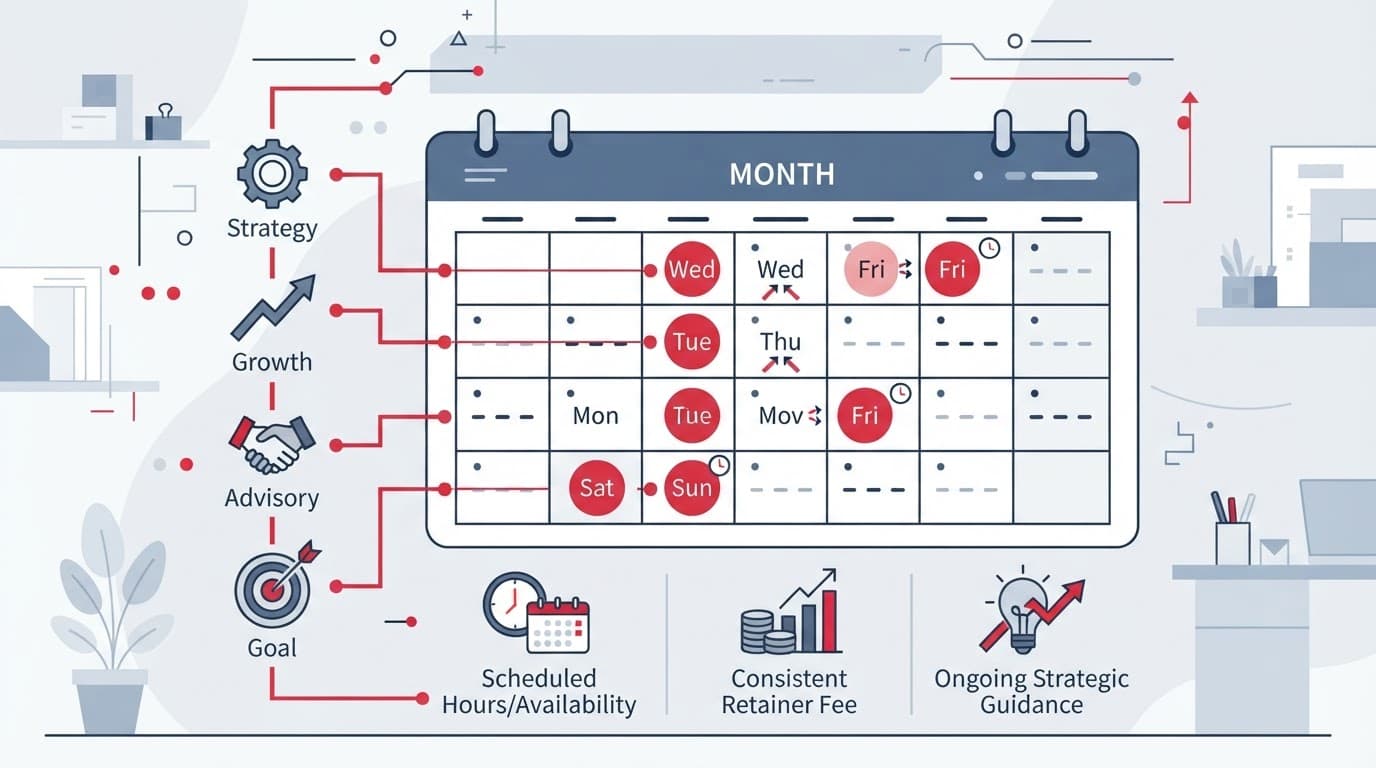
Light advisory work often falls around $3,000 to $6,000 a month. This may include executive meetings, targeted advice, review of major decisions, and a limited number of working hours.
More involved fractional CTO services often sit between $8,000 and $18,000 a month. At this level, you should expect more than advice. You may have a 12-month technology roadmap, recurring leadership reviews, vendor management, technology dashboards, board technology reporting, and active support for priority decisions.
Higher-touch work can reach $20,000 to $25,000 or more per month. That range can be appropriate when the leader is deeply involved in delivery recovery, executive leadership meetings, major vendor negotiations, cybersecurity oversight, or a serious technology leadership gap.
A good retainer should make the operating rhythm visible. It should answer:
- Which business outcomes are technology priorities this quarter?
- Who owns the decision and who owns delivery?
- What is at risk, delayed, or over budget?
- Which vendors need attention?
- What should management decide now, rather than revisit next month?
This is where a business-aligned technology strategy earns its keep. You should not pay a monthly fee to review a list of tools. You should pay for a short list of outcomes the business can measure and govern.
A retainer also gives your internal technology team a clearer direction. It should not create a second IT department. It should reduce noise, set priorities, and help good people work toward a plan that leadership supports.
Project-Based Fractional CTO Fees
Project pricing works when you need a defined result, not an ongoing executive role. The work has a beginning, an end, clear deliverables, and a practical decision waiting at the other side.
That might include a technology assessment, a software platform evaluation, a technology audit, a vendor due diligence review, a cybersecurity risk assessment, or a one-page technology strategy.

Public market ranges for fixed-fee work often run from $5,000 to $50,000 or more. The spread is wide because a two-week assessment is not the same as a complex architecture review, an acquisition readiness assessment, or a post-merger technology integration plan.
A small technical assessment may be a focused review of your systems inventory, major vendors, security posture, technical debt, and immediate decision bottlenecks. A larger project may include stakeholder interviews, contract review, application portfolio rationalization, data quality concerns, and a 90-day technology plan.
Fixed pricing protects you from open-ended hours. But it only works when scope is real.
Ask for a written answer to these questions before you sign:
- What decision will this project help leadership make?
- What evidence will be reviewed?
- What is included, and what is outside scope?
- What does the final deliverable look like?
- Who needs to participate from your team?
- What happens if the review uncovers a larger problem?
For example, a technical due diligence project should not end with a technical report that sits in a folder. It should show the findings that could affect valuation, integration cost, customer risk, delivery capacity, or the investment case. If you are preparing for a transaction, a technical due diligence review should help you name those risks in business language.
Project work is often the right first step when you are unsure what kind of leadership you need. It gives you a cleaner picture before you commit to a long retainer, an interim CTO, or a full-time hire.
Should You Offer Equity to a Fractional CTO?
Equity compensation is the most misunderstood model in fractional CTO pricing.
For a pre-seed startup with little cash, equity or a cash-plus-equity arrangement can be reasonable. The company may need an experienced technology leader before it can afford market cash rates. Both sides are taking a real risk. The leader is betting that the business will become valuable.
That is different from a $5 million to $100 million operating company.
If your business has customers, revenue, operating complexity, staff, vendors, and a board asking harder questions, equity should not be your default answer to a leadership need. You are not asking for occasional startup advisory. You may need someone to bring order to a technology strategy, improve technology governance, control tool sprawl, and create reporting leaders can trust.
Equity has a cost. It dilutes existing owners. It can create a long-term relationship that outlives the work. It can also make a simple performance conversation harder if expectations were never written down.
A hybrid model can work in limited cases. You might use cash for a defined advisory or interim role, then add a small equity component if the leader takes on a longer-term strategic mandate. That arrangement needs clear vesting, a defined role, confidentiality terms, intellectual property terms, and an exit plan.
Do not offer equity because you want to avoid a cash decision. If the work is important enough to affect growth, risk, and execution, it deserves a clear budget.
For most growing companies, the better choice is a paid engagement with visible outcomes. A fractional CTO, virtual CTO, outsourced CTO, or part-time CTO should help you make stronger decisions now. Ownership in the company is not required for that work to matter.
Retainer vs. Project vs. Equity at a Glance
The right engagement model should match the pressure you are under, not the pricing structure that feels easiest to approve.
| Pricing model | Best fit | What you should expect | Main risk |
|---|---|---|---|
| Monthly retainer | Ongoing leadership gap and recurring decisions | Strategy, operating rhythm, vendor control, reporting, and executive support | Paying for access without defined outcomes |
| Fixed-fee project | A defined assessment, roadmap, recovery, or diligence need | Clear scope, findings, decisions, and a practical plan | Scope grows after the work starts |
| Equity or hybrid | Early-stage companies with limited cash and high uncertainty | Long-term alignment with clear vesting and boundaries | Dilution and unclear expectations |
For a growth-stage company, the retainer is often the right choice when technology decisions are landing across several leaders with no single owner. You may have a capable COO, CFO, IT manager, MSP, and software vendors. Yet nobody owns the entire picture.
That is a technology leadership gap, not a lack of effort.
Project-based fees are better when you need to answer one hard question first. Are you ready for an acquisition? Is your ERP replacement still viable? Are vendors driving your roadmap? What is your real technology debt? Which systems create the most operational drag?
Equity belongs in a narrower lane. Use it carefully and only when the business stage makes the tradeoff sensible.
What Drives the Price Beyond Hours
Two fractional CTO proposals can show the same hours and have very different value. The real pricing variables are the decisions at stake.
Board exposure raises the bar. If you need board-ready risk reporting, cyber risk reporting to the board, and a clear cyber risk appetite, you are asking for executive technology leadership. That work carries more responsibility than a monthly check-in with an IT team.
The same is true when you have acquisition readiness, a leadership departure, a failing project, or a serious vendor problem. An interim CTO may cost more than a light fractional engagement because the business needs a fractional executive who can assess the situation quickly, make decisions, and steady the room.
Depth also matters. A fractional CIO may be a better fit when the work centers on operations, enterprise systems, data strategy, and business process, especially if it requires a detailed architecture review. A fractional CISO, virtual CISO, or interim CISO may be the better call when cybersecurity oversight, ransomware readiness, risk management, incident response readiness, or cyber insurance renewal is the immediate issue.
Do not confuse a fractional CTO with an IT consultant. A consultant may assess a narrow workstream or deliver a project, while true fractional executive leadership provides strategic guidance to help you make and hold decisions across the lifecycle of that work.
You should also look at the cost of inaction. A low-priced advisor is not a bargain if you still approve the wrong CRM, sign a three-year vendor agreement that blocks your roadmap, or let a failing project burn another quarter.
Technology spend optimization is not only about reducing licenses. It is about knowing what your money is buying. Technology ROI and spend discipline should connect major costs to outcomes such as shorter quote-to-cash time, fewer manual exceptions, better customer service, lower downtime, or reduced risk.
A finance leader and technology leader should be able to have the same conversation. If you need a better view of that partnership, this perspective on a fractional CFO for tech startups is a useful reminder that cash, priorities, and operating decisions belong in the same room.
How to Get a Proposal You Can Compare
Do not ask three firms for fractional CTO pricing and compare only the monthly total. That approach rewards vague promises and hides different assumptions. Evaluating these proposals carefully is a critical step in the hiring process, especially when you need to understand the true fractional cto cost before making a commitment.
Give each provider the same business context. Explain your growth plans, current leadership structure, major systems, vendor concerns, board expectations, and decisions that keep getting stuck.
Then ask each provider to address:
- The first 30, 60, and 90 days of work.
- The business outcomes and priorities they would focus on.
- The meetings, reporting, and decision cadence they would establish.
- The leaders and vendors they would work with.
- What they would own directly and what remains with management.
- How they would show progress and technology ROI.
- What would cause the scope or fee to change.
The proposal should show whether you are buying interim CTO services, a steady fractional role, technology strategy consulting, or a defined project. Those are different needs. A title does not make them the same.
Start with clarity if your situation is still muddy. A short assessment can identify the systems, risks, decision rights, and priorities that deserve attention first. It can also tell you whether a full-time executive hire is premature.
If technology decisions feel scattered, risky, or too dependent on the wrong people, Get an Executive Technology Clarity Check. You should leave the conversation with sharper priorities, stronger ownership, and a practical next step.
Frequently Asked Questions About Fractional CTO Costs
Is a fractional CTO cheaper than hiring a full-time CTO?
Usually, yes, because you are not carrying a full-time salary, benefits, recruiting cost, bonus structure, or long-term employment commitment. But affordable fractional cto cost is not the primary point.
The right comparison is whether the engagement gives you the leadership capacity you need now. If you need two days a week of executive technology leadership, a retainer may be more sensible than hiring a full-time CTO before the mandate is clear.
When does an interim CTO make more sense than a fractional CTO?
An interim CTO fits when the business needs immediate control. The role may be vacant. A major initiative may be slipping. Trust may have broken down. A diligence process, cyber event, or board concern may have exposed weak ownership.
A fractional CTO fits better when you need consistent senior guidance, but the environment is stable enough to build a deliberate operating rhythm. You can compare the two roles more closely through this guide on when to hire a fractional CTO.
What should be included in a monthly retainer?
You should expect clear priorities, a predictable monthly retainer schedule, recurring leadership meetings, vendor oversight, decision support, practical reporting, and a technology roadmap tied to business outcomes.
The exact mix depends on your business. The important point is that the work should create visible control, not another layer of meetings. You can see how this structure works through fractional CTO and interim leadership services.
Choose the Model That Creates Control
Understanding fractional CTO pricing is a business decision before it is a procurement decision. A retainer buys steady leadership. A fixed-fee project buys clarity around a defined problem. Equity is a high-risk trade that fits only a narrow set of early-stage situations.
Your goal is not to pay the lowest fee. It is to stop technology from creating drag, confusion, wasted spend, and risk you cannot see.
The right engagement gives you clearer visibility, stronger ownership, and a more confident technology strategy when the business needs them most.