
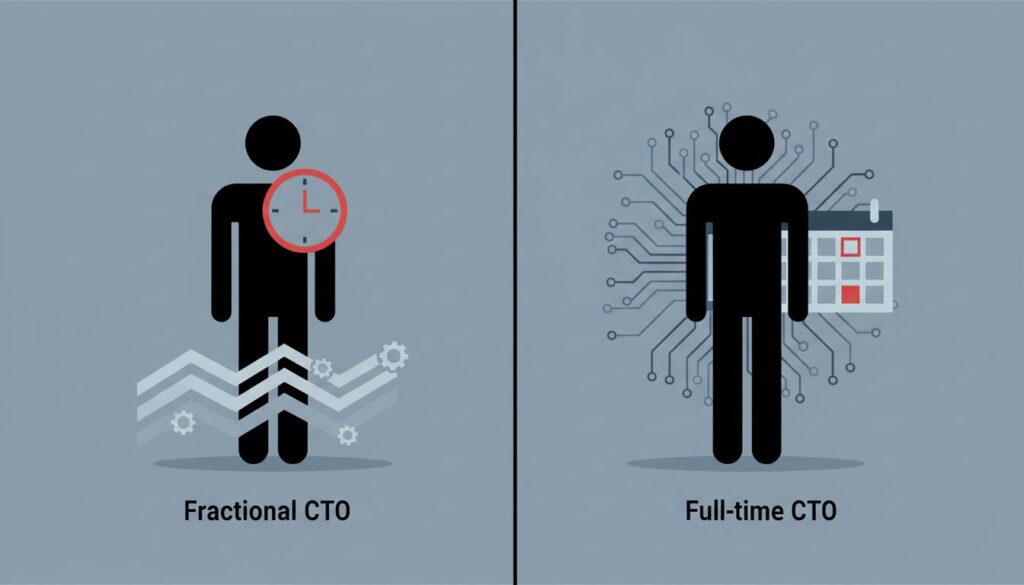
When technology starts shaping growth, risk, and board questions, the wrong leadership choice gets expensive fast. You can pay for more executive depth than you need, or you can try to stretch a part-time answer across a problem that needs daily ownership.
The real question is not which title sounds more impressive. It is which kind of leadership gives you clearer visibility, better decisions, and less drag.
If you’re stuck between a fractional CTO vs full-time CTO decision, start with the pressure you’re under, the shape of your team, and how fast you need someone in the seat.
Key takeaways for choosing the right CTO
- Choose fractional leadership when you need senior judgment now, but not a permanent executive yet.
- Choose full-time leadership when technology is the product, or when the business needs someone embedded every day.
- The wrong choice usually costs more in confusion, delay, and weak ownership than it does in salary alone.
If you need strategy, structure, and speed, don’t confuse that with a full-time hire.
When a fractional CTO makes sense
A fractional CTO fits when your business has outgrown informal leadership, but you do not need a full-time executive yet. That is common when the company is growing, the system has gotten messy, or the board wants better answers before the next big decision.
You may already have capable managers, internal IT, or outside vendors. The problem is not effort. The problem is that ownership is blurry, reporting is weak, and the business still lacks one person who can connect technology to business priorities.
That is where fractional leadership earns its keep. It gives you executive judgment without the long search, full-time cost, or commitment that may be too early for the stage you are in. In 2026, that matters even more. Mid-market companies are using fractional leaders more often because they need speed, flexibility, and cleaner decision-making without waiting months for a hire.

A fractional CTO is often the better fit when you need help with one or more of these:
- a leadership gap that cannot wait
- weak visibility into delivery, spend, or risk
- a major initiative that is slipping
- vendor sprawl that is getting hard to control
- board questions that need clearer reporting
If your team keeps saying, “we are busy, but we still are not aligned,” fractional leadership is usually the cleaner move. If your board needs better reporting, a board and funder reporting readiness checklist can help you spot where the gaps are before the next conversation gets awkward.
For another plain-English take on the tradeoffs, this fractional CTO vs full-time comparison lays out the spend side in a useful way.
When a full-time CTO earns the seat
A full-time CTO makes sense when the business needs daily, embedded leadership, not occasional executive guidance. That usually shows up when technology is central to how you deliver value, not just something that supports the work behind the scenes.
If you are building software as the product, running a large engineering group, or making constant architecture and hiring decisions, part-time leadership can run out of runway fast. You do not need advice once a week. You need someone inside the business every day, hearing the noise, making tradeoffs, and managing the team closely.
That is also true when the company is big enough that technology leadership is now a management job as much as a strategy job. Hiring, coaching, prioritizing, and unblocking people can take more time than a fractional leader can reasonably carry.
A full-time CTO is usually the better call when:
- your engineering or product team needs a daily leader
- technology is a core part of revenue
- the company is scaling fast and every week brings new complexity
- you need one executive to own the long-term technical direction
- the business can support the full cost and the longer search
A full-time hire is not automatically better. It is just better when the work demands full-time attention. If you hire too early, you can lock yourself into a costly seat before the role is fully defined.

The practical difference is about commitment, not status
Here is the simplest way to compare the two.
| Question | Fractional CTO | Full-Time CTO |
|---|---|---|
| How fast can they start? | Days to weeks | Usually months |
| What do you pay for? | Senior judgment and structure | Daily ownership and deep management |
| Best fit | Growth, transition, visibility, and urgent gaps | Core product, larger teams, constant technical decisions |
| Main risk | Not enough daily bandwidth | Paying for more leadership than the business needs yet |
The table says what most boards and operators already know. The right choice depends less on ego and more on the operating problem in front of you.
If you are still unsure, ask one hard question: do you need a leader who can set direction and restore control, or do you need a leader who will live in the work every day? That answer usually tells you which side you’re on.
Common questions before you choose
Can you start fractional and move to full-time later?
Yes, and that is often the smartest path. A fractional CTO can help you stabilize the business, clean up reporting, and define the real scope before you make a permanent hire.
Is a full-time CTO always better for scale?
No. If technology supports the business but is not the product, full-time can be too much too soon. Scale alone does not justify the role. The workload does.
What if you already have strong IT managers?
Then you may need executive oversight, not another manager. Strong managers still need clear priorities, ownership, and board-level reporting. That is where fractional leadership can be the right bridge.
Conclusion
The choice between fractional and full-time is not about which option sounds more serious. It is about which one matches the pressure you are actually carrying.
If you need clarity, faster decisions, and stronger ownership, fractional leadership often gets you there sooner. If you need someone embedded in the business every day, full-time is the right seat. The mistake is hiring for status when what you need is control.
If you want help sorting out which path fits your company now, start with a technology leadership call.