

SEO title: Growth-Stage Technology Leadership and the 90-Day Plan to Regain Control
Meta description: Growth-stage technology leadership is about owners, cadences, and decision rights. Learn why scaling feels chaotic and how to install a simple 90-day operating system.
Slug: growth-stage-technology-leadership-tame-scaling-chaos
You can feel it before you can explain it.
Revenue is up. Headcount is up. Customer demand is real. But inside the business, work keeps sticking to the walls. Projects drift. Priorities change midweek. The same names show up in every escalation. Your team says they need focus, yet everyone is trapped in status checks, rework, and urgent fixes.
This is a familiar growth-stage problem. The company looks more successful from the outside while it feels less controlled from the inside.
If you're a founder, CEO, or COO asking why growth suddenly feels so expensive and chaotic, the answer usually isn't that your people care less or your tools are worse. It's that the informal way you ran technology when the company was smaller no longer works. You don't have a clean operating system for ownership, decisions, and execution.
Why Your Growth Is Creating More Chaos Than Progress
A lot of growth-stage companies hit the same wall.
At first, speed comes from closeness. The founder knows the product well enough to make fast calls. A senior engineer remembers how every system fits together. People solve problems in Slack, over lunch, or by pulling in the one person who “always knows.” That can work for a while.
Then the company grows.
More customers bring more edge cases. More hires mean more handoffs. More vendors mean more moving parts. Suddenly the shortcuts that once helped you move fast start creating drag. Nobody is quite sure who owns the integration issue, the security exception, the reporting delay, or the customer-facing bug that only happens under load.
What this usually looks like on the ground
The symptoms are boring because they repeat everywhere:
- Projects slip without notice: Nobody says a key dependency is blocked until the date is already gone.
- Leadership gets pulled back in: Founders and executives become the approval path for decisions that shouldn't need them.
- Teams work around weak systems: People maintain shadow spreadsheets, side channels, and undocumented fixes.
- Urgency replaces priority: Everything arrives labeled important, so nothing really gets managed.
The business still moves. That's what makes this stage deceptive.
You can still close deals, hire talent, and ship features while the operating model gets shakier underneath. That is why many leaders normalize the friction. They assume this is just what scaling feels like.
Growth doesn't just expose weak systems. It punishes informal leadership that used to feel efficient.
Why this isn't a personal failure
Founders often read this chaos as a judgment on them. It isn't.
You've likely outgrown a style of management that depended on memory, availability, and trust between a small group of people. That was appropriate earlier. It just isn't enough now. Once complexity rises, the company needs something more durable than good intentions and hard work.
What felt like agility becomes confusion at the next stage.
What felt like autonomy becomes unclear authority.
What felt like hustle becomes burnout.
If your company feels busy but not calm, the issue is usually structural. You haven't installed the leadership mechanics that make scaling legible.
The Leadership Gap Hiding Behind Your Tech Problems
Most companies don't have a “tech problem.” They have a growth-stage technology leadership problem.
That's a different thing.
A tech problem sounds like tools, architecture, vendors, or developers. Sometimes those matter. But in growth-stage companies, the repeat pattern is usually leadership failure around ownership and decisions. During the founder-to-operator transition, a critical gap opens around fuzzy ownership and decision leakage, and that creates drag, single points of failure, and what many leaders feel as a quiet coordination tax in fire drills and status hunts, as noted in this founder-to-operator transition analysis.

What the leadership function actually does
Technology leadership is not just a title. It's a function that makes the business answer three basic questions clearly:
- Who owns this
- What decision was made
- How do we know the work is moving
When those answers are vague, even strong teams struggle. Work gets debated twice. Risks sit between departments. Vendors start shaping priorities because nobody inside is governing the tradeoffs tightly enough.
This is why some companies with capable engineers still feel disorderly. Engineering can build. Operations can hustle. Security can raise concerns. Product can prioritize. But if nobody governs the whole system, the company accumulates friction faster than it accumulates output.
Where leaders get misled
Leaders often invest in new software before they fix ownership.
That's backward.
A roadmap tool won't save you if nobody can decide what gets deferred. A monitoring tool won't restore trust if incident ownership is split across three teams. More dashboards won't help if the underlying work isn't assigned to a named owner with authority.
Practical rule: If the same issue keeps resurfacing, the missing piece is usually decision clarity, not another platform.
This is also where adjacent functions matter. If product leadership is weak or overloaded, technology gets dragged into reactive delivery. That's one reason resources like Product Management as a Service can help a scaling company tighten planning and product decisions without overbuilding the org chart too early.
If you're trying to understand what this leadership role should look like in a scaling business, this guide to a technology leader for growing companies is a useful reference point. The point isn't to add ceremony. It's to make execution inspectable.
Three Failure Modes That Stall Scaling Companies
Monday starts with a roadmap meeting. By Wednesday, the founder is breaking a deadlock between product and engineering. By Friday, a senior engineer is manually fixing a customer issue because nobody trusts the billing integration enough to leave it alone. That pattern is not a capacity problem. It is a leadership operating problem.
Scaling companies usually stall in three predictable ways. Each one points to the same gap. The business has outgrown informal coordination, but nobody has installed clear owners, decision rights, and review cadences.
Hero dependence turns speed into fragility
A few people become the system.
They are the architect who remembers every exception, the founder who settles priority fights, or the operations lead who knows which workflow will break if the team touches the wrong service. Early on, this feels efficient. Later, it creates a hidden queue for every important decision.
Once that happens, speed becomes inconsistent. Work waits for one person to review it, explain it, approve it, or rescue it. Knowledge stays trapped in heads instead of showing up in runbooks, service ownership, and routine review forums. The company calls this high standards. What it has is concentrated dependency.
Manager load usually makes this worse. The Center for Creative Leadership notes that a manager's effectiveness declines as direct reports increase beyond a manageable level because coaching, oversight, and decision quality all suffer under excessive span of control, especially in fast-changing environments (Center for Creative Leadership on span of control). If one leader carries too many reports and too many escalations, bottlenecks are guaranteed.
Unmanaged technical debt becomes an operating tax
The second failure mode hides behind the shipment count.
The team is still releasing code, so leadership assumes the engine is healthy. Underneath, core services age, dependencies drift, alert noise rises, and integrations get harder to change safely. Engineers start budgeting extra time for every release because the system has become unpredictable.
McKinsey found that companies with modernized technology environments can deliver software far more efficiently than peers stuck with fragmented legacy complexity, and that technical debt acts as a material drag on delivery speed and business agility (McKinsey on the business cost of technical debt). That is the right way to view debt at this stage. It is not a purity issue for engineers. It is a recurring tax on roadmap confidence.
The symptoms are easy to spot:
- Small changes trigger large testing effort.
- Incident follow-up keeps getting deferred.
- Estimates include wide buffers because hidden dependencies are everywhere.
- Teams avoid touching brittle systems, so the risky parts of the stack get riskier.
You do not need to clean up everything at once. You do need an explicit owner for technical debt, a monthly review of the highest-cost areas, and a rule that every roadmap carries maintenance work alongside feature delivery.
Micromanagement crushes the middle layer
The third failure mode shows up after the org chart expands.
A strong individual contributor becomes a manager or tech lead, but the company never defines what decisions they own, which ones need review, and which ones should never rise upward. So that person keeps acting as the approval point for architecture, delivery choices, production changes, and cross-functional tradeoffs. Soon, every team is waiting.
Gallup has repeatedly found that managers account for a large share of the variance in team engagement and performance (Gallup on the manager's role in performance). In a scaling technology organization, that cuts both ways. Good managers create clarity and throughput. Overinvolved managers become routing layers that slow both.
This failure mode is expensive because it spreads beyond engineering. Product cannot get timely decisions. Operations cannot get clean handoffs. Security reviews arrive late because nobody knows who can sign off without pulling in the same overstretched lead again.
If managers need to touch everything, decision rights are broken.
That is the pattern across all three failure modes. The company does not need more hustle. It needs a simple technology operating system. Named owners for systems and outcomes. Clear thresholds for which decisions stay with teams and which escalate. Weekly and monthly cadences that force risks, dependencies, and tradeoffs into the open before they become chaos.
A Maturity Model to Assess Your Tech Leadership
Most leaders know they're frustrated. Fewer can place the business clearly on a maturity curve.
That matters because you can't fix what you're still describing vaguely. A simple maturity model gives you a clean diagnosis.
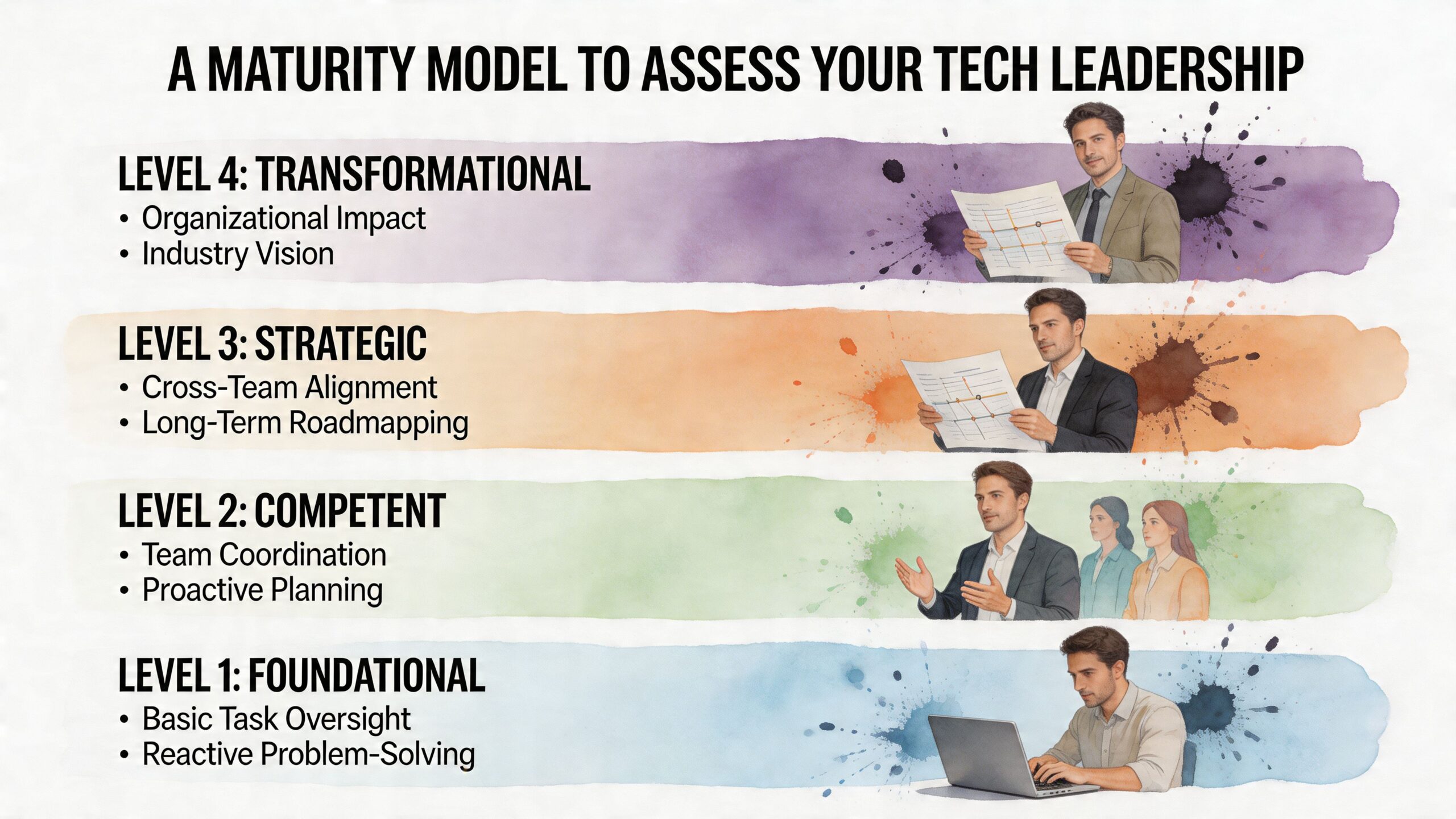
Stage 1 reactive and heroic
The company runs on responsiveness.
Decisions happen in chat, meetings, and side conversations. Roadmaps shift often. Incidents depend on whoever is available. Vendors may know more about system reality than leadership does. Work gets done through effort, memory, and heroics.
Typical signs include:
- Ownership is implied: Everyone “thought someone else had it.”
- Reporting is shallow: Leadership gets activity updates, not clear risk or progress signals.
- Risk feels surprising: Issues become visible only when they disrupt delivery or customers.
Stage 2 aware and fragmented
At this stage, leaders know the current model isn't enough.
Some structure exists. There may be a roadmap, ticketing discipline, or regular standups. But the pieces don't connect. Product plans, engineering work, operational readiness, and security obligations still live in separate streams. Ownership exists in spots but not end to end.
Many growth-stage companies commonly stall. They know enough to see the mess, but not enough to govern it calmly.
A fragmented company can look organized in each department while still failing at the seams.
Stage 3 defined and managed
Now the company starts acting like a system.
Key domains have clear owners. Core meetings have a purpose. Decision rights are explicit enough that teams know who can approve, defer, or escalate. Technology and business priorities connect in a way senior leaders can inspect.
You'll usually notice three shifts:
- Escalations get narrower
- Plans become more believable
- Board and executive reporting gets crisper
Stage 4 strategic and optimized
Technology leadership evolves into a business advantage rather than a stabilizing function.
The company doesn't just react well. It chooses well. Leaders can explain where technology creates value, where risk sits, and what tradeoffs are being made. Teams operate with autonomy because the rules, ownership, and rhythms are already clear.
You don't need to obsess over reaching some idealized endpoint. Most growth-stage companies need to move from Stage 1 or 2 into Stage 3. That's where chaos starts to recede and trust starts to return.
How to Install a Technology Operating System
You don't fix this by buying another platform. You fix it by installing a simple operating system for technology leadership.
That operating system has three parts. Clear owners, calm cadences, and explicit decision rights. If one is missing, execution gets noisy again.
Start with owners not org charts
A lot of companies confuse ownership with seniority.
Ownership means one named person is accountable for a domain, a decision, or an outcome. Not a committee. Not “engineering.” Not “ops and product together.” One owner. Other people can contribute, advise, or approve, but the owner carries the thread.
The first pass should cover practical domains such as:
- Core systems: Who owns reliability, dependencies, and maintenance
- Vendors: Who owns renewals, risk review, and overlap
- Data and reporting: Who owns definitions, quality, and access
- Security controls: Who owns exceptions, evidence, and response readiness
Build a weekly rhythm that lowers noise
Good cadence reduces escalation because teams know where issues belong.
You need fewer meetings than most companies think. You just need meetings with a clear job. If you want a deeper planning lens, strategic technology planning for growing companies helps connect day-to-day execution with longer-term priorities.
Here is a simple example.
| Meeting | Frequency | Owner | Attendees | Purpose & Decision Rights |
|---|---|---|---|---|
| Sample Technology Operating Model Cadence | ||||
| Weekly tech sync | Weekly | Technology lead | Engineering, product, ops, security as needed | Review delivery, blockers, incidents, and dependencies. Decide what gets escalated, reassigned, or deferred this week. |
| Risk and reliability review | Weekly | Ops or security owner | Technology lead, infrastructure, relevant managers | Review open risks, control gaps, vendor issues, and incident follow-up. Decide owners and due dates. |
| Product and technology planning review | Biweekly | Product or technology lead | Product, engineering, executive sponsor | Confirm roadmap tradeoffs, sequencing, and capacity constraints. Decide what won't be worked on now. |
| Executive visibility review | Monthly | Executive sponsor | CEO, COO, finance, technology lead | Review progress, risk, spend, and decisions requiring executive alignment. |
| Roadmap and architecture review | Quarterly | Technology lead | Executive team, product, engineering | Evaluate major changes, platform bets, debt reduction priorities, and vendor fit. Decide strategic direction and investment priorities. |
Make decision rights visible
This part is usually missing.
Teams need to know who can say yes, who can say no, who can recommend, and who must be consulted. A lightweight RACI can help, but don't turn it into theater. Use it where decisions keep leaking or circling.
One practical option is to assign decision rights across a few categories:
- Delivery decisions: Team leads decide within agreed scope and standards
- Priority decisions: Product and executive sponsor decide based on business goals
- Risk acceptance decisions: Named executive owner decides after input from technology and security
- Vendor decisions: Business owner and technology owner decide together, with finance informed
The goal isn't bureaucracy. The goal is to stop rediscovering how decisions get made every week.
If you need outside help installing this layer, options range from internal operating discipline to a fractional leader. One route companies use is CTO Input, which provides fractional executive technology leadership focused on clarifying ownership, governance, and execution in growth-stage settings.
Your 90-Day Plan to Stabilize and Simplify
Most companies don't need a grand transformation first. They need relief.
The right growth-stage technology leadership move is usually a short stabilization cycle that reduces noise, reveals ownership gaps, and creates a calmer rhythm. A good 90-day plan should produce visible control quickly.

First 30 days stabilize
The first month is about making reality legible.
Don't start with a reorg. Start with visibility. You want a working map of systems, vendors, current initiatives, and operational pain points. If you inherit a messy environment, you then separate stories from facts.
Focus on a few moves:
- Map active vendors: List every platform, contract owner, business purpose, and overlap.
- Name single points of failure: Identify the people, systems, or workflows that would stall the business if they disappeared tomorrow.
- Stand up one weekly leadership cadence: Use a simple meeting to review blockers, open risks, and ownership changes.
- Create one issue register: Put incidents, dependencies, and delivery risks in one place with named owners.
A useful reference for this phase is what the first 90 days with a fractional CTO should cover. The point isn't to copy a template blindly. It's to create enough structure that decisions stop evaporating.
Days 31 to 60 simplify
Once you can see the mess, reduce it.
Many companies get immediate relief. They don't need more tooling. They need less duplication and fewer unresolved dependencies. Simplification means shrinking the surface area that leadership has to keep in its head.
Good targets include:
- Vendor overlap: Consolidate tools that serve the same basic function
- Unowned workflows: Document the critical handoffs in onboarding, customer support, incident response, and reporting
- Recurring approval loops: Remove approvals that don't meaningfully change outcomes
- Debt hotspots: Start a maintenance cadence for old dependencies, brittle integrations, and neglected services
During this phase, clarity matters more than elegance. A plain document used weekly beats a complex system no one trusts.
Days 61 to 90 sustain
By the final stretch, the goal is a defensible operating model.
That means named owners are in place for key domains. Core meetings happen on rhythm. Open issues are visible. Leaders know what is blocked, what risk has been accepted, and what is moving as planned.
The company should be able to answer practical questions without drama:
- Who owns each core system and vendor relationship?
- Which risks are open, and who is driving them down?
- What decisions are pending executive input?
- Where is delivery slipping, and why?
Calm doesn't come from fewer problems. It comes from a system that can absorb problems without turning every week into a scramble.
If your business can answer those questions cleanly, you're no longer relying on effort alone. You're operating.
Key KPIs for Technology Health and Business Value
A growth-stage company usually does not need more metrics. It needs fewer metrics with clear owners, a review cadence, and an agreed action when a number moves the wrong way.
That is the point of KPI design at this stage. You are not building a trophy dashboard for the board. You are installing a control system for the business.
Measure whether technology decisions are turning into business results
Start with indicators that show whether planned work is finishing, getting used, and changing an outcome the business cares about. If a metric cannot drive a decision in a monthly leadership review, cut it.
A practical set usually includes:
- Roadmap reliability: planned versus completed work for the period
- Adoption of shipped capabilities: whether teams or customers are using what was released
- Business impact from delivered work: revenue contribution, margin improvement, cost removed, or cycle time reduced
- Escalation rate: how often senior leaders have to step in to unblock routine execution
- Decision latency: how long important product, architecture, or vendor decisions sit unresolved
The last two matter more than many founders realize. If executive escalations keep rising and decisions sit open for weeks, your operating system is weak even if delivery charts look healthy.
If you need a clean format for leadership reporting, this key performance indicator report template is a useful starting point.
Measure whether the business is actually in control
System health is broader than uptime. A company can hit availability targets and still be poorly run.
Track the controls that show whether responsibility is explicit and risk is managed before it turns into a fire:
- Critical systems with named owners
- Open high-severity risks or incidents
- Average age of unresolved issues
- Percentage of key vendors reviewed on schedule
- Known exceptions without an approved owner and deadline
- Repeat incidents caused by the same root issue
These metrics expose a common failure pattern. Problems are visible, but no one is clearly accountable for closing them. That is a leadership design issue, not a tooling issue.
Data quality belongs in this view too. IBM explains that poor data quality increases operational cost, weakens decisions, and undermines analytics outcomes in its overview of data quality and why it matters. If the inputs are unreliable, the report becomes status theater.
Keep the board report on one page
A useful monthly technology report should be brief enough to read in five minutes and specific enough to trigger action.
| Reporting area | What leadership needs to see |
|---|---|
| Delivery | What shipped, what slipped, and which decisions are blocking progress |
| Adoption and value | Usage, commercial impact, or efficiency gains from recent releases |
| Risk | Top open risks, owner for each, due date, and current exposure |
| Reliability | Material incidents, repeat causes, and corrective actions in flight |
| Spend and vendors | Variance, overlap, renewals coming up, and decisions needed |
If your board packet cannot answer these three questions, fix the report. Are we delivering what we said. Are the main risks under control. Is technology improving business performance.
Stop Paying the Coordination Tax
Monday starts with a roadmap review. By Wednesday, the roadmap is already wrong. Sales promised a date engineering did not approve, product changed priority after a customer escalation, and your leadership team is spending another Friday afternoon reconciling three different versions of reality.
That is the coordination tax.
Growth creates it when the company adds people, vendors, tools, and priorities faster than it adds operating discipline. The result is familiar. More meetings. More status checking. More rework. More decisions reopened because nobody knows who had the call in the first place.
The fix is a technology leadership system with three parts: clear owners, fixed cadences, and explicit decision rights. Founders who skip this step keep paying for the same confusion in salary, delays, incident recovery, and missed revenue.
As noted earlier, the market is rewarding companies that build stronger technology leadership. The point is simple. Better operating discipline is now a competitive advantage, not an internal hygiene project.
What better looks like
A healthy growth-stage company does not run on heroics. It runs on a simple operating system that people can follow under pressure.
You should be able to ask who owns platform reliability, vendor rationalization, delivery commitments, security exceptions, and architecture decisions, and get one name for each. You should know which meeting handles each issue, how often it happens, what decision can be made there, and what gets escalated. If those answers change depending on who is in the room, you do not have a scaling problem. You have a leadership design problem.
The payoff is practical. Fewer handoff failures. Less status theater. Faster decisions. Less duplicate tooling. Better board conversations because the company can explain what is happening, who owns the risk, and what happens next.
You do not need more activity. You need a system people can trust.
If your company still feels chaotic after adding experienced people, stop blaming communication quality or team maturity. Install the missing operating system. Assign owners. Set the weekly and monthly cadences. Define who decides what. Hold that structure for 90 days without drifting back into improvisation.
If technology is slowing growth, blurring accountability, or making board questions harder to answer, a Clarity Call with CTO Input is a practical next step. In one conversation, you can surface the main bottlenecks, identify trust risks, and get a straightforward view of what the first 30 days should look like.