
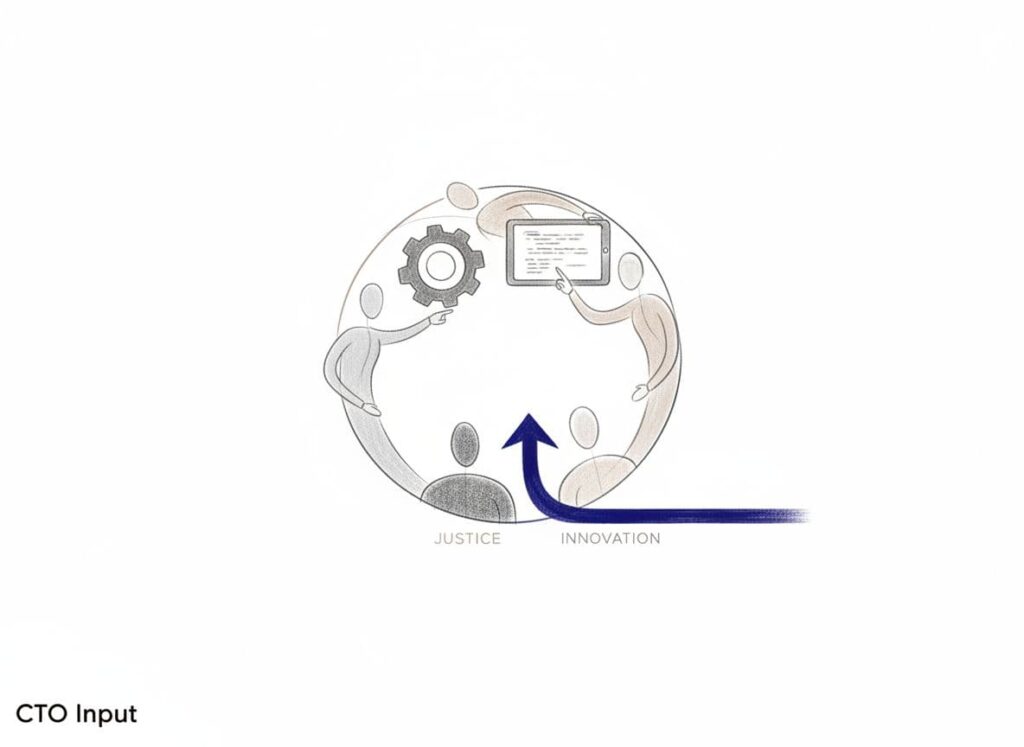
Your organization runs on intake forms, urgent emails, grant deadlines, and partner calls. Underneath, there is a messy tangle of legacy systems, case systems, shared drives, spreadsheets, and tools that no one fully trusts.
Staff copy the same data into three places. Grant reports require late-night spreadsheet marathons. Security and privacy feel fragile, especially where youth, immigration, or incarceration are involved and the rule of law is at stake. People are tired.
The real question is simple: how to align operations and technology in justice focused organizations so that systems actually support access to justice instead of slowing it down.
This is not a call to rip everything out and buy a shiny new platform. It is a practical path for digital transformation to make the tools you have, and the ones you will add, match the work your teams do every day.
Key Takeaways: How to Align Operations and Technology in Justice Focused Organizations
 – See your work clearly by mapping a few critical journeys from intake to impact.
- Turn those maps into a short list of gaps across process, data, justice tech, and support.
- Focus your first changes on operations alignment through shared data and workflows that reduce chaos and manual reporting.
- Use security and privacy as design constraints so staff do not have to choose between care and compliance.
- Build light governance and, when needed, fractional technology leadership for aligning technology decisions with operations in justice focused organizations over time.
Start With Mission and Real Work, Not With Tools
Real alignment starts before any software demo. It starts with your mission, strategy, and commitment to the rule of law, and how work actually happens on the ground.
Funders want impact stories on racial justice and equity and clean data. Communities want access to justice, care, and results. Staff want tools that do not fight them. You only get all three when operations and technology share the same picture of reality for accountability.
Business process analysis comes first. That means sitting with program leads, clinic teams, finance, development, and network partners in collaboration. Ask them to show you the actual clicks, files, and workarounds they use to get from intake to decision to outcome.
Resources like the Stanford Legal Design Lab’s key areas for justice innovation in human rights can help you think about justice journeys in human terms, not just system fields.
Map your critical journeys from intake to impact
Pick two or three journeys that matter most:
- A person seeking legal assistance, from intake to referral or representation.
- A grant or contract, from award to reporting.
- A partner network, from first training to shared campaign or case.
Draw each one on a single page. No fancy software needed.
Ask simple questions about judicial processes and systems: What happens first, then what, then what? Who touches the work at each step? Where do they store information? Which tools or forms do they use?
Mark the rough spots:
- Duplicate entry into different systems.
- Missing or inconsistent data.
- Long waits for a decision or approval.
- Steps that rely on “only one person knows how to do this.”
You are not hunting for blame. You are building a shared map of how justice work really moves through your organization today.
Name the gaps between operations, data, and systems
Next, turn those maps into a short list of alignment gaps.
Common patterns:
- Staff enter the same client data into three systems.
- Finance and programs use different numbers for the same grant.
- Every grant report needs custom spreadsheets to glue data together, highlighting the need for an interoperability platform.
- Security rules are unclear for case notes or partner files.
Group the gaps into a few buckets:
- Clarity and process.
- Data and reporting.
- Tools and integrations.
- Skills and support.
This turns a vague “our tech is a mess” feeling into a concrete agenda. The goal is not perfection. The goal is a clear picture of where systems fail the work and where small changes could make a big difference.
Design Simple Alignments Between Operations and Technology
Once you see the gaps, you can design a short, believable alignment plan. One your staff can feel.
Focus on practical changes that lower stress, improve reporting, and reduce risk within months, not years. Legal aid resources like the LSC Model Practices for technology for legal services organizations (LSOs) show how peers are doing this in a grounded way.
Choose a small set of shared data and workflows to fix first
Do not try to fix everything. Choose one to three high-leverage areas.
Examples:
- A standard client intake dataset across immigration clinics.
- Shared outcome fields for youth programs, so every site tracks the same basics.
- A common way to track training events across a national network.
Agree on “good enough” standards that protect privacy, support racial justice and equity. Keep the number of required fields small. Make sure the terms you use are respectful and consistent with community language.
When these shared pieces are clear, grant and board reporting gets easier and more trusted. People stop arguing about whose numbers are “right,” and start asking what the numbers mean.
Use technology to remove manual work, not add new chores
 For each priority workflow, walk through the steps again and ask:
What can be automated with algorithms or artificial intelligence (AI)? What must stay human?
Practical moves:
- Automatic reminders for documents, so staff do not have to chase people by email.
- Simple integrations between case management and finance, so you do not retype matter IDs and hours.
- Document assembly for repeat reports, with fields that pull from your systems instead of manual copy-paste.
Any new system or configuration, like expert systems, should improve efficiency by reducing clicks and spreadsheets for staff within the first 3 months. If it does not, you have the wrong design or the wrong problem.
Start with current tools where you can, to prevent them from becoming legacy systems that hinder future progress. Then fold larger upgrades like mobile technologies into a 1 to 3 year roadmap for justice systems modernization, similar to the staged approach in the NIJ Criminal Justice Technology Adoption Guide.
Build data security and privacy into everyday workflows
Security cannot live in a policy binder that no one opens. It has to be baked into daily work.
Keep it simple:
- Clear rules about who can see what, based on role.
- Safe ways to share case or research data with partners, with time-limited links and access logs.
- Strong defaults for sensitive groups, like youth, immigrants, or people facing detention.
Aim for role-based access, secure document sharing, and basic audit trails. These help with funder, ethics, and regulator expectations, and they protect the people you serve.
Good alignment means staff do not have to choose between doing the right thing for a client and following security rules. The safest path should also be the easiest path.
Make Alignment Stick With People, Governance, and Outside Help
Tools change. People and governance keep alignment alive.
Your goal is a light, steady structure for operations alignment that can survive staff turnover, new grants, and platform shifts.
The Recidiviz guidance on adopting criminal justice technology highlights the same theme: operational ownership is as important as any feature list.
Give operations and technology shared ownership of change
Create a small cross-functional group fostering collaboration. Include operations, programs, and whoever leads technology or data.
Their job, aligning technology decisions:
- Keep the journey maps current.
- Set 90 day priorities for process, data, and system changes.
- Decide when to change tools, rules, or both, streamlining the procurement process.
Short, focused check-ins beat long, wandering committees. This shared ownership also gives executives a clear story of accountability to bring to boards and funders: technology decisions are linked to real workloads, not vendor pressure. Sound governance here provides a defensible story to the board, upholding the rule of law.
Invest in training and change support that fits your staff
Tech change fails when staff feel blamed, rushed, or ignored.
Keep support practical:
- Short live demos tied to real tasks, not abstract features.
- Office hours for questions.
- Written how tos with screenshots.
- Peer “super users” inside programs who can help in context.
Hold listening sessions with frontline staff and partner organizations. Ask where things feel confusing or slow. Adjust workflows before you lock them into tools, not after.
When to bring in fractional technology leadership
At some point, the complexity outgrows your internal bench.
Signals it is time to bring in fractional technology leadership:
- Constant reporting fire drills for major grants or the board.
- Growing cyber risk or compliance questions that no one owns.
- Stalled platform projects with rising costs and no clear outcome.
- A board asking for a technology and data strategy that operations cannot write alone.
A seasoned fractional CTO or CIO can translate mission and operations into a roadmap, pick the right level of tooling, and coach internal staff without pushing a single vendor. CTO Input specializes in this role for justice focused organizations, acting as a calm, senior partner without the cost of a full-time executive.
Common Questions on Aligning Operations and Technology in Justice Work
What should we fix first if our systems are a mess?
Start with one or two critical journeys, like client intake for civil legal needs or grant reporting. Fix the shared data and workflow issues there before touching everything else.
How long does it take to align operations and technology in mid-sized legal services organizations (LSOs)?
You can see real relief in 3 to 6 months if you focus on a few high-impact workflows. Full alignment through justice systems modernization, including judicial processes, is a 1 to 3 year effort, but it should pay off in stages, not only at the end.
Do we need a new case management system to get started?
Not always. Many wins come from clearer processes, shared data standards, and light integrations, including artificial intelligence (AI), on top of what you already have.
How do we talk with funders about tech investments?
Tie every tech dollar to impact on access to justice, equity, and risk. Show how better alignment will give cleaner outcome data, data security and privacy for sensitive information, and more staff time, improving efficiency for frontline advocates to provide better legal assistance.
Conclusion: A Calmer Path to Aligned Systems
You do not need a full rebuild to better align operations and technology in justice focused organizations. You can start with a pen, a whiteboard, and honest maps of how work really moves. From there, you name gaps, fix a few shared workflows and data standards, and put simple governance in place.
Progress in 3 to 6 months is realistic if you keep the plan small and concrete. If you want a calm, defensible roadmap covering informed technology decisions for your board and funders, and a senior partner who understands justice tech ecosystems, CTO Input can help you do that work and stand behind it with your board and funders. When you are ready, schedule a strategy call with our team and achieve a digital transformation that puts your systems back in service of your mission, instead of the other way around.