

Your technology roadmap isn't yours anymore. It's a patchwork of vendor release cycles, aggressive sales promises, and "urgent" upgrades you're paying to maintain. The cost is more than money. It's the constant chaos, the project delays, and the sense that you are reacting, not leading. If this feels familiar, it’s because this pattern is common in organizations where ownership is ambiguous.
The first step to regaining control is to stop vendors from driving your roadmap. It requires a clear decision and a simple operating cadence.
The Real Problem: A Broken Operating System

You have smart people and you've invested in good tools. So why does it feel like you are still stuck in a cycle of vendor-driven chaos?
The problem is not your people or your tools. It's your company’s operating system: the way you make decisions, assign ownership, and govern technology. When this system is ambiguous, it creates the perfect environment for vendors to thrive. They find department heads and project managers, pitch a "strategic" new feature, and exploit the lack of clear authority to close a deal.
This creates a massive, unseen expense called the coordination tax. It’s the sum of all the endless status meetings and frantic emails your team runs because a vendor bypassed your process and sold a new tool directly to a business unit. Every time this happens, you pay the tax in project delays, security risks, and rework.
We see this constantly. A department, trying to solve a real problem, buys a tool the vendor promised would integrate seamlessly. Six months later, the tool doesn't work with your core systems, the team that bought it cannot manage it, and your engineers are stuck with another security vulnerability. This is why a formal third-party risk assessment is non-negotiable.
Smart teams fall into this trap because their operating model is based on implied trust, not explicit rules. But heroics don't scale. They just lead to burnout. To fix this, you must fix the system.
The Decision: Name One Owner for Vendor Governance

To stop vendors from driving your roadmap, you must make one decision. You must explicitly define who, and only who, has the authority to approve spending and projects involving outside vendors.
This is not about creating red tape. It’s about creating a clear guardrail to protect your strategy and budget.
The simplest way to do this is to name a single, accountable owner for vendor governance. This cannot be a committee. This leader’s job is not to say "no" to everything, but to ensure every vendor proposal is measured against your business priorities, not a salesperson’s quarterly quota. Their one question for every request is: "Which strategic objective does this support, and where is the proof?"
Making this one decision moves procurement from a scattered, invisible activity into a centralized, inspectable function.
| Area | Chaos State (Vendor-Driven) | Controlled State (Business-Driven) |
|---|---|---|
| Decision-Making | Anyone can say "yes" to a vendor pitch. | A single, designated owner approves all new commitments. |
| Budgeting | Unpredictable, with costs spiraling from unvetted projects. | Protected and aligned with strategic priorities. |
| Team Focus | Engineers get pulled into random, low-value work. | Teams execute on a planned, prioritized roadmap. |
| Risk Management | Unmanaged vendors create silent security and data risks. | Every new partner is vetted, onboarded, and managed deliberately. |
This is the shift from implied authority to inspectable governance. From a board perspective, it demonstrates responsible management of delegated authority and third-party risk.
This decision also clarifies how you use external talent, which is critical for control. Comparing models like in this strategic guide comparing Staff Augmentation vs. Managed Services becomes a strategic choice, not a reactive one. And as your team's capacity is finite, this focus is essential to how to prevent employee burnout.
The 30-Day Move to Restore Control

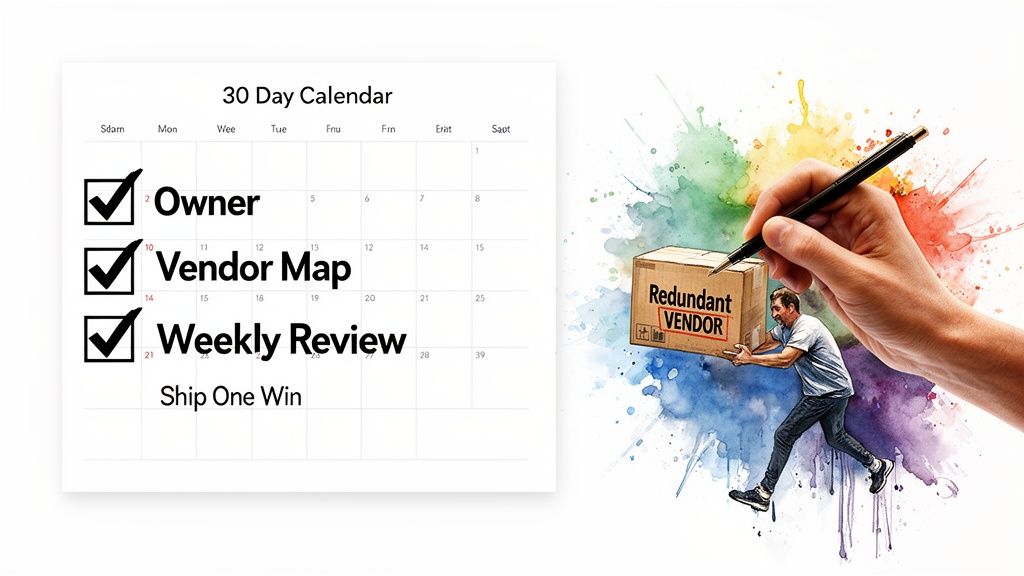
Talking about vendor bloat is not a plan. You need a deliberate, 30-day move designed to deliver immediate results and build momentum. This approach breaks the problem into manageable weekly sprints, proving that progress is possible now.
Week 1: Name the Owner and Define the Outcome. Your first move is to name a single person who owns vendor governance. Their first task is to define the mission in one sentence, like: "All vendor spending above $5,000 must be approved and aligned with a documented business priority."
Week 2: Map the Handoffs and Define Done. The owner creates a simple inventory of all active vendors. A spreadsheet with four columns is enough: Vendor Name, Annual Cost, Internal Sponsor, and Renewal Date. The goal is not a perfect audit; it is to make the invisible visible. This inventory is your single source of truth and a key input for application portfolio rationalization.
Week 3: Remove One Major Blocker and Ship One Visible Fix. The owner identifies one clear target and takes action to build credibility. This could be offboarding a redundant vendor, consolidating licenses for an underused tool, or renegotiating an upcoming contract. Shipping a real result proves this initiative is about action, not just more meetings.
Week 4: Start the Weekly Cadence and Publish a One-Page Proof Snapshot. The owner puts a 30-minute weekly review on the calendar. The agenda: review new vendor requests, check progress on offboarding targets, and identify blockers. This transforms vendor management from a chaotic fire drill into a predictable and effective operating rhythm.
Proof: What to Track for Inspectable Governance
Feelings of control are not evidence. To make this new system stick, you must prove its value to the board, your leadership team, and skeptical managers. This means tracking a few key numbers that translate operational wins into the language of governance: risk reduction and reliable execution.
Your goal is a simple, one-page ‘Proof Pack’ to share monthly. It is your defensible evidence that the new system is working.
Start with three metrics that prove you are learning how to stop vendors from driving your roadmap:
- Total Number of Active Vendors. This is your measure of vendor sprawl. A flat or declining number proves you are managing your footprint instead of letting it grow unchecked.
- Percentage of Spend Aligned to Strategic Initiatives. Map every vendor dollar to a top-three company goal. A rising percentage shows you are redirecting money from reactive work to high-value initiatives.
- Reduction in Unplanned, Vendor-Initiated Work. Count the "urgent" requests that pop up because a vendor is pushing their agenda. When this number drops, it's direct proof that your governance is working.
This is not just an IT report; it's a governance tool. It provides the board with evidence that delegated authority is being managed responsibly. As noted in a more detailed analysis of vendor prioritization, firms that implement transparent review cadences can slash wasted development spending by up to 30%. That is inspectable progress that stands up to diligence or an audit.
Your one-page proof pack should be simple enough for any executive to grasp in 60 seconds.
This simple artifact makes your progress undeniable. It proves you are systematically building a more resilient, focused, and governable organization.
Restore Your Roadmap, Reduce Your Risk
The constant firefighting and endless meetings to align vendor projects are the coordination tax you pay for an ambiguous operating system. It leads to delayed projects, a burned-out team, and a technology stack that serves your vendors more than your business.
The solution is not more policies or another tool. It is a commitment to a governable operating system where decisions and ownership are explicit and visible. By naming one owner and running a disciplined weekly review, you shift from being reactive to being in control.
At CTO Input, we provide fractional and interim CTO, CIO, and CISO leadership. We restore clear ownership, clean decisions, and reliable execution. We are not an MSP or a report-dropper; we install a practical operating system to reduce your coordination tax and risk exposure.
Ready to start?
Book a Clarity Call with CTO Input. In one focused session, we'll help you map out a 30-day plan to restore control.
Not ready for a call?
Download our Vendor Inventory and Offboarding Checklist to make your vendor footprint visible and manageable today.
Isn't it time to take back your roadmap?