

Technology usually feels chaotic long before leadership admits it. Spend goes up. Meetings multiply. The same projects stay “in progress” for months. The board asks for a simple update and gets a long explanation instead.
That isn’t a tooling problem. It’s an it strategy and roadmap problem.
If you’re the CEO or COO, you don’t need another technical presentation. You need to know what’s driving the noise, who owns the outcomes, what gets done first, and how to make technology support growth instead of draining attention. The fix is not more software, more vendors, or more heroic effort from your team. The fix is a practical roadmap with clear priorities, clear decision rights, and a weekly rhythm that makes execution inspectable.
Why Your Technology Feels Chaotic and Expensive
The pattern is usually easy to recognize.
You approve technology spend because the business is growing, customers expect more, risk is rising, or a system is obviously overdue for attention. A few months later, the spend is real but the confidence isn’t. Teams still chase updates in Slack. Leaders still ask who owns what. Every problem becomes urgent because no one trusts the plan.

That’s the coordination tax. It shows up as status hunts, duplicate work, meeting overload, fuzzy approvals, and projects that move only when a senior leader intervenes. The business pays for that tax in slower execution, weaker reporting, tired managers, and growing doubt about whether technology is helping at all.
Growth exposes the cracks
This often starts when a company outgrows informal leadership. What worked at a smaller stage stops working when there are more systems, more vendors, more risk, and more people touching the same process. The team keeps operating on implied ownership, tribal knowledge, and goodwill. Then pressure rises and the whole thing starts to wobble.
If you’re trying to improve operational efficiency, technology often gets in the way instead of helping. The issue usually isn’t that your team is lazy or incapable. It’s that the operating model is unclear, so work keeps leaking between handoffs.
When everything is urgent, nothing is prioritized. When no one can see the real queue, every interruption looks important.
Spend without a plan creates more complexity
A lot of leaders feel this tension right now because the market keeps pushing digital investment. Global spending on digital transformation is projected to hit $3.9 trillion by 2027, according to digital transformation market projections. Without a clear plan, that money doesn’t automatically create control. It often creates more systems, more integrations, more pilots, and more confusion.
The visible symptoms tend to look like this:
- Projects drag: Delivery dates keep moving because dependencies were never made visible.
- People burn out: Good operators spend too much time coordinating instead of finishing.
- Reporting gets weaker: Leadership hears activity updates, not business outcomes.
- Board confidence drops: Questions about risk, cost, and progress get longer answers than they should.
Technology chaos is rarely random. It’s usually the business signal that execution has outgrown improvisation.
The Real Reasons Your IT Strategy Is Failing
Most leaders assume the problem is technical complexity. It usually isn’t.
The deeper issue is that the business has technology activity without technology governance. Work is happening. Money is being spent. Vendors are making promises. But no one has forced those moving parts into a coherent system for decisions and accountability. That’s why so many plans look busy and still fail.
The failure starts with execution, not effort
According to analysis of strategic initiative failure patterns, 70-95% of large-scale strategic initiatives fail. The main causes are not technical. They’re execution failures: misalignment between IT and business goals, poor prioritization, and weak change management.
That should change how you diagnose the problem.
If your team keeps saying the roadmap slipped because of dependencies, bandwidth, or changing requirements, don’t stop there. Those are surface explanations. The core question is why the business allowed unclear priorities and weak ownership to sit in the system in the first place.
Fuzzy ownership breaks delivery
A project with five stakeholders and no single accountable owner is not well supported. It is ownerless.
CEOs and COOs often find themselves trapped. They hear that a project is “cross-functional,” which sounds sensible. In practice, it often means no one can force a decision, no one is carrying the outcome, and every delay gets explained away as collaboration. That’s how status meetings multiply while finished work stays scarce.
Here’s the test. Ask a direct question: who owns the business result, not the task list? If the room gets quiet, your roadmap is weak.
Vendor capture is more common than leaders think
The second failure mode gets less attention, but it’s one of the most damaging. Vendors begin to shape the roadmap.
A platform provider wants a migration. A security vendor wants another module. An AI vendor wants a pilot. A cloud partner wants you deeper into their stack. Each pitch sounds reasonable on its own. Collectively, they hijack the sequence of work and pull attention away from what the business needs.
That’s why I often tell leaders to spend time reading beyond vendor content. Even broad strategic insights from leading DevOps books can help executives see the pattern. Delivery improves when teams reduce handoff confusion and align work to outcomes, not when they merely buy more tooling.
For a sharper view of how strategy should drive technology, not the reverse, this piece on technology strategy for business leaders is useful.
Vendors should inform your options. They should not decide your priorities.
Wrong incentives create the wrong roadmap
The third issue is incentive design.
Many internal teams are measured on uptime, responsiveness, or keeping users happy in the moment. Those things matter. But if no one is measuring whether technology is improving speed, control, resilience, or profitability, the roadmap gets distorted. Teams optimize for ticket flow and short-term peace instead of business value.
That’s how you end up with a roadmap full of activity but no clear contribution to growth or risk reduction.
Watch for these warning signs:
- Success is described as effort: “The team is working hard.”
- Updates focus on tasks: “We completed configuration and training.”
- Business outcomes stay vague: No one can say what changed for margin, speed, customer experience, or risk.
- Tradeoffs are hidden: Low-value work keeps surviving because nobody forces priority decisions.
A failing roadmap is rarely the result of one bad project. It’s what happens when ownership is fuzzy, vendors influence the agenda, and incentives reward motion instead of outcomes.
Start by Mapping Your Current Reality
You can’t fix what leadership can’t see.
An effective it strategy and roadmap starts with making the current state legible at an executive level. Not a thick technical audit. Not a giant spreadsheet no one reads. A one-page view of the work, systems, vendors, and decision rights that run the business.

This step matters more than most leaders realize. Organizations with a well-defined IT strategy roadmap are 30% more likely to achieve their business objectives on time and within budget, according to research on IT strategy roadmaps. That work begins with a clear assessment of the current IT environment.
Map the work that is active, stuck, or pretending to be active
Start with the work itself. Ask for a list of all current initiatives touching technology. Include projects led by operations, finance, marketing, or external partners if technology is involved.
Then separate them into three simple buckets:
- Moving: Work that has an owner, a next milestone, and active progress
- Stalled: Work that exists on paper but is blocked by decisions, dependencies, or missing resources
- Zombie work: Work that still appears in updates but no one would notice if it disappeared
That last category matters. Zombie projects absorb budget and attention while creating the illusion of momentum.
A simple executive summary can look like this:
| Work status | What to capture | Why it matters |
|---|---|---|
| Active | Initiative name, owner, next milestone | Shows what is truly in motion |
| Stalled | Blocker, decision needed, age of delay | Surfaces leadership bottlenecks |
| Zombie | Original purpose, current relevance | Clears noise from the roadmap |
Map the systems that matter most
Most businesses carry more systems than leadership realizes. Some are critical. Some are redundant. Some are lightly used but firmly embedded in reporting or customer operations.
Don’t ask for a technical architecture diagram first. Ask for a business view:
- Which systems are operationally critical
- Which systems store sensitive or regulated data
- Which systems multiple teams rely on every day
- Which systems feel painful but unavoidable
- Which systems overlap in function
This is not about perfect inventory. It’s about exposing concentration risk, duplication, and invisible dependency. If one billing platform, CRM, ERP, EHR, warehouse system, or reporting tool breaks, what stops with it? If no one can answer quickly, leadership has a visibility problem.
Practical rule: If a system is business-critical, its owner, purpose, and risk should be visible in one sentence.
Map the vendors and what they control
Most companies underestimate vendor influence because they look at spend, not control.
List every meaningful technology vendor and answer four questions:
- What do we pay them for?
- What business process do they affect?
- What would break if they failed us?
- Who inside the company owns the relationship and the decision rights?
You’re not trying to build a procurement file. You’re trying to expose hidden dependence. The biggest risk often isn’t cost. It’s when a vendor controls a critical process, key data flow, or strategic decision path and no executive has really named that fact.
Map the decisions, not just the org chart
This part is usually where the truth comes out.
A company may have an IT manager, ops leader, CFO, project manager, and outside provider all touching the same decisions. But touching is not owning. You need to know who can ultimately say yes, no, not now, and not worth it.
Use a one-page decision map with categories like these:
- Business priority decisions: CEO, COO, or executive team
- Technology architecture decisions: technology leader or delegated technical owner
- Vendor contract and renewal decisions: finance plus accountable business owner
- Risk acceptance decisions: executive sponsor with board visibility where needed
If a decision category has three approvers and no final owner, that’s a bottleneck disguised as inclusion.
The one-page output you want
By the end of this exercise, leadership should have a plain-language summary that answers:
- What work is consuming attention
- What systems are critical
- Which vendors have outsized influence
- Who owns the important decisions
That one-page map is the foundation of a credible roadmap. It replaces assumptions with visibility. It also makes the next conversation much easier, because now you can prioritize based on reality instead of whichever problem shouted loudest this week.
How to Set Priorities and Define Clear Ownership
Once the current state is visible, the next job is harder. You have to say no to things that sound useful.
That’s what a real roadmap does. It imposes order on demand. It tells the business what matters now, what waits, and who owns the result. Without that discipline, your roadmap becomes a negotiation between internal noise and vendor pressure.

Prioritize in two buckets, not ten
Most leadership teams overcomplicate prioritization. Start simpler.
Put initiatives into two groups:
Quick wins that reduce drag
These are the moves that make the business easier to run now. They usually involve simplification, cleanup, visibility, risk reduction, or removal of repeated friction.
Examples include consolidating duplicate tools, clarifying reporting ownership, fixing a broken handoff, tightening access around sensitive systems, or retiring a platform no one should still depend on.
Quick wins matter because they create relief. They buy back time and attention.
Strategic investments that support growth
These are the initiatives that expand capability or remove structural constraints. Think platform changes, critical integrations, operating model upgrades, core system replacements, or roadmap work tied directly to new revenue, customer experience, or scale.
These require more care because they compete with everyday operational noise. If you don’t protect them, urgent work will crowd them out every time.
Use a simple priority filter
Before anything enters the roadmap, force it through five questions:
- Does this support a business objective
- What breaks or slows down if we do nothing
- Is this solving a root cause or just relieving symptoms
- Who is accountable for the business outcome
- What has to stop so this can move
That last question is the one most companies avoid. Every real priority displaces something else. If no work is being removed, then you’re not prioritizing. You’re just stacking more commitments onto the same overloaded system.
A roadmap isn’t a wish list. It’s an agreement about what the business will protect and what it will defer.
Reclaim the roadmap from vendors
At this stage, a lot of companies lose control.
Industry analysis shows that 60-70% of IT leaders report vendor roadmaps dictate 40% or more of their own strategy, according to Rimini Street’s discussion of business-driven roadmaps. That is exactly backward.
A vendor proposal should have to earn its place. It doesn’t go into the roadmap because the demo was polished, the sales team created urgency, or another company in your sector bought it. It goes in only if it clearly supports your business priorities, fits your operating reality, and has a named owner inside the company.
Use this vendor filter before approving any major proposal:
| Vendor question | Good answer | Red flag |
|---|---|---|
| What business outcome does this support | Clear link to growth, control, speed, or risk reduction | “It’s best practice” |
| What has to change internally for this to work | Named owner, process change, timeline | “The tool will handle it” |
| What work will this replace or retire | Specific legacy process, system, or manual burden | Adds another layer without removal |
| What is the no-go condition | Defined reason to pause or reject | No clear threshold |
If your team can’t answer those questions, delay the decision.
Define ownership with decision rights, not vague involvement
You do not need a complicated governance model. You need crisp decision rights.
For each major initiative, define four roles:
- Accountable owner: One person responsible for the business result
- Technical lead: The person responsible for execution choices
- Executive sponsor: The leader who clears blockers and protects priority
- Informed stakeholders: People who need updates, not veto power
That distinction matters. Many initiatives fail because “stakeholder input” becomes distributed authority. Then no decision sticks.
A lightweight ownership matrix can be as simple as this:
| Decision area | Final owner | Input from | Who is informed |
|---|---|---|---|
| Priority and sequence | CEO or COO | Tech lead, finance, ops | Broader leadership team |
| Architecture and platform choice | Tech leader | Security, ops, vendor | Executive sponsor |
| Budget and contract approval | CFO or delegated exec | Tech leader, business owner | Board or finance committee as needed |
| Risk acceptance | Executive sponsor | Security, legal, tech lead | Leadership and board as needed |
If two people think they both own the same decision, nobody owns it.
One practical tool worth considering
If you want a simple planning format instead of building one from scratch, CTO Input offers a roadmap template approach that connects strategy, technology, cost, and risk on a single page. That kind of format can be useful because it forces executive-level clarity instead of technical sprawl.
The important part isn’t the template itself. It’s that your priorities, ownership, and decision rules are visible enough that leaders can inspect them quickly.
When that happens, meetings get shorter. Approvals get cleaner. Vendors stop steering the business by default.
Creating a 30-90-180 Day Plan That Actually Works
Most roadmaps fail because they try to look complete instead of trying to stay usable.
That’s why rigid multi-year plans often become shelfware. Conditions change. Vendors shift direction. Leadership priorities move. New risks appear. The right response is not to abandon planning. It’s to use a shorter horizon with a stronger operating rhythm.
Most CIOs now favor flexible 12-18 month plans over rigid 3-year roadmaps, according to CIO reporting on roadmap shifts. But shorter plans only work if you pair them with disciplined quarterly and weekly execution. Otherwise “agile” becomes a polite way to describe drift.
A practical answer is a rolling 30-90-180 day plan.
Why this format works
This structure is useful because it keeps strategy close to execution.
The first 30 days focus on visible movement and clarity. The next 90 days build traction and remove key blockers. The 180-day horizon forces leadership to define what meaningful business impact should look like if the initiative is real.
It also gives the board and executive team a cleaner view. Instead of hearing abstract updates, they can see what changed, what’s next, what risk is being reduced, and what owner is carrying the work.
If you want a broader planning reference, this guide to a technology roadmap for business execution is a useful companion.
The template to use
Here is a simple version you can adapt.
30-90-180 Day IT Roadmap Template
| Initiative | Owner | 30-Day Outcome (Quick Win) | 90-Day Outcome (Build Momentum) | 180-Day Outcome (Strategic Impact) | Measures (KPI) |
|---|---|---|---|---|---|
| Reporting cleanup | COO | Single reporting owner named, duplicate reports removed | Monthly leadership pack simplified and consistent | Faster, more reliable executive decisions | Timeliness, decision cycle clarity |
| Critical system risk review | Technology lead | Top risks documented and assigned | Remediation work underway for highest-risk issues | Reduced operational fragility | Risk status, incident exposure |
| Vendor rationalization | CFO or COO | Major vendors mapped by cost and business dependence | Low-value overlap identified for removal | Less sprawl and cleaner ownership | Vendor count, overlap reduction |
| Core process automation | Business owner | Manual bottleneck documented and redesigned | Pilot workflow launched | Improved throughput and lower coordination burden | Process speed, exception rate |
How to fill each column properly
A lot of teams weaken this tool by filling it with vague language. Don’t do that.
Initiative
Name the initiative in plain business terms. “Fix infrastructure” is weak. “Stabilize customer billing process” is better. If the title sounds technical but the business can’t explain why it matters, rewrite it.
Owner
Use one name. Not a department. Not a committee.
The owner is accountable for the outcome. They do not need to do every task, but they must be able to answer for progress, decisions, and blockers.
30-day outcome
This should produce immediate clarity or visible relief. Not final completion.
Good examples are naming an owner, making a backlog visible, documenting a critical dependency, retiring duplicate work, or deciding between competing options. The point is to create evidence that the initiative is now under control.
90-day outcome
At this point, the organization should feel momentum. You are no longer just diagnosing. You are changing the system.
Examples include starting a migration, fixing a recurring process break, reducing a risk concentration, or implementing a simpler reporting rhythm. The 90-day mark should prove the roadmap is more than a planning exercise.
180-day outcome
This should tie to a strategic effect. Better execution. Lower fragility. Cleaner reporting. A stronger customer process. A more defensible control environment.
If the 180-day statement still sounds like a task list, it’s not strong enough.
Measures
Use business-facing measures wherever possible. Don’t flood this column with technical metrics no executive cares about.
Good measures often include decision cycle quality, timeliness of reporting, reduction in recurring incidents, process throughput, control coverage, or visible reduction in duplicate effort. The KPI should help leadership answer, “Is this work changing the business for the better?”
Run it with a weekly and quarterly rhythm
A plan without cadence will still fail.
Use a weekly operating review for owners to surface blockers, decisions, and risk movement. Keep it short. The point is to maintain momentum and stop surprises from hiding.
Then use a quarterly reset to adjust priorities based on current reality. Some initiatives will advance. Some should pause. Some should be killed. That is not failure. That is governance.
Keep the horizon flexible, but keep the cadence firm.
What to avoid
Leaders often sabotage this process in predictable ways:
- Too many initiatives at once: Focus breaks and owners get diluted.
- No explicit tradeoffs: Old work lingers while new work gets added.
- Vague measures: Teams report activity because outcomes were never defined.
- No board-friendly summary: Leadership hears operational noise instead of decision-grade updates.
A good 30-90-180 day plan doesn’t pretend the future is certain. It creates a controlled way to move, inspect, and adapt without losing governance.
What Success Looks Like Predictable Execution and Clear Value
A strong it strategy and roadmap changes the feel of the business.
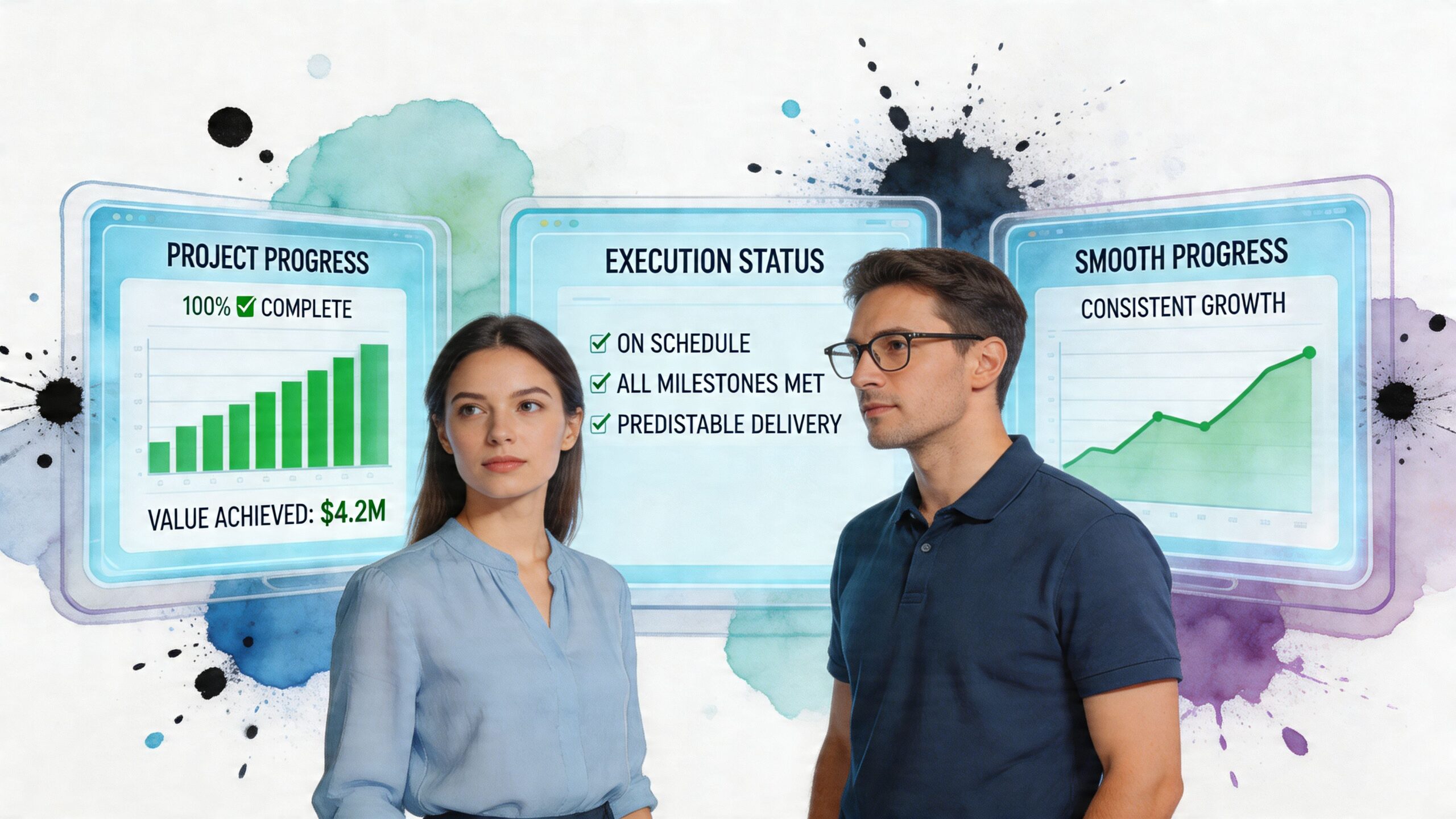
Not because every project suddenly becomes easy. Not because risk disappears. But because people stop guessing. Priorities hold. Decisions stick. Leadership can explain what is happening without hunting through five teams and three vendors to get the story straight.
The before and after is obvious
Before the roadmap is working, technology feels like a drain on management attention. Leaders intervene too often. Teams escalate basic decisions. Reporting sounds busy but not reassuring. You spend money and still don’t feel in control.
After the roadmap is working, the operating pattern is different:
- Work finishes: Fewer initiatives, clearer sequencing, stronger ownership
- Leaders get shorter updates: The story is visible, not buried in side conversations
- Risk is easier to defend: Issues are named, tracked, and assigned
- Vendors lose influence: They respond to strategy instead of shaping it
- Teams get air cover: They can solve root problems because priorities are protected
That shift matters for morale, but it matters even more for execution quality. A calm team usually makes better decisions than an exhausted one.
Board confidence gets easier to earn
It is frequently CEOs and boards who first experience the difference.
When governance is weak, board conversations drift into vague reassurance. Leaders say the team is “working through it.” Questions about risk, resilience, cost, and progress stay fuzzy because the roadmap itself is fuzzy.
When governance is stronger, the board gets direct answers. Here’s what matters. Here’s who owns it. Here’s what changed this quarter. Here’s what risk remains. Here’s what the business should expect next.
Better governance doesn’t mean more bureaucracy. It means fewer surprises.
Inaction keeps charging interest
If you leave this unresolved, the cost keeps building.
The business keeps paying in rework, delays, vendor sprawl, executive frustration, and avoidable risk. Key people become single points of failure. Sensitive processes stay under-documented. Strategy gets crowded out by interruption. Then one incident, missed deadline, insurer question, customer issue, or diligence process forces the problem into the open.
That’s why this matters now. A roadmap is not documentation theater. It is the operating discipline that turns technology from a recurring source of friction into a reliable business capability.
Success looks boring in the best way. Fewer fire drills. Cleaner numbers. More confidence in meetings. Less dependence on heroics. More trust that the business can move without stepping on a landmine.
Your Next Step to Restore Control
If your technology feels chaotic, don’t start by buying something.
Start by making the current reality visible. Map the work. Map the systems. Map the vendors. Map the decision rights. That alone will show you where the coordination tax is coming from.
Then force priorities. Decide what matters now, what waits, and who owns each outcome. Push vendor proposals through a business filter before they touch the roadmap. If a proposal doesn’t support a real objective, it doesn’t belong.
Finally, install a rhythm. A 30-90-180 day plan with weekly review and quarterly reset gives the business a way to move without pretending the future is fixed. That’s how you get execution that is both flexible and governable.
For leaders who need outside help tightening this up, technology strategy consulting can be a practical next step. The right support should help you create visibility, define ownership, and build a plan leadership can effectively use.
If you’re reading this and recognizing your own company, trust that reaction. Technology chaos rarely fixes itself. It usually gets more expensive, more political, and harder to unwind.
The goal isn’t a prettier roadmap. The goal is control.
If technology is slowing growth, weakening visibility, or making board conversations harder than they should be, a Clarity Call with CTO Input is a practical next step. In one conversation, you can surface the main execution bottlenecks, the biggest trust risks, and the first moves that would restore control.