

Look at your calendar for next week.
Is it a map of your strategy, or a graveyard of random meetings?
Great CEOs are defined as much by what they say no to as by what they say yes to. The best leaders are brutal about the meetings great CEOs skip on purpose, not because they are lazy, but because they protect their time like a scarce asset.
This post walks through which meetings top CEOs avoid, why they do it, and how you can copy their habits. The goal is simple: help you win back hours for strategy, customers, and the technology decisions that actually move the business.
You do not need a bigger calendar. You need a sharper filter.
Why Great CEOs Skip So Many Meetings On Purpose
Time is a CEO’s scarcest asset, not capital. Once an hour is gone, it never comes back.
Recent research shows that CEOs spend close to three quarters of their work time in meetings, often more than 23 hours per week. Studies like BCG’s analysis of how CEOs spend their time show the pattern clearly. Calendars are packed, but real impact is limited.
High-performing CEOs treat meetings as investments. Every invite is a pitch: “Spend your most expensive resource here.”
They skip aggressively, not because they do not care, but because they care about the right work.
They ask simple questions:
- Does this move the strategy forward?
- Does this protect or grow revenue?
- Does this reduce meaningful risk?
If the answer is no, the meeting shrinks, shifts, or disappears.
Your calendar shows your real strategy, not your slide deck
PowerPoint might say your top priorities are growth, technology, and people. Your calendar might tell a very different story.
If your week is clogged with status updates, vendor check-ins, and sprawling “catch-ups,” then strategy, technology, and leadership get crowded out. You feel it in late projects, rising tech risk, and a team that is confused about what truly matters.
A calendar full of passive meetings leads to:
- Tech projects that drift without clear trade-offs.
- Security and resilience questions that never get real answers.
- A leadership team that waits for you, instead of acting.
Your calendar is not neutral. It broadcasts what you reward. When you sit through low-value meetings, you teach people that your attention is cheap.
Great CEOs send a different signal. They show up where decisions, people, and growth are on the line. Everything else is handled in writing, by a delegate, or not at all.
The hidden cost of one more meeting
One extra meeting never feels like a big deal. Then you look back and see you have stacked 37 of them in a week.
Every added meeting has an invisible price:
- Less time for deep thinking about growth and margins.
- Slower decisions on investments, tech platforms, and cyber risk.
- More drag on your executives, who mirror your overloaded calendar.
Some research suggests that only a minority of meetings are seen as productive. One summary notes that only 29% of meetings are considered productive. That means seven out of ten are dead weight.
For a CEO, the real loss is not the hour in the room. It is the energy you do not have later for a board discussion, a key customer, or a tough call on a risky system implementation.
Skipping the right meetings is not selfish. It is how you protect your attention for the choices only you can make.
The Meetings Great CEOs Skip On Purpose (And What They Do Instead)
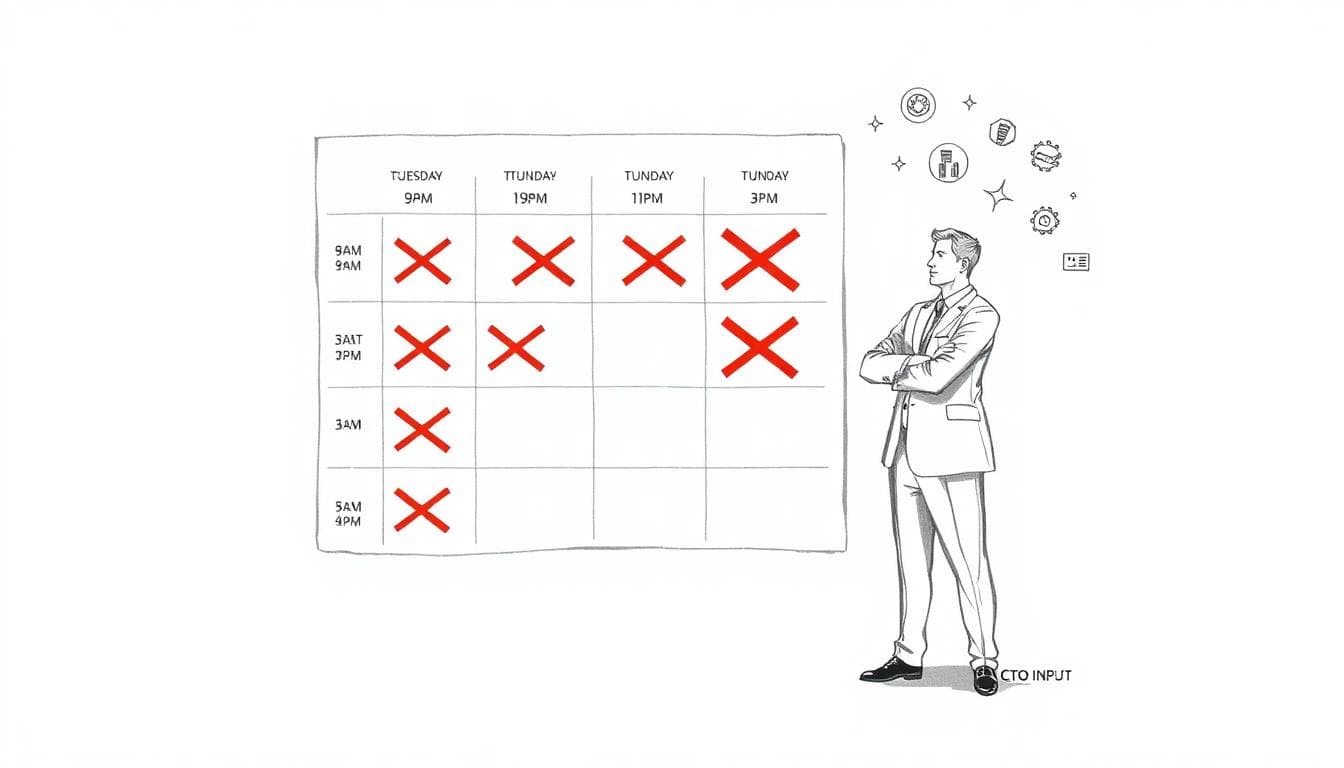
Caption: Focused on remembering the idea that meetings great CEOs skip, a CEO clears low-value meetings to focus on strategy, customers, and technology. Image created with AI.
Here are the repeat offenders on most CEO calendars, and what great leaders do instead.
Bloated status update meetings that should be a one-page brief
You know this meeting. Sixty minutes, 10 to 20 people, each going around the room. No real decisions, just updates. Everyone leaves with the same problems, plus less time.
Great CEOs refuse to sit through group status theater.
They insist on:
- One-page written briefs before the meeting.
- Simple dashboards that show red, yellow, green for key tech and risk items.
- Clear questions where the CEO input is actually needed.
When updates are written, thinking gets sharper. There is a record of what was said and decided. People are more honest about project delays, integration issues, and budget overruns, because the facts are in black and white.
If no decision is required, the CEO often just reads the brief and replies in five minutes. The meeting vanishes.
Large group meetings where the CEO is just a spectator
Large project reviews, internal ceremonies, big vendor demos. In many of these, the CEO sits quietly while others present to each other. Your title adds pressure, but not value.
High-performing CEOs avoid these “spectator” meetings.
Instead, they:
- Name a clear decision owner, often the CIO, CTO, COO, or Head of Product.
- Define the decision in advance, for example, “Approve or reject this platform change.”
- Ask for a short summary and one to three recommendations afterward.
This approach keeps you informed, without dragging you into every detail. It also strengthens your direct reports, who learn to decide inside the guardrails you set.
Recurring one-hour meetings that have no clear agenda
Calendars fill up with weekly and biweekly sessions that made sense once, then never got canceled. After a few months, no one can explain why they still exist.
Great CEOs use a simple rule: no agenda, no meeting.
If a recurring meeting:
- Has no written purpose,
- Has not produced a decision in weeks, or
- Can be replaced with a short update,
they kill it or shrink it. Many switch default lengths to 25 or 45 minutes, a practice echoed in ideas like the “30-minute CEO” approach to time-boxing meetings.
The result is a calendar with fewer zombie meetings and more space for actual thinking.
Cross-functional meetings that should be solved by two people talking
You have seen this too. Ten people in a room to solve what is really a fight between Sales and Product, or Operations and IT. Most attendees are spectators, not decision makers.
Strong CEOs push these issues back to the real owners.
They say, in effect, “This is a decision between these two leaders. I expect you to meet, propose a joint solution, and only pull me in if you are stuck on something that hits strategy or major risk.”
When you do get involved, it is because:
- The decision changes the growth plan.
- The risk profile shifts in a serious way.
- There is a true deadlock that your authority must break.
You stop using your calendar to host conflict. You use your position to set expectations and clear escalation paths instead.
Vendor and partner meetings that belong to your lieutenants
Tool demos, quarterly vendor reviews, routine partner check-ins. These meetings multiply fast, especially when technology and cybersecurity are hot topics with your board.
Great CEOs rarely sit in these sessions.
They set the direction and constraints, for example:
- “We will spend up to this amount to reduce this risk.”
- “Any new system must support these customer outcomes.”
- “We will not accept vendor lock-in on this core process.”
Then they let a trusted CIO, CTO, COO, or fractional technology leader own the vendor calendar. That leader filters what truly needs CEO attention from what is just noise.
This keeps you out of tool debates and negotiation details, while still giving you tight control over spend, risk, and outcomes.
How To Decide Which Meetings You Should Skip As CEO
You do not need a complex productivity system. You need a simple filter you can apply to next week’s calendar.
Start with a one-week audit. Print your schedule or look at it day by day. For each meeting, ask yourself, “If this vanished, what would truly break?” That question alone is often a shock.
Then use a sharper test.
Use a simple filter: “Do I create unique value in this meeting?”
Before you accept or keep any meeting, ask:
- Does this require a decision only I can make?
- Is my presence needed to unblock a team or signal priority?
- Is this about company-wide strategy, key people, or material risk?
- Will this conversation be worse or slower if I am not there?
If the answer is no, you have three options:
- Skip it and ask for a short written summary.
- Shorten it and define a clear decision that must come out of it.
- Delegate it to the right leader, with clear expectations.
Resources on CEO time management, like this guide on how high-performing CEOs manage their time, all point in the same direction. Great leaders guard their focus and push routine work down to trusted lieutenants.
Redesign the few meetings that really matter
Once you cut the noise, you will see a smaller set of meetings that truly deserve you. Executive team sessions. Strategy reviews. Key customer, investor, or board touchpoints.
Make these excellent.
- Send pre-reads and dashboards in advance, so meetings are for decisions, not updates.
- Start with the question or choice on the table, especially around technology investments and cyber risk.
- Time-box discussions and end with a clear “who decides what, by when.”
- Capture decisions and next steps in writing before anyone leaves the room.
Your calendar shifts from a random collection of invites to a tight operating system. That system shapes how your company plans technology, manages risk, and drives transformation, rather than the other way around.
Conclusion
The best CEOs are ruthless about skipping the wrong meetings so they can show up fully for the right ones. The Meetings Great CEOs Skip on Purpose are not a sign of disinterest. They are a sign that the CEO understands their highest and best use.
Try a simple one-week experiment. Cancel or redesign three to five meetings using the filters in this post. Watch what happens to your focus, your energy, and the quality of your technology and growth decisions.
If you want seasoned CTO, CIO, or CISO leadership to take low-value technology and vendor meetings off your plate, visit https://www.ctoinput.com. To keep sharpening how you use your time as a growth-minded leader, explore more executive-level articles on the CTO Input blog at https://blog.ctoinput.com. Your calendar should serve your strategy, not the other way around.