

Your technology strategy is probably too long, too tactical, or buried in a slide deck nobody opens twice. That’s a problem when you’re the one accountable for growth, margin, risk, and board confidence.
A good one-page technology strategy gives you something sharper. It tells you what you’re trying to win, what work matters now, who owns it, and what risk you’re willing to carry.
If you can’t explain that in a minute, your team is probably managing activity, not direction. Here’s how to fix that.
Key takeaways for busy CEOs
- A one-page strategy is a decision document, not a status report.
- It should connect business goals, technology priorities, risk, owners, and the next 90 days.
- It gives you better board-ready technology reporting and cleaner technology governance.
- If the page can’t be defended, you likely have a technology leadership gap, not a tool problem.
What a one-page technology strategy should actually say
A useful page does not try to list every project. It names the business outcomes first, then shows how technology supports them.
That is why a strong version sits above the longer IT strategy and roadmap. Think of it as the executive layer on top of your 12-month technology roadmap or technology roadmap template. For a useful benchmark, Forrester’s IT-strategy-on-a-page template makes the same point, compact beats complicated when leaders need clarity.
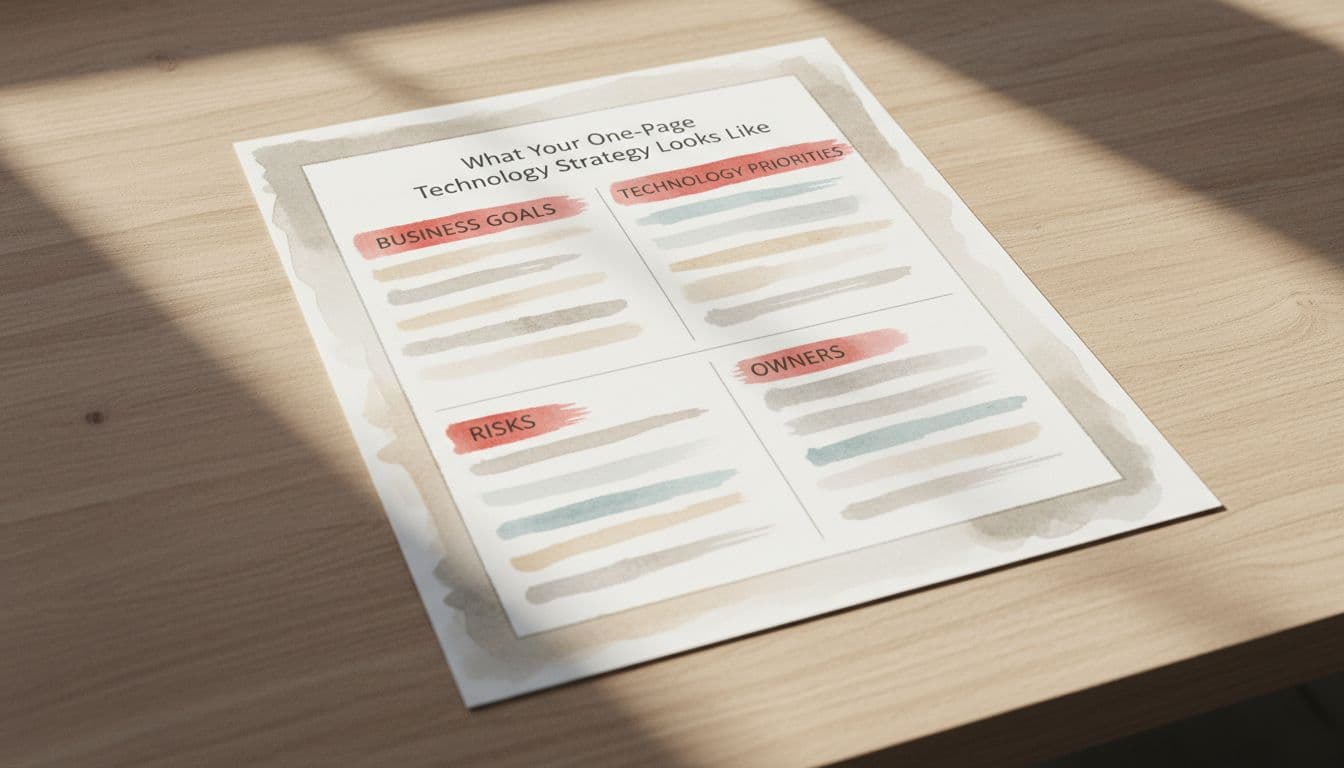
Here is the shape the page should have.
| Page element | What it answers | What it should prevent |
|---|---|---|
| Business outcomes | What the business is trying to change | Tech work that exists for its own sake |
| Technology priorities | Which initiatives matter now | Tool sprawl and side projects |
| Risk and control | Where you are exposed | Surprise outages, cyber risk, and vendor drift |
| Ownership | Who makes decisions | Blurry accountability |
| Next 90 days | What happens first | A plan that never leaves the page |
If the page does not force those answers, it is not a strategy. It is a wish list.
This is where technology strategy becomes business-aligned technology strategy. You are not writing for the IT team. You are writing for your business.
Why CEOs need this now
The pressure is not coming from one place. It comes from growth strain, board questions, vendor influence, and the slow spread of shadow IT and tool sprawl.
McKinsey’s view of the CEO’s new technology agenda gets this right. Technology is not a side function anymore. It is part of the job of leadership.

When your company is growing, the cost of weak direction shows up fast. Projects multiply. Owners blur. Reporting gets noisy. Your technology governance for CEOs starts to slip, and your technology governance for boards gets harder to defend.
If your board cannot see the tradeoffs, you do not have governance yet.
That is why the page has to do more than summarize. It needs to show your board technology reporting, board cybersecurity reporting, and technology risk oversight in plain language. It should also clarify your cyber risk appetite, your third-party risk management posture, and the level of technology risk management you are prepared to carry.
If you have a fractional CTO, interim CTO, outsourced CTO, virtual CTO, part-time CTO, fractional CIO, fractional CISO, virtual CISO, or interim CISO, this page keeps those roles pointed at the same outcomes. Without it, each person can pull in a slightly different direction.
A useful strategy page also keeps the focus on technology spend optimization and technology ROI, not just activity. It gives you tech spending ROI language you can defend when someone asks why the budget went up.
How to build it without making it soft or vague
Start with outcomes, not systems. If you are trying to improve customer retention, margin, delivery speed, or compliance, say that first. Then map the technology work behind it.
A short technology health check or technology assessment helps here. So does a blunt review of your systems inventory. If you do not know what you own, your technology roadmap will drift before it starts.
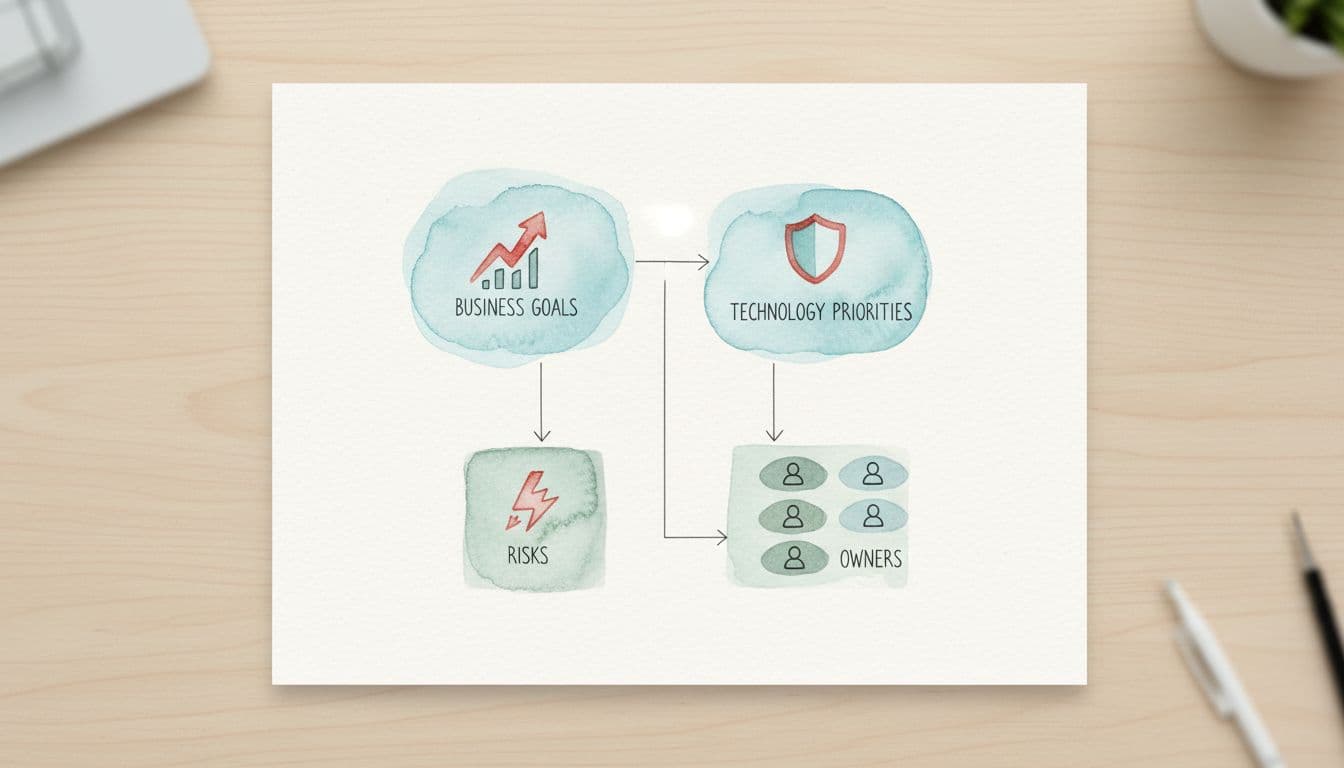
Use this sequence.
- Name three business outcomes.
Keep them real. Growth, resilience, customer experience, cost control, or acquisition readiness. This is your business technology strategy and your strategic technology planning anchor. - Assign decision rights.
Write down who owns what. A simple decision rights map saves you from founder-led technology decisions, crossed wires, and last-minute escalations. If you are a CEO or COO, this is part of your CEO technology decisions and COO technology strategy job. - Show the 12-month path.
Your page should point to the next 12-month technology roadmap, not every possible project. Include the 90-day moves, the application portfolio rationalization, the technical debt management priorities, and the software platform evaluation work that matters most. - Add the control layer.
Call out technology risk management framework items, vendor risk management, vendor management, vendor due diligence, vendor offboarding, and a simple vendor incident response plan. If AI is part of the picture, include AI governance, AI adoption strategy, responsible AI, AI acceptable use policy, and AI vendor due diligence.
A strong page also names business continuity planning, disaster recovery planning, incident response readiness, ransomware readiness, cybersecurity oversight, data governance framework, data strategy, data quality, data privacy, and information governance. That may sound like a lot. It is still less work than explaining a failure to the board.
If you want a practical model for that operating rhythm, the Fractional CTO Playbook is a good reference point.
When the page is enough, and when you need more help
A one-page strategy works best when the problem is clarity. It helps when the work is drifting, the roadmap is muddy, or nobody can explain why spend and outcomes do not match.
It is also the right bridge when you are deciding whether you need a full-time hire, a fractional CTO services model, or interim CTO services. If you are still asking when to hire a fractional CTO, the answer usually comes down to decision quality, not headcount. If the issue is urgent, interim CTO leadership is the cleaner fit. If you need a steadier operating rhythm, executive technology leadership keeps the work anchored in business outcomes.
This is also where the difference between a fractional CTO vs full-time CTO becomes practical, not theoretical. A growing company may need a technology leader for growing companies before it needs another permanent executive. The same is true if you are weighing how to hire a CTO, or deciding whether technology leadership before hiring should come first.
If you are in acquisition prep, the page should also reflect acquisition readiness, technical due diligence, cybersecurity due diligence, and post-merger technology integration. That is when you need more than a roadmap. You need a defensible posture.
If technology decisions feel scattered, risky, or too dependent on the wrong people, Get an Executive Technology Clarity Check. It gives you a clean read on what is slowing growth, where risk is building, and what needs to be fixed first.
Common mistakes that turn strategy into wallpaper
The biggest mistake is simple. You list projects and call it strategy.
You also see these patterns a lot:
- Too many priorities, so nothing has real weight.
- No named owner, so accountability stays fuzzy.
- No risk posture, so cyber issues show up too late.
- No board rhythm, so reporting stays decorative.
That is where technology strategy consulting often earns its keep. Not by making the page prettier, but by forcing clarity around technology priorities for growing companies, technology decisions for growth, and the tradeoffs behind each call.
If the page does not tell you what gets stopped, what gets delayed, and what gets funded, it is not helping you lead. It is helping you feel organized.
Conclusion
You do not need a binder to lead technology well. You need one page that tells the truth.
That page should show what your business is trying to do, what technology work matters now, who owns each decision, and where risk lives. When that is clear, your business-aligned technology strategy stops being an idea and starts becoming a working tool.
The value is not the page itself. It is the calmer leadership that comes from knowing what matters, what does not, and what happens next.
FAQ
What should be on a one-page technology strategy?
Keep it tight. Include business outcomes, top priorities, ownership, risk, and the next 90 days. If it reads like a project list, it is too long.
How often should you update it?
Review it at least quarterly. Update it whenever your growth plan, risk posture, or leadership structure changes. A one-page strategy should move with the business.
Do you still need one if you already have a roadmap?
Yes. Your roadmap is the detail layer. The one-page strategy is the leadership layer. It keeps the roadmap honest, and it makes board-ready reporting easier to trust.
What if no one owns technology strategy today?
That is a technology leadership gap. Start with clear ownership, then decide whether you need a full-time hire, a part-time CTO, or support through fractional technology leadership before you add more projects.