
For nonprofits dedicated to justice, a Privacy Impact Assessment (PIA) isn't just another compliance task. It's a formal process for spotting and reducing privacy risks whenever you launch a new project or adopt a new system that handles personal data. More importantly, it's a vital tool for leadership to manage risk and protect the vulnerable communities you serve.
It often starts with a nagging feeling of rising privacy anxiety. You're looking over a new grant agreement filled with dense data security clauses. You hear about a data breach at a partner organization. Or you have the sudden, uncomfortable realization that sensitive client information—immigration status, incarceration records, details about youth in crisis—is scattered across countless spreadsheets and old systems that don’t talk to each other. That feeling is a signal that your informal, "we'll figure it out" approach can no longer support the weight of your mission.
Key Takeaways
- Shift from Chore to Strategy: A Privacy Impact Assessment (PIA) isn't just a technical task; it's a strategic framework for leadership to make defensible decisions about risk, protecting both your clients and your mission.
- Focus on People-Centered Risk: The core of a PIA is identifying potential harm to the people you serve. Frame the conversation around the real-world consequences of a data incident, like deportation or loss of housing, not just technical vulnerabilities.
- Start with One Small Win: You don't need a massive budget to begin. Start by conducting a PIA on a single, manageable project, like a new client survey tool or a small software purchase, to build momentum and prove the value of the process.
- Embed PIAs into Your Operations: To make privacy a sustainable practice, integrate it into your core processes. Make a streamlined PIA a mandatory step in your vendor procurement and a regular, high-level reporting item for your board.
Why Privacy Assessments Are a Leadership Responsibility
It often starts with a nagging feeling. Maybe you're looking over a new grant agreement filled with dense data security clauses. Or you hear about a data breach at a partner organization. It could even be the sudden, uncomfortable realization that sensitive client information is scattered across countless spreadsheets and old, creaky systems.
For the people you serve—whose data might involve immigration status, incarceration records, or sensitive details about youth in crisis—the stakes couldn't be higher.

That feeling is a signal. It’s telling you that your informal, "we'll figure it out as we go" systems can no longer support the weight of your mission. The good news? There's a calm, structured way to get ahead of these risks before they turn into full-blown crises. That process is the Privacy Impact Assessment, or PIA.
From Technical Chore to Strategic Imperative
It's easy to mistake a PIA as a purely technical or legal chore—just another box to check. But for mission-driven leaders, it's much more than that. Think of it as a strategic framework that guides your decision-making. It’s a disciplined way to ask the tough questions before you roll out a new case management system, share data with another agency, or adopt that new "must-have" technology.
A PIA forces you to answer questions that are fundamental to your work:
- What sensitive information are we actually collecting, and is every piece of it absolutely necessary for our mission?
- How are we using, storing, and sharing this data? Who has access?
- What’s the worst-case scenario for the people we serve if this information were lost, stolen, or misused?
- What concrete steps can we take, right now, to prevent that harm from happening?
Framing it this way transforms the PIA from a burden into a powerful tool for building trust. It shows your funders, your board, and—most importantly—the communities you support that you are thoughtful stewards of their most sensitive information. It’s a core part of your duty of care.
A PIA forces the conversation to move from "what tool should we buy?" to "what risks are we accepting on behalf of our clients?" This shift is the hallmark of mature governance and is essential for any organization handling sensitive data.
Answering these questions gives you the clarity to make informed decisions and build a defensible plan. For leaders who want to get a better handle on their organization's overall risk profile, our guide on what a board should expect in a cyber risk report provides a great starting point for effective governance. This process turns that nagging anxiety into a clear, actionable roadmap, making privacy a cornerstone of your mission's success.
A Leader’s Guide to Privacy Impact Assessments
For a nonprofit leader, a Privacy Impact Assessment (PIA) can easily sound like one more compliance headache on a very long list. But it's not. The best way to think about a PIA is as a core strategic tool—it’s a disciplined way to shield your mission, protect your reputation, and safeguard the very people you exist to serve.
At its core, a PIA is just a structured process to find and fix privacy risks before they blow up into a full-blown crisis. It forces your team to ask the hard questions before you roll out that new client management system, sign a contract for a new piece of software, or start a data-sharing partnership with another organization. This proactive thinking shifts privacy from a constant source of worry into a predictable, manageable part of your daily operations.
Why This Matters for Your Mission
Ultimately, a privacy impact assessment for legal nonprofits is about good stewardship. It’s the practical, on-the-ground expression of your duty of care, making sure that every new program or system is built with your clients' safety baked in from the start.
Taking this seriously builds incredible, long-lasting trust with your funders, your board, and the communities that depend on you. It sends a clear signal that you’re focused not just on delivering services, but on the ethical and secure handling of the deeply personal information people entrust to you.
A PIA isn't about chasing some mythical state of "perfect" security. It’s about making conscious, documented decisions about risk. It’s a framework that empowers you to confidently say, "We looked at the potential for harm, we understood it, and we took these specific, deliberate steps to prevent it."
So, where do you begin? The table below breaks down a few immediate actions your leadership team can take to start weaving this mindset into your organization’s DNA.
PIA Quick Wins for Nonprofit Leadership
Here are some immediate, high-impact actions you can take to begin integrating PIAs into your operations without a massive budget or a team of experts.
| Action Item | Why It Matters | First Step |
|---|---|---|
| Inventory Your Data | You can't protect what you don't know you have. Understanding what sensitive data you collect and where it lives is the bedrock of any risk management effort. | Ask an operations lead to create a simple inventory of systems holding client or donor data (think: case management software, donor CRM, even shared spreadsheets). |
| Appoint a Privacy Point Person | Without clear ownership, privacy becomes "everyone's job and no one's job." This person doesn’t need to be a technical guru, just a responsible owner of the process. | Assign your COO or a senior operations manager to be the go-to person for privacy questions and to shepherd your first PIA. |
| Pilot a Small-Scale PIA | Start small. Pick a single, manageable project to build your team's confidence and prove the value of the process. This takes the fear factor out of it and builds momentum. | Choose one upcoming project—like adopting a new survey tool or a small software purchase—and walk through a basic PIA checklist as a team. |
These small wins demystify the process and build the muscle memory your team needs to make privacy a natural part of how you work.
Understanding Your Legal Triggers and Obligations
For most nonprofit leaders, data privacy law feels like a dense, intimidating fog. You hear the acronyms—GDPR, CPRA, PIPEDA—but it's tough to know which ones apply to your organization and, more importantly, what they actually require you to do.
The secret is to stop thinking about memorizing laws and start thinking about triggers. These are specific actions or situations that create a legal duty to conduct a Privacy Impact Assessment (PIA). A PIA isn't just a "nice-to-have"; it's often a legal requirement. The moment you decide to roll out a new system for handling personal data, you may have already crossed a legal line.
This isn’t about becoming a legal scholar overnight. It’s about learning to spot the common operational moments where privacy obligations pop up.
Common Triggers Mandating a PIA
Think of these as signposts. If your organization is about to do any of the following, it’s a huge signal that you need to hit pause and conduct a PIA:
- Implementing New Technology: Launching a new case management system, a client intake portal, a donor CRM, or even a simple survey tool that collects personal information.
- Starting a New Data-Sharing Partnership: Collaborating with a government agency, another nonprofit, or a research institution where client or constituent data will be exchanged.
- Expanding Services or Programs: Starting a new program that serves a different vulnerable population or collects new kinds of sensitive data (like health information or immigration status).
- Using Data in New Ways: Employing analytics, AI, or automated decision-making tools to analyze client data for trends or to determine eligibility for services.
For legal nonprofits, the stakes are even higher given the unique demands of protecting client data. A deep dive into specialized IT support for law firms can reveal how to manage these complexities and stay compliant. This kind of proactive planning is key to maintaining trust.
Navigating the Patchwork of Privacy Laws
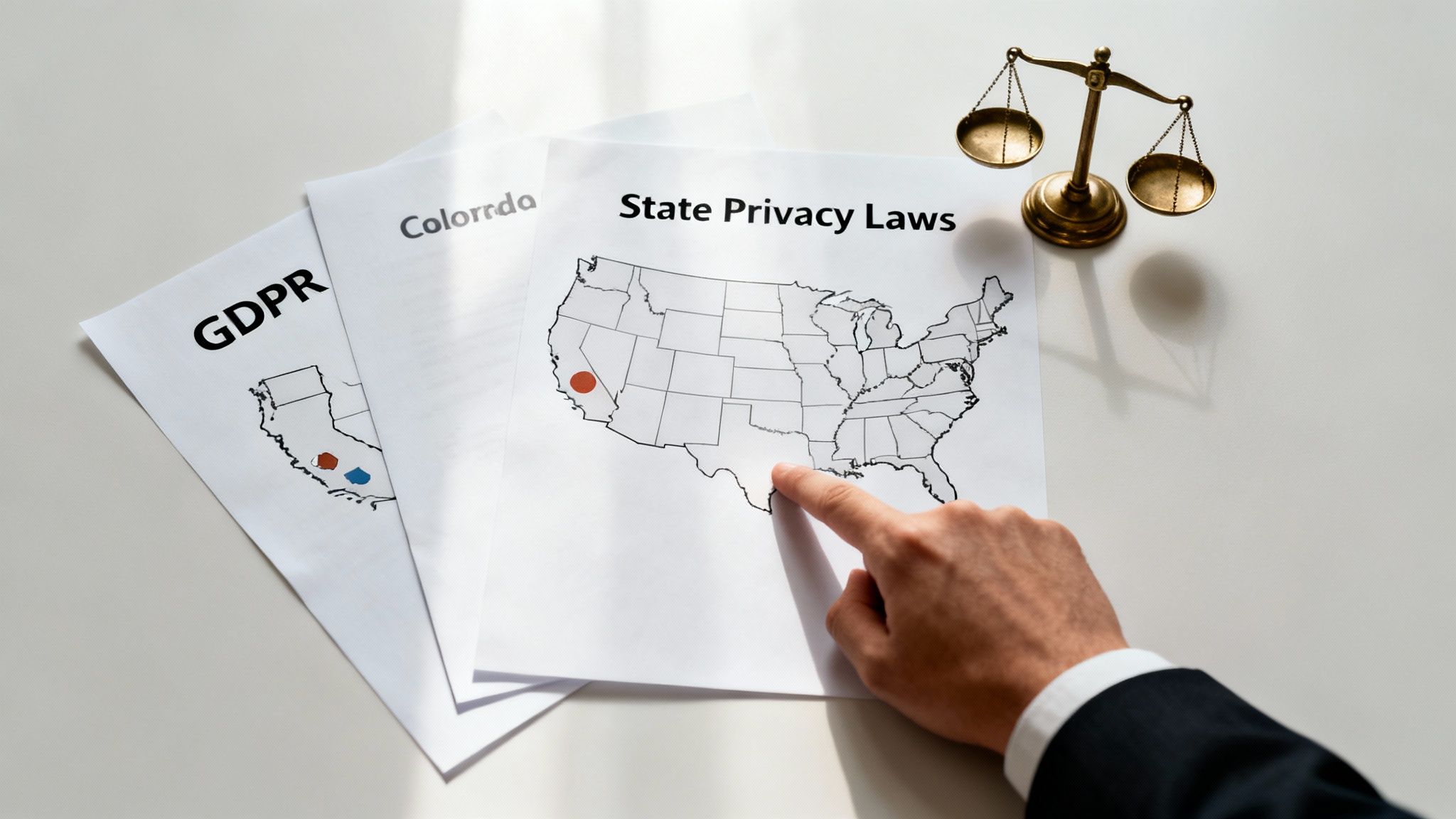
The legal landscape is a jumble of broad international rules and a fast-growing number of U.S. state laws. You don’t need to memorize them all, but you absolutely need to know the main players and how they might impact your work.
Data protection rules vary wildly across the globe. The EU's GDPR sets the gold standard for enforcement, with potential fines reaching 20 million euros or 4% of an organization's total annual turnover—whichever is higher. The United States, on the other hand, has a more fragmented, state-by-state approach, with California's CPRA leading the charge.
Here are the key regulations to have on your radar:
-
General Data Protection Regulation (GDPR): Even if you’re a U.S.-based nonprofit, GDPR applies if you process the personal data of anyone in the European Union. This could be donors, program participants, or even people visiting your website. GDPR explicitly requires a Data Protection Impact Assessment (DPIA) for any "high-risk" data processing.
-
U.S. State Laws (CPRA, CPA, etc.): States like California (CPRA), Colorado (CPA), and Virginia (VCDPA) have their own tough privacy laws. They often require assessments for activities that present a "heightened risk of harm" to consumers, which almost always includes processing sensitive data.
-
Canadian Laws (PIPEDA & Law 25): Our neighbors to the north have their own rules. Canada’s federal law, PIPEDA, and Québec’s even stricter Law 25 have unique requirements. For instance, Law 25 mandates PIAs for pretty much any project involving personal information, especially when that data is transferred outside of Québec.
And that's not all. Regulations like HIPAA can come into play if your nonprofit handles any protected health information. If that sounds like your work, then getting a firm grip on HIPAA compliance for legal nonprofits is non-negotiable. These aren't just rules for hospitals; they create crystal-clear duties for any organization entrusted with health data.
A Practical PIA Framework for Your Nonprofit
A Privacy Impact Assessment might sound like a dense, legalistic chore, but it’s really just a structured way of thinking through a project’s impact on people. It's a repeatable workflow that turns abstract compliance rules into a concrete, mission-aligned process. It’s how you move from anxiety to action.
Let's demystify the process by breaking it down into five manageable stages. We’ll use a running example to make it real: an immigration legal network launching a new online portal for clients to submit their intake information and upload sensitive documents.
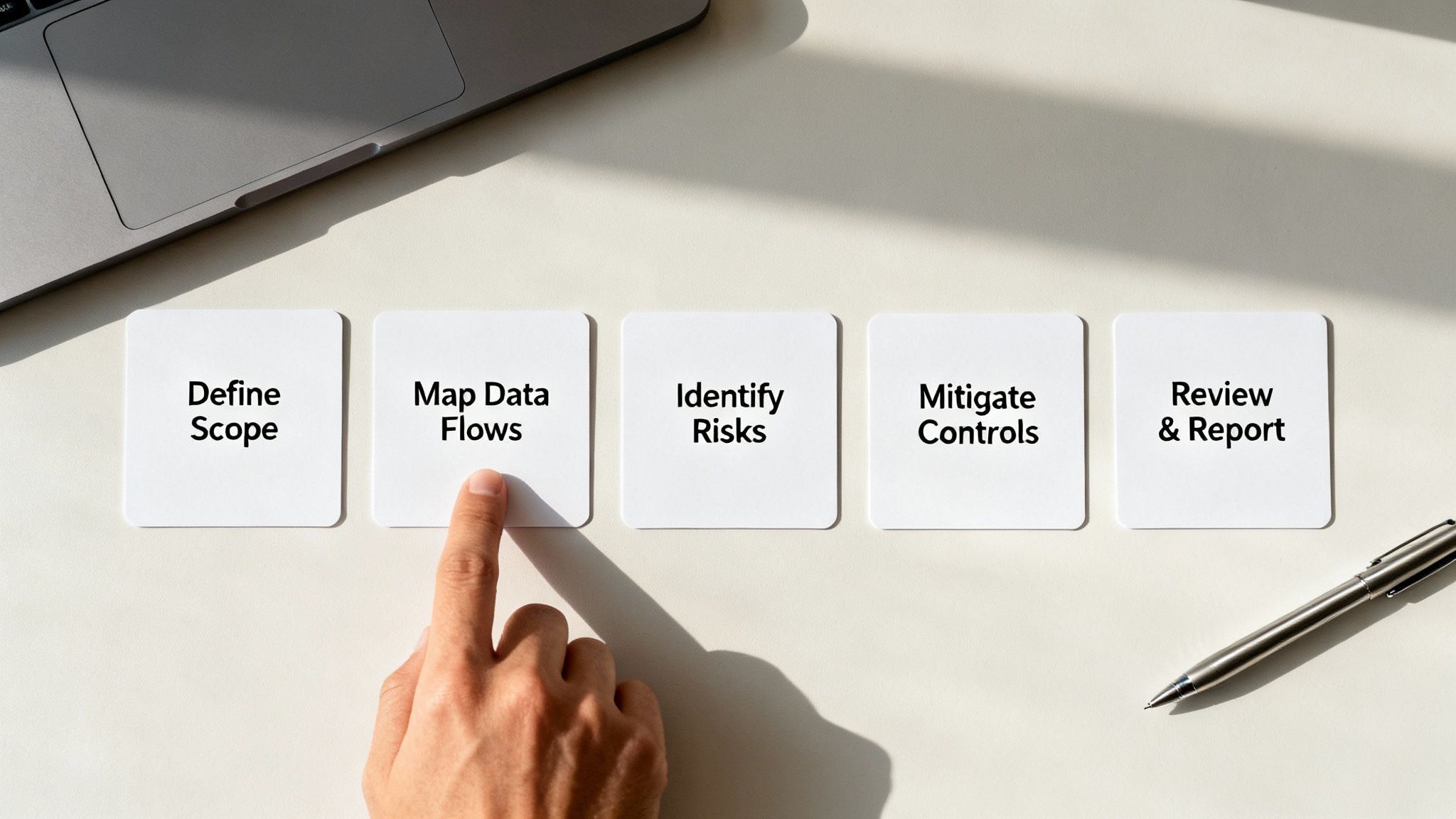
This framework isn't about creating more red tape. It’s about building institutional muscle memory, ensuring that protecting the people you serve is always at the heart of your operational decisions.
Stage 1: Define the Project Scope
First things first, you need to draw a clear circle around what you're assessing. Ambiguity is your enemy here. Get ruthlessly specific about the project, system, or process you’re putting under the microscope.
For our immigration network, the scope isn't "our website." It's specifically "the new secure client intake portal." This includes the web forms clients fill out, the database where their information is stored, and the back-end interface staff will use to access submitted data.
Stage 2: Map the Data Flows
This is the most critical and often the most eye-opening stage. You have to follow the data. The goal is to create a simple, visual map of how personal information moves through the system you just defined in Stage 1. To do this well, you have to understand how to document business processes effectively, as this documentation is the bedrock of any good privacy assessment.
You need to answer a few fundamental questions:
- What data is collected? Be exhaustive. List every single data point—name, date of birth, country of origin, asylum application details, supporting documents, everything.
- Why is it collected? Justify the need for each piece of data. If you can’t connect it directly to delivering a service or meeting a legal requirement, you should seriously challenge why you’re collecting it at all.
- Where is it stored? Name the specific server, cloud service (like AWS or Azure), or database. Be precise.
- Who can access it? Get granular about roles, such as intake paralegals, supervising attorneys, or IT administrators.
- Who is it shared with? List any and all third parties. This could be translation services, government agencies, or partner organizations.
For the intake portal, this map would clearly show client data flowing from their web browser, through an encrypted connection, into a cloud database, where it can then be accessed by specific staff roles.
Stage 3: Identify and Analyze Risks
With your data map in hand, you can start asking the most important question: "What could go wrong for our clients?" This is where the PIA shifts from a technical exercise to one deeply rooted in your duty of care. You're brainstorming potential harm from the perspective of the people you serve.
A PIA forces you to name the specific, human consequences of a data incident. It’s not about a generic "data breach"; it's about the risk of deportation, family separation, or loss of housing for a real person.
Common risks for a legal nonprofit might include:
- Unauthorized Access: A staff member looking at client files they have no business seeing, or a hacker gaining access to your entire system.
- Inappropriate Disclosure: Accidentally emailing a client's file to the wrong person or having sensitive data exposed through a software bug.
- Data Loss: Information being permanently wiped out by a system failure or ransomware attack, which could completely jeopardize a client's case.
- Secondary Use: Data collected for intake being repurposed for fundraising or advocacy campaigns without explicit, informed consent.
Each risk needs to be evaluated on its likelihood and potential impact. A data leak that exposes a client's immigration status has a catastrophic impact, even if you think the likelihood is low.
Stage 4: Mitigate Risks with Controls
This is the "so what?" stage. You've identified a list of scary risks; now, what are you actually going to do about them? For each risk, you must define a "control"—a specific action, policy, or technical safeguard designed to reduce its likelihood or impact.
- Risk: Unauthorized staff access. Control: Implement strict role-based access controls in the new portal so paralegals can only see the cases they are assigned to.
- Risk: Data interception during upload. Control: Ensure and verify that end-to-end encryption is enabled and functioning correctly for the portal.
- Risk: Data is shared with a third-party translator without safeguards. Control: We need to update our vendor contract to include strict confidentiality and data deletion clauses.
This stage produces your action plan. It’s the to-do list for making the project safer before it ever goes live.
Stage 5: Review and Report
Finally, the completed PIA must be formally documented and shared with leadership. This isn't about filing a report away in a drawer to be forgotten. It’s a crucial governance step that creates a clear, defensible record of your decision-making process. The report should concisely summarize the project, the key risks you found, and the plan you’ve put in place to address them.
This document becomes an invaluable tool for communicating with your board and funders. It's tangible proof of your foresight and responsible stewardship.
More and more, PIAs are becoming legally mandated. Under GDPR, for example, Data Protection Impact Assessments (DPIAs) are required for any "high-risk" processing. Similarly, the Colorado Privacy Act mandates assessments for activities with a heightened risk of harm, focusing on things like financial loss, discrimination, or identity theft. Following this five-stage framework doesn’t just build trust—it helps you meet your legal duties head-on.
Embedding Privacy into Your Governance and Vendor Management
A Privacy Impact Assessment isn't a one-and-done project you check off a list and file away. For a PIA to genuinely protect your mission, it has to become part of your organization's operational DNA. This means weaving the discipline of a PIA into two critical areas where risk often hides in plain sight: your internal governance and your relationships with vendors.
The real goal is to shift from a reactive, compliance-driven mindset to a proactive culture of "privacy by design." This is just a fancy way of saying that privacy thinking should be baked into every new project, partnership, and tech decision from the very beginning—not bolted on as an afterthought when a regulator comes knocking.
This is how you turn a document into a core organizational habit.
Making PIAs a Standard Step in Procurement
Your vendors are an extension of your organization. That means their security failures can quickly become your mission’s failures. Too often, I see nonprofits sign contracts for new software or services without rigorously vetting the provider's data handling practices. By the time someone asks about privacy, you're already locked into a contract.
Integrating a PIA directly into your procurement process stops this reactive cycle cold. It forces a conversation about risk before you sign on the dotted line.
Here are a few essential questions, pulled straight from the PIA framework, to ask every potential vendor:
- Data Access and Handling: Can you describe exactly who on your team will have access to our data and under what circumstances? We need specifics.
- Security Controls: What technical measures, like encryption in transit and at rest, do you have in place to protect our information?
- Data Location: Where, geographically, will our data be stored and processed? This is a deal-breaker for compliance with laws like Québec's Law 25, which requires a PIA for any data transfer outside the province.
- Breach Notification: What is your documented process for notifying us if there's a data incident, and what is your guaranteed timeline?
- Sub-processors: Do you use any other third-party services (sub-processors) to handle our data? If so, who are they, and what are your contractual privacy requirements with them?
Making these questions a mandatory part of your vendor checklist transforms procurement from a simple purchasing function into a powerful risk management tool. You can find more practical guidance in our detailed overview of how to build a vendor risk management assessment.
Translating PIAs for Your Board
Your board of directors has a fiduciary duty to oversee organizational risk, and in this day and age, data privacy is a huge part of that. But let's be realistic—board members don't need a line-by-line technical breakdown of a PIA. They need a clear, concise summary that helps them make informed, strategic decisions.
The trick is to translate the technical findings into the language they understand: mission risk.
Instead of presenting a 20-page report, provide a one-page executive summary that answers three questions: What is the project? What is the worst-case privacy risk to our clients? And what specific steps are we taking to mitigate that risk?
This approach respects the board's time and focuses their attention on governance, not technical minutiae. It helps you have a productive conversation about acceptable risk levels and where to put resources.
Presenting PIA summaries regularly isn't just about reporting; it demonstrates mature oversight. It gives your board the confidence that you are responsibly managing the sensitive data entrusted to your organization.
When Non-Compliance Becomes a Mission Failure
For a justice-focused nonprofit, a data privacy failure is never just a technical problem or a compliance headache. It’s a mission failure. The consequences ripple far beyond potential fines; they strike at the very heart of why you exist.
Think about it. When you serve vulnerable communities, the trust you build is your most valuable asset. A privacy incident can shatter that trust in an instant. It creates a chilling effect, making the people you serve hesitant to seek help. They fear that their most sensitive information—on immigration status, incarceration history, or a family crisis—could be exposed.

This erosion of trust doesn't just impact clients. It can permanently damage relationships with funders and boards who have a fiduciary duty to oversee risk. From their perspective, non-compliance isn't a simple oversight; it's a fundamental failure of governance.
The Cautionary Tale of a Vendor Breach
The 2020 Blackbaud ransomware attack is a perfect example of this. Blackbaud, a massive software provider for the nonprofit sector, was breached, exposing the donor and constituent data of thousands of organizations around the globe. For the nonprofits affected, it was a brutal lesson: your privacy is only as strong as your weakest vendor.
The incident triggered a massive, chaotic fire drill. Organizations scrambled to figure out what data was compromised, who they needed to notify, and how to answer tough questions from their communities. The attack wasn't their fault directly, but the fallout was entirely theirs to manage. It drove home a critical reality: you can delegate a task to a vendor, but you can never delegate the ultimate responsibility for protecting your community's data.
The Growing Gap Between Mission and Compliance
Many nonprofit organizations are facing a critical compliance gap that exposes them to huge financial and reputational risk. Research shows that roughly 90% of nonprofits are not adequately prepared for compliance with data privacy laws. The consequences can be devastating, with potential penalties reaching up to one million dollars for certain violations.
But the fines are just the beginning. Non-compliance creates a cascade of operational, cybersecurity, and reputational damage that can cripple a mission-driven organization. You can learn more about these significant risks and how to tackle them in recent analyses of nonprofit data privacy.
For a legal aid organization, a data breach isn’t just about losing donor information. It's about case files on domestic violence survivors, asylum seekers, or formerly incarcerated individuals being exposed. The potential for human harm is catastrophic.
This is precisely why a privacy impact assessment for legal nonprofits is so essential. It’s not about getting bogged down in red tape; it's a fundamental safeguard. A PIA is the disciplined, proactive process that protects the very people you exist to serve. It ensures that your systems and vendors are allies of your mission, not a hidden source of risk, reframing compliance from a burden into a core expression of your duty of care.
Your Next Steps: From Assessment to Action
You’ve made it this far, which is a huge step. But reading about PIAs is one thing; putting them into practice is another. The goal isn't to solve every single privacy risk overnight—that's a recipe for burnout. Instead, it’s about starting small, building momentum, and replacing that nagging anxiety with a clear, disciplined process.
The journey from understanding to doing begins with one manageable step.
To get the ball rolling, here's a simple 30-day plan to lock in your first win. This approach takes the mystery out of the process and starts building the institutional muscle you need for a lasting privacy program.
A Simple 30-Day Plan
This plan is designed to work for any nonprofit, no matter the size of your team or budget. It’s all about learning by doing.
-
Identify One Project: Sometime in the next week, pick a single upcoming initiative that feels like a good candidate for a privacy impact assessment. Maybe you're about to sign a contract for new case management software, launch a data-sharing partnership with another agency, or even just roll out a new client survey tool. The key is to choose something tangible and time-bound.
-
Assemble a Small Team: You don't need a formal committee. Just grab a small, cross-functional group—someone from programs, someone from operations, and your tech lead is a great start. Their job is to walk through the PIA framework together, map out how the data will move, spot potential risks to your clients, and brainstorm practical ways to mitigate them.
-
Present One Recommendation: At the end of the 30 days, ask the team to present their findings and just one key, actionable recommendation to the leadership. It could be as straightforward as, “We need to add specific data protection clauses to our next vendor contract,” or “We must implement role-based access before this new system goes live.”
This simple exercise transforms the PIA from an abstract concept into a real-world tool for making better decisions. It shows its value almost immediately and helps build the case for making this a standard part of how you operate.
The most powerful outcome of your first PIA isn't the finished document; it's the shift in mindset. It forces a structured conversation about risk from the perspective of the people you serve, which is the cornerstone of responsible stewardship.
Finally, to cut through the noise and force real prioritization, every leadership team should ask themselves one brutally honest question:
What is the single biggest unassessed privacy risk to our clients right now, and what is our concrete plan to address it in the next 90 days?
Answering that question gives you a clear, manageable path forward. It’s how you go from just reading an article to making a tangible improvement in how you protect your mission and the communities that depend on you.
Frequently Asked Questions
Digging into Privacy Impact Assessments can feel like one more overwhelming task, especially when you're already juggling a tight budget and an urgent mission. Let's break down some of the most common questions nonprofit leaders have.
We’re a Small Nonprofit with a Limited Budget. How Can We Afford a PIA?
This is the most common worry I hear, and it’s a valid one. But a privacy impact assessment for a legal nonprofit doesn't have to mean hiring an expensive consulting firm. The real value comes from the internal discipline of stepping back and thinking through privacy risks from your clients' perspective.
You can start small and be effective. Grab a free template and designate someone on your team—maybe an operations manager or your go-to "tech person"—to walk through the process for a single, high-risk system. Your client intake process is often a perfect place to start. Your first PIAs might not be perfect, but just the act of asking these critical questions is a huge win.
If you hit a roadblock or are dealing with a more complex system, you could bring in a fractional advisor for a right-sized diagnostic. They can guide you through that first assessment without the massive price tag. Remember, the cost of this proactive work is a tiny fraction of the financial and reputational damage a data breach can cause.
When, Exactly, Do We Need to Perform a Privacy Impact Assessment?
The simple rule of thumb is this: conduct a PIA before you launch any new system, program, or technology that handles personal data. Think of it as a mandatory checkpoint before you sign a contract or push the "go-live" button.
For legal nonprofits, some of the most common triggers include:
- Bringing in new case management software
- Launching new online forms for client intake
- Setting up a data-sharing agreement with a partner organization
- Using a new communication tool, like a chatbot or client texting platform
From a legal standpoint, regulations like GDPR and many U.S. state laws require PIAs for any "high-risk" data processing. Given that legal nonprofits inherently handle sensitive information about vulnerable people, your work almost always falls into this high-risk category.
Is a PIA the Same as a Security Audit?
That’s a great question. They're different but deeply connected. A security audit is technical; it's looking at the digital locks on your doors. It checks things like firewalls, encryption standards, and password policies to make sure your systems are hardened against a direct attack.
A Privacy Impact Assessment (PIA), on the other hand, is broader and starts with people, not servers. It asks about the potential impact on individuals if their information were to be misused. A PIA examines the entire data lifecycle—why you're collecting data in the first place, how you plan to use it, who you'll share it with—to spot risks to a person's privacy and fundamental rights.
A good PIA will absolutely inform your security needs, but its focus is always on preventing human harm.
Navigating these challenges is tough when you're already stretched thin. CTO Input provides the seasoned, fractional technology and risk leadership that mission-driven organizations need to build stable, secure systems. If you're ready to move from recurring fire drills to a clear, believable modernization path, let's connect.