

Before you trust product usage data, establish where it comes from, what each metric counts, and whether it reconciles with customer and financial records. Software activity can inform revenue decisions, but it doesn’t establish revenue, customer value, or renewal intent on its own.
Your exposure grows when uncertain numbers enter forecasts, pricing decisions, or board reporting without visible limitations. Start with traceable evidence, clear definitions, and an owner who can resolve discrepancies.
Key takeaways for CFOs
- Trace important usage metrics back to source events, customer accounts, and documented transformations.
- Separate activity, adoption, customer retention, and financial performance. Each answers a different business question.
- Require clear ownership for definitions, quality exceptions, access, and approved use.
- Reconcile billable consumption before invoicing. Present forecast assumptions separately from realized financial results.
Establish where product usage data comes from

Follow the source and its transformations
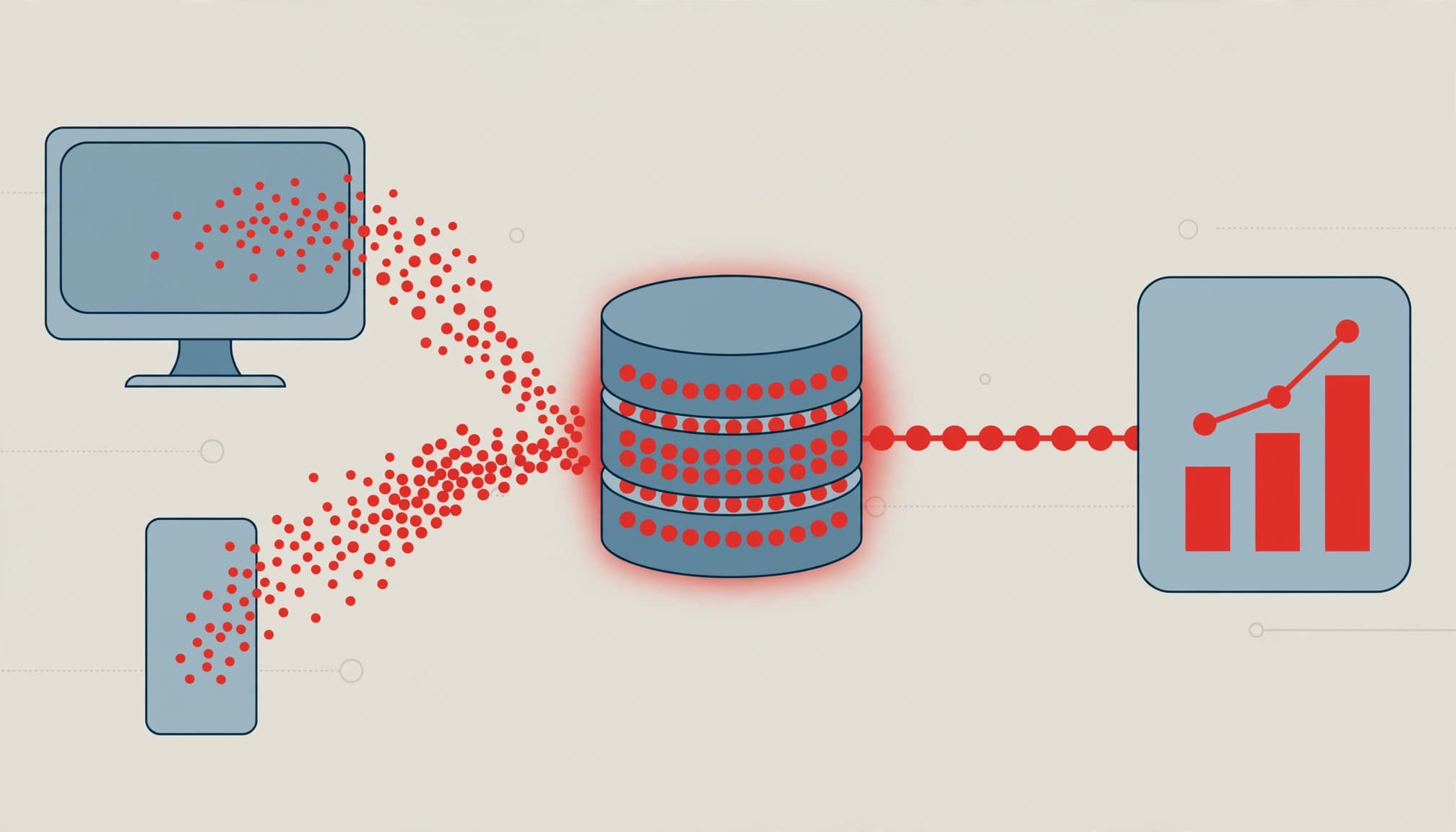
Product usage data records behavior inside software, including usage frequency, session duration, feature interactions, and completed actions. These records show user behavior and help you understand what customers actually do.
However, raw software logs aren’t business-ready reports. Mixpanel’s product analytics guide describes the preparation involved: extracting, transforming, and loading logged data into a database for analysis.
Product usage analytics should let finance trace each reported metric back to its source events. Document every transformation along the way, including exclusions, account matching, aggregation, and reporting cutoffs.
A dashboard with no documented lineage gives you a number without a defensible explanation.
Test completeness and identity
Require stable user and account identifiers for usage events. Otherwise, one customer using several devices can appear as multiple users, while shared accounts can distort the count in the opposite direction.
Flag missing or late events, duplicate retries, failed transfers, and unmatched accounts. Also distinguish when an action happened from when the reporting system received it.
Your data quality view should show collection coverage and unresolved exceptions. Investigate unexplained changes in coverage, since a rising activity count can reflect expanded tracking rather than stronger customer engagement.
Define product usage metrics before comparing them
Common product usage metrics include usage frequency, time spent, bug reports, customer retention, and churn. Also monitor activation, time to value, feature adoption, engagement, and drop-off points.
Start with definitions your finance, product, and customer success teams can apply consistently:
- Define activation as a completed customer milestone, rather than account creation alone.
- Measure time to value between an agreed starting event and the first meaningful outcome.
- Calculate feature adoption against customers eligible for that feature, and state how feature usage is counted.
- State the denominator and reporting window for engagement rate, retention rate, customer retention, and churn.
- Keep bug reports and support demand visible alongside activity measures.
Prefer meaningful activity over session length
In ChurnZero’s product usage guide, Ethan Riley recommends tracking roughly 10 to 20 events and grouping similar actions under one event name.
ChurnZero also favors active days over time-in-app. Longer sessions can indicate difficulty, while background tabs can inflate duration.
Logins provide an accessible starting signal. However, they don’t show whether someone completed useful work.
Separate customer counts from customer value
Customer retention measures how many customers remain. Revenue retention measures the value retained after expansion, contraction, and cancellations.
Keep customer retention and revenue retention separate because expansion in large accounts can conceal customer losses elsewhere.
For churn reporting, define the starting cohort and period used to calculate the churn rate. Changes in customer behavior can inform a churn-risk assessment, but activity alone doesn’t predict cancellation.
Product teams can use feature adoption and drop-off points to guide product development and update the product roadmap. Track drop-off points alongside outcomes, since adoption alone doesn’t prove customer value.
Distinguish collection capability from decision readiness
Revenera’s 2026 Monetization Monitor discussion reports that 41% of software producers say they collect usage data “very well.” Another 41% collect it through processes requiring manual work or engineering support.
Revenera also reports 39% use homegrown software, 53% use commercial usage analytics, and 15% have no collection and analysis tool. These figures don’t establish mutually exclusive categories.
More concerning, 30% collect telemetry without analyzing it, compared with 11% three years earlier. A collection system can consume money without supporting a recurring decision.
Upsell opportunities lead the reported use cases at 70%, followed by churn risk and product roadmap prioritization. Usage data can flag a possible opportunity, but it doesn’t establish a buying need. Yet only 28% use automated low-engagement notifications. Meanwhile, 42% review support tickets for churn risk, and 47% analyze usage for declining engagement.
For you, the test is whether someone acts on the signal and records the result.
Revenera also forecasts 56% growth in consumption-based licensing by 2027. Dependable, reconciled metering is a prerequisite for evaluating usage-based pricing, although the projection doesn’t establish demand for your product.
Reconcile activity with money and customer outcomes
Trace billable consumption separately
When usage drives invoices, follow a billable event through capture, storage, validation, pricing, and invoicing. Require an event identifier, customer identifier, timestamp, quantity, and relevant pricing attributes.
Then reconcile quantities and amounts. A correct rate applied to incomplete consumption still produces an incorrect invoice.
Require explicit handling for duplicate retries and late events. Replaying an event mustn’t create another charge.
Also keep consumption, billings, cash receipts, and recognized revenue separate. Finance needs documented rules for how each connects to the others.
Give each team a decision it can support
Customer success can use account-level adoption, customer satisfaction, and completed customer outcomes in quarterly business reviews. Product teams can investigate drop-off points before funding roadmap changes. Support teams can connect bug reports to affected workflows.
For finance, connect those signals to renewal timing, contract terms, support costs, and account margin.
Our guidance on software adoption and business outcomes explains why adoption alone doesn’t establish technology ROI.
An account can use more software while becoming less profitable. Review consumption alongside support effort and contract economics.
Treat free-plan activity as evidence of interest. Expansion requires a paid need, purchasing authority, and an offer the customer values.
Assign ownership for quality, access, and approved use
Make business decision rights explicit
Your data owner should control business meaning, acceptable quality, approved use, and funding priorities. A name in a spreadsheet doesn’t establish that authority.
Data stewards maintain definitions and coordinate exceptions. Technology teams implement collection, permissions, and retention controls. Privacy and legal leaders interpret obligations involving personal information.
Our approach to assigning business data ownership keeps those responsibilities distinct.
You shouldn’t have to settle every tracking dispute as CFO. However, you need a clear escalation route when uncertainty affects forecasts, billing, or reporting.
Report exceptions leaders can act on
Include the business consequence, accountable owner, next action, and resolution date for each material issue.
Also record who can access usage records, what information vendors receive, and whether the approved use has changed. Add basic privacy and quality controls to the operating process rather than treating them as separate projects.
A monthly leadership review is a practical starting cadence for unresolved cross-functional issues. Escalate material billing or reporting failures sooner.
For acquisition readiness, retain definitions, reconciliation evidence, and remediation decisions. Those records make technology due diligence less dependent on individual explanations.
Build a tracking process that can survive scrutiny
Contentsquare’s usage analytics framework provides six implementation steps. Apply a financial control lens to each:
- Choose an analytics platform that supports your required analysis, exports, access controls, and operating capacity.
- Set goals around decisions, such as renewal intervention or billing completeness.
- Choose metrics with named owners, defined denominators, and reporting periods.
- Define events consistently, including required identifiers and meaningful completion states.
- Collect across web and mobile with consistent identity matching.
- Analyze behavior regularly, record actions, and review the outcomes.
Contentsquare reports that more than 65% of website traffic comes from mobile. That is broad website context, not your product’s mobile share. Still, excluding a supported channel can distort your picture.
Before relying on usage trends, validate the data:
- Confirm metric definitions and denominators are documented. Name owners, set exception-handling rules, and record approved uses. Watch for undocumented definition changes and ownerless exceptions.
- Check event instrumentation, identity matching, and collection coverage. Investigate missing or duplicated events.
- When usage is billable, reconcile consumption to billing and finance systems. Resolve unexplained differences.
- Compare reporting periods consistently, accounting for tracking changes. Use product usage analytics to review trends across stable customer segments and cohorts, and investigate unexplained cohort shifts.
Review usage analytics regularly, especially after redesigns or feature releases. Tracking changes can break comparisons even when customers haven’t changed their behavior.
For board reporting, summarize the trend, confidence level, material limitations, and decision required. Our guidance on board-ready technology dashboards keeps that discussion tied to business consequences.
If you lack executive technology leadership, a fractional CTO can help establish ownership and a practical technology roadmap. An analytics platform can’t resolve unclear definitions or decision rights.
Questions CFOs ask about usage data
Which metrics should you trust first?
Start with metrics whose source, identity matching, denominator, and reporting period your team can explain. Active days and completed customer outcomes provide useful starting points.
Then connect those measures to account-level retention and economics. Ease of collection makes logins convenient, but it doesn’t make them proof of value.
Why do companies collect telemetry without using it?
Collection often has a technical owner while analysis lacks a business owner. Teams also accumulate noisy events without defining the decision each supports.
Require an accountable leader and a review cadence for important metrics. Retire measures that don’t inform action, and address unresolved quality issues before expanding the dashboard.
Make confidence visible before approving the decision
You can trust product usage data when its meaning, lineage, limitations, and ownership are clear. Financial decisions also need reconciliation to contracts, billing, and customer outcomes.
Ask your team to bring one material usage metric to your next leadership review, with its supporting evidence and unresolved exceptions. Make decision confidence visible before the number enters the forecast.
If ownership remains scattered, Get an Executive Technology Clarity Check to establish sharper priorities, clearer accountability, and a practical next step.