

When the same system outage grinds business to a halt for the third time this quarter, the frustration in the leadership team is palpable. The immediate reaction is often to ask who dropped the ball, but the real failure is almost never a person. It is a process.
Recurring problems are not a sign of a bad team. They are a sign of a weak system for finding and fixing the actual cause. Without a structured approach like a root cause analysis template, you are just treating symptoms, guaranteeing the problem will return.
Why Recurring Problems Are a System Issue, Not a People Problem
As a leader, you see the fallout: missed deadlines, frantic teams, and vague status updates that do little to inspire confidence. The instinct is to push people harder, assuming they are the bottleneck.
This is a leadership trap. Pushing individuals to compensate for a broken process burns out your best people and erodes trust. The real issue is the lack of a disciplined way to look past the immediate fire and diagnose the source of the failure.
Without a structured process, you are stuck in a reactive loop of firefighting. The goal is to shift from this chaos to a state of calm, structured ownership and continuous improvement.
Moving From Reactive Firefighting to Systemic Fixes
| Reactive Firefighting (Common State) | Structured RCA (Target State) |
|---|---|
| Focus is on the immediate symptom. | Focus is on the underlying system weakness. |
| Blame is assigned to individuals or teams. | Ownership is assigned to the process itself. |
| The "fix" is a quick patch to restore service. | The "fix" is a systemic change to prevent recurrence. |
| Knowledge is lost after the crisis passes. | Findings are documented for organizational learning. |
| Leadership sees the same problems repeatedly. | Leadership gains confidence that the system is improving. |
This table shows the fundamental shift required. Moving to the right column is how you build a resilient, learning organization.
The Business Cost of Constant Firefighting
When every problem is a crisis, your best people spend their time putting out flames instead of building value. This constant state of reaction has business consequences that go far beyond a single incident.
- Eroding Profitability: Every recurring incident burns cash through unplanned work, customer churn, and missed opportunities.
- Declining Morale: Talented people get demoralized fixing the same preventable issues. They know the fix is just a temporary patch.
- Weakened Board Confidence: Nothing shakes a board’s confidence more than seeing the same risks and incidents appear on reports quarter after quarter.
The cycle repeats because the so-called "fix" only addresses the symptom. You have patched the hole in the wall but ignored the leaky pipe behind it.
Shifting From Blame to Ownership
A Root Cause Analysis (RCA) is not just a technical debrief for engineers. It is an executive tool for restoring control and building a system that learns. When you shift the conversation from who failed to what in the system failed, the dynamic changes. You create a blameless environment where people feel safe being transparent, and problems become opportunities for improvement.
The goal is not to find a person to blame. The goal is to find a flaw in the process or a weakness in the system that we can fix together.
Adopting a formal process brings much needed clarity. It establishes a common language and a predictable set of steps for when things go wrong, turning a chaotic post-mortem into a calm, evidence-based investigation.
This creates an inspectable record that proves the organization is learning from mistakes, a critical factor for building trust with your teams, your customers, and your board. Exploring a formal decision-making framework can help instill this kind of discipline across the organization.
Your Downloadable Root Cause Analysis Template
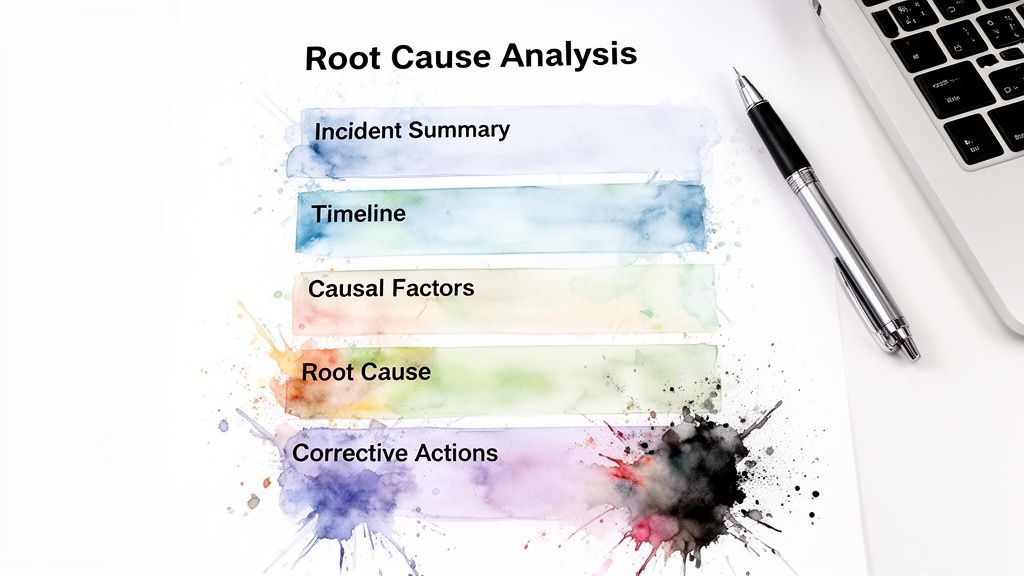
When something goes wrong, the pressure is on to find answers. A solid root cause analysis template is your best tool for cutting through the noise. This framework helps leaders guide a disciplined investigation and produce a single source of truth you can confidently present to anyone, including the board.
The template itself is not magic. Its power comes from the structured conversation it forces. Simply filling out a form is a waste of time. The goal is to use this document to drive a methodical discussion that uncovers the real problem and leads to concrete, lasting fixes. It becomes the proof that your organization learns from its mistakes.
Get the Root Cause Analysis Template (Google Doc / PDF)
Root Cause Analysis Report: [Incident Name]
- Incident Summary: A tight, one-paragraph overview written for an executive. Focus on the business impact. For example: “On November 24th, a critical payment processing outage lasted 45 minutes, preventing approximately 2,500 customer transactions and causing an estimated $150,000 in lost revenue.”
- Timeline of Events: A detailed, minute-by-minute log of what happened. This is all about objective facts from system logs, alerts, and team chats. No opinions allowed, just pure data.
- Causal Factor Analysis (The "5 Whys"): This is where the real digging happens. Start with the immediate cause and keep asking "Why?" until you find the systemic issue beneath the surface.
- Root Cause Identification: A definitive statement explaining the systemic failure. This should point to a broken process, a gap in a tool, or a flawed system, never a person.
- Corrective and Preventive Actions (CAPA): A table of specific, measurable actions. Each one needs a single owner and a firm deadline. This is where accountability lives.
- Sign-off: The key stakeholders who reviewed the analysis and are committing to the action plan.
How to Use the Template Effectively
A great RCA document tells a story, moving from high-level business pain to the specific fixes needed to prevent a recurrence.
The Incident Summary is your executive briefing. It must be short, sharp, and focused on what leaders care about: money, customers, or operational disruption. It answers "what happened and why it mattered" in a single paragraph.
The Timeline of Events builds the factual foundation for your investigation. It strips out subjectivity and forces everyone to work from the same set of facts. Key moments to capture include:
- First detection: When did the first alert fire or customer email arrive?
- Team engagement: When was the on-call engineer paged? When did the response team form?
- Key actions: What steps were taken to diagnose and fix the problem?
- Service restoration: When was the system confirmed to be 100% operational again?
This factual record is non-negotiable. I have seen many RCAs go off the rails because the timeline was based on memory and speculation, which quickly leads to finger-pointing.
From Symptoms to Systemic Flaws
The Causal Factor Analysis is the detective work. Using a simple but powerful technique like the "5 Whys," the team methodically drills down past the obvious symptoms. You follow a chain of "why" questions to get from "the site was down" to the real, underlying weakness in your system or process.
A weak root cause is "human error." A strong root cause is "the deployment process lacks an automated check to prevent misconfigured code from reaching production." The first blames a person; the second identifies a fixable system flaw.
Finally, you get to the most important part: the Corrective and Preventive Actions. This is where your analysis becomes a commitment. Vague goals have no place here. "Improve monitoring" is useless. A strong action item sounds like this: "Deploy new database query alerts for the payment gateway by EOD Friday, owned by Jane Doe."
This level of specificity separates a performative RCA from one that drives meaningful change. It makes accountability clear and progress easy to track, which is the exact kind of assurance your leadership team needs to see.
How to Run an Effective Root Cause Analysis Meeting

Having a template is a great start, but a successful root cause analysis depends on how you run the process. A great RCA is not about technical genius; it is about a calm, methodical investigation. The goal is to transform a stressful incident from a "who-did-it" mystery into a valuable learning opportunity.
When done right, this process builds trust with leadership and makes your entire organization stronger.
Declare the RCA and Appoint an Owner
The moment a major incident is resolved, a leader needs to officially declare that an RCA is happening. This signals to everyone that the problem is being taken seriously and sets the expectation for follow-through.
Immediately assign a single person to own the RCA. This person is the facilitator or incident commander. Their role is not to assign blame but to manage the investigation. They will manage the timeline, get the right people involved, and ensure the final report is completed. Without a single owner, the process will drift.
Assemble a Small, Focused Team
The owner’s first job is to pull together a small, cross-functional team. You want people who were directly involved or have deep knowledge of the systems that failed. This is not a company all-hands meeting. Keep the group tight for a focused discussion.
Your team might include:
- Engineers or developers who own the code or infrastructure.
- A product manager who can explain the impact on users.
- Customer support leads who heard from customers.
- Subject matter experts whose systems were involved.
The point is to have enough expertise to understand the technical failure and its business impact.
Gather Evidence, Not Blame
With the team in place, start building an objective timeline of what happened. This stage is about facts, not feelings. The facilitator must steer the conversation away from blame and toward concrete evidence.
Collect data as soon as possible, while memories are fresh and logs are available. Pull from multiple sources for a complete picture.
Focus on collecting timestamped data:
- System monitoring alerts (CPU spikes, error rates, latency).
- Application and server logs.
- Chat logs from Slack or Teams where the response was coordinated.
- Customer support tickets and social media posts.
This evidence becomes the skeleton of your analysis. It moves the conversation from "I think this is what happened" to "The logs show this error occurred at 10:47 AM."
Dig for the Real Root Cause with the "5 Whys"
Once you have a factual timeline, the real work begins. The "5 Whys" technique is a simple, powerful method for this. You start with the observed problem and keep asking "Why?" until you uncover a systemic flaw.
Here is how it works:
- The problem: The website was down.
- Why? The payment API was timing out.
- Why? A recent code change introduced a database locking bug.
- Why? The bug was not caught by our automated tests before deployment.
- Why? Our test suite does not cover that specific API interaction under load.
The root cause is not "a developer made a mistake." It is "our testing process is inadequate." One is about a person; the other is a system problem you can fix. This is a core part of mature incident management best practices.
Define Actions and Ensure Follow-Through
An RCA that does not lead to concrete action is a waste of time. For every root cause, the team must define specific, measurable actions to prevent it from happening again.
In your root cause analysis template, every action item needs three things:
- A clear description of the task.
- A single, named owner responsible for getting it done.
- A firm but realistic due date.
The facilitator’s job is not over until every action item is complete. They must track progress and confirm that every fix has been implemented. This final step builds lasting organizational trust.
Why Most RCA Efforts Fail
Do you ever feel stuck in a loop? You run a root cause analysis, fill out the root cause analysis template, and hold the post-mortem meeting. Then, a few months later, the same system fails in the exact same way.
This happens when the RCA process becomes a box-ticking exercise that gives the illusion of progress but drives no real change. The breakdown usually happens in the messy, human-powered steps that are supposed to come next. When follow-through is missing, the entire effort is just theater.
The Blame Game and Weak Recommendations
Want to kill an RCA before it starts? Let it turn into a witch hunt. The moment people feel they are being set up to take the fall, they stop being transparent. Instead of honest feedback, you get carefully crafted answers that are useless for finding the real systemic flaw.
This culture of blame leads directly to weak recommendations. Instead of pinpointing a gap in a process, the "fix" becomes a note for someone to "be more careful" next time. It is a complete cop-out.
A recommendation to "be more careful" is not a systemic fix. It is an admission that you failed to identify the true root cause. It places the burden of a broken process on an individual and guarantees the problem will happen again.
Real improvements come from finding tangible, fixable problems, like a missing automated check in your deployment pipeline or an ambiguous handoff between teams. You can fix those with better processes and automation.
Lack of Ownership and Follow-Through
I have seen it a hundred times: a team produces a brilliant RCA document with a solid list of action items. And then nothing happens. The document is filed away and never seen again. This is the most common failure mode for any RCA.
The problem is a lack of accountability. Action items are assigned to "the infrastructure team" instead of a specific person. Deadlines are vague suggestions like "by end of quarter." No one is tasked with ensuring the work gets done. Often, this failure is rooted in a misunderstanding of core incident management best practices.
When no single person feels responsible, the urgent fires of today will always win out over the important fixes for tomorrow. Meaningful change demands clear owners and firm deadlines. If you are looking for tools to help manage these organizational shifts, our guide on the best change management software is a useful resource.
Analyzing Without the Right Data or People
Finally, RCAs fall apart when the team lacks the right evidence or the right people in the room. Without hard data, the meeting devolves into a speculative storytelling session.
For an RCA to have any teeth, the team needs three things:
- Full Data Access: This means everything, system logs, monitoring dashboards, APM traces, and even customer support tickets. If you do not have the data, you are flying blind.
- The Right People: You need the engineers who have their hands on the keyboard every day. A manager who has not touched the code in years is not the person to explain a service dependency failure.
- A Skilled Facilitator: The person leading the RCA must know how to guide the conversation, keep everyone focused on evidence, and pull out insights without letting the discussion get derailed by blame or technical rabbit holes.
If any of these elements are missing, your team cannot get past the surface-level symptoms. The final report will be shallow, the "root cause" will be wrong, and the fixes will miss the mark.
What Better Looks Like: A System That Learns

Imagine a major incident triggers a calm, predictable process. This is what a mature organization looks like. It uses a root cause analysis template not just to put out fires, but to build a more resilient company.
In this environment, leadership gets a clear report answering the only questions that matter: What happened? Why did it happen? And what are we doing to make sure it never happens again? Teams are not afraid of transparency because the focus shifts from blaming people to fixing the broken processes that set them up to fail.
This change stops you from paying the steep price of recurring failures in lost revenue, wasted engineering hours, and dwindling customer trust.
From Firefighting to Predictable Execution
An organization with a disciplined RCA process moves with more confidence. Reporting risk to the board is no longer a scramble to explain the same old problems. Instead, it is a summary of concrete learnings and systemic improvements, proving the business is getting stronger.
That predictability is what lets you move faster. When you have faith that problems will be solved at their source, you can take calculated risks and chase growth without worrying that one small mistake will bring everything crashing down. This is the bedrock you need to build a continuous improvement culture that fuels growth.
A learning system does not just fix what broke. It inoculates the organization against that entire class of failure. It turns a liability into a durable competitive advantage: the ability to execute reliably under pressure.
The Tangible Outcomes of a Learning System
This is not just a theoretical perk. It shows up in operational metrics. Research shows that disciplined processes, sometimes aided by modern tools, can drive significant improvements in system uptime, operating costs, and Mean Time to Resolution (MTTR).
The signs of this healthy state are unmistakable:
- Fewer repeat incidents: Problems are actually solved for good.
- Faster, calmer incident response: Teams follow a playbook instead of their gut.
- Higher team morale: Engineers get back to building, not constantly firefighting.
- Stronger board confidence: Risk reporting shows a clear, positive trend line.
Getting to this state is not an accident. It happens when leadership commits to the process, uses tools like a root cause analysis template to enforce discipline, and holds everyone accountable for turning painful lessons into permanent improvements.
Common Questions About Root Cause Analysis
If you are rolling out a formal root cause analysis process, you probably have some practical questions. It is one thing to have a template, but another to run an RCA in the real world. Here are the most common questions I hear from leaders.
What Warrants a Full RCA?
A formal RCA is not for every little hiccup. You use the full process for significant, recurring, or high-impact problems. Think of any customer-facing outage, a notable security incident, or a nagging issue that keeps derailing your team.
The gut-check question is this: does the cost of this problem happening again outweigh the cost of spending a few hours investigating it? If a repeat would mean lost revenue or angry customers, an RCA is a necessary investment.
How Do You Get Honest Answers Without Blame?
This is the most critical part to get right. You must establish a blameless culture from the beginning. The person kicking off the RCA needs to state unequivocally that the goal is to find flaws in the system, not to point fingers at people. That statement sets the tone.
The facilitator must constantly steer the conversation toward gaps in process, tooling, or automation. Every question should be about what happened, not who did something.
When people see the process leads to system improvements and not punishment, they start opening up. Trust is built when they realize the goal is to make their jobs easier and the system more resilient.
The core principle is simple: Assume everyone involved acted with the best intentions based on the information and tools they had at the time. The failure is in the system, not the person.
How Long Should an RCA Take?
For an RCA to be effective, it has to be fast. Lagging on the analysis means details get fuzzy and momentum is lost. For most business system failures, aim to have the final RCA report done and published within 3-5 business days.
The initial heavy lifting, gathering the timeline, talking to key people, and identifying causal factors, should happen in the first 24 hours. The memory of what happened is sharpest then. The goal is a timely, actionable report that helps the business fix what is broken. Fast and effective beats slow and perfect every time.
If your team feels like they are constantly firefighting and you are struggling to get ahead of recurring problems, CTO Input can help. We specialize in implementing the calm, clear operating rhythms that build more resilient organizations.
Book a Clarity Call to figure out what is really breaking and how you can fix it for good.