

When you want to scale technology without headcount, you must move beyond the traditional strategy of adding one new person for every new system, report, or integration. True operational efficiency comes from reducing how much work depends on manual handoffs, tribal knowledge, and constant rescue missions. By decoupling output from your total staff numbers, you can achieve better results without relying on linear headcount growth.
If your technology spend keeps climbing but the business still feels slower, the problem is usually not a lack of effort. It is rooted in weak ownership, soft reporting, too many overlapping tools, and a missing operating model for growth. This is entirely fixable, and it usually starts with making smarter architectural and process decisions before you commit to more payroll.
Key Takeaways
- If you want to scale technology without matching headcount growth, start with ownership, not automation.
- A tighter tech stack beats a bigger tech stack. Cut tool sprawl, shadow IT, and duplicate systems before adding new platforms.
- Executive technology leadership matters more than extra managers when priorities, vendors, and risk start pulling in different directions.
- Board-ready reporting should show spend, risk, and progress in business terms, not ticket counts and jargon.
- A short technology assessment and 90-day plan usually creates more traction than another rushed hire.
Scale through decisions, not bodies
Most companies hit the same wall. Revenue grows, systems multiply, and every new initiative seems to require more coordination. Soon, adding customers feels the same as adding friction to your revenue growth.
That is the point where you need a real technology strategy, not a collection of requests. A useful business technology strategy tells you what matters now, what gets delayed, who owns each call, and how technology supports growth. A business-aligned technology strategy ensures long-term scalability for small teams, even when they are facing tight budget constraints. This approach keeps the roadmap tied to revenue, margin, risk, and execution, rather than the loudest internal voice or the most persuasive vendor.
If you scale bad systems, you only get more expensive confusion.
This is where many founder-led technology decisions start to break down. What worked when the company was smaller often becomes a drag at the next stage. You need a cleaner decision rights map, stronger stakeholder alignment, and a regular technology operating rhythm that helps the CEO, COO, finance, and operators make faster calls with less guesswork. It is also the ideal time to re-evaluate your tech stack to ensure it is not creating unnecessary complexity.
For most leadership teams, that means working from a short one-page technology strategy, a practical IT strategy and roadmap, and a living technology roadmap that supports your business processes for a full 12 months of execution. A 12-month technology roadmap should show priorities, investment, owners, and timing. A technology roadmap template is useful only if it forces tradeoffs. If it turns into a wish list, it is not helping.
If you want a practical frame for this, CTO Input’s business-aligned technology strategy playbook is a strong example of how to connect technical work to business outcomes. That is what strategic technology planning should do. It should help you make better technology decisions for growth, not create a prettier slide.
Simplify the stack before you automate it
You cannot automate chaos and expect a clean result. Start with a systems inventory. Find out which tools are core, which are duplicate, which are poorly adopted, and which are creating hidden work for your team.
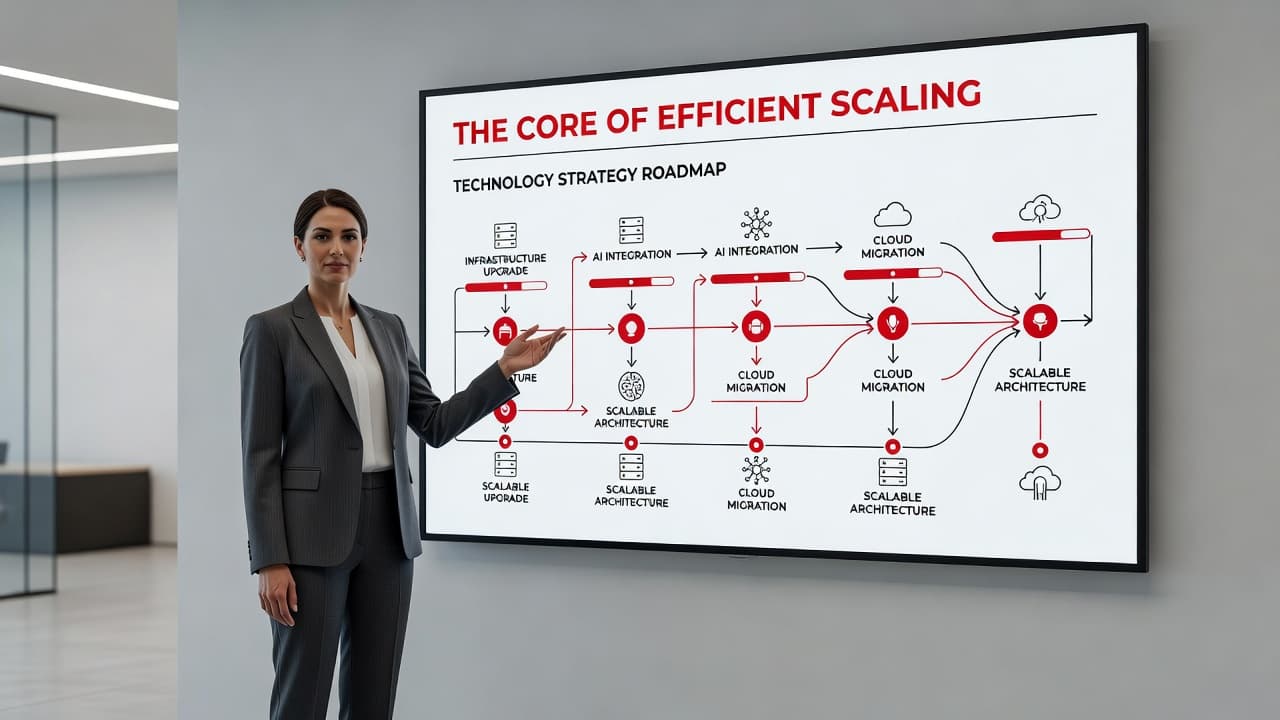
This is the point of application portfolio rationalization and software platform evaluation. You are not looking for perfect tools. You are looking for fewer systems that carry more of the load. That means reducing tool sprawl, cleaning up shadow IT, and getting serious about technology vendor selection using intent-driven technology to align software with specific business goals. It also means honest vendor management, tighter vendor risk management, and stronger third-party risk management. If a critical supplier fails, you need vendor due diligence, a clean vendor offboarding process, and a vendor incident response plan before the pressure hits.
The financial upside is real. Fewer systems usually improve technology spend optimization, technology ROI, tech spending ROI, IT cost optimization, and IT cost reduction. The trick is to measure spend by outcome, not by license count. Your technology dashboards should support cost-per-outcome reporting, not vanity metrics.
Good operators already know this. Even broad advice on scaling operations without increasing headcount keeps coming back to the same ideas: document bottlenecks, remove duplicate work, and make teams less dependent on heroics.
Automation helps, but only after the basics are clean. Your data strategy, data governance framework, data quality, data hygiene, data privacy, and information governance need to be stable first. The same is true for access control best practices. If you add artificial intelligence on top of weak data and loose permissions, you create faster mistakes.
Before deploying AI-powered tools, ensure your business processes are optimized. You can use workflow automation to strip away repetitive administrative tasks, which frees up your team for high-value work. For instance, implementing workflow automation in areas like lead capture can significantly improve the overall customer experience. A sound artificial intelligence adoption strategy, AI transformation strategy, and responsible AI posture should include an AI acceptable use policy, AI vendor due diligence, and an AI opportunity assessment. By leveraging agentic AI alongside traditional automation tools, you can handle complex administrative tasks more efficiently. That is a safer path than spraying AI-powered tools across the company and hoping for the best. Even ERP-focused examples of scaling through better data and automation land on that same point—using artificial intelligence to enhance human output rather than simply adding more software to the pile.
Add executive technology leadership before more payroll
Many companies do not need a larger IT team first. They need a better leader in the room. When priorities drift, vendors start driving the roadmap, and reporting becomes difficult to trust, you are likely dealing with a technology leadership gap.
It is important to understand that executive leadership is fundamentally different from staff augmentation. While the latter simply adds more bodies to your payroll, executive oversight brings the strategy required to scale operations efficiently. For many teams, the right approach involves a hybrid team structure, which can be supported by outsourcing IT services to bridge the skills gap without the immediate commitment of a full-time hire.
Here is the short version of how these flexible models work:
| Model | Best fit | What you get |
|---|---|---|
| fractional CTO, virtual CTO, part-time CTO, outsourced CTO | Growth without enough senior direction | Ongoing ownership of roadmap, spend, vendors, and delivery |
| interim CTO and interim CTO services | Open seat, failed initiative, or urgent instability | Fast stabilization, clearer ownership, and a defensible plan |
| fractional CIO | Broader systems and operations issues | Stronger cross-functional alignment beyond engineering |
| fractional CISO, virtual CISO, interim CISO | Cyber pressure and weak security governance | Clearer risk ownership, reporting, and oversight |
A fractional CTO is often the right move when you need senior judgment but not full-time overhead. Fractional CTO services help when the business has outgrown tactical IT and needs steady direction. An interim CTO fits when the seat is open or the room needs calming fast. A fractional CIO fits when the issue is enterprise-wide operations, data, and systems. A fractional CISO or interim CISO fits when security and risk are the immediate pressure points.
This matters because focusing on technology leadership before hiring permanent staff is often cleaner than rushing into a full-time role. You can sort out the operating picture first, then make a better call on how to hire a CTO, when to hire a fractional CTO, and whether the real choice is fractional CTO vs full-time CTO or fractional CTO vs IT consultant. That is a smarter pattern for technology leadership for mid-market companies and any technology leader for growing companies.
If your technology decisions still feel scattered, risky, or too dependent on the wrong people, Get an Executive Technology Clarity Check. It is a practical way to see where ownership is weak and what needs executive attention first.
Make scale visible to leadership and the board
Growth becomes expensive when leaders cannot see the impact technology has on cost, speed, and risk. This is why technology governance matters. Good technology governance for CEOs focuses on decision rights, cadence, and priorities, while effective technology governance for boards centers on visibility, thresholds, and accountability. Implementing these frameworks also reduces the burden of manual administrative tasks on your technical leaders, allowing them to focus on high-value initiatives.
That means better board-ready technology reporting that leadership can actually use to drive the business. A useful board-ready tech roadmap connects spend to specific outcomes, which is essential when securing enterprise clients and maintaining a competitive edge in your market. A good board-ready risk summary clearly explains what is stable, what is exposed, and who owns the next move. The same applies to board cybersecurity reporting, cyber risk reporting to the board, and defining the board’s cyber risk appetite. If those conversations stay vague, cybersecurity oversight and technology risk oversight remain weak.
The work underneath that reporting is practical. You need a real technology risk management framework, stronger technology risk management, and cleaner third-party risk reporting. You also need to verify whether your business continuity planning, disaster recovery planning, incident response readiness, and ransomware readiness would hold up under stress. That is where a current executive incident response checklist, cybersecurity risk assessment, IT security assessment, and upcoming cyber insurance renewal all matter.
If the business is entering a transaction or leadership change, the same discipline helps with acquisition readiness, technology due diligence, technical due diligence, cybersecurity due diligence, an acquisition due diligence checklist, a CTO transition plan, and later post-merger technology integration. Weak ownership gets exposed fast in those moments. If that is on your horizon, Prepare Technology for Diligence or Transition.
Most of this starts the same way. Run a technology assessment, a technology audit, or a technology health check. Turn it into a short 90-day technology plan to ensure long-term scalability for your growth-stage company. Then, manage it through a steady operating cadence. That is how technology strategy for CEOs, technology strategy for COOs, and broader growth-stage technology leadership stop feeling abstract and start helping the business run better. CTO Input’s view on moving beyond technology planning to execution is worth a read if you want that discipline in plain language.
Conclusion
If you want to scale technology without headcount, the first move is not to hire more people. Instead, you must prioritize operational efficiency to make your output less dependent on manual labor.
The goal is to empower small teams through smarter, consolidated systems rather than relying on endless headcount growth. By focusing on fewer tools, clearer ownership, and stronger reporting, you can lead with clarity and make difficult tradeoffs without the usual organizational drama. When technology supports your business goals instead of adding drag, you achieve exactly what you were after all along: better decisions and a company that is significantly easier to run.
FAQ
When should you use a fractional CTO instead of hiring full time?
A fractional CTO makes sense when you need senior ownership now, but the business is not ready for a permanent executive hire. It is often the cleanest answer when priorities are drifting, vendors have too much influence, or the board wants clearer visibility before you commit to a full-time role.
What should your first 90 days look like?
Start with a systems inventory, a technology assessment, and a short 90-day technology plan. Then set a simple technology operating rhythm, assign owners, and build reporting that leadership can trust.
Can AI help you grow without adding people?
Yes, but only if your data, controls, and decisions are clean first. Artificial intelligence works best when it sits inside a clear operating model, with defined use cases, strong permissions, and reporting that shows whether it is saving time or creating new risk. By leveraging AI-powered tools, you can automate repetitive administrative tasks and streamline complex business processes. Ultimately, implementing artificial intelligence effectively allows your team to focus on high-impact initiatives rather than manual workflows.