
You’ve heard the term before, probably from a sales director or a board member. But what is a SOC 1 Type II report, really? In simple terms, it’s proof. It’s an independent auditor’s stamp of approval that your company’s internal financial controls aren’t just well-designed, but actually work, day in and day out, over a long period—usually 6 to 12 months.
That “Urgent” SOC 1 Request Has Landed. Now What?
It always starts with an email. A key customer’s finance department sends a message with a simple, direct subject line: “Request for SOC 1 Report.” Suddenly, a piece of compliance jargon becomes a very real, very urgent business problem.
As a leader focused on growth, this moment is a crossroads. You’re not just being asked for a document; you’re being asked to prove you’re a trustworthy partner. This report is a gatekeeper to the bigger deals and deeper relationships your company needs to scale.
If you can’t produce it, you’re facing serious roadblocks:
- Stalled Deals: Enterprise clients, especially in regulated industries like finance or healthcare, won’t even start a conversation without it. Their policy is often “no SOC 1, no deal.”
- Lost Customers: Your existing clients have their own auditors. If an audit flags your company as a risk because you lack the right compliance, they might be forced to find a competitor who has it.
- Eroded Trust: A missing SOC report signals operational immaturity. It makes potential partners wonder how seriously you take the integrity of their financial data. The risk is just too high for them.
This Isn’t About Compliance. It’s About Credibility.
At its core, a SOC 1 Type II report is a certificate of trust. It’s an official statement from a neutral third party that tells your customers their financial data is safe in your hands.
Think about it. If your service handles payment processing, subscription management, or any data that lands on a client’s financial statements, their auditors need to know your internal processes are solid. They need assurance that you won’t introduce errors or risks into their books.
The report answers one critical question for your customers: “Can we trust your systems not to mess up our financial reporting?” A clean report says “yes” more powerfully than any sales pitch ever could.
Ignoring this is a direct threat to revenue. But tackling it head-on flips a compliance hurdle into a competitive advantage. It proves you’re committed to operational excellence and sets you apart from less mature players. This guide will show you what a SOC 1 Type II report really means for your business, how to navigate the process without derailing your team, and how to use it to fuel growth.
What a SOC 1 Report Actually Signals to Your Customers
Let’s cut through the jargon. A SOC 1 report isn’t a catch-all cybersecurity certificate. It has one specific job: to prove you can protect the integrity of your customer’s financial data.
If your service even touches a process that could impact a client’s financial statements—payroll processing, billing platforms, data centers hosting financial apps—then this report is non-negotiable. It’s the formal assurance their auditors need to feel confident that the numbers coming out of your system are trustworthy.
The Skyscraper Analogy: A Quick Guide for Leaders
Imagine your company is a specialized subcontractor working on a massive skyscraper. That skyscraper is your client’s annual financial audit. You might be the team pouring the foundation, installing the electrical grid, or managing the plumbing.
Your client’s auditor is the general contractor. They are responsible for the entire project and must certify that every component is sound. Your SOC 1 report is your engineering certificate. It’s the independent, third-party proof that your piece of the project is solid and won’t jeopardize the final structure. Without that proof, the general contractor simply can’t sign off.
In business terms, a SOC 1 report demonstrates you have robust Internal Controls over Financial Reporting (ICFR). It tells customers your systems won’t inject errors into their financial records, directly addressing their biggest risk.
SOC 1 vs. SOC 2: Choosing the Right Tool for the Job
It’s easy to confuse the different SOC reports, but the distinction is critical. They answer two fundamentally different questions for your customers.
- SOC 1 asks: “Can we trust your service not to mess up our financial statements?” It’s laser-focused on financial controls.
- SOC 2 asks: “Can we trust you to keep our data secure and your platform online?” This covers a broader set of operational controls like security, availability, and privacy.
While both build trust, they serve different masters. A company might need one, the other, or both. Choosing the wrong one is a fast track to a wasted six-figure investment and a failed audit with a key client.
This distinction also highlights why you need to understand the vulnerabilities your own partners introduce—a core part of managing your third-party cyber risk. The very controls verified in a SOC 1 Type II report are exactly what you should be demanding from your own critical vendors.
A SOC 1 report is more than a compliance checkbox; it’s a business development tool. It projects maturity, shortens sales cycles, and shows you’re serious about protecting what matters most to your customers’ finance teams. It shifts the conversation from “Are you safe?” to “How do we get started?”
Choosing Between a Type I and Type II Report
Deciding between a Type I and Type II report comes down to one question: do you need to show you have a good plan, or do you need to prove that plan works in the real world? It’s the difference between a blueprint and a battle-tested product.
A Type I report is like getting the architectural drawings for a new skyscraper approved. An expert reviews the plans and confirms that, on paper, the building is designed to be structurally sound. It’s an essential checkpoint that says, “If built as designed, this should work.”
A SOC 1 Type II report, however, is like having that same expert on-site for a full year after the skyscraper is built. They’re there through summer heat and winter storms, continuously testing the foundation and safety protocols. This proves the building isn’t just well-designed; it’s reliably safe, day in and day out.
Why Your Customers Demand Proof, Not Promises
For most enterprise clients, a Type I report is just a starting point. Their auditors and risk managers need the full story.
A Type I report looks at the design of your controls at a single moment in time. It’s a snapshot. This is a fine first step for companies just starting their compliance journey.
A Type II report goes much further. It tests both the design and the operating effectiveness of your controls over a period of time, usually six months or more. This is what enterprise customers actually want. It provides powerful assurance that you don’t just have a dusty policy binder on a shelf—you actually follow your own rules.
Handing over a Type I report when a customer needs a Type II is like showing up to a final exam after only reading the syllabus. You know the topics, but you have no proof you can solve the problems under pressure.
Making the Right Call for Your Business
So, which one should you choose? It depends on where you are as a business and what you’re trying to achieve.
- Choose a Type I if: You’re in the very early days of setting up controls. It can be a quick win to satisfy an initial request or serve as a formal readiness assessment before the much bigger Type II effort.
- Choose a Type II if: Your primary goal is to land and keep enterprise customers. A Type II smooths out the sales cycle and builds a rock-solid foundation of trust. For any company serious about growth, the SOC 1 Type II report is the destination.
Honestly, planning for a Type II from the start is almost always the smarter move. It instills the right operational habits from day one and saves you from the awkward moment when you proudly present your Type I, only to have your most important prospect say, “Great, now where’s the Type II?”
This isn’t just a trend; it’s the new standard. The market for SOC reporting services was valued at around USD 5.4 billion in 2024 and is projected to nearly double by 2030, all because clients and regulators are demanding this level of proof. The AICPA sets the standards, and you can find more data on the SOC reporting market showing just how critical this has become. The message from the market is loud and clear: proving your controls work is no longer optional.
A Simple 3-Phase Plan for Your First SOC 1 Audit
Getting a SOC 1 Type II report shouldn’t be a last-minute scramble. It’s a serious project, but one you can control with the right game plan. By treating it like any other strategic initiative—with a clear beginning, middle, and end—it goes from a source of stress to a predictable, manageable process.
We guide our clients through a straightforward, three-phase framework that breaks the journey into digestible stages. It gives you the visibility and control you need, without forcing you to become a full-time compliance expert.
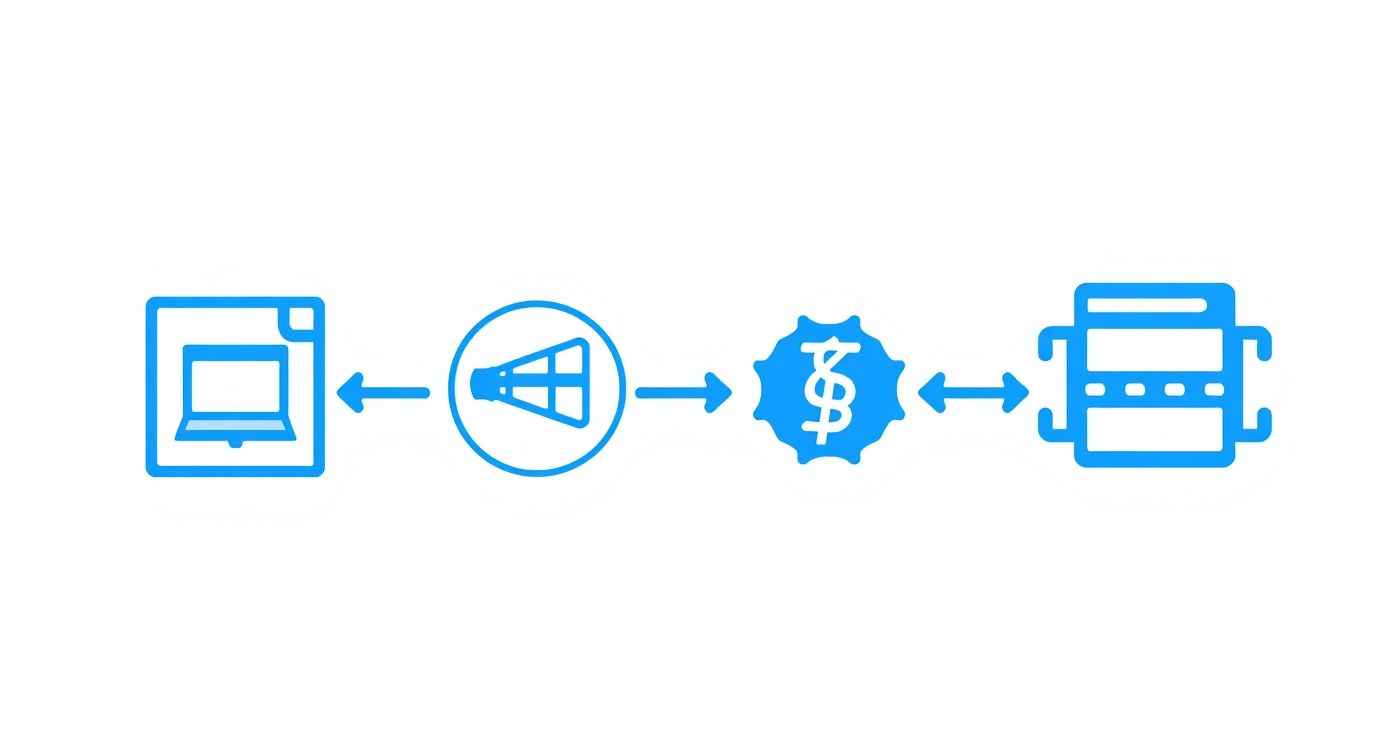
The big difference between a Type I and a Type II is that the latter is a movie of your operations, not just a single photograph. That’s why having a structured, multi-phase plan is critical.
Phase 1: Readiness and Scoping (The Blueprint)
This is where you lay the foundation. Getting this phase right saves you time, money, and headaches later. It’s about drawing the right lines in the sand and getting an honest look at where you are today.
- Define the Scope: Work with an advisor to nail down exactly which systems, processes, and locations matter for your customers’ financial reporting. This is your best defense against “scope creep,” the number one reason audit budgets spiral.
- Conduct a Gap Analysis: Think of this as a pre-audit. A readiness assessment compares your current controls to the SOC 1 framework, giving you a clear, actionable punch list of everything that needs to be fixed.
- Assign Ownership: Every control needs a person’s name next to it. This creates accountability and makes gathering evidence later much smoother.
This phase typically takes 2 to 4 months. Rushing it is a false economy. A poorly scoped audit is practically designed to fail.
Phase 2: Remediation and Evidence Gathering (The Build)
With the roadmap from Phase 1, your team moves into execution. This is where you fix the gaps and start methodically collecting proof that your controls are working as designed.
This is often the most labor-intensive part of the journey. Your teams will be busy updating documentation, implementing new procedures, and tweaking system configurations. Consistency is key.
This phase is the heart of the SOC 1 Type II report process. It’s where you prove operational discipline. It’s not about having perfect policies on paper; it’s about demonstrating those policies are alive and active in your daily work.
During your chosen audit window (6 to 12 months), your team will gather evidence like system logs, change management tickets, and employee access reviews. This takes a lot of coordination, which is where having expert guidance across a range of IT compliance services can keep your internal team from getting bogged down.
Phase 3: The Audit and Reporting (The Inspection)
Once your observation period closes and the evidence is organized, the independent auditor steps in to do their fieldwork. If you’ve done the work in the first two phases, this last stage should be relatively painless.
The auditor will:
- Request Evidence Samples: They’ll ask for specific examples for each control, pulled from different times throughout the audit period.
- Conduct Interviews: They’ll talk to your team to confirm they understand the processes they’re responsible for.
- Perform Testing: The auditors will test the evidence to verify that your controls were operating effectively.
After testing is complete, the CPA firm drafts the final SOC 1 Type II report. This audit and reporting phase usually takes another 1 to 2 months. By following this plan, you turn a daunting compliance burden into a clear, manageable project that builds lasting trust with your customers.
What This Really Costs: A Look at the Numbers and Common Pitfalls
Let’s talk about the real investment for a SOC 1 Type II report. The auditor’s proposal is just the tip of the iceberg. The true cost is a mix of that fee, your team’s time, and any new tools or process changes you need. For most growing companies, this is a major strategic decision.
A classic mistake is treating this as a simple “IT problem.” That mindset is a one-way ticket to a painful, expensive audit. Without an executive champion, the project gets stuck because it lacks the authority to push for necessary changes in other departments like HR, finance, or operations.
Breaking Down the True Cost
When budgeting for a SOC 1 audit, you have to look beyond the auditor’s invoice. A realistic plan accounts for a few different pieces.
- Readiness Assessment: Think of this as your insurance policy. Before the audit, an expert performs a gap analysis. Plan to spend $15,000 to $30,000 for a clear roadmap of exactly what to fix.
- Auditor Fees: The formal audit itself can run from $25,000 to $75,000+ for a first-time Type II report. The price depends on the complexity of your systems and the scope.
- Internal Resources: This is the hidden cost. For a first-time audit, budget at least 400-600 hours of your own team’s time. This isn’t just IT; it’s time from engineering, HR, and management, all pulled away from their core jobs.
All in, a first-year SOC 1 Type II report can easily be a $100,000+ investment. Forgetting to account for your team’s time is the quickest way to blow your budget and burn out your best people.
The Pitfalls That Cause Audits to Fail
I remember one client, a fast-growing fintech platform, that rushed into an audit to lock down a huge deal. They had beautifully written policies, but in practice, nobody followed them. The way their developers actually pushed code was completely different from what the rulebook said.
It took the auditors less than a week to spot the disconnect. The result? They received a “qualified opinion,” the auditor’s polite way of saying they failed. The deal was put on hold, and they had to spend another six months—and a lot of unbudgeted money—fixing their daily processes before trying again.
The most common reason for a failed audit isn’t a dramatic security breach. It’s the simple, boring gap between written policies and everyday reality. An audit tests what you do, not what you say you do.
To avoid this, watch out for these common traps:
- Poor Scoping: Trying to audit everything is a recipe for disaster. A good advisor helps you narrow the scope to only the systems and controls that are truly important. This alone can save a massive amount of time.
- Last-Minute Evidence Scrambles: Trying to pull together proof while the auditors wait is chaotic, stressful, and leads to failed controls. It has to be a steady, systematic process.
- Treating It as a One-Time Project: A SOC 1 report is an annual commitment. To make it manageable, build a sustainable, repeatable process from day one.
Pulling this off is a challenge, especially when you’re stretched thin. In fact, studies show that 62% of small to medium enterprises struggle with resource constraints and understanding the complex controls involved. You can read more about these SMB compliance challenges to see how common this is. With the right approach, you can turn this burden from a painful cost center into a predictable, value-adding project.
Turning Compliance into a Competitive Advantage
Getting a SOC 1 Type II report is far more than checking a box. It’s a powerful signal to the market, your customers, and your own board. It’s a strategic move that transforms your company from just another vendor into a trusted partner.
When you can hand this report to a potential customer, you clear a major hurdle in their buying process. Your sales team can sidestep endless security questionnaires and get right to business.
From a Cost Center to a Growth Engine
For your board and investors, this report is proof of a mature approach to risk management. It’s tangible evidence of operational excellence, a quality that boosts company valuation and makes you a more attractive prospect for the next funding round or a future acquisition.
But the real, lasting value is internal. The audit process instills a level of discipline that fortifies your entire operation.
A SOC 1 audit isn’t just about compliance; it’s about building a more resilient, valuable, and trustworthy company. It forces you to build the operational muscle required for sustainable, long-term growth.
This journey requires you to create better documentation, clarify process ownership, and genuinely strengthen your security posture. You can’t fake your way through a Type II audit. The rigor it demands becomes part of your company’s DNA.
The Business Case for Proactive Compliance
In today’s market, the stakes are high. Without a SOC 1 Type II report, you risk losing deals to competitors who have already made the investment. You appear less mature, less secure, and a bigger risk. With it, you build a foundation of trust that accelerates your entire growth plan.
This is part of a larger trend. As threats grow, companies are layering their compliance efforts. In fact, 92% of organizations now conduct two or more compliance audits annually, with 58% performing four or more to keep their controls sharp. You can see more on this in these compliance statistics.
For any ambitious company, this is no longer optional. A SOC 1 report is a definitive statement that you’re ready to play in the big leagues. It’s a strategic investment in credibility that pays dividends across the entire business. This is central to turning cyber risk into a strategic advantage, a topic we cover in The Board’s Guide to a Fractional CISO. The report proves you have the controls to not only protect your customers but to scale your business with confidence.
Common Questions We Hear About SOC 1 Reports
Even with a solid plan, a few questions always pop up about the details of a SOC 1 Type II report. Getting clear answers is crucial for setting the right expectations with your board, team, and customers. Here are the most common ones we tackle.
How Long Does a SOC 1 Type II Audit Take?
This is not a quick project. From the day you start assessing readiness to the moment you have the final report, you’re typically looking at 9 to 15 months. It’s a marathon, not a sprint.
The audit period itself—the “Type II” part—needs to cover at least six months to be taken seriously. Many companies choose a full 12-month review period to show the highest level of assurance. Don’t forget to budget 3 to 6 months for the prep work before the audit clock even starts.
Who Can Perform a SOC 1 Audit?
This is non-negotiable. Only an independent, licensed Certified Public Accountant (CPA) firm can perform a SOC 1 audit. The standards are set by the American Institute of Certified Public Accountants (AICPA). When picking an auditor, look for a firm with deep experience in your industry. It makes the process much smoother.
Does a SOC 1 Report Expire?
Yes, absolutely. A SOC 1 report is a snapshot in time. It provides an opinion on your controls over a specific, defined period. Your customers will expect a fresh report every year to prove that your controls are still effective. It shifts the audit from a one-off project to a core part of your annual business rhythm.
We Already Have a SOC 2 Report. Do We Need a SOC 1?
This comes up all the time. The answer depends on what your service does for your customers. While both reports build trust, they serve different, non-interchangeable purposes.
A SOC 2 report proves you can keep data secure and available. A SOC 1 report proves your systems won’t mess up a client’s financial statements.
If your platform touches anything related to your clients’ financial reporting—revenue processing, payroll, or billing systems—their financial auditors will almost certainly ask for a SOC 1. The two reports answer different questions for different audiences. It’s not uncommon for a company to need both.
Getting through your first SOC 1 Type II report is a major milestone. It signals operational maturity that big customers demand, but you don’t have to figure it out alone.
At CTO Input, we act as your guide, translating complex compliance rules into a clear, step-by-step plan. We help you define the right audit scope, prepare your team, and turn a potential compliance headache into a real competitive advantage.
If a SOC 1 request has landed on your desk and you need a clear path forward, schedule a no-pressure discovery call with CTO Input today.