

Amid digital transformation driving modern business growth, technical debt rarely shows up with a warning label. It shows up as slower launches, messier handoffs, more manual work, and leaders who keep asking, “Why does this take so long?”
You can still have a capable team and a healthy business on paper, full of latent potential. The trouble is that the system beneath it starts to absorb time, money, and attention. When technical debt growth gets ahead of your ability to clean things up, growth slows in ways the budget does not always catch right away.
Key takeaways
- Technical debt becomes a growth problem when it starts slowing decisions, delivery, software quality, or customer experience.
- The warning signs usually show up in business terms first, not technical ones.
- You don’t need to rebuild everything. You need to know where the drag is, who owns it, and what it is costing you.
- Time-to-market is a critical business metric that technical debt slows, delaying competitive launches and feature rollouts.
Growth stalls before the stack breaks
A lot of leaders wait for a system failure before they call it a problem. That is usually too late. The earlier signal is softer. Projects take longer. Performance degradation becomes evident. Reporting gets less trustworthy. The team starts working around legacy systems instead of through them.
That is how technical debt turns into drag. Not all at once. By accumulation.
If you run a mission-driven team, you may see the same pattern in technology challenges for legal nonprofits. The labels are different. The pressure is the same. Growth adds load, old shortcuts pile up, and nobody has a clean line of sight into what is slowing things down.
The real test is simple. If your business keeps growing but your operating pace does not, the problem is no longer just technical. Architectural debt makes it structural.
The warning signs are usually business signs
You don’t need to understand every line of code to spot trouble. You need to watch what the business is doing.
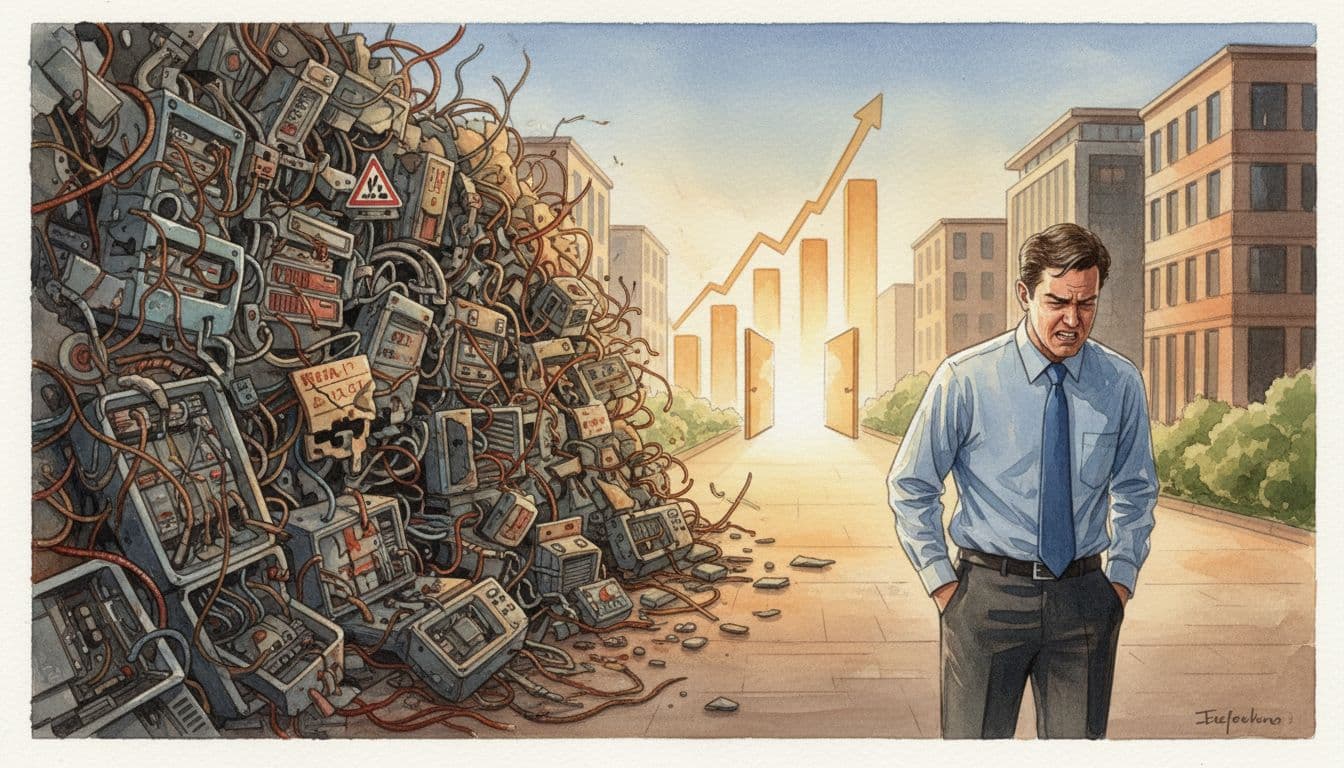
Look for the signs that keep showing up in leadership meetings:
- Small changes take weeks, because each one touches too many systems.
- Teams rely on spreadsheets and side processes to get basic work done.
- Your staff keeps asking for more tools, but the real issue is overlap.
- Leadership gets different answers from different reports due to inconsistent data infrastructure.
- Vendors hold too much of the truth, which complicates risk management and your ownership of the operating picture.
These technical debt symptoms block your path to AI transformation, as legacy systems resist the modern upgrades needed for intelligent automation and data-driven decisions. That is the practical version of technical debt signs that hurt business growth. You feel it in delays, rework, and customer friction before you feel it in architecture diagrams.
If the slowdown shows up in revenue, retention, or staff capacity, you are past a small cleanup issue.
Martin Fowler’s technical debt quadrant provides a useful framework for his bottleneck model here too. His point is straightforward. Debt matters when it blocks the next thing the business needs, not when it only looks messy on a diagram.
If this sounds familiar, your team may not be “bad at technology.” You may simply be carrying too many old decisions into a new stage of growth.
How to measure the drag without guessing
You do not need a perfect scorecard. You need a clean read on where the business is losing time and money.

Start with the questions that matter in a boardroom:
| What you see | What it may mean | Technical Debt Metrics | Business impact |
|---|---|---|---|
| Delivery keeps slipping | The stack is too tangled | Cycle time > 30 days; deployment frequency down 50% | Slower growth, missed timing, and pressure on earnings per share for public firms |
| Manual work keeps rising | Systems do not connect well, blocking real-time streaming due to poor data infrastructure | Manual processes > 40% of workflows | Higher labor cost and more errors |
| Reporting takes too long | Data is scattered or unreliable | Data refresh > 24 hours; error rate > 5% | Weak decisions, lower trust, and stalled data maturity |
| Vendors control too much | You do not own the operating picture | Vendor dependency > 60% of core systems | More risk and less flexibility |
The point is not to turn this into a technical audit. The point is to connect the drag to business outcomes. If you cannot tie the slowdown to cost, capacity, or risk, you are probably measuring symptoms, not the source.
This is where leadership gets sharper. A good technology roadmap for legal nonprofits works because it forces priorities. What should move first? What can wait? What is creating avoidable friction right now? Once technical debt is managed, IT budget allocation can shift from maintenance to innovation.
That kind of sequence matters in every sector. Without it, teams keep patching the same problems and calling it progress.
What to do before the debt compounds
You do not fix technical debt by buying more tools. Strategic infrastructure modernization fixes it by making the business picture clearer with software intelligence.

Start here:
- Identify the three workflows that slow growth the most.
- Note documentation debt as a key factor slowing down those workflows.
- Name the owner for each one, not just the technical contact.
- Ask what breaks if you leave it alone for six more months.
- Cut overlap before you chase new capability.
- Build a short plan that leadership can actually review, leading to tech debt remediation and code refactoring.
If you work in a mission-driven environment, legal nonprofit technology case studies show the same lesson. Teams often regain control by simplifying the stack into a robust digital core, clarifying ownership, and reducing the number of places where work can stall.
That is the part many leaders miss. You do not have to solve every old problem at once. You do have to stop the technical debt from compounding while the business keeps moving.
FAQs
How do you know technical debt is hurting growth?
You know it is a problem when technical debt or code debt starts slowing delivery, raising cost, or making decisions harder to trust. If growth depends on more manual work or more exceptions, the debt is already affecting the business.
Can you keep growing with technical debt?
Yes, but only for a while. Growth can hide the problem and mask scalability issues for a season. Then the cost shows up as slower execution, weaker reporting, and more strain on the team.
Should you fix all technical debt before you expand?
No. That is not realistic, as a total rebuild would harm developer productivity. Focus on the debt that blocks revenue, customer experience, risk control, or core operations. Fix the parts that matter now.
Conclusion
Technical debt is not a problem because it exists. It becomes a problem when it starts slowing the business you are trying to run, driving up maintenance costs and complicating delivery. The warning signs are usually plain once you look at delivery, reporting, vendor dependence, and manual work together.
If growth feels harder than it should, don’t assume the answer is more effort. Sometimes the real answer is a clearer view of what is getting in the way, including technical debt, and who needs to own it next. This visibility minimizes maintenance costs and builds digital readiness, the ultimate goal of addressing technical debt. Resolving these issues paves the way for advanced initiatives like generative AI.