
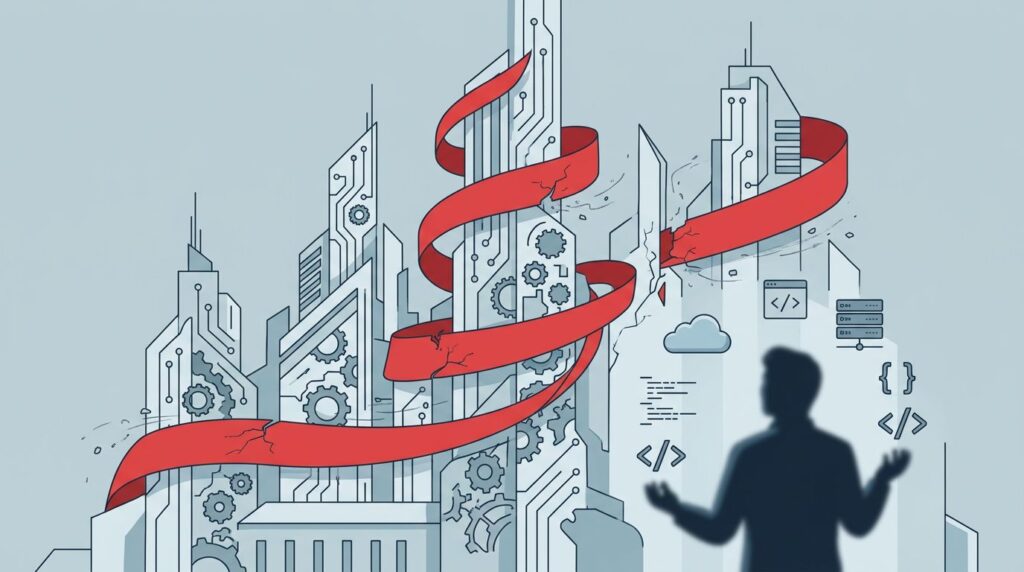
Fast growth looks good on the outside. Inside the business, it often means more systems, more vendors, more workarounds, and less time to slow down and clean up the mess.
That is how technical debt piles up. Originally coined by Ward Cunningham to describe the consequences of imperfect software development, this concept has become a defining struggle for scaling organizations. It rarely stems from one bad decision. Instead, it accumulates through a dozen sensible choices made too fast, often with too little ownership behind them.
Key takeaways for busy leaders
- Growth creates pressure to move first and govern later, often leading teams to bypass standard agile practices, which is where technical debt starts.
- Most of the damage comes from blurry ownership, weak reporting, and too many decisions bouncing around, which eventually makes software maintenance significantly more complex.
- Tool sprawl, shadow IT, and vendor drift make the stack harder to trust.
- The fix is not more activity. It is clearer technology leadership, a tighter roadmap, and better decision rights to manage long-term technical debt.
Growth creates more movement than control
When the business is growing, your team is rewarded for speed. You hire fast, add tools fast, and say yes to requests that keep revenue moving.
That sounds practical. It is practical, until systems overlap and ownership becomes unclear. The finance team wants reporting, sales wants speed, and operations wants fewer manual steps. Meanwhile, IT is stuck in the middle, trying to keep the lights on while managing mounting technical debt.
That is where technical debt starts to compound. Because teams are often pressured by tight deadlines and a constant need for rapid feature development, they frequently prioritize new work over necessary refactoring. Every temporary fix gets treated like a normal process within the software development lifecycle, and every shortcut becomes a permanent part of the operating model. Before long, your team spends more time managing friction and resolving technical debt than improving the business.
You can see the same pattern in Paddle’s overview of technical debt impact. When the pace of feature development ignores the long term health of the codebase, these rushed fixes are not small issues. They are the beginning of a much more expensive, unstable stack.
Ownership gets blurry, then the work gets expensive
Most growing companies do not have a technology problem first. They have an ownership problem.
The founder thinks the COO owns it. The COO thinks the IT lead owns it. The IT lead thinks the vendor owns it. Meanwhile, nobody owns the full outcome. That is when technology decisions start to drift, leading to an accumulation of technical debt that the business pays for in rework, delay, and weak confidence. When ownership is unclear, items in the product backlog begin to stack up without clear priority, turning simple software development tasks into complex hurdles.
If no one owns the full stack, the business pays for it in technical debt, project delays, rework, and constant surprises.
This is why leadership teams need clearer decision rights, not just more meetings. A useful calculation of the cost of technical debt usually starts with the support load, project delay, risk exposure, and lost time. Furthermore, software maintenance costs inevitably rise when the underlying technical debt is ignored because no single owner is accountable for the health of the system. The balance sheet rarely shows the full picture of this drag on software development, but the operating team feels it every week.
Once ownership is fuzzy, you also get half-finished reporting. Dashboards look busy, but they do not answer the real question, which is simple: what matters most now, and who is responsible for it?
Speed without standards adds hidden debt
Fast-growing companies often add tools before they define standards. That is where tool sprawl and shadow IT take root, accelerating technical debt across the organization.
One department buys a platform. Another department adds a different one. A third team builds a spreadsheet workaround because the approved system is too slow. Each move feels local and harmless, but collectively, these actions create documentation debt and infrastructure debt that become impossible to manage. Without proper code documentation, the resulting stack becomes difficult to govern and even harder to trust.
The same thing happens with vendors. You lean on them for speed, then they start shaping your roadmap. Vendor risk management turns into vendor dependence, and third-party risk reporting becomes a burden. Vendor due diligence happens after the contract is signed, rather than before it.
This is also where data quality slips. If your data infrastructure and governance framework are weak, your board-ready reporting becomes a guess. If generative AI tools arrive before your internal policies do, you accumulate significant technical debt in the form of noise, privacy risks, and confusion about acceptable use.
For a cleaner way to think about what to fix first, this CEO playbook for prioritizing technical debt keeps the focus on business impact instead of technical noise.
The cost shows up in revenue, risk, and board attention
Technical debt does not stay inside the IT function. It spreads into the rest of the business, creating friction that compounds over time.
Projects slow down because engineers are constantly diverted to address urgent bug fixes and reactive cleanup efforts. Customer-facing initiatives suffer delays because a core system lacks the necessary system scalability to support growth. Furthermore, new hires require extensive handholding because documentation is scattered, making it difficult to maintain a clear definition of done for new features.

The risk side of technical debt is just as real. Weak access control best practices, thin disaster recovery planning, and poor incident response readiness turn a routine event into a major business interruption. If your business continuity planning is built on wishful thinking rather than robust system scalability, the debt inevitably gets paid in downtime and expensive bug fixes.
That is why board-ready reporting matters. Boards do not need a technical data dump. They need board cybersecurity reporting, cyber risk reporting to the board, and a clear view of cyber risk appetite. They need to know where the real exposure sits, what the tradeoffs are regarding technical debt, and what leaders are doing to ensure long-term sustainability.
If you need a better framework for that conversation, start with how to reduce technical debt. The best plans are not heroic. They are visible, assigned, and paced.
The leadership gap is what keeps it growing
This is where the problem stops being technical and becomes a leadership issue.
Fast-growing companies often outgrow informal technology leadership before they notice it. The business has capable people. It may even have strong technical managers or a good MSP. What it does not have is enough executive technology leadership to make tradeoffs, set priorities, and keep the roadmap honest. When executive oversight is missing, technical debt accumulates rapidly, and the team lacks the remediation strategies necessary to reverse the trend.
That is the real technology leadership gap.
You need a technology leader for growing companies who can connect the business plan to the stack. That means business-aligned technology strategy, not a pile of disconnected projects. It means strategic technology planning that starts with outcomes, not tools. It means a clear technology roadmap, a one-page technology strategy, and a 12-month technology roadmap that leadership can actually use. More importantly, this leader must champion high standards in software development, ensuring that code quality remains high as the company scales. Without a focus on sustainable software development, the organization will continue to struggle with mounting technical debt that hinders long-term innovation.
A useful business technology strategy also covers technology governance for CEOs and technology governance for boards. It provides board-ready technology reporting, a board-ready risk summary, and a straight answer on what the company can safely delay. By implementing rigorous continuous integration and enforcement of code quality, a strong leader prevents technical debt from spiraling out of control. Effective remediation strategies ensure that past shortcuts are addressed before they become systemic failures.
That is where a fractional CTO often fits. So do fractional CTO services when the business needs executive judgment without a full-time hire. If the seat is open, interim CTO support or interim CTO services can steady the room faster. In some cases, an outsourced CTO, virtual CTO, or part-time CTO is the right bridge.
Sometimes the gap is broader. If the issue is enterprise-wide leadership, a fractional CIO may fit better. If the pressure is cyber-heavy, a fractional CISO, virtual CISO, or interim CISO can bring sharper technology risk oversight and cybersecurity oversight.
The point is not the title. The point is ownership. If your team has motion but no clear decision-maker, Talk Through Your Technology Leadership Gap gives you a clean place to start.
FAQs
Is technology debt the same as technical debt?
They overlap, but technology debt is a much broader concept. While technical debt usually refers to specific coding shortcuts that require refactoring later, technology debt encompasses weak governance, poor reporting, vendor dependence, and the maintenance of complex legacy systems. It also includes architectural debt, where the fundamental design of your stack no longer supports your current scale, making the entire environment harder to run compared to manageable, isolated technical debt.
Why do fast-growing companies accumulate it so quickly?
Fast-growing companies accumulate technical debt and broader technology debt because growth rewards speed over structure. You add new tools, personnel, and vendors much faster than you can establish ownership, standards, or decision rights. This debt grows every time a temporary fix is left in place, turning a quick workaround into a permanent, inefficient process that clutters your legacy systems.
What should you fix first?
Start with the components that directly slow down revenue, increase risk, or create confusion regarding ownership. A strong first pass includes a comprehensive systems inventory, a thorough vendor review, and the implementation of automated testing to prevent further technical debt from creeping into your codebase. You should also prioritize a short technology roadmap that addresses the most critical bottlenecks. If you need help sorting through the mess, always focus on the tangible business impact rather than just the code itself.
What matters most now
Technical debt grows fast when growth outruns ownership. That is the pattern. It is not about bad intent or lazy teams, but rather too much motion without enough control.
If the business feels harder to run, the answer is rarely found in buying another tool. Instead, the solution requires clearer leadership, cleaner reporting, and a roadmap that ties software development to the outcomes you actually care about. By addressing these foundational issues, you can minimize technical debt while prioritizing the long-term sustainability of your systems. This is how you stop paying interest on yesterday’s shortcuts and begin building a more stable future.