

A buyer just sent the diligence list. Your team is forwarding spreadsheets, hunting for contracts, and asking whether this belongs to engineering, IT, security, finance, or legal.
That scramble tells you something important. The deal risk is not the request list itself. The risk is that your technology may be harder to explain, prove, and govern than leadership assumed.
If you're the CEO, this is not an IT side quest. It's a valuation issue, an execution issue, and a trust issue. The buyer isn't only asking whether the product works. They're asking whether the business can scale without surprises, whether the risks are knowable, and whether the claims in the pitch deck survive contact with operational reality.
Why Your Next Deal Depends on Technology Due Diligence
The pressure tends to hit all at once. A deal gets serious, the room gets smaller, and suddenly your systems, vendors, codebase, access controls, reporting habits, and engineering leadership all sit under a microscope.
That moment exposes a common leadership mistake. Many teams still treat technology due diligence like a technical appendix. It isn't. It is one of the clearest ways a buyer tests whether the company is governable.
According to Beyond M&A's technology due diligence analysis, 62% of mergers and acquisitions fail to meet financial objectives, with poor due diligence named as a primary cause. In technology-specific acquisitions, that failure rate rises to 76%. If technology is central to the value story, weak diligence doesn't just slow the process. It can break the logic of the deal.
This is about business truth, not technical theater
A serious buyer wants answers to basic leadership questions:
- Can the platform support growth: Or will performance, reliability, or architecture limits force expensive rework after close?
- Can the business protect customer trust: Or are security controls mostly policy language with thin operational evidence?
- Can key people leave without breaking delivery: Or does one engineer, one founder, or one vendor hold the whole thing together?
- Can the acquirer integrate cleanly: Or will system sprawl, inconsistent ownership, and undocumented processes drag the deal into a swamp?
Those are executive questions. They affect price, structure, post-close investment, and confidence.
A buyer can tolerate known problems. They hate surprises.
If you're in private equity or preparing a portfolio company for exit, talent and operating structure matter as much as the stack itself. This is why work on scaling portfolio company engineering teams is relevant before a transaction, not after one. Buyers don't just evaluate software. They evaluate whether the people system around that software can keep producing results.
The board sees this differently than the tech team
Your engineers may hear diligence and think code review, cloud spend, or ticket hygiene. A board or investment committee sees something else. They see concentration risk, unverified claims, hidden liabilities, and the cost of fixing problems after the money is committed.
That difference matters.
When leadership delegates the whole exercise downward, the company usually answers the wrong questions. The team sends architecture diagrams, policy PDFs, and a vendor list. The buyer asks who owns incident response, why access reviews aren't clearly evidenced, whether open-source use is controlled, and how much post-close remediation is going to cost.
That's when valuation pressure begins.
The right stance before diligence
If a deal is in motion, assume your technology story will be challenged. Good. Better now than after close.
Your job is not to pretend the environment is cleaner than it is. Your job is to surface what is true, show that leaders understand the implications, and prove there is an operating system for fixing what's weak. That is what protects value.
What Technology Due Diligence Really Examines
Most leaders hear "technology due diligence" and picture a team of specialists judging code style in a repo. That's too narrow and misses the point.
Technology due diligence is a business risk assessment of the systems, practices, and technical decisions that support the investment thesis. The buyer is trying to answer one question: does the technology strengthen the deal, or is it hiding cost, fragility, and execution risk?

Think home inspection, not feature demo
A home inspector doesn't care whether the living room paint looks good in afternoon light. They look for foundation cracks, wiring problems, water damage, and shortcuts hidden behind the walls.
Technology due diligence works the same way.
A buyer doesn't care much that your roadmap looks ambitious or that your app demo lands well in a meeting. They care whether the system underneath that story is maintainable, secure, scalable, and owned clearly enough to survive stress.
What sits inside the review
At a practical level, technology due diligence usually examines areas like these:
- Architecture and maintainability: Can the system evolve without constant breakage?
- Operational readiness: Do releases, incidents, monitoring, and recovery processes work in a repeatable way?
- Security and privacy: Are sensitive systems protected, and can the company prove those controls operate in practice?
- Data and integrations: Where does critical data live, who can access it, and how entangled is it with third parties?
- People dependencies: Is the business relying on a few individuals or contractors to keep the platform alive?
- IP and software rights: Does the company clearly own what it says it owns?
This is why the service has moved from specialist niche to standard deal machinery. The technical due diligence service market projection from Worldwide Market Reports says the market is projected to grow from USD 1.2 billion in 2025 to USD 2.3 billion by 2032, at a 10.5% CAGR. That projection matters less as a market forecast and more as a signal. Buyers now expect this work.
What it is not
It is not a pass or fail code exam.
It is not a beauty contest between frameworks.
It is not a compliance theater exercise where a pile of documents earns trust by volume.
Practical rule: If the business case depends on the product, data, or platform, technology due diligence is really a review of whether the company can execute without hidden technical drag.
The strongest management teams understand this early. They don't try to look perfect. They try to be legible. A legible business can defend its weaknesses, show where the risks sit, and explain what gets fixed first.
A Practical Framework for Your Tech Diligence Assessment
Most diligence efforts go sideways for one simple reason. Leaders respond to the request list item by item without a governing frame. That turns the process into document chase, not business assessment.
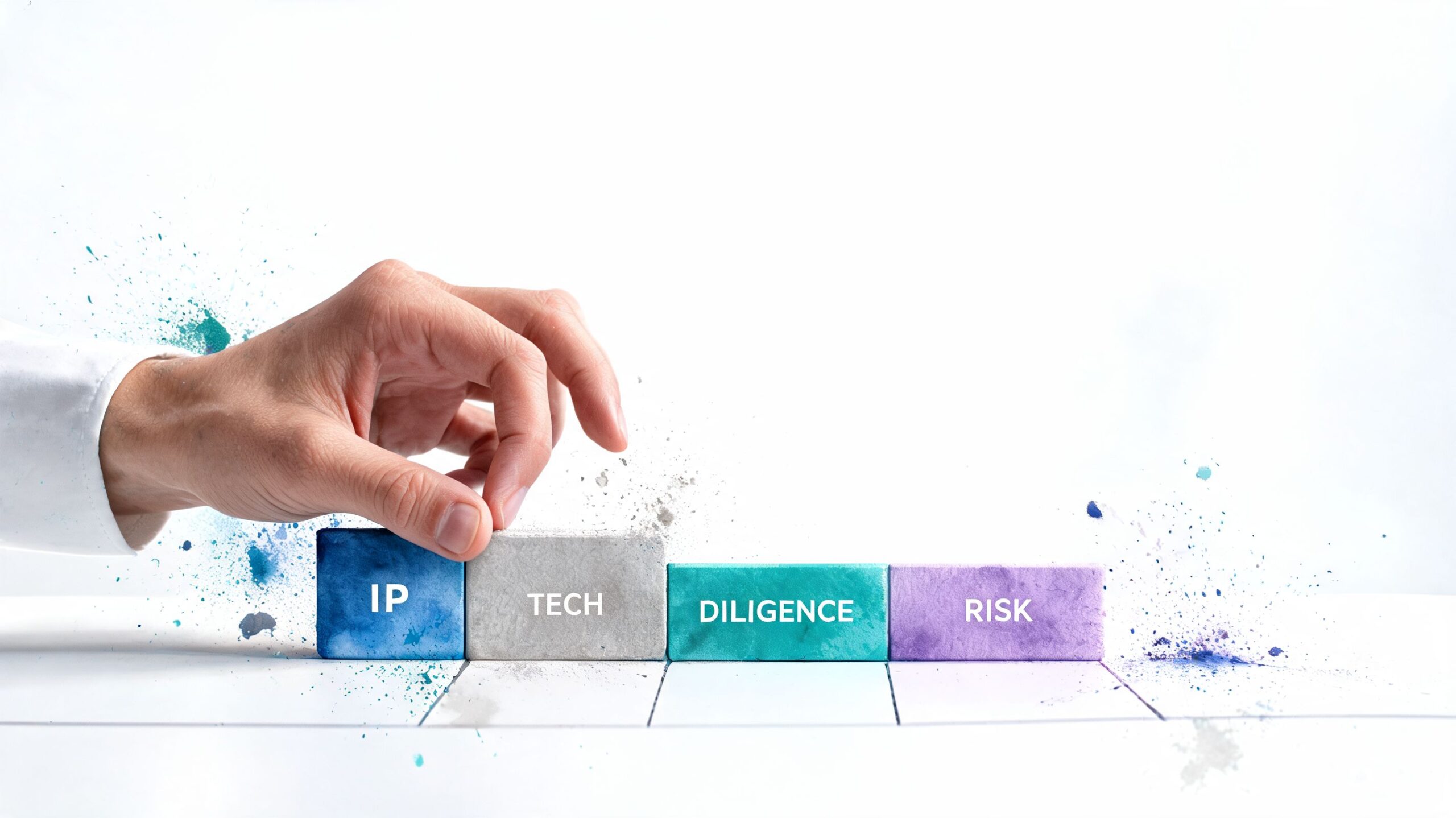
Use four pillars instead. They give you a clean way to organize what matters and to see where a buyer will press hardest.
The other important principle is evidence. As ThoughtSource Consulting notes on technical due diligence, effective diligence depends on resolving information asymmetry through Virtual Data Room materials, directed interviews, and live inspection, because documented claims often differ from operational reality. That means your slides and policies are only the starting point. A buyer will want to see the controls working.
People and organization
Start here because unclear ownership poisons everything else.
A buyer wants to know who runs the platform, how decisions get made, and whether critical knowledge is concentrated in a few people. If the answer to most hard questions is "ask Sam" or "the founder knows that part," you've got key-person risk whether you admit it or not.
Look at:
- Decision rights: Who approves architecture, security exceptions, vendor choices, and production changes?
- Role clarity: Where do product, engineering, IT, data, and security responsibilities begin and end?
- Bench strength: Can leads be absent without delivery stopping?
- Contractor dependence: Are contractors filling strategic roles the company doesn't effectively control?
A buyer reads organizational fuzziness as future execution drag. If teams can't explain ownership now, they won't move faster under integration pressure.
Processes and operations
This pillar answers whether the company runs technology deliberately or by improvisation.
You don't need a giant process stack. You do need repeatable habits. Buyers look for whether incidents are handled sanely, releases are controlled, priorities are visible, and postmortems produce change instead of blame.
These questions matter:
| Area | What a buyer is really testing |
|---|---|
| Incident handling | Does the company know who responds, how escalation works, and how customer impact is tracked? |
| Change management | Are production changes visible and controlled, or do teams push fixes informally? |
| Monitoring | Can the team see failures early, or do customers discover problems first? |
| Delivery cadence | Does work move through a predictable system, or does every release depend on heroics? |
If operations depend on memory and goodwill, the business is more fragile than the revenue multiple suggests.
Technology and architecture
Leadership often expects the hardest technical questions at this stage. Some are technical. Most are economic.
A buyer is asking whether the platform can support growth without a rewrite, whether complexity is intentional or accidental, and whether the current setup creates a tax on every future initiative.
Look beyond the stack names. Node, Python, Java, AWS, Azure, Kubernetes, Snowflake, Datadog, GitHub Actions, Terraform. Those don't impress anyone by themselves. The central issue is whether the architecture is understandable, supportable, and proportionate to the business.
If every strategic change requires custom work across brittle systems, the technology is not an asset yet. It is a negotiation waiting to happen.
For many companies, vendor dependency is part of this architectural picture. If you haven't already built a clear third-party map, this guide on third-party vendor risk management is worth reviewing before diligence gets serious.
Security and compliance
Buyers are not looking for perfect security. They are looking for proof that leadership takes it seriously, knows where the critical risks sit, and can show basic control operation.
That means more than a policy folder.
A credible security posture usually includes visible ownership, sensible access control, data classification that leadership can clearly explain, incident response that exists outside one person's head, and evidence that the company knows where sensitive data lives.
The key leadership question is simple. Can you prove control, not just describe intent?
If you can answer these four pillars clearly, diligence becomes easier to manage. If you can't, the request list will feel endless because the underlying business system is still fuzzy.
The Prioritized Checklist Before Diligence Begins
When time is short, do not attempt to produce a perfect diligence package. Build a credible one. The goal is to reduce uncertainty fast and show that leadership understands where the actual risks sit.
A good checklist isn't long. It's prioritized. These are the moves I'd push first if a CEO called me before a serious M&A process.
Start with the evidence that changes buyer confidence
The first jobs are not glamorous. They are the items that make the company legible.
| Priority | Action Item | Why It Matters to Investors |
|---|---|---|
| High | Build a current system map | It shows what exists, what is critical, and where business operations depend on technology |
| High | Name owners for each critical system and process | It proves the company isn't running on implied responsibility |
| High | Identify systems handling sensitive data | It focuses security, compliance, and integration review on what matters most |
| High | List your most critical software vendors and dependencies | It exposes concentration risk, exit risk, and hidden operating cost |
| High | Document your incident response process | It shows how the business behaves under pressure |
| Medium | Summarize architecture decisions and known constraints | It helps buyers separate managed tradeoffs from neglected debt |
| Medium | Gather evidence of access control and review practices | It supports trust in operational discipline |
| Medium | Clarify IP ownership and contractor agreements | It reduces legal and valuation friction |
| Medium | Show release and change practices | It signals whether delivery is controlled or improvised |
| Medium | Create a remediation list with owners | It proves leadership knows what needs fixing and isn't waiting for the buyer to discover it |
The first ten moves I would insist on
Map the core business systems
Show the systems that run revenue, customer delivery, finance, operations, identity, analytics, and support. Keep it readable. A single diagram in Lucidchart, Miro, or even Google Slides is better than six conflicting spreadsheets.Identify where sensitive data lives
Don't answer this vaguely. Name the systems, data stores, major integrations, and third parties involved.Assign one accountable owner per critical area
Shared ownership sounds collaborative. In diligence, it reads as no ownership.Create a top vendor list
Include the vendors that hold important data, enable customer delivery, or would hurt operations if they failed. If vendor sprawl is already a problem, say so and show the cleanup plan.Write down the incident response path
Even a simple page helps. Who declares an incident, who communicates, who investigates, who approves customer messaging, and where actions are tracked.Clarify IP and code ownership
Review contractor arrangements, repositories, licenses, and any software built outside normal employment structures.Summarize your deployment and rollback approach
Buyers want to know whether production changes are controlled. They do not need a novel.Prepare live demonstrations of control operation
Be ready to show monitoring, logging, access management, ticket flow, and change history. Document review alone won't carry the day.List known technical debt Don't bury it. Rank it by business impact and remediation path.
Build the management narrative
The CEO, CTO, COO, and security lead should all tell the same story about risk, ownership, and next steps.
The fastest way to lose credibility is to let every function describe the same system differently.
Don't confuse completeness with readiness
I've seen teams waste days trying to answer every possible diligence question before they can answer the obvious ones. That's backward.
What buyers usually want first is coherence. They want to see that the company understands its environment, knows where the sharp edges are, and can produce evidence without panic. If you're selling, a broader business-side resource like Miro Capital's due diligence guide can be useful alongside your tech work, but don't hide behind generic checklists. Your technology story still needs to stand on its own.
If you need a more transaction-focused preparation view, this due diligence checklist for acquisition is a practical companion.
What to ask your team this week
Use these prompts in your next leadership meeting:
- What would break if our two most technical people left this month
- Which systems hold sensitive customer or regulated data
- Which vendors could materially disrupt operations
- What security or operational control do we claim that we can't easily demonstrate live
- What known issue would a buyer discover and ask why leadership hadn't already addressed it
Those questions cut through the noise quickly. They surface what diligence is supposed to surface anyway.
Common Red Flags That Erode Valuation and Trust
Red flags in technology due diligence usually aren't dramatic. They are patterns of weak control, fuzzy ownership, and unmanaged dependency that signal future cost.
A buyer doesn't need to see a breach, outage, or rewrite disaster to get cautious. They just need enough evidence that leadership cannot explain how the system works.
Hero culture
Symptom: one engineer, founder, or contractor carries the primary operational knowledge.
Root cause: the business scaled without converting tribal knowledge into repeatable systems.
First fix: document the top critical workflows, rotate ownership in visible areas, and require a second operator for key production, security, and vendor decisions.
A buyer sees hero culture and immediately discounts resilience. If one person can freeze delivery or incident response, the platform is unstable even if uptime looks fine today.
Vendor sprawl
Symptom: too many tools, overlapping functions, unclear admins, and weak understanding of data flow between systems.
Root cause: buying tools was easier than making decisions.
First fix: create a vendor inventory by business criticality, data sensitivity, owner, and renewal risk. Then cut what nobody can justify.
Security and cost problems often overlap in this area. If you need a deeper prep lens on that front, use this due diligence cybersecurity readiness checklist.
Ambiguous IP ownership
Symptom: code lives in mixed repositories, contractors built core features, and legal ownership isn't easy to prove.
Root cause: early growth habits never got cleaned up.
First fix: review employment and contractor agreements, repository access, license use, and any custom-built assets that sit near the heart of the value story.
If a buyer can't get comfortable that the company owns its own technology, the conversation turns legal fast. That almost always slows the deal and can reshape terms.
Technical debt dressed up as innovation
Symptom: the product demo is strong, but engineering avoids touching certain areas because releases are risky, test coverage is thin, or dependencies are outdated.
Root cause: speed was financed with future pain and nobody kept a ledger.
First fix: name the brittle zones, estimate the operational consequence, and connect remediation to business outcomes. If modernization is part of the answer, a practical perspective on improving software ROI through modernization can help leadership think beyond "rewrite everything."
Buyers don't punish debt itself. They punish debt that leadership can't quantify, prioritize, or explain.
Weak reporting cadence
Symptom: status lives in Slack, risk updates are ad hoc, and nobody can produce a clean view of current priorities, incidents, and decision owners.
Root cause: management habits never matured as the company grew.
First fix: install a weekly operating rhythm with visible owners, deadlines, blockers, and risk review. Diligence goes better when the company already runs on inspectable routines.
Uncontrolled AI claims
This one is becoming more important. If the target claims differentiation from AI, the buyer now needs to know whether those systems are governable.
According to AKF Partners' technical due diligence checklist, modern diligence must evaluate AI and ML risks such as model drift and bias, and a target claiming AI differentiation without evidence of model lifecycle governance may be carrying hidden technical debt and legal liability.
That means practical questions about retraining, monitoring, fairness review, data governance, and production oversight. If leadership can't answer them, "AI-enabled" starts sounding like "unpriced risk."
From Findings to Fixes The Post-Diligence Roadmap
Most technology due diligence advice stops at the report. That's a mistake.
The report is not the finish line. It is the first usable map of what the business must fix, simplify, and govern if the deal is going to create value after close.

The post-diligence execution gap is where too many teams lose control. Vaultinum's discussion of tech diligence and deal structures cites a 2024 Gartner report stating that 65% of PE-backed tech acquisitions underperform value creation targets due to unaddressed tech debt and ownership fuzziness post-close, and 22% of firms have structured handoff processes from diligence to integration teams. That is the operational warning. A strong diligence report means little if nobody translates it into owners, sequence, and operating rhythm.
Turn findings into a board-defensible plan
Every diligence finding should move into one of four buckets:
- Stabilize now: Risks that threaten security, uptime, customer trust, or deal confidence
- Fix in the first integration wave: Problems that block reporting, ownership clarity, or shared workflows
- Rationalize deliberately: Vendor, architecture, and process issues that need sequencing rather than panic
- Accept temporarily: Lower-priority issues with a documented reason and review date
Then put structure around each item:
| Finding | Owner | Time horizon | Budget view | Business reason |
|---|---|---|---|---|
| Example security gap | Named leader | Immediate or near-term | Rough estimate | Protects trust and reduces exposure |
| Example ownership issue | Functional exec | First operating cycle | Usually low | Removes delay and confusion |
| Example architecture constraint | Technology lead | Planned roadmap | Investment decision | Supports scale and integration |
The first operating moves after the report
A useful post-diligence plan is simple enough to run weekly.
Start with these actions:
- Assign direct ownership: Every finding needs one person accountable for movement
- Set a short review cadence: Weekly beats monthly when trust is still forming
- Separate critical from cosmetic issues: Don't let low-impact cleanup bury real risk reduction
- Attach evidence requirements: Define what "done" looks like before work begins
- Report in business terms: Tie each action to resilience, speed, customer impact, or valuation protection
A good post-close plan doesn't say "we are addressing findings." It says who owns each risk, what will change, and when leadership will see proof.
What better looks like
The best outcome of technology due diligence is not a clean report. It is a clearer company.
You want a business where system ownership is visible, vendor dependency is understood, security claims are demonstrable, and leadership can talk about technical risk without hand-waving. That is what calms boards, reassures investors, and helps operators move without constant status hunts.
Diligence should lead to a governable execution system. If it doesn't, you collected observations, not an advantage.
Your Next Step Toward Calm Execution
Technology due diligence isn't a bureaucratic hurdle to survive. It is one of the few moments when leadership gets forced to see the business as it really operates.
That's useful.
The request list, interviews, system reviews, and awkward follow-up questions all point at the same thing. Where ownership is fuzzy, value leaks. Where controls are weak, trust drops. Where the team can't show how the system works, the buyer assumes the cleanup bill is larger than you think.
Treat the process as a chance to get honest and get organized. Not just for the deal. For the company you're going to have to run after the deal.
If you're already seeing the warning signs, scattered vendors, brittle reporting, hero dependencies, security claims that are hard to evidence, don't wait for the buyer to diagnose them for you. Fix the operating system behind the technology, not just the presentation layer in the data room.
If your business is heading into a transaction, board scrutiny, or investor pressure and the technology story still feels harder to explain than it should, a CTO Input Clarity Call is a practical next step. You'll leave with a sharper view of the biggest execution risks, the trust gaps that could hurt valuation, and the first moves to turn diligence findings into a system the business can run.