

You are a CEO facing technology leadership challenges, spending more on tech and cyber and getting less back. Vendors are loud, reports are vague, and every board pack seems to add new risk without a clear return. You feel it in margins, in late projects, and in anxious questions from directors.
That tension is not an IT problem anymore. It is a board problem that touches technology governance for boards within corporate governance, customer trust, lender confidence, and the value of your company.
CTO Input exists as a seasoned, neutral guide in exactly this space, helping boards and CEOs turn messy technology into a clear, governed system that drives innovation. This article gives you a practical, board-ready way to structure technology governance with board oversight using a few smart levers: committees, policies, dashboards, and simple oversight rhythms. No jargon, no 200-page manuals, just decisions your board can make in the next 90 days.
What Good Technology Governance for Boards Actually Looks Like
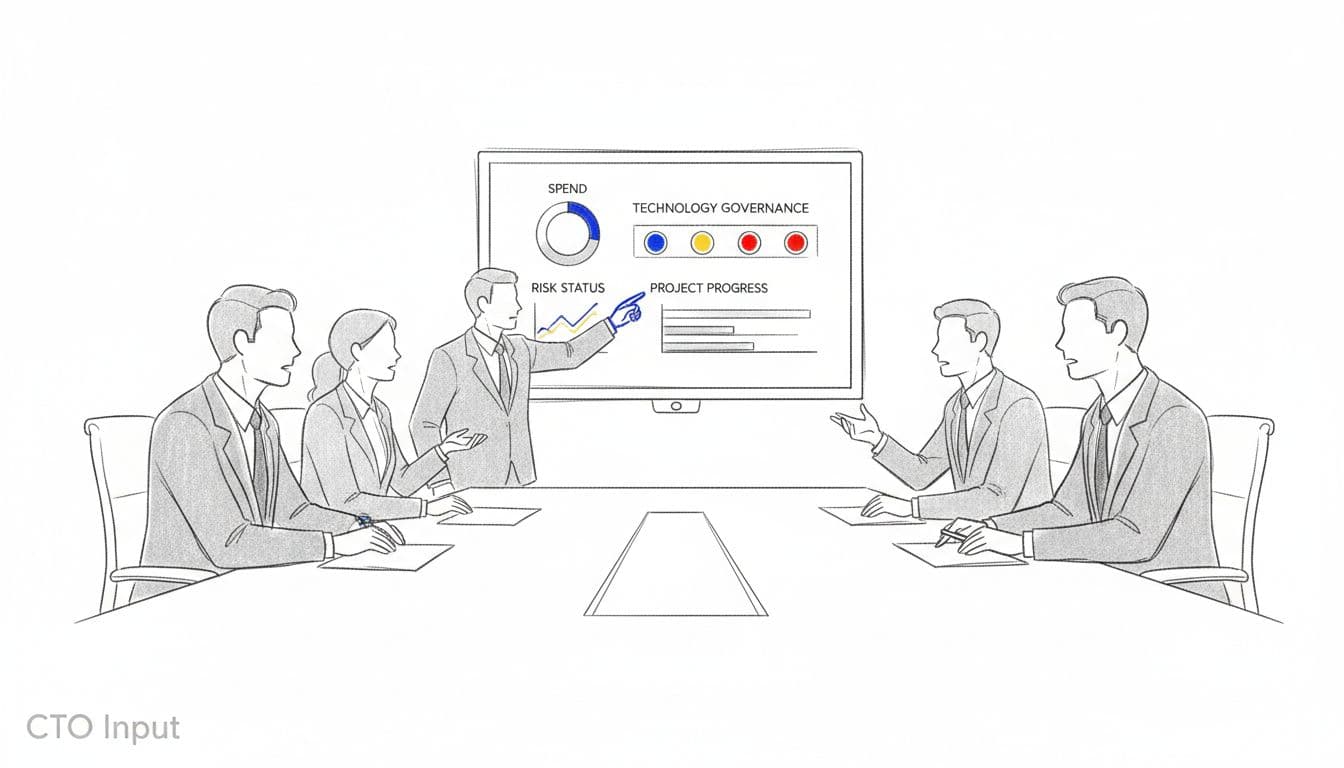
Illustration of a board reviewing a simple technology governance for boards for dashboard. Image created with AI.
At board level, technology governance is simple. It is the way directors set direction through IT governance, watch the risk, and track return on technology and cyber spend.
The pressure on boards has jumped in the last two years. AI sits inside core processes, regulators and lenders ask sharper questions on risk management, and ransomware headlines hit your customers’ inboxes every week. Recent work from McKinsey on how effective boards approach technology governance points to the same pattern: boards that provide strategic oversight and treat tech as a strategic asset outperform those that treat it as a cost center.
What do directors really want from governance? Directors seek fewer surprises. Cleaner numbers. Faster execution. Clear accountability when something breaks or runs late.
Good technology governance for boards is not a thick binder. This technology governance is a small set of board decisions and routines that shape how technology is funded, controlled, and questioned.
From IT Black Box to Clear Oversight
Most mid-market boards live with an IT black box amid accelerating digital transformation. Projects slip with little warning. Budgets are rolled up into vague “technology” lines. Cyber updates sound technical but do not answer the simple question: “Are we safe enough for our risk appetite?”
In a governed state, the board sees a one-page view of spend, risk, and roadmap. Directors know where the big bets are, which risks sit above tolerance, and which projects are red, amber, or green.
Directors do not need to be engineers. They need clear signals and a short list of questions they ask every time.
The Four Building Blocks Boards Must Put in Place
For a mid-market company, you can think about technology governance as four building blocks:
- The right committee structure to own the topic.
- A small, sharp set of board-level tech and cyber policies.
- A simple dashboard of technology and risk metrics.
- A steady oversight rhythm tied to your business calendar and long-term strategy.
These are levers any board can pull within a quarter or two, even without a full-time CIO or CISO. They turn technology from noise into a managed part of strategy.
Designing Committees, Policies, Dashboards, and Rhythms That Work

Executive presenting performance dashboards to colleagues. Photo by Karola G
You do not need to copy a large public company to get this right. You need a version that matches a 2 to 250 million business, with real complexity but lean leadership.
Think about each building block at the level of decisions: what the board approves, what it reviews, what it delegates, and what it expects to see on paper.
Choosing the Right Board Committee Structure for Technology Governance for Boards
There are three common board structures for a technology committee:
- A dedicated technology or innovation committee.
- Technology and cyber folded into the audit or risk committee.
- A joint mandate across strategy and risk.
Which one fits you depends on three things: the size and complexity of your tech footprint, the level of regulatory and data pressure, and how exposed you are to cyber and operational outages. Harvard’s corporate governance forum outlines similar trade offs in its piece on how boards can enhance technology oversight.
Whatever structure you pick, the committee charter should clearly own:
- Technology strategy and alignment with business strategy.
- Major technology and cyber investments above a spend threshold.
- Enterprise risk governance, cyber risk, data privacy, and AI use.
- Oversight of critical vendors and platforms.
If you do not have a trusted senior tech or cyber leader, this is where a fractional CTO, chief information officer, or CISO can sit beside the committee, translate, and provide neutral advice that is not tied to any one vendor or internal agenda.
Setting a Small, Sharp Set of Board-Level Tech and Cyber Policies
Boards do not need a phonebook of policies. They need a small set of clear guardrails.
At board level, focus on five areas, including risk assessment:
- Cyber risk appetite and incident expectations
What level of disruption, data loss, or extortion is acceptable in cybersecurity, and what does the board expect in the first hours of a serious incident? - Data governance and privacy standards
Which regulations apply, data oversight, and where the board wants independent assurance. - Spend thresholds and approval rules
At what dollar amount or risk level does a tech or AI project need committee review or full board approval? - Third-party and vendor risk
Expectations for due diligence, contracts, concentration risk, and regulatory requirements for key platforms. - AI governance and automation principles with ethical standards
Where AI technologies are welcome, where it is restricted, and how bias, transparency, and human review are handled. The NACD’s report on technology leadership in the boardroom highlights this as a growing topic in board discussion.
The board members set these guardrails, then asks management to maintain the detailed procedures that sit under them.
Building a Simple Technology Governance for Boards Dashboard Directors Actually Use
Real-time dashboards are now standard for strong boards. You do not need a fancy tool. You do need a clear one-page view.
A practical IT governance dashboard at board level might include:
- Spend: Total technology and cyber spend versus plan, with major variances called out.
- Strategic initiatives: Top three tech or AI projects with red, amber, green status and a one-line explanation.
- Reliability: Outage counts, critical incidents, and any impact on customers or revenue.
- Risk and compliance: Top cyber and regulatory risks, with trend and control status.
Resources like this guide to an IT governance board’s duties and best practices show similar categories, but your version should fit on one page and speak plain business language.
The goal is not more data. It is faster, sharper questions from directors, and quicker action from management when something slips.
Creating an Oversight Rhythm That Fits the Board Calendar
Structure beats heroics. A good oversight rhythm ties tech and cyber to the same beats as budget, audit, and strategy.
A simple pattern for a mid-market board:
- Annually: One deep-dive session on technology strategy, architecture, and risk appetite through effective board processes. This is where you link the roadmap to the growth plan.
- Quarterly: Short tech and cyber update as a standing item using the dashboard. Focus on changes, surprises, and decisions needed.
- Ad hoc: Extra committee sessions for large deals, major incidents, or a significant AI or platform bet.
The rhythm matters more than any one meeting. It reduces surprises and builds a shared language about technology at board level.
Putting Technology Governance for Boards Into Practice in the Next 90 Days
You may feel behind. Maybe your last board meeting included questions on AI use or cyber exposure that you could not answer cleanly. That is common right now.
The good news is that you can reach a “good enough” IT governance setup in 90 days, then refine it over the next year. A recent Forbes piece on lessons in implementing board-level AI governance shows the same pattern in larger firms: start simple, then raise the bar.
Think of the next quarter as a reset. You are not building perfection. You are building clarity and control.
A 90-Day Action Plan for CEOs and Boards
Use this as a practical checklist:
Weeks 1 to 4: Map the current state
- List who owns what across tech, cyber, data, and capital allocation today.
- Note which committees see tech topics, and how often.
- Collect existing policies and any metrics already reported.
Weeks 5 to 8: Design the basic structure
- Agree which committee will own technology governance for boards; this is key for improving board oversight.
- Approve your small set of board-level tech and cyber policies.
- Draft the first version of the one-page dashboard.
Weeks 9 to 12: Test and refine
- Run at least one committee meeting and one full board session using the new dashboard and agenda.
- Capture board members’ feedback: what was clear, what was missing, what felt too detailed.
- Adjust metrics, policy wording, and cadence based on that input.
Start small, but start now. Every quarter without structure adds more hidden risk to your risk management and sunk cost.
When to Bring in a Fractional CTO, CIO, or CISO as Your Guide
There are clear signs you need outside help:
- No trusted senior tech or cyber leader with technology expertise at the table.
- Repeated project delays or failed implementations.
- Strained vendor relationships and surprise invoices.
- Board questions on strategic oversight of risk, AI, or resilience that management cannot answer in two or three slides.
A fractional CTO, CIO, or CISO can sit on your side of the table. They translate between engineers and directors, design committees and policies that fit your size, and build dashboards that link cost, risk, and growth as your technology expert.
This is the role CTO Input plays for growth-minded mid-market companies: independent, outcome focused, and aligned with the board and CEO, not with any vendor. We provide fractional chief information officer support alongside CTO and CISO expertise.
Conclusion: Turn Technology From Anxiety Into A Governed Asset
Technology governance for boards is now a core part of steering the business, not a side topic for IT. Effective technology governance keeps it simple: the right committee mandate, a small set of clear policies, a one-page dashboard, and a steady rhythm of reviews. That structure gives you cleaner board packs, stronger board oversight, fewer surprises, and faster decisions.
Picture your next year of board meetings with that in place. Directors see a clear link between technology innovation and the growth plan. Cybersecurity is discussed in business terms. You feel confident that technology is a governed asset aligned with your risk appetite, not an uncontrolled cost.
If you want a neutral partner to help you build this, visit https://www.ctoinput.com to see how fractional technology leadership as CTO, CIO, or CISO can support your board and executive team. Then spend time with the articles on the CTO Input blog at https://blog.ctoinput.com to dig deeper into strategy, risk, and technology choices that match your growth plan. Treat this as your next step toward turning tech from a source of anxiety into a source of advantage.