
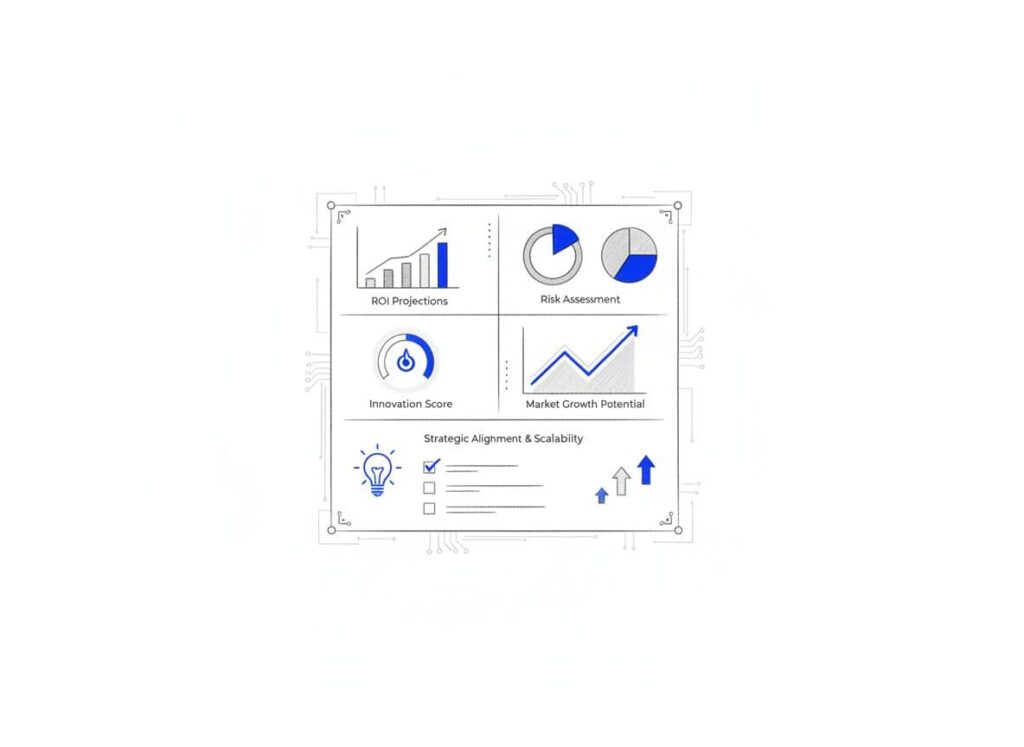
Technology investment feels expensive, risky, and strangely distant from the business plan. Yet every quarter you face new requests: AI pilots, ERP upgrades, cybersecurity tools, data platforms. Each vendor promises gold. Your team argues. The board wants proof.
Scorecard templates such as a technology investment scorecard template for boards give you one shared page to calm that chaos. They turn “strong opinions” into clear scores that you can defend. These scorecard templates are printable, simple, and repeatable across board cycles.
In this article, you will see a practical technology scorecard (an evaluation scorecard) for boards that rates each project on value, risk, and strategic fit. You can adapt it for your company, print it, and use it in your next meeting.
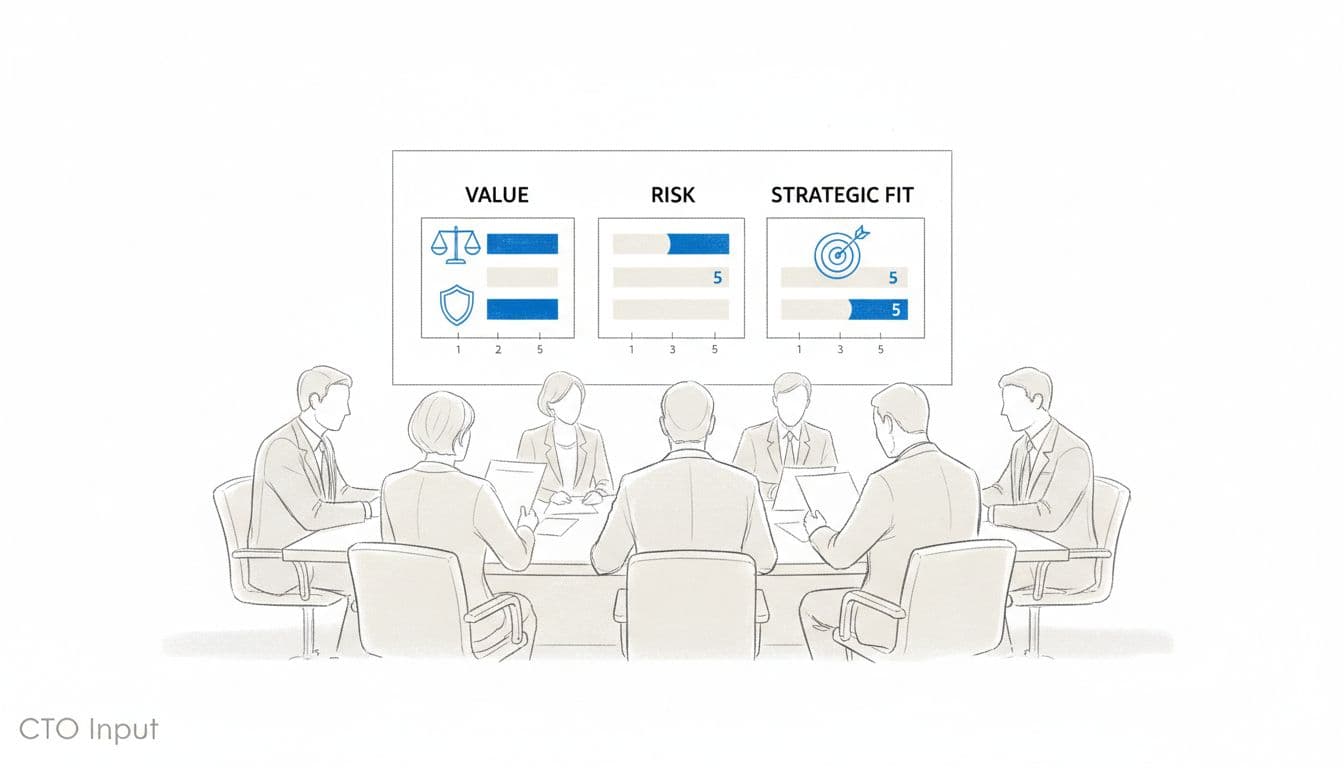
Why Boards Need Simple Technology Investment Scorecard Templates

If you lead a company between 2 and 250 million in revenue, you feel the squeeze. Tech and cybersecurity spend rises every year. AI, data, automation, and digital transformation are now board topics. Lenders and investors ask new questions about cyber risk and resilience.
Yet most boards still see tech decisions as a fog.
You see:
- Project lists that read like vendor brochures
- IT budgets with an IT cost breakdown that is hard to tie back to growth or margin
- Cybersecurity line items that feel like insurance, not investment
- AI ideas with big claims and fuzzy payback
The result is a pattern you know well. Projects get approved because a sponsor shouts the loudest. Other projects stall because no one can explain them in simple, financial, board-grade terms. You end up with a patchwork of tools, half-finished rollouts, and rising operating cost.
A simple, board-ready technology investment scorecard template changes the conversation.
It gives CEOs, COOs, CFOs, and tech leaders a shared language for performance management:
- Value: What business outcome do we get, in revenue, cost, or customer terms that drive business performance?
- Risk: What could go wrong, in cyber, delivery, or operations?
- Strategic fit: Does this move the company toward its 3 to 5 year strategy map and strategic planning goals?
You do not need a complex framework like the Balanced Scorecard. In fact, many boards that have tried heavy Balanced Scorecard models, like those in classic balanced scorecard templates, end up back in the weeds. What you need in the boardroom is a one-page, pencil-ready or Excel-based scorecard template that helps you say “yes”, “no”, or “not now” without drama.
Common problems with tech decisions in mid-market companies
In many mid-market companies, vendors quietly drive the agenda. The CRM provider wants the “premium AI analytics add-on”. The cloud vendor wants a full migration this year. Cyber firms pitch new tools after every breach in the news.
Projects then:
- Start with excitement and stall in the middle
- Go live late or over budget
- Create surprise costs for licenses, integration, or change management
- Increase cyber exposure because no one looked at data flows end to end
Imagine a CRM upgrade that was sold as a 6 month project and lands as an 18 month saga. The board hears about it only when extra funding is needed. Or an AI pilot that runs in a corner of the business with no security review and no clear owner.
Board packs usually make this worse. You get:
- Long decks with technical detail and little business framing
- Thin cyber summaries that say “risk is managed” without evidence
- No clean comparison across projects
You are being asked to approve millions on trust.
How a board-ready scorecard turns opinions into clear choices
A board-ready scorecard takes very different projects and puts them on the same page. An AI pilot, a cloud migration, and a cybersecurity upgrade can all be rated on:
- Business value that supports business performance and performance management
- Risk
- Strategic fit to the company strategy map
You still debate, but you debate using the same scale, aligned with your strategy map.
Instead of “I like AI” or “our ERP is old”, you see that:
- The AI pilot scores high on value but medium on risk and low on strategic fit to the strategy map
- The cybersecurity upgrade scores medium on value but high on risk reduction and high on fit
- The ERP enhancement scores medium on all three
Now you can ask the right questions, much like formal Balanced Scorecard or technology-focused Balanced Scorecard approaches, without burying everyone in theory. You can also show your logic to auditors and investors. This simple Excel scorecard, unlike complex Balanced Scorecard templates, keeps the focus on clear, actionable choices tied to your strategy map.
The Core Of Your Technology Investment Decision Scorecard For Boards
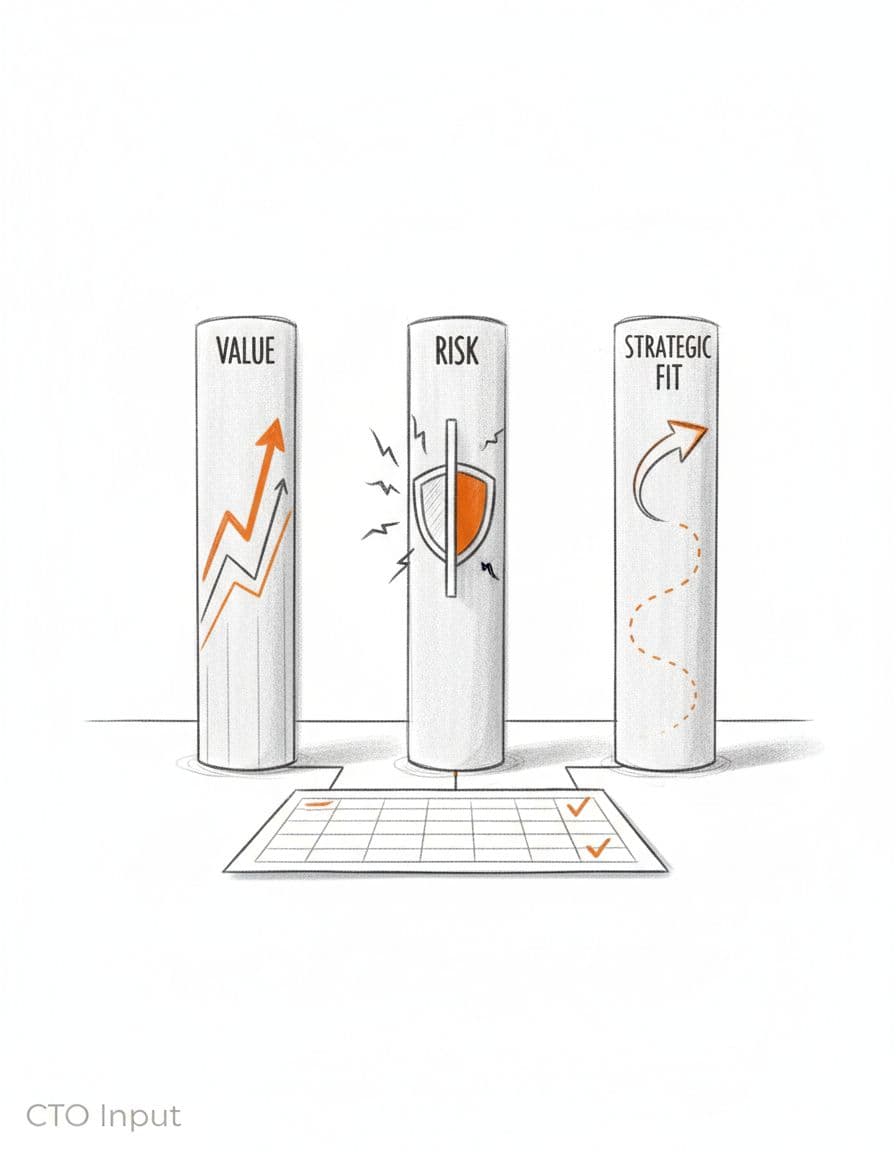
At the heart of your technology scorecard for boards lies a Balanced Scorecard approach built on three pillars:
- Value
- Risk
- Strategic fit
These pillars align with key Balanced Scorecard perspectives: value to financial and customer views, risk to internal processes, and strategic fit to learning and growth. Each pillar uses a simple 1 to 5 score to hit clear targets.
You can also add one or two extra columns, such as “feasibility” or “time to benefit”, but only if they truly help the board. Remember, this scorecard should live on paper in a meeting, not hide in a complex spreadsheet.
A simple scoring scale for each pillar could be:
ScoreMeaning1Very low2Low3Moderate4High5Very high
The power is not in the numbers alone. It is in the questions you ask to arrive at those numbers, revealing cause-and-effect links where risk reduction, for example, enables greater value realization.
Scoring business value: revenue, cost, and customer impact
For this Balanced Scorecard, “value” is not about features. It is about money and customers, tracked through KPIs (Key Performance Indicators) like financial measures.
Projects should score higher on value when they:
- Grow revenue or margin
- Reduce operating cost or headcount pressure
- Remove manual work that slows growth
- Improve customer experience or reliability
- Strengthen data for data-driven decisions, including AI use
Guiding questions the board can ask, focusing on measurable KPIs (Key Performance Indicators):
- How much new revenue or margin could this project create in the next 1 to 3 years?
- How much cost can we remove or avoid if this works?
- How does this improve reliability or speed for customers and customer experience?
- Does this free up key people from manual work?
- Can we measure the benefit within 12 months using specific KPIs (Key Performance Indicators)?
If the answer to most of these is weak or “we are not sure”, the value score should be 1 or 2. If you see clear, quantified benefits with line-of-sight to P&L impact and financial measures, score it 4 or 5.
Scoring risk: cyber, delivery, and operational disruption
Risk often hides in technical language. Your Balanced Scorecard pulls it into plain sight across three buckets during technology assessment:
- Cybersecurity and data privacy
- Project delivery risk
- Business disruption to internal processes
Board questions to set the risk score through thorough technology assessment:
- What is the cyber and compliance exposure if this project fails or is breached?
- How confident are we in the internal team and vendor to deliver?
- How much downtime or process change will this cause to internal processes?
- Have similar projects in our company finished on time and on budget?
- If this fails, how painful is it for customers, staff, or regulators?
If you see high data sensitivity, weak delivery history, and heavy process change, risk might be 4 or 5. If the project is small, well understood, and low impact if delayed, risk might be 1 or 2.
Higher risk does not mean automatic rejection. It means stronger controls, more board attention, and sometimes a different sequencing.
Scoring strategic fit: support for the company’s growth plan
Strategic fit is where you protect the company from shiny objects in this Balanced Scorecard pillar.
In simple terms, strategic fit asks: does this project clearly support the strategy, key strategic objectives, or nonnegotiable compliance outcomes?
Board questions tying to the overall strategy:
- Does this project support our top 3 strategic objectives and strategy?
- Will this still matter in 3 years if our strategy holds?
- Does it unlock future options in learning and growth, such as AI, new products, or M&A integration?
- Is this something our competitors or peers already treat as standard in their strategy?
- If we say no for 12 months, what is the real downside to our strategic objectives?
A low strategic fit score (1 or 2) is a yellow flag, even with strong learning and growth potential. Even if the technology is trendy or impressive, a weak link to the growth plan and strategic objectives suggests “not now”. You can keep it on the radar but fund projects with clearer strategic pull first.
For extra inspiration on structuring scores and KPIs (Key Performance Indicators), many leaders study general KPI scorecard templates and then simplify them for the board as a practical Balanced Scorecard.
How To Use This Technology Investment Scorecard Template In Your Next Board Meeting
A technology investment scorecard template only helps if it shapes real decisions in your strategic planning. The goal is a clear tech and cybersecurity portfolio, not a pretty chart. This approach draws from the discipline of a formal Balanced Scorecard system for project portfolio management.
Step-by-step: from raw project list to a clear tech portfolio
Here is a simple flow you can follow before your next board cycle, using practical scorecard templates like those in Excel:
- List all projects on one page. Include IT, product, data, AI, and cybersecurity items right in an Excel sheet.
- Pre-score each project. Have finance and your senior tech leader draft 1 to 5 scores, or targets, for value, risk, and strategic fit in Excel.
- Review scores as an exec team. Conduct a technology assessment where you disagree, talk it through and adjust. The debate is part of the value.
- Sort projects. First by strategic fit, then by total score. This shows which items are truly core to the plan. Avoid a weighted scorecard for simplicity at this stage.
- Decide on timing. Mark each project as “fund now”, “fund later”, or “stop” directly in your Excel scorecard template.
- Take the final sheet to the board. Discuss the pattern, not just individual projects. Print it from Excel for a clean handout.
You are not handing over control to a formula. You are giving the board a clear view of tradeoffs, in plain language, while leveraging scorecard templates to build a disciplined tech portfolio inspired by Balanced Scorecard principles.
Using the scorecard to explain decisions to investors and lenders
The same one-page technology investment decision scorecard, functioning like a dashboard template, can become a key exhibit for:
- Investor updates
- Lender reviews
- Audit and risk committees
You now have an evidence trail that tech and cyber investments follow a disciplined process rooted in Balanced Scorecard project portfolio management. Each line shows value, risk, and strategic fit scores, plus the funding decision and related KPIs (Key Performance Indicators) to monitor performance post-approval.
This is far more credible than a loose list of “strategic projects”. It shows that cost, risk, and growth are being managed together, with board oversight, not by vendor pressure or last-minute panic. Strong performance management practices help you monitor performance and demonstrate improved business performance to stakeholders.
Conclusion
A simple, printable technology investment scorecard template—one of the most practical scorecard templates—brings the discipline of the Balanced Scorecard to your board’s technology decisions. It gives them something priceless: a shared way to judge value, risk (like monitoring server status for operations or device security for cybersecurity), and strategic fit on one page. Instead of reacting to the loudest voice or the trendiest tool, you decide which projects truly move the business forward.
Start small. Take your next 3 to 5 proposals for IT systems, IT infrastructure, tech, or cybersecurity and run them through this technology scorecard for a thorough technology assessment. Avoid a complex weighted scorecard; adjust the questions so they match your strategy, your risk appetite, and your company’s overall strategy. Then use the results as the backbone of your next board discussion, applying the Balanced Scorecard approach.
If you want an experienced partner at your side while you do this, visit CTO Input to see how fractional CTO, CIO, or CISO leadership can help you turn scorecard templates like this technology scorecard into a living Balanced Scorecard practice, not a one-off exercise. Keep building your playbook by exploring the articles on the CTO Input blog and move your technology decisions from anxiety to confidence.