

Revenue is up. Headcount is up. The board is asking sharper questions. Yet inside the business, technology feels slower, murkier, and more expensive than it should.
You approve software. Teams open projects. Vendors promise speed. Then work stalls in handoffs, reporting turns into a status hunt, and nobody can tell you plainly what is on track, what is at risk, and who is responsible for the result. That is the point where technology stops acting like an advantage and starts acting like drag.
For many leaders, the mistake is assuming this is a tooling problem. It usually isn’t. It’s a technology leadership problem. More specifically, it’s a mid-market leadership problem. The company has outgrown informal decision-making, but it hasn’t installed a clear operating system for technology yet.
That’s why technology leadership for mid-market companies matters. Not because you need more theory. Because you need decisions that stick, spending that maps to business priorities, and an execution rhythm that doesn’t depend on heroics.
When Growth and Technology Stop Working Together
If you’re a CEO or COO in a growing mid-market company, you’ve probably lived some version of this already.
Sales are moving. New locations, products, customers, or acquisitions add complexity. The business is clearly bigger than it was a year or two ago. But the internal experience gets rougher instead of smoother. Launches take longer. Simple changes bounce between departments. Vendor meetings multiply. The same people become bottlenecks in every critical initiative.
Nobody says, “we have a coordination problem.” They say things like:
- “We need better visibility.”
- “Why are we paying for all these systems?”
- “I thought this was already decided.”
- “Why does every project become an emergency?”
Those aren’t random complaints. They point to a business that has outgrown informal technology management.
What it feels like in practice
A finance leader wants cleaner reporting. Operations wants fewer workarounds. Sales wants a CRM process people will consistently follow. Security wants basic controls to exist outside policy documents. IT wants priorities that won’t change every two days.
Each request sounds reasonable on its own. Together, they create a pile of partially defined work with no stable decision path. So the business pays a hidden tax. Meetings to clarify what should already be clear. Rework because decisions weren’t recorded. Delays because one vendor depends on another vendor. Fire drills because no one surfaced the risk early.
You can tell a company has outgrown informal technology leadership when progress requires constant intervention from senior people.
That’s the part leaders feel first. Not a technical failure. An organizational one.
The signal most leaders miss
The usual response is to push harder. Add another project manager. Ask for weekly updates. Buy another platform. Replace one vendor with another. Those actions can help at the margin, but they don’t fix the root issue.
The root issue is that ownership is still implied instead of explicit.
In a smaller business, that can work for a while. In a mid-market business, it breaks. Complexity rises faster than clarity. Then technology becomes an anchor on growth instead of an engine for it.
The Three Failure Modes of Mid-Market Technology
Most mid-market technology problems don’t start with bad people or bad intent. They start with weak structure. The same three patterns show up again and again.

Fuzzy ownership
This is the biggest one.
Everyone assumes someone is handling the issue. The application owner thinks IT owns it. IT thinks the business sponsor owns it. Finance thinks procurement reviewed the vendor. Security assumes legal covered data terms. The executive team assumes the whole thing is under control because the project exists on a slide.
That’s how important work falls through the cracks while still appearing active.
You’ll see it when:
- Projects keep moving but key decisions stay unresolved
- Status updates describe activity, not outcomes
- Escalations happen late because nobody wanted to overstep
- One reliable person becomes the informal owner of everything
Vendor-shaped roadmaps
A surprising number of companies let vendors shape the roadmap without admitting it.
A CRM partner pushes more modules. Your ERP firm frames its release path as strategy. The MSP recommends tools that fit its service model. A security product vendor creates urgency around controls that don’t match your actual operating risk. Soon the roadmap is just a pile of external opinions.
That doesn’t mean vendors are malicious. It means they are selling from their point of view. If your company doesn’t have strong internal technology leadership, their priorities fill the vacuum.
Practical rule: If your roadmap mostly exists in vendor decks, you don’t have a roadmap. You have outsourced prioritization.
Constant firefighting
Fuzzy ownership and vendor-led priorities create the third failure mode. The team spends its time reacting.
Incidents, exceptions, rushed approvals, broken integrations, access requests, reporting fixes, and surprise renewals take over the calendar. The business starts normalizing chaos. Leaders praise responsiveness because the team is working hard. Meanwhile, root causes remain untouched.
Firefighting feels productive because people are busy. It is not the same as control.
Technology Failure Modes vs. Healthy States
| Dimension | Failure State (Chaos) | Healthy State (Clarity) |
|---|---|---|
| Ownership | Responsibility is assumed and disputed late | A named owner exists for each decision, system, and outcome |
| Prioritization | Vendors and loudest voices drive the queue | Business goals drive sequencing and tradeoffs |
| Reporting | Leaders get fragmented updates and status hunts | Leaders get a simple view of progress, blockers, and risk |
| Execution | Teams start work quickly but finish slowly | Teams commit less, finish more, and surface issues early |
| Risk control | Reviews happen late and inconsistently | Architecture, security, and compliance checks happen early |
| Key-person dependence | One or two people hold the whole system together | Knowledge and decisions are shared, visible, and durable |
These three failure modes feed each other. Weak ownership creates reactive work. Reactive work gives vendors more influence. Vendor influence creates more disconnected projects. Then everyone wonders why everything is urgent and nothing finishes.
Why Weak Technology Leadership Is a Drag on Growth
You can run a business for a while with vague ownership and heroic effort. You can’t scale one that way.
The strongest argument for better technology leadership isn’t technical. It’s commercial. Companies that treat technology as a leadership discipline perform differently from companies that treat it as a support function plus a software budget.
Deloitte found that 66% of faster-growing mid-market tech companies spend over 5% of annual revenue on technology, compared with 46% of slower-growth peers. Those faster-growth firms were also more than twice as likely to report being “very successful” at using technology to enable business growth, at 47% versus 23%. The same research also found 47% of faster-growth firms had active AI solutions in business areas compared with 28% of slower-growth firms, supported by stronger data foundations. See Deloitte’s mid-market technology findings.
That matters because technology isn’t a side issue in the middle market. The National Center for the Middle Market reports nearly 200,000 U.S. middle market businesses employ 48 million workers, and information technology ranks as the top investment area for ongoing growth. In the same report, 74% planned AI spend increases over the next two years, 71% planned cybersecurity increases, 63% cloud, and 44% human capital systems. Review the National Center for the Middle Market year-end 2024 report.
What the drag looks like in the executive seat
Weak technology leadership shows up in business terms long before anyone labels it that way.
- Growth slows at the seams because new initiatives run into integration problems, approval delays, and unclear ownership.
- Margin gets squeezed because teams buy overlapping tools, rework avoidable mistakes, and carry expensive complexity.
- Board confidence weakens because answers about risk, readiness, and progress stay vague.
- Customer experience suffers because internal workarounds leak into service delivery.
That is why stronger leadership beats isolated upgrades. A better CRM won’t fix weak decision rights. A cloud migration won’t fix bad prioritization. A new data tool won’t help much if nobody owns data quality across the business.
Better spending requires better judgment
Mid-market leaders often ask whether they are spending enough on technology. That’s the wrong first question.
The sharper question is whether technology decisions are being made in a way that supports the business. If your reporting is weak, your ownership is unclear, and your vendors are shaping priorities, more spend can make the problem worse.
A simple example is data movement. Many companies add analytics, automation, and AI ambitions on top of a messy integration base. If you’re sorting through tradeoffs around pipelines, sync, and architecture, a resource like this strategic ETL tools comparison can help leadership teams ask better platform questions before they buy themselves into more complexity.
Technology spending creates advantage when leadership turns it into execution. Without that, it just creates a more expensive version of the same confusion.
Installing a Calm Operating Rhythm and Clear Governance
The fix is not bureaucracy. The fix is structure that fits a mid-market company.
You need a small number of governance habits that make reality legible, clarify decision rights, and stop urgent noise from driving the roadmap. Consequently, many companies improve quickly once someone senior takes ownership of the operating model.

Start with decision rights
Most chaos survives because decisions aren’t designed.
For every meaningful initiative, define three things:
- Who proposes the recommendation
- Who approves the tradeoff
- Who executes the work and reports progress
That sounds obvious. It rarely exists in writing.
Once you map this clearly, a lot of noise disappears. Teams stop escalating routine questions to the executive layer. Vendors stop shopping for easier answers from side doors. Functional leaders know when they are advising, when they are deciding, and when they are supporting.
A useful pattern is to do this first for a small set of high-friction areas:
- Core systems such as ERP, CRM, Microsoft 365, identity, and data platforms
- Material vendors with contract, security, or operational impact
- Cross-functional initiatives that involve finance, ops, sales, and IT at the same time
Build a weekly operating rhythm
Most mid-market companies don’t need a giant PMO. They need a clean weekly cadence.
That rhythm should answer five questions, every week, in the same format:
- What changed
- What is blocked
- What decision is needed
- What risk moved
- What finished
Keep it short. Keep it consistent. Don’t let updates become storytelling.
A calm operating rhythm reduces one of the biggest costs in the business. Senior leaders no longer burn time chasing status across email, Slack, Teams, and vendor calls. The team also learns that unresolved issues will surface in a dependable forum, so people stop hiding problems until they become emergencies.
Good governance doesn’t slow a mid-market company down. It removes the repeated confusion that already is.
Pilot a lightweight IT steering committee
You do not need enterprise theater. You do need one place where business priorities and technology decisions meet.
A lightweight IT Steering Committee works well when it includes the right cross-functional leaders and has a narrow purpose:
- Set priorities for major technology initiatives
- Review tradeoffs across risk, cost, speed, and business value
- Resolve dependency conflicts before they become delays
- Track a small portfolio of the most important work
Harvard’s governance discussion notes that high-maturity firms with dedicated IT Steering Committees achieve 40% faster decision cycles and 25% lower rework costs, and formalized tech committees in mid-market companies can reduce single points of failure by 35%. It also notes that 66% of mid-market leaders are pursuing AI and cloud investments, which makes prioritization and oversight more important, not less. Read the Harvard governance analysis on technology leadership in the boardroom.
If you want a practical model for executive oversight rather than ad hoc IT management, this guide to executive technology leadership is a useful companion.
Keep the governance light and inspectable
A good governance system leaves evidence. It doesn’t create paperwork for its own sake.
Use a simple record for each major decision:
- Decision made
- Owner
- Date
- Why this path was chosen
- Key risk or dependency
- Next checkpoint
That single habit improves board reporting, insurer conversations, diligence readiness, and internal accountability. What's more, it stops the endless cycle where teams revisit the same decision because nobody can find what was agreed.
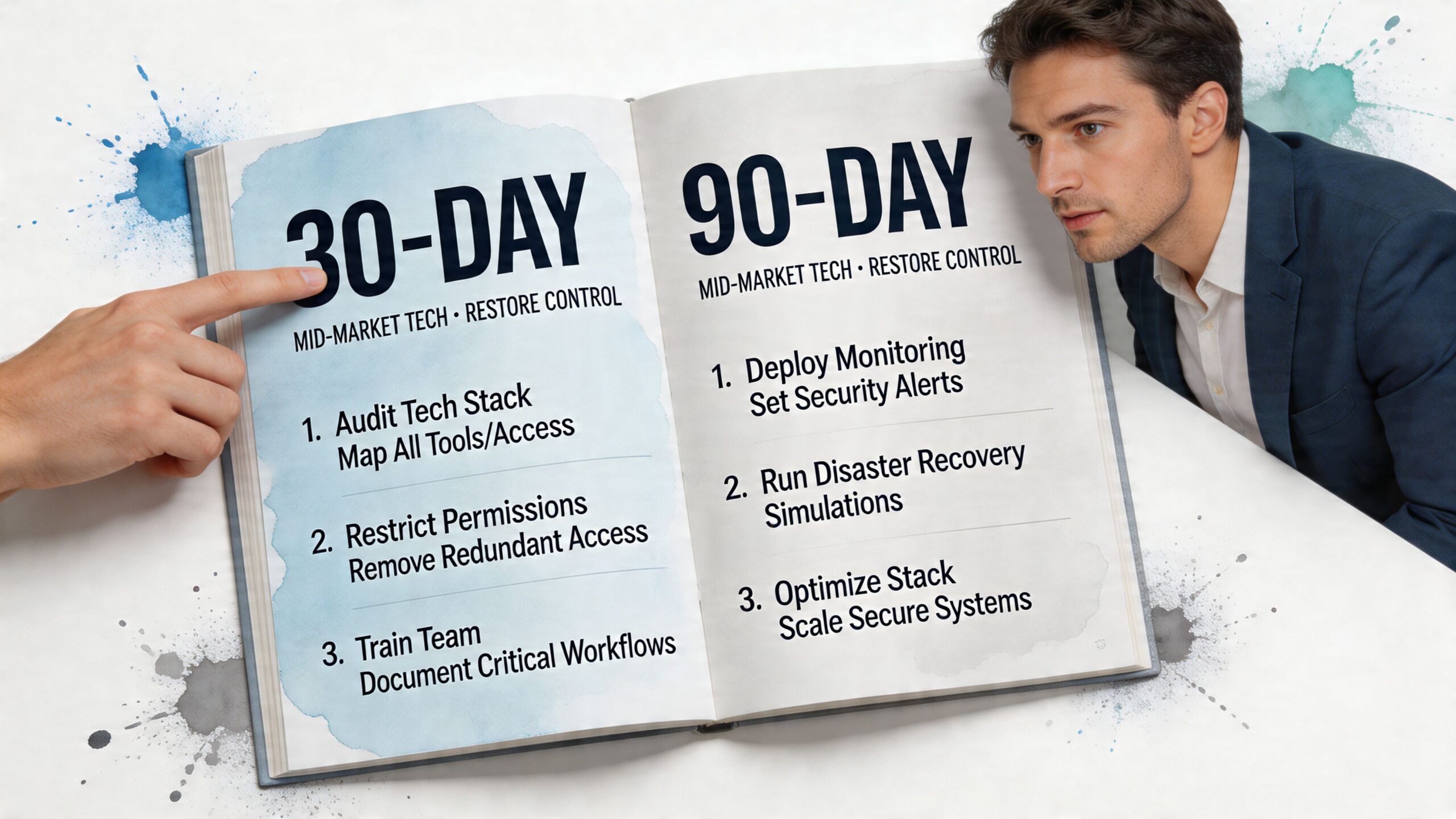
Your 30 and 90-Day Playbook to Restore Control
If the business is already paying a coordination tax, don’t start with a grand transformation plan. Start by making the current reality visible and reducing obvious risk.
The first 30 days
The first month is about legibility. You are trying to replace assumptions with facts.
Map what exists
Achieve a single perspective on your core technology environment:
- Systems that matter to revenue, operations, finance, and customer delivery
- Vendors with meaningful spend or operational dependence
- Owners for each system, vendor, and critical process
- Active projects that are consuming time, money, or executive attention
Don’t aim for perfection. Aim for something complete enough to expose confusion.
In many companies, this is the first time leadership can see the same environment on one page. That alone surfaces duplicate tools, unsupported systems, quiet renewals, and critical dependencies sitting with one overextended person.
Identify the top trust risks
Not every issue matters equally. Pull out the few that create the most drag or downside.
Common examples include:
- Unowned systems that the business depends on daily
- Vendor concentration where one provider controls too much of the operating stack
- Fragile reporting where leadership numbers depend on manual work
- Security theater where policies exist but controls are inconsistent
A fractional or interim leader earns their keep by separating “annoying” from “material.”
Ship one or two visible wins
You need momentum early. Pick a small number of fixes that reduce friction quickly.
Good early wins usually have three traits:
- They remove confusion
- They cut repeated manual work
- They improve confidence without requiring a major rebuild
Examples might include clarifying ownership for Microsoft 365 administration, consolidating a duplicate SaaS tool, fixing one broken approval path, or establishing a single weekly portfolio update.
If you want a practical reference on inherited technology environments, especially around productivity and identity platforms, this piece on New CTO's First 90 Days is worth reading.
The next 60 days to reach day 90
By day 90, you should have moved from visibility to control.
Launch the weekly cadence
Put the operating rhythm into the calendar and protect it. Use the same agenda every week. Keep it short enough that leaders attend and useful enough that they care.
The point isn’t more meetings. The point is fewer random interruptions.
Create the first business-aligned roadmap
This roadmap should not try to include everything. It should show the few priorities that matter most to the business and the dependencies that could derail them.
A usable roadmap answers:
- What are we doing now
- What comes next
- What must wait
- What risk needs executive attention
That last item matters. Many roadmaps hide risk because teams want to appear in control. Mature leadership does the opposite. It makes risk discussable before it turns expensive.
Stand up the steering forum
Your first IT steering meeting doesn’t need polished slides. It needs clean decisions.
Bring the right people. Review the active portfolio. Resolve one or two cross-functional conflicts. Confirm ownership. Record the decisions. Repeat.
That pattern starts to retrain the organization. Instead of technology being a blur of tickets, projects, and vendor conversations, it becomes a managed portfolio tied to business outcomes.
A practical sequence for leaders
Here is the order I recommend:
- Make reality legible
- Name the few issues that create most of the chaos
- Assign explicit owners
- Install a weekly review rhythm
- Resolve cross-functional decisions in one steering forum
- Build a shorter, clearer roadmap than your instincts want
- Track visible progress and open risks in the same place
A lot of companies delay this because they assume they need a full reorganization first. They don’t. They need operating discipline.
One option for this kind of work is CTO Input’s guide to the first 90 days with a fractional CTO, which outlines how to make the environment legible, reduce risk, and install a workable cadence without enterprise overhead.
If you can’t explain who owns the important systems, what the top risks are, and what the next 90 days will change, the business is still running on hope.
What Better Looks Like A Calmer, Faster Organization
The goal isn’t perfect technology. The goal is a business that no longer gets surprised by its own operating model.
In a healthier mid-market company, leaders stop spending their week on status hunts. They can see which work matters, who owns it, what is blocked, and what risk needs a decision. The reporting gets shorter because it gets clearer.
What changes for the leadership team
The CEO and COO don’t have to mediate routine technology disputes. The CFO can connect spend to priorities instead of untangling overlapping contracts after the fact. The board gets cleaner answers because management has cleaner facts.
You also feel the change in the pace of execution. Work doesn’t become magically easy, but it does become more predictable. Fewer initiatives open without defined ownership. Fewer dependencies appear as surprises. Fewer decisions get reopened because the original decision was vague or undocumented.
What changes for the team
The IT director, security lead, operations manager, and application owners get air cover.
They are no longer forced to carry the business through improvisation. They can work on root causes because the leadership layer has created a stable path for decisions. Firefighting drops. Escalations get sharper. Vendors get managed instead of allowed to roam.
A calm organization isn’t one with less pressure. It’s one where pressure moves through clear owners, clear decisions, and a clear rhythm.
That is what strong technology leadership produces. Not theater. Not jargon. Reliable execution.
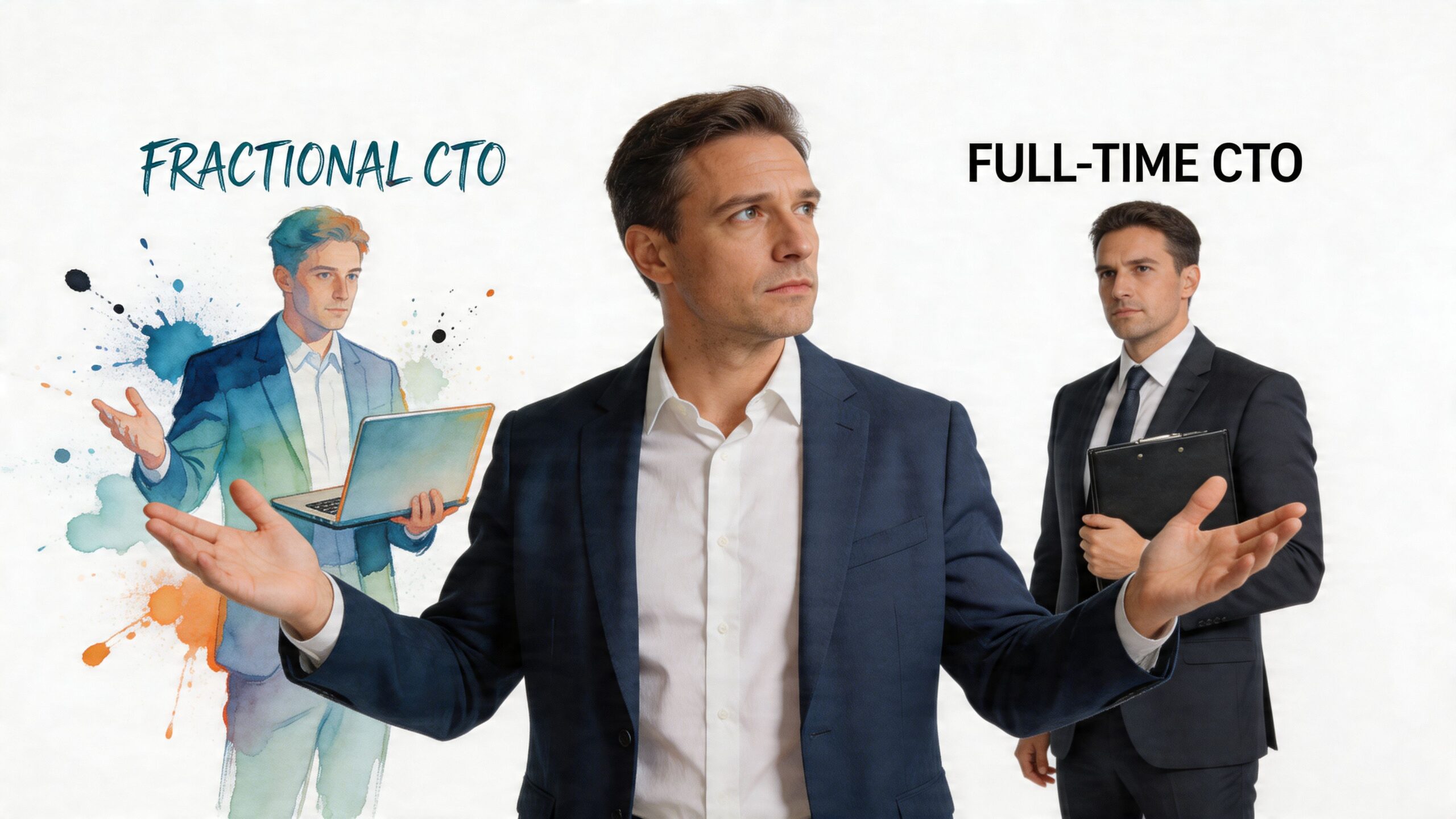
The Right Leader for the Job Fractional vs Full-Time
A lot of mid-market companies reach this point and jump straight to one conclusion. We need to hire a full-time CTO.
Sometimes that is right. Often it is early.
Why the default answer is often wrong
The mid-market sits in an awkward spot. The company is too complex for simple IT support, but not always ready for enterprise-scale executive overhead. That is exactly why so many firms stay stuck in the middle. They have real technology leadership needs, but the leap to a full-time executive role feels heavy, expensive, and hard to define.
The North Carolina Technology Association article makes this point clearly. The mid-market is often underserved, and while 91% of companies with digital skills gaps report performance impacts, the practical answer isn’t always a full-time hire. The article argues that fractional leadership addresses fuzzy ownership and the coordination tax by bringing experienced executive guidance to install calm operating rhythms and ship risk reductions in the first 30 days. See the Silver Tree guest blog on mid-market technology leadership gaps.
What fractional leadership is actually for
Fractional leadership is not a cheaper substitute for a “real” executive. It is a fit-for-stage operating model.
It works well when your business needs:
- Executive judgment on priorities, vendors, and risk
- Operating structure that your current team can run after it is installed
- Faster stabilization than a long executive search can provide
- Flexibility while you figure out whether the eventual need is CTO, CIO, CISO, or stronger internal management
A seasoned fractional leader should be able to do three things quickly:
- Make the current environment legible
- Clarify decision rights and ownership
- Create a cadence that reduces noise and improves follow-through
That is different from managed services. It is also different from advisory work that ends in a slide deck.
When full-time makes sense
A full-time CTO can be the right choice when technology is central enough to the company’s product, operations, growth model, or risk profile that the role needs daily embedded leadership.
But many mid-market firms aren’t there yet. They first need to repair structure, clean up governance, and create a usable roadmap. Hiring a full-time executive before that can create a costly mismatch. The role gets filled, but the operating context is still muddy. Then the business judges the person before it fixes the system.
If you’re weighing that decision, this article on a part-time CTO gives a useful lens for deciding whether your company needs right-sized executive leadership now or a permanent hire later.
Frequently Asked Questions about Technology Leadership
| Question | Answer |
|---|---|
| How do I know if we need stronger technology leadership or just better IT management? | If the main problems involve ownership, prioritization, vendor control, board confidence, or cross-functional execution, you need leadership, not just better task management. IT management handles daily operations. Technology leadership aligns decisions to business outcomes. |
| Are fractional and interim the same thing? | No. Interim usually means stepping into a role for a defined transition or gap. Fractional means ongoing executive-level leadership on a part-time basis. Some companies need interim stabilization first, then fractional guidance after the urgent period passes. |
| Will this undermine our current IT director or team? | It shouldn’t. In a healthy setup, stronger leadership gives the internal team more clarity, better escalation paths, and protection from random priority churn. Good people usually welcome it because it removes guesswork and political ambiguity. |
| When is the right time to act? | Earlier than most leaders think. If major projects keep slipping, reporting feels fuzzy, vendors have too much influence, or the board is asking harder questions than management can answer cleanly, don’t wait for a bigger failure. |
| Do we need a formal committee to improve governance? | You need a decision forum, not ceremony. For many mid-market companies, a lightweight cross-functional steering group is enough. What matters is regular cadence, clear ownership, and recorded decisions. |
| What happens to existing vendors under stronger leadership? | Good vendors usually become more effective because expectations, priorities, and accountability improve. Weak vendors get exposed faster. Either outcome is useful. |
| Can this work if we are already in the middle of too many projects? | Yes, but the first move is usually to reduce active noise, not add more initiatives. Strong leadership starts by narrowing focus, clarifying ownership, and creating a small number of visible wins. |
If technology is slowing growth, weakening visibility, or creating avoidable board risk, CTO Input helps mid-market leaders restore clear ownership, cleaner decisions, and a calmer operating rhythm through fractional and interim technology leadership. A clarity call is a practical next step if you want to surface the biggest bottlenecks and decide what the first 30 days should look like.