
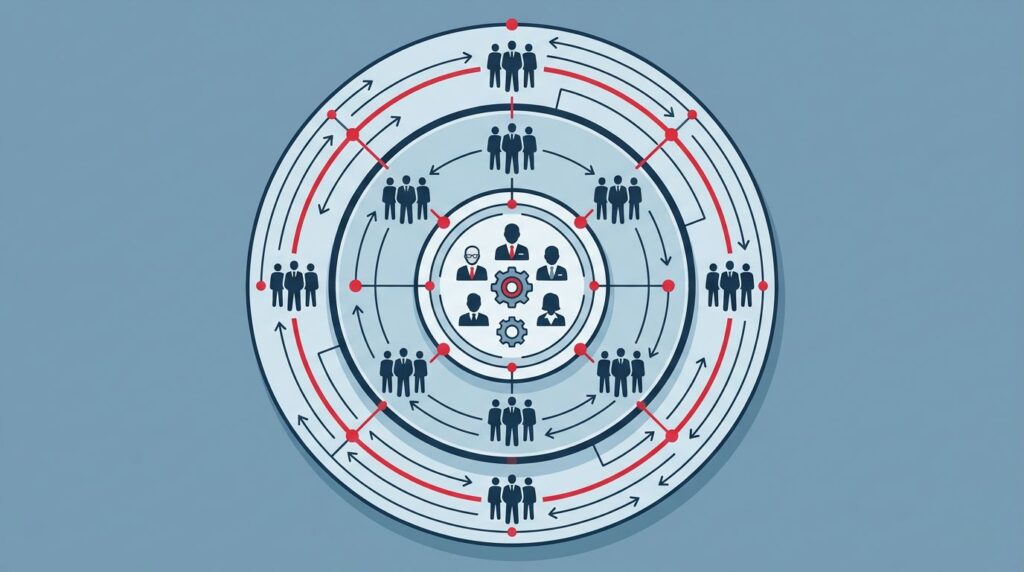
Effective technology organization design is the primary factor that prevents rapid growth from descending into organizational confusion. Whether your company is at the $25M, $50M, or $100M revenue milestone, the business requires a different shape, distinct owners, and a refined level of control to thrive. If you maintain your current IT organizational structure for too long, the cost of inaction will manifest as slow decision-making, weak reporting, vendor sprawl, and a board that stops trusting your narrative.
You do not necessarily need more motion or headcount. Instead, you need a resilient structure that fits the specific stage you are in to successfully navigate the complexities of digital transformation.
Key takeaways for your team
- At $25M, you need a small, senior technology core, not a big organizational chart.
- At $50M, you need named ownership, cleaner reporting, and a formal IT organizational structure to maintain a healthy operating rhythm.
- At $100M, you need clear separation across platforms, data, security, and business systems as part of a matured operating model.
- The right answer is usually a fractional CTO, interim CTO, or other fractional technology leadership before a full-time hire.
- If the board cannot see risk, spend, and progress in plain language, the structure is already behind the business.
How the operating model changes as revenue grows
The job changes faster than most leaders expect. What worked when the company was smaller starts to buckle once the systems, vendors, and priorities multiply, forcing you to evolve your internal ways of working to keep pace.
| Revenue stage | What the tech org should look like | What usually breaks | What you should do next |
|---|---|---|---|
| $25M | Small, senior, hands-on, with one clear decision-maker | Founder-led technology decisions, scattered vendors, weak reporting | Tighten your IT organizational structure and build a short roadmap |
| $50M | A real leadership layer with named owners for delivery, data, and risk | Bottlenecks, tool sprawl, unclear tradeoffs | Add structure, board-ready reporting, and focus on organizational effectiveness |
| $100M | A more formal operating model with product, platform, security, and data leadership | Silos, technical debt, shadow IT, and stalled change | Segment the work and refine the operating model without turning it into bureaucracy |
That shift is not unique to tech. It shows up in every growing function. MIT Sloan has a useful parallel in designing an organization for its growth stage, because the lesson is the same. Your structure has to match the work.
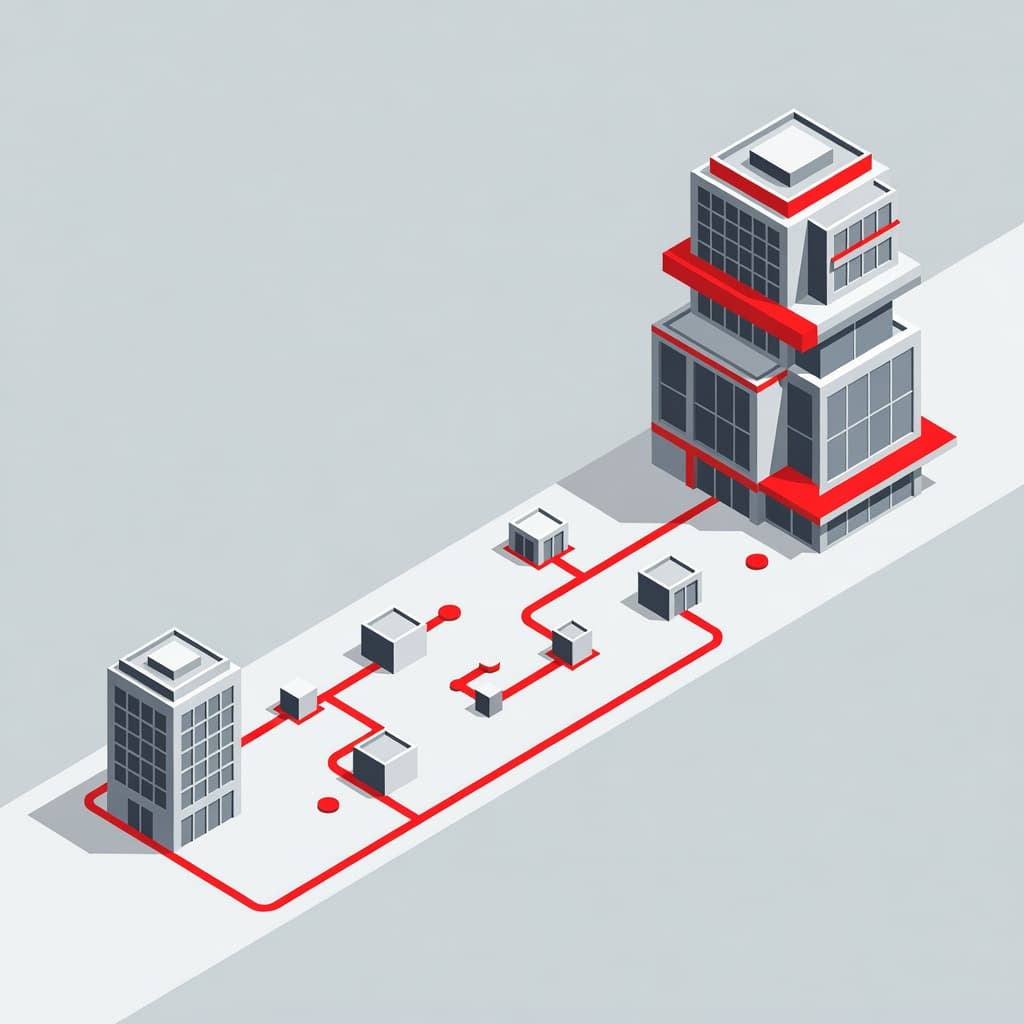
You can also see this in tech startup growth stages. Even if you are no longer a startup, the same truth applies. The operating model that gets you started is rarely the one that gets you through scale.
What the $25M company needs most
At $25M, founder-led technology decisions are still common. That is not the problem. The challenge is assuming speed can replace structure forever, especially when you are balancing technology staffing needs with the ongoing search for top-tier tech talent.
At this stage, you need a technology leader for growing companies who can connect the business plan to the technology plan without adding noise. That might be a fractional CTO, virtual CTO, part-time CTO, or outsourced CTO. If the seat is open and the business needs steadiness fast, interim CTO support or interim CTO services may make more sense.
If you do not have a CTO yet, start with a technology assessment, a technology audit, and a board-ready risk summary. Then, decide whether the next move is a full-time hire, a fractional role, or an interim one. By implementing a simple functional IT model, you can maintain the agility you had at the startup phase while professionalizing your approach. If you are still sorting out the gap, technology team leadership gap is a useful way to frame the decision.
A roadmap without an owner is just a list of hopes.
At $25M, the structure should still feel light. But it should not be vague. You need one person who can make the tradeoffs, say “not now,” and report in plain business language. If you want a clearer read on whether the seat is the issue, Talk Through Your Technology Leadership Gap is the cleanest first move.
What changes at $50M
By $50M, one person cannot carry all the context anymore. The company has outgrown casual coordination.
This is where technology leadership has to become more deliberate. You need a clear decision rights map, a real technology operating rhythm, and stronger stakeholder alignment across operations, finance, product, and security. By establishing clear reporting relationships across these departments, you ensure stronger business-IT alignment and robust IT governance. If you want a simple model for what that can look like, technology leadership team structure is a better starting point than a big org chart.
At this stage, the board wants technology governance for CEOs and technology governance for boards to look more disciplined. That means board-ready technology reporting, board-ready reporting, board cybersecurity reporting, and cyber risk reporting to the board that says what is stable, what is slipping, and what needs attention now. It also means a clear board-ready risk summary, not a pile of technical detail.
The job of the leader changes too. You are no longer just keeping systems running. You are shaping technology strategy, business technology strategy, and business-aligned technology strategy around growth, margin, and risk. If you are still using founder instincts alone, the business starts paying for it in rework and delay.
At $50M, this is also where technology strategy consulting should turn into action. Your IT strategy must now be anchored to your core strategic objectives. This should feed an IT strategy and roadmap, a practical one-page technology strategy, and a focused 12-month technology roadmap. A simple technology roadmap template is enough if it tells the truth about ownership and timing.
What the $100M company needs to stop guessing about
At $100M, technology is no longer a support function in the background. It is a fundamental component of how the company executes, reports, and protects itself.
This is the point where you need an explicit split between platform, product, data, security, and business systems. You must decide whether to move toward a centralized IT model, a decentralized IT structure, or a federated IT approach to balance speed and control. The goal is not to add layers, but to eliminate fuzzy ownership. Instead of traditional hierarchies, many organizations now lean on cross-functional teams and product-based IT to deliver value without making every decision a committee event.
This is also where technology debt and technical debt become expensive. The problem is not just old code or complex legacy systems. It is weak reporting, overlapping tools, shadow IT, and systems that no one owns end to end. Tool sprawl and shadow IT usually show up long before the budget owner wants to admit it.
A useful next step is application portfolio rationalization. You also need regular software platform evaluation and tighter technology vendor selection so the stack fits the business instead of the other way around. That is where an internal team, or a fractional CIO when the scope is broader than engineering, helps keep the room honest.
At this size, the board should see whether the company is keeping pace on technology risk oversight, technology risk management, and a practical technology risk management framework. If your board pack still feels vague, IT maturity model framework can help you see the gaps in plain view.
Build the roadmap around outcomes, not tickets
Most technology roadmaps fail for a simple reason. They describe activity rather than actual business change.
You need a business-aligned technology strategy that ties each line item to clear strategic objectives and real outcomes, such as growth, customer retention, cash flow, compliance, resilience, or speed. If you cannot say what a project changes, it belongs in the questionable pile. Furthermore, successful roadmaps treat business-IT alignment as a continuous process, ensuring that change management is integrated into every initiative to guarantee adoption and value realization.
The test is simple. For every major item, ask three questions. Which outcome does it support? Who is the business owner, rather than just the IT owner? What breaks if you turn it off for 30 days?
That is where technology spend optimization starts. It does not begin with cuts for the sake of cuts, but with technology ROI, tech spending ROI, IT cost optimization, and IT cost reduction that leaders can actually defend. You want cost-per-outcome reporting, not vanity dashboards. You want technology dashboards that show what matters, instead of a pile of green lights.
A practical growth plan from Workday starts with goals first. Your technology plan should do the same. That is how you turn a budget into a decision-making tool.
This is also where founder-led technology decisions have to give way to clearer CEO technology decisions and a more structured COO technology strategy. If the company is serious about growth, the technology priorities for growing companies need a visible owner and a clear sequence.
Which leadership model fits your stage
You do not need the fanciest title. You need the right kind of ownership to ensure your IT organizational structure remains resilient as you scale.
| Situation | Better fit | Why |
|---|---|---|
| You need steady executive guidance but not a full-time hire | fractional CTO, virtual CTO, part-time CTO, or outsourced CTO | Gives you senior judgment without full-time overhead while managing reporting relationships |
| The seat is open, trust is shaky, or the room needs calm now | interim CTO or interim CTO services | Stabilizes the business fast |
| Security and risk are the bigger issue | fractional CISO, virtual CISO, or interim CISO | Brings sharper cybersecurity oversight |
| The issue is broader than engineering | fractional CIO | Helps with enterprise-wide structure and control |
| You only need to scale your team | fractional CTO vs IT consultant usually means you need someone to help hire and mentor tech talent | Advice is not the same as executive responsibility |
If you are still figuring out how to hire a CTO, start with the work, not the title. Define what needs ownership, what needs oversight, and what can stay tactical. That is the heart of technology leadership before hiring.
When the seat feels fuzzy, the fastest move is to Get an Executive Technology Clarity Check. You leave with sharper priorities, clearer ownership, and a practical next step.
The risk work has to sit inside the operating model
Security, data, vendors, and AI cannot be side projects anymore. They belong in the main operating model.
Start with the basics. You need a current systems inventory, clear access control best practices, a working business continuity planning process, and real disaster recovery planning. By integrating DevOps practices into these workflows, you drive greater operational efficiency while managing risks. Add incident response readiness, ransomware readiness, and an executive incident response checklist so the response does not depend on memory during a bad week. Keep a live cybersecurity risk assessment and IT security assessment in front of leadership, not buried in a folder. That matters when cyber insurance renewal comes around too.
Then move to the data layer. A robust data governance framework is the core of this tier. When paired with a clear data strategy, data quality standards, data privacy, and broader information governance, these elements keep the business from making decisions on bad inputs.
Vendors need the same discipline. Third-party risk management, third-party risk reporting, vendor management, vendor due diligence, vendor offboarding, and a basic vendor incident response plan should all be part of the job. If vendors are steering more of your roadmap than you are, your structure is already off balance.
AI deserves a real gate, not a free-for-all. You need AI governance, an AI adoption strategy, an AI transformation strategy, responsible AI standards, an AI acceptable use policy, AI vendor due diligence, and an AI opportunity assessment before tools spread faster than policy.
If you are preparing for a transaction, the bar goes up again. Technology due diligence, technical due diligence, cybersecurity due diligence, an acquisition due diligence checklist, a clear CTO transition plan, and clean post-merger technology integration all depend on stronger ownership before the deal gets close. If that is where you are headed, Prepare Technology for Diligence or Transition is the right next step.
Conclusion
At $25M, $50M, and $100M, the question is not whether technology matters. It does. The real question is whether your structure matches the stage of the business.
When ownership is clear, reporting is honest, and the right leader owns the tradeoffs, technology stops feeling like a drag. It starts acting like a core part of the business. By refining your organizational effectiveness, you ensure that these structural adjustments support long term growth. Ultimately, scaling successfully is about evolving your ways of working so that your technology organization remains an engine for value rather than a bottleneck.
FAQ
How does technology organization design change between $25M and $100M?
At $25M, you usually need a small senior core and a clear owner. At $50M, you need named accountability and a real operating rhythm. By the time you reach $100M, your IT organizational structure requires a clearer separation across product, platform, data, security, and business systems to manage the increased scale.
Do you need a full-time CTO at $25M?
Not always. If you need executive judgment but not a permanent seat, a fractional CTO, virtual CTO, part-time CTO, or interim CTO can fit better. The point is ownership, not payroll size.
What if you do not have a CTO yet?
Start with a technology assessment, a technology audit, and a board-ready risk summary. Then build a 90-day technology plan that shows what needs to be stabilized, what needs an owner, and what can wait.
How do you know the structure is wrong?
You usually feel it before you can prove it. Reporting is weak, projects drift, vendors exert too much influence, and the board keeps asking the same questions. These symptoms suggest that your technology leadership for mid-market companies needs a reset. You might find that your current setup lacks the benefits of an agile operating model, or perhaps you are outgrowing your initial approach and need to transition toward a matrixed IT structure. If your team is struggling to keep pace with digital transformation initiatives, it is a clear sign that you need to evolve your organizational design rather than simply adding more noise.