
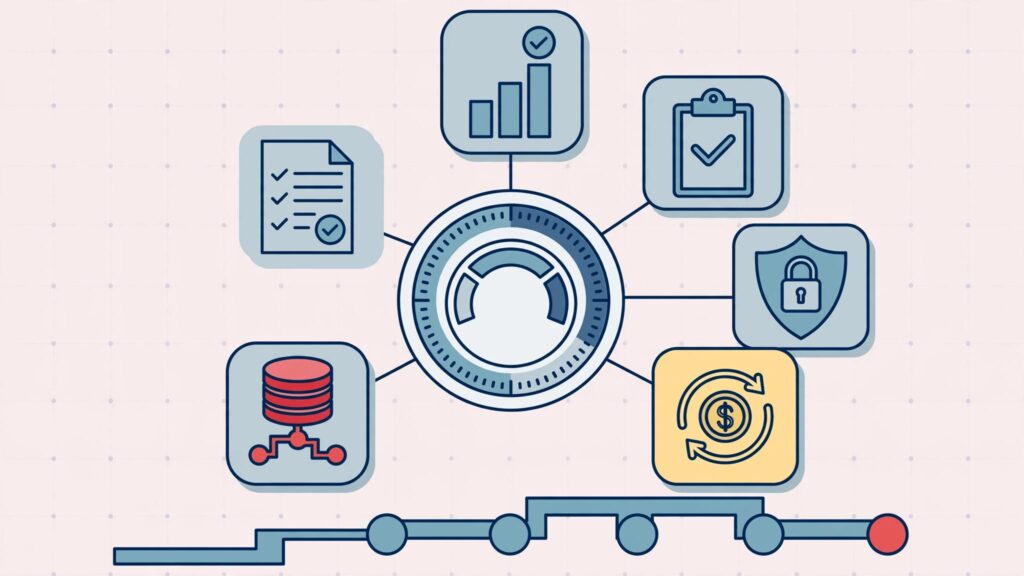
Before approving technology project funding, ask what outcome you are buying, who owns delivery, and what happens after the money runs out. A credible proposal makes those answers clear before it asks you to trust the technology.
You don’t need to inspect every technical decision. You do need clear ownership, defensible costs, and evidence that the organization can carry the work.
Start with the questions that expose uncertainty while you still have room to change the plan.
Key Takeaways for Technology Project Funding
- Tie funding to a measurable business or mission outcome, with a baseline and a named owner.
- Assess delivery capacity, security, adoption, and ongoing costs alongside the proposed technology.
- Match the project to the funding program’s purpose and applicant rules.
- Release further funding against agreed evidence, with clear conditions for continuing, changing, or stopping.
1. What Outcome Will This Funding Buy?

Ask for the result before the solution
“Implement a new platform” describes activity. You need to know whose problem improves and how management will measure that improvement.
Ask for the current baseline, the expected result, and the cost of doing nothing. For an operating business, that may mean processing time, customer retention, or order errors. For a nonprofit, it may mean referral completion, service access, or staff capacity.
Research projects need a different standard. Their outcome may be evidence that resolves a technical uncertainty. The proposal should name that uncertainty and explain what the test will establish.
Test alignment with the wider plan
Every significant request should support a stated priority in a one-page technology strategy or 12-month technology roadmap.
Ask what the project replaces, which manual work it removes, and what other work must wait. That last question exposes capacity constraints and pet projects.
Our guide to stress-testing a technology roadmap connects proposed spending with outcomes, dependencies, and delivery decisions. A roadmap should explain the choices behind the project queue.
2. Can the Team Deliver the Work?
Look for evidence behind the promise
Request a working demonstration, preliminary research, pilot findings, or other evidence appropriate to the project’s stage.
A polished presentation doesn’t establish feasibility. Ask what has been tested, what failed, and which assumptions remain unresolved.
Your technology assessment should also cover existing systems, integrations, data quality, and material technical debt. A proposal can look affordable while depending on expensive cleanup elsewhere.
For mission-driven organizations, technical due diligence helps expose security and integration weaknesses before expansion magnifies them.
Separate delivery capacity from executive ownership
Name the business sponsor, delivery lead, and person accountable for adoption. Ask how much time each has available alongside existing responsibilities.
A technology leadership gap can leave vendors making decisions that belong to management. Fractional CTO services can provide executive technology leadership where a full-time hire isn’t justified. An interim CTO can provide continuity during a leadership transition.
Neither arrangement removes management’s accountability. The funding agreement still needs clear decision rights, escalation routes, and a handover plan. Funders should also understand which decisions the delivery vendor cannot make alone.
3. What Is the Full Cost and Risk?
Fund the operating reality
Review implementation, internal labor, data migration, integration, training, licenses, support, security, and eventual retirement costs.
Then ask who pays after the grant or investment period ends. A successful launch can still create an unfunded operating obligation.
Approval thresholds should reflect total commitment, business impact, risk, and reversibility. Competitive bids or deeper market research may be appropriate for significant purchases, subject to applicable procurement rules.
Use cost-per-outcome reporting where practical. Cost per completed referral or processed order tells you more about technology ROI than subscription invoices alone. Keep research spending tied to learning milestones rather than forcing an artificial revenue forecast.
Make risk visible before approval
Ask which sensitive data the project uses, who can access it, and how operations recover after an outage.
Vendor due diligence should address security responsibilities, subcontractors, breach notification, data export, and vendor offboarding. Business continuity planning needs tested recovery arrangements, not an unused document.
For AI projects, require an AI opportunity assessment, data privacy decisions, human review, and an AI acceptable use policy. Establish how errors will be detected and corrected.
A project can meet its delivery deadline and still exceed your risk appetite. Budget approval and risk acceptance need separate, named decisions.
Translate cybersecurity exposure into plausible operational, financial, legal, and customer consequences. Avoid unsupported promises about risk reduction.
4. Which Innovation Funding Route Fits?
Innovation grants can reduce the financial strain of research and prototyping. Some funding opportunities also provide mentorship, exposure, and networking. Those benefits don’t compensate for a poor program match.
These five funding routes address different purposes.
| Funder | Main fit | Important distinction |
|---|---|---|
| National Science Foundation | Innovative technologies with commercial potential | NSF SBIR/STTR supports qualifying small businesses. |
| National Institutes of Health | Healthcare, biotechnology, medical devices, and life sciences | The proposed work needs a clear health-related purpose. |
| Department of Energy | Clean energy, sustainability, and advanced technology | Projects must align with the relevant program’s technical scope. |
| Economic Development Administration | Regional innovation ecosystems | Tech Hubs funding supports regional development, rather than every individual invention. |
| Google.org | Technology-enabled social outcomes | Challenge-based support can include education, accessibility, and sustainability. |
Commercial research, mission-driven innovation, and regional capacity building require different applications and evidence, so compare innovation grants by purpose.
Federal SBIR/STTR programs include SBIR grants for qualifying small businesses and STTR awards that require research institution partnerships. For a concrete scale reference, National Science Foundation’s 26-510 solicitation lists Phase I proposals of up to $305,000 for six to 18 months. That is a solicitation-specific limit, not a universal technology grant amount.
Common categories for technology grants include prototype development, startup and entrepreneur, research and technology, nonprofit innovation, and corporate and foundation grants. These categories overlap. Choose according to purpose, applicant eligibility, maturity, and expected results.
Treat Google.org Innovation Grants as challenge-specific opportunities, not a standing award available to every nonprofit.
5. Does the Application Support the Promise?

A strong application makes its claims traceable. The proposal, budget, evidence, and work plan should describe the same project.
Six common innovation grant application requirements are a project proposal, budget and financial plan, proof of concept or preliminary research, team CVs, letters of support or collaboration agreements, and institutional approval letters where applicable.
Read those documents together. Team CVs should support the proposed work. Collaboration agreements should explain actual commitments. The budget should fund the activities required to reach the stated milestones.
Strong proposals state clear objectives, expected results, and a realistic schedule. Recommendation letters help when they establish relevant capability or demand. Generic praise adds little.
Competition for limited grants is high. Common rejection causes include unclear explanations of how the idea works, missing supporting data, incomplete applications, and unrealistic budgets. Late submission can make the rest irrelevant.
As a funder, distinguish weak evidence from weak presentation. A promising team may need help framing its case. Missing feasibility evidence or an unresolved funding gap requires a substantive answer.
6. What Evidence Will Release the Next Funding?
Agree on milestones before disbursement. Each milestone needs an owner, evidence of completion, and a decision about what happens next.
For exploratory research, evidence may be a validated finding. For deployment, it may include adoption, service performance, or a successful recovery test. Match the evidence to the uncertainty you are funding.
Require concise technology dashboards showing spend, delivery status, adoption, risk, and major dependencies. Reporting should expose the decision management needs to make.
Our guidance on technology priorities in operating plans connects ownership, budgets, and board-ready reporting.
Before committing, use this approval checklist:
- The outcome has a baseline, success measure, and accountable owner.
- Delivery assumptions, dependencies, and team capacity have supporting evidence.
- Full costs, security responsibilities, and post-award ownership are explicit.
- Milestones define when to continue, revise, pause, or stop funding.
Write down deferred work and the consequences. Funding one project consumes capacity that cannot simultaneously support another. That tradeoff belongs in the decision record.
Frequently Asked Questions
Who can apply for technology innovation grants?
Eligibility for technology grants varies by program and project stage. Applicants may include independent inventors, small businesses, startups, nonprofits, and academic research teams. Some programs accept international applicants.
U.S. SBIR/STTR awards require qualifying U.S. small businesses. An individual inventor may need an eligible business entity or institutional partner.
For African ICT and educational technology projects, country eligibility, local delivery capacity, accessibility, connectivity, and ongoing support all affect fundability.
Where can applicants find relevant opportunities?
Applicants can search grant opportunities through government programs, private foundations, nonprofit innovation funds, corporate CSR programs, university portals, and a grant portal. An online grant database can also help applicants find funding opportunities and innovation grants.
Grants.gov funding listings cover U.S. federal opportunities. The SBIR/STTR opportunity database organizes small-business research opportunities.
Compare grant opportunities by eligibility and project fit before investing time in an application.
What does The Grant Portal provide?
The Grant Portal is a subscription grant database built on IRS Form 990-PF filings. Its filters include funding type, eligibility, location, and area of interest. It also offers opportunity alerts, past-recipient information, and grant-writing resources.
Before paying, review the grant portal’s subscription terms and fees, and compare its grant database coverage with your needs. Historical awards help you understand a foundation’s interests. They don’t establish that your project qualifies or that funding is available now.
Make the Funding Decision Easier to Defend
You can support ambitious technology work while keeping uncertainty visible. Require a clear outcome, stronger ownership, realistic costs, and evidence proportionate to the commitment.
If those answers remain scattered, Get an Executive Technology Clarity Check. We help you identify what needs executive attention and establish a practical next step.
Fund the next defensible stage of work, with clear conditions for what follows.