
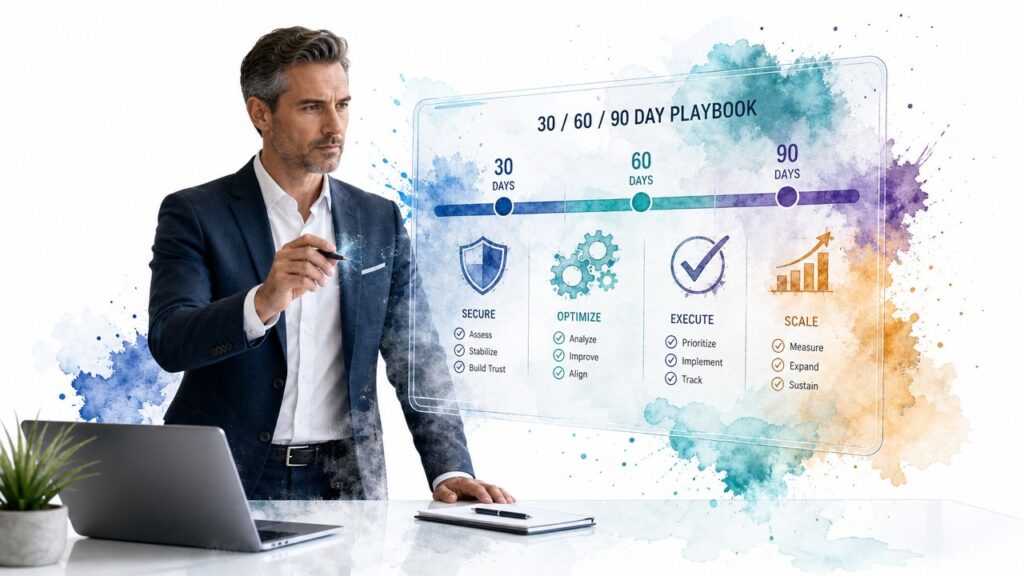
A buyer asks for the technology diligence list, and the mood changes fast. Until that moment, technology can sit in the background as a cost line, a growth enabler, or a source of occasional frustration. Once diligence starts, it becomes evidence.
That's the shift most CEOs underestimate. Buyers aren't just asking whether the product works. They're asking whether the business can survive transition, whether the platform can scale without drama, and whether hidden tech risk will become their problem the day after close.
Technology readiness for acquisition is not a cleanup exercise for perfectionists. It's a value protection exercise for leaders who don't want preventable technology issues to become price cuts, escrow demands, ugly indemnity language, or a dead deal. The right move is not to polish everything. The right move is to understand what matters, fix what changes deal economics, and present a clear, credible story.
Why Your Technology Is a Multimillion-Dollar Risk (or Asset)
The hard part of tech diligence isn't the request list. It's what the list means.
A buyer's team is translating your technology into financial exposure. They want to know how much they'll need to spend after close, how likely key people are to leave, how brittle the platform is under growth, and whether your intellectual property is clean enough to own without surprises. If your answers are vague, they'll assume the cost is higher than you think.
That doesn't mean buyers expect perfection. It means they expect control.
What buyers are actually testing
Most CEOs think the buyer's CTO or diligence lead is looking for “good code.” That's too narrow. Buyers usually assess three things.
People
They want to know whether knowledge is concentrated in one founder, one contractor, or one exhausted senior engineer. If the team can't operate without a few heroes, the acquirer sees transition risk and retention risk.Process
They're looking for repeatability. Can your team release changes predictably? Can you respond to incidents? Are vendors managed, access controlled, and key decisions documented? Weak process tells the buyer that operations depend on memory and improvisation.Platform
They care about architecture, security, resilience, documentation, integrations, and dependency risk. They're not asking whether your stack is fashionable. They're asking whether it can be owned, integrated, defended, and scaled.
Practical rule: Buyers discount uncertainty faster than they discount known problems with a credible plan.
Messy code is not just a technical issue. It signals future integration cost. Thin documentation is not just annoying. It tells the buyer they may inherit a business that slows down every time someone asks a basic question. Weak security controls don't just create theoretical risk. They can trigger liability concerns and delay the deal while everyone argues about exposure.
Where deal value gets damaged
Some technology issues reduce price. Others change terms. A few kill trust altogether.
Here's how that usually plays out:
Technical debt becomes integration cost
If systems are fragile or tightly coupled, the buyer assumes the post-close roadmap will take longer and cost more.Security gaps become legal and reputational exposure
If access control, logging, incident response, or data handling are sloppy, the buyer worries about inherited liability.Documentation gaps become operating risk
If no one can explain how core systems work, the buyer assumes continuity depends on tribal knowledge.IP ambiguity becomes ownership risk
If code ownership, contractor assignments, model training inputs, or open-source obligations are unclear, the deal team gets nervous. That's especially true in AI-heavy businesses, where the impact of AI on intellectual property law is still forcing companies to get sharper about what they own and can defend.
The buyer's question is simpler than it sounds
They are asking one thing in several different ways. Will this technology help us create value after close, or will it absorb capital, management attention, and goodwill?
If your systems are slowing execution already, that shows up in diligence. If vendors effectively control your roadmap, that shows up too. If your business growth has outpaced the discipline around technology ownership and operating rhythm, you'll feel the same pain described in why your technology is holding back business growth.
A clean diligence outcome doesn't come from pretending the platform is flawless. It comes from showing that leadership understands the weak spots, knows which ones matter, and has already made sensible decisions about them.
An Assessment Framework to Find Problems Before a Buyer Does
Most companies go into diligence backwards. They start collecting documents before they've decided what story the documents tell.
Start with an internal assessment instead. Not a giant consulting exercise. A focused management review that tells you where your technology is strong, where it's fragile, and where a buyer is likely to press hardest.
A useful frame is to score readiness across a handful of business-critical domains, then decide what needs remediation, what needs documentation, and what needs honest disclosure. If you want a broader primer on the mechanics, this guide to mastering IT due diligence is a useful companion.
Use a maturity scale instead of gut feel
One practical way to do this is to borrow the logic of Technology Readiness Levels, or TRLs. TRLs are a 9-point maturity scale that originated at NASA in the 1970s for space exploration technologies and are now widely used in acquisition to compare technical maturity consistently across programs. In defense acquisition, TRLs are typically assessed through a Technology Readiness Assessment, and the Department of Defense's 2026 guidebook says those assessments help decision-makers judge feasibility, risk, and return on investment, with maturity reviewed before Milestone A and during Analysis of Alternatives, as summarized in AcqNotes on technology readiness levels.
You don't need to run a defense-style assessment. The useful lesson is this: maturity should be evidenced, not assumed.
For acquisition prep, use the same discipline. Score each critical area on a simple scale from early, fragile, and under-documented to proven, repeatable, and inspectable. The score matters less than the honesty behind it.
A buyer will trust a management team that says, “This capability is important, currently immature, and already on a controlled remediation path,” far more than one that insists everything is fine.
Five domains to assess
Use these domains to build your internal map.
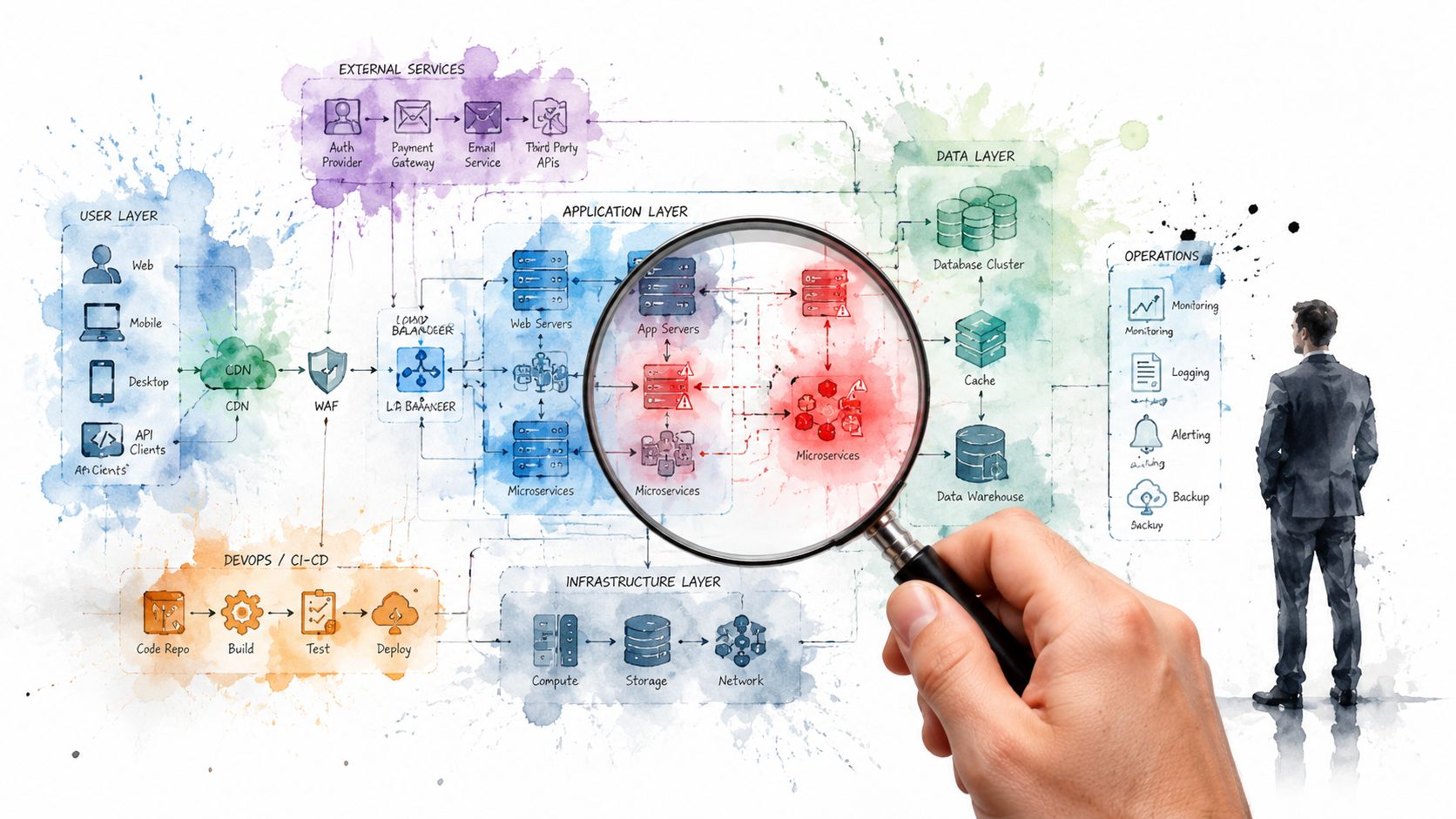
Architecture and scalability
Ask direct questions that expose fragility fast.
- Can the team explain the core system in one diagram that a buyer's technical lead can understand?
- Do you know which integrations break revenue, service delivery, or reporting if they fail?
- Can you deploy changes without unusual heroics from a few senior people?
- Has growth exposed bottlenecks in performance, data flow, or support burden?
If the answers are fuzzy, the architecture probably depends on habit, not design.
Security and compliance
Many deals become tense when leadership assumes “we take security seriously” is an answer. It isn't.
- Who has access to production systems and sensitive data
- Can you show how access is granted, reviewed, and removed
- Do you have a usable incident response process
- Are backups, logging, and recovery understood well enough to explain calmly under pressure
If you can't answer those crisply, a buyer hears operational risk.
Intellectual property and licensing
This area gets neglected until counsel starts asking pointed questions.
- Do you clearly own the code created by employees and contractors
- Do you know what open-source components are embedded in the product
- Have you reviewed license obligations for anything core to the platform
- If AI tools were used in development, do you understand the ownership and policy implications
Team and operations
A solid product with a brittle operating model still scares buyers.
- Who are the single points of failure
- Would a new engineering leader understand priorities, architecture, and release practices within a reasonable handoff
- Are responsibilities clear across product, engineering, security, and infrastructure
- Do recurring issues get fixed at the root, or just patched
Budgets and vendor management
Many companies discover too late that vendors own more influence than management realized.
- Which vendors are critical to product delivery or customer commitments
- Are contract terms, renewal dates, and dependency risks visible
- Can you explain technology spend in terms of business value
- Do you know where tooling is redundant, underused, or unmanaged
A stronger review of these operating issues usually overlaps with formal technology due diligence, but done early, it gives you room to act before a buyer sets the tone.
What good looks like at this stage
You are not trying to prove the company is perfect. You are trying to build a management-grade map.
That map should show:
- What matters most to product value and business continuity
- What is mature and supported by evidence
- What is weak but fixable
- What will remain imperfect and must be disclosed clearly
That alone changes the conversation. You stop reacting like a seller under inspection and start operating like a leadership team that knows its business.
How to Prioritize Remediation for Maximum Deal Impact
An honest assessment usually creates a depressing list. That's normal. The mistake is trying to fix everything.
Buyers don't care equally about every flaw, and neither should you. You need a remediation plan that protects valuation, reduces avoidable negotiation pressure, and shows disciplined judgment. That means sorting issues by impact on valuation and effort to remediate.

Focus on what underpins the deal
In acquisition language, not every system is equal. Some capabilities directly support the thing the buyer is paying for. Those are your Critical Technology Elements, whether or not you use that term internally.
That concept matters because the Department of Defense's Technology Readiness Assessment Guidebook makes a sharp point: readiness is only credible when it is tied to Critical Technology Elements and tested against demonstrated capability in relevant mission and operating environments. The guidebook also warns that immature technology increases program risk and is associated with overruns and delays, and that failure often stems from broad system-level optimism while specific enabling technologies remain under-demonstrated, as stated in the DoD Technology Readiness Assessment Guidebook.
That's exactly how deals get into trouble. Leadership says the platform is solid. Diligence finds that one integration, one data pipeline, one model workflow, or one security control that everything depends on is thinly documented and poorly owned.
Use a simple prioritization matrix
A basic matrix is enough if you use it properly.
| Remediation bucket | What belongs here |
|---|---|
| Quick wins | High valuation impact, low effort fixes such as closing obvious access issues, cleaning up missing documentation for core systems, tightening contractor IP paperwork, or organizing vendor records |
| Strategic projects | High valuation impact, higher effort items such as stabilizing a fragile integration layer, reducing a major key-person dependency, or improving resilience around a revenue-critical workflow |
| Acceptable risks | Lower impact issues that won't be solved before diligence but can be documented, disclosed, and paired with a sensible post-close plan |
| Low priority | Nice-to-have improvements that may help the business eventually but won't materially influence buyer confidence now |
Questions that force better choices
Leaders usually get clearer priorities when they ask four blunt questions:
- If this issue came up in diligence tomorrow, would it change price, terms, or trust?
- Does this issue touch a Critical Technology Element tied to revenue, delivery, or defensible IP?
- Can we fix it fast enough to matter, or do we need to document it cleanly instead?
- Would a serious buyer see this as normal complexity or poor control?
Decision lens: Fix the issues that make a buyer question ownership, continuity, or the cost to integrate. Document the rest.
What to remediate first
The highest-payoff work usually sits in a few predictable areas.
Core system documentation
If your platform can't be explained clearly, the buyer assumes hidden complexity.Key-person exposure
If one developer, architect, or founder holds too much operational knowledge, transfer that knowledge now.IP hygiene
Confirm assignment agreements, contractor terms, and software licensing around anything central to product value.Access and control gaps
Remove stale privileges, tighten production access, and make evidence easy to show.Vendor dependency
Identify where third parties effectively control uptime, delivery, or roadmap decisions.
Practical outside help can make a difference. Some companies use internal engineering leadership, outside counsel, specialist security firms, or a fractional technology lead. CTO Input provides executive-level fractional and interim CTO, CIO, and CISO support for organizations that need someone to map issues, set priorities, and install a calmer operating rhythm before scrutiny rises.
What not to do
Don't launch a grand modernization program because diligence is coming. Buyers usually see through cosmetic transformation, and your team will lose weeks on work that doesn't shift the deal.
Don't hide lower-maturity areas behind confident language either. A controlled weakness is manageable. An uncovered weakness that management minimized is corrosive.
The best remediation roadmap is narrow, visible, and tied to the buyer's likely concerns. That's what makes it credible.
Building the Diligence Data Room and a Confident Narrative
Once you know what matters and what you're fixing, you need to package the evidence. At this stage, many teams blow it by treating the data room like a dumping ground.
A strong tech diligence data room is curated. It lets a buyer move from high-level confidence to detailed validation without getting lost, alarmed, or forced to infer basic facts. The job isn't to bury them in files. The job is to make competence visible.
Build the room around how buyers think
Start with categories that match the questions buyers already have. Then make sure every folder contains current, intelligible material rather than five outdated versions of the same thing.
Here's a practical baseline.
| Category | Essential Documents & Artifacts |
|---|---|
| Architecture and systems | Current architecture diagrams, data flow diagrams, environment overview, integration map, core system inventory, dependency map |
| Security and controls | Security policies, access control procedures, incident response materials, backup and recovery documentation, vulnerability management records, security training or governance artifacts |
| Product and engineering operations | Release process documentation, backlog governance, QA approach, deployment workflow, observability or monitoring overview, service ownership list |
| IP and legal | Employee invention assignment agreements, contractor IP assignments, open-source software review materials, software license inventory, patent or trademark materials if relevant |
| Team and org | Org chart, key role descriptions, team responsibilities, contractor roster, succession or transition notes for critical personnel |
| Vendors and spend | Vendor inventory, major contracts, renewal calendar, critical service dependencies, spend summary tied to major systems |
| Compliance and assurance | Audit reports, policy attestations, privacy documentation, and if relevant, materials related to SOC I Type II reporting or similar control evidence buyers may ask to inspect |
Write a Tech and Ops memo before you upload everything else
The memo is the most underrated diligence document in the room.
It should sit at the front and do three things well:
- Explain the business-critical technology environment
- Name known weaknesses without drama
- Show the remediation posture and operating plan
This memo keeps the buyer from constructing the story for you.
Don't force buyers to reverse-engineer competence from scattered files. Give them a short narrative that tells them what they're looking at and why it should make them comfortable.
What to include in the memo
A useful memo is usually concise and plainspoken. It should cover:
Business context
What technology powers revenue, delivery, customer experience, and reporting? Which systems are core, and which are support functions?
Current operating model
Who owns product, engineering, security, infrastructure, and vendor management? How do decisions get made? What cadence keeps work moving?
Core strengths
Be specific. Stable release rhythm. Strong customer retention tied to platform reliability. Clear architectural boundaries in core systems. Good documentation in revenue-critical workflows. Pick real strengths, not slogans.
Known risks and status
Name the issues that matter. Then show the response. “This integration is too dependent on one senior engineer” is credible if paired with documentation transfer, cross-training, and a target state.
Post-close view
What should the buyer preserve, where should they invest, and what integration constraints matter? Here, you can turn diligence into a value-creation conversation instead of a defensive exercise.
Presentation matters more than most teams think
If your files are sloppy, contradictory, or obviously assembled overnight, buyers don't just question the documents. They question management control.
A clean room has simple naming, current versions, dated artifacts, and obvious ownership. It also has restraint. If a document is stale and misleading, fix it or leave it out until it's corrected.
The best signal you can send is calm completeness. Not polished theater. Not over-explained jargon. Just organized evidence and a management narrative that holds together under pressure.
Your 90-Day Plan for Technology Readiness
Most CEOs don't need a year-long transformation before a transaction. They need a disciplined sprint that improves the facts, sharpens the narrative, and reduces obvious risk before the buyer starts driving the timetable.
A good 90-day plan does exactly that. It doesn't promise to perfect the platform. It gives leadership a credible way to assess, remediate, document, and rehearse.
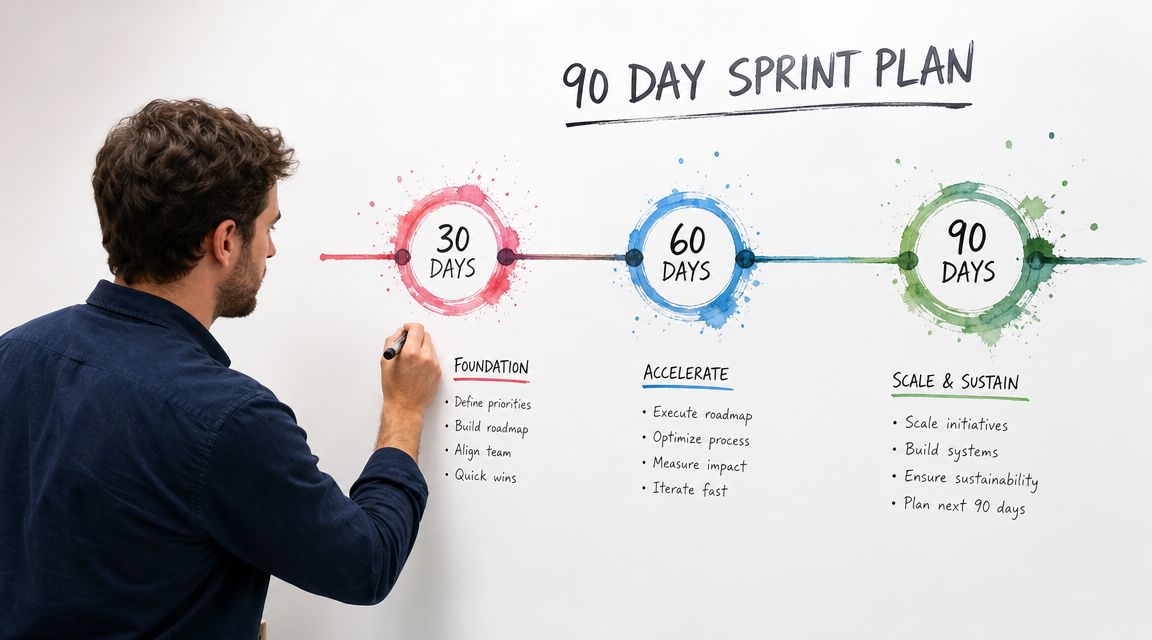
Days 1 to 30 assess and plan
The first month is about getting the current state legible. That means naming owners, forcing decisions, and building a realistic backlog.
Key activities:
Form the working group
Include the CEO or COO, technology lead, security owner if you have one, finance, and legal counsel where IP or data exposure matters.Run the internal readiness assessment
Score the five key domains and identify Critical Technology Elements tied to product value and continuity.Map the top risks
Separate what presents a real danger from what is merely untidy.Build the remediation backlog
Use the valuation-versus-effort lens, not engineering preference.Set a weekly operating cadence
Diligence readiness dies when it becomes a side project with no owner.
Days 31 to 60 remediate and document
Month two is where most of the value protection happens. This is not the time for giant rebuilds. It's the time for high-confidence improvements and disciplined evidence gathering.
A practical middle sprint often looks like this:
| Focus area | What leadership should push through |
|---|---|
| Control fixes | Tighten access, clean up permissions, confirm backups and incident materials, close obvious governance gaps |
| Knowledge transfer | Reduce dependence on key individuals through documentation, paired ownership, and recorded walkthroughs |
| IP and vendor cleanup | Collect assignment agreements, review contractor terms, organize licensing records, confirm critical vendor contracts and renewals |
| System clarity | Finalize architecture diagrams, integration maps, data flow views, and service ownership lists |
| Data room buildout | Start loading the room in a buyer-friendly structure instead of waiting until the last minute |
Buyers don't need every issue solved in 90 days. They need proof that leadership can identify risk, act on it, and explain the remaining exposure without hand-waving.
Days 61 to 90 package and rehearse
The final month is about confidence. By now, the work should be visible enough that you can present it cleanly.
Use this phase to:
Finalize the Tech and Ops memo
Make sure it reflects the current state, not an aspirational one.Complete the data room
Remove duplicates, stale artifacts, and contradictory drafts.Prepare management answers
The CEO, CTO-equivalent, security lead, and finance lead should all answer basic diligence questions consistently.Test the story
Have someone uninvolved review the room and memo. If they can't understand your platform and risks quickly, a buyer won't either.Document what remains open
Open items are fine if they are controlled, owned, and scheduled.
Why a 90-day sprint is defensible
There's a useful lesson from acquisition modeling here. The Aerospace Corporation built a statistical model using NASA TechPort project data to estimate the probability of moving from one TRL to another within a given time, based on project start TRL, end TRL, and elapsed time. That matters because it gives acquisition teams a numerical basis for schedule risk and technology maturation planning instead of relying only on expert judgment, as described in this paper on statistical modeling of TRL advancement.
You don't need to replicate that model for a commercial deal. The lesson is simpler. Maturity moves over time, and disciplined planning beats hopeful opinion.
A 90-day program works because it creates evidence of motion. Buyers can live with some unfinished work. They struggle with drift, denial, and chaos. If your plan produces clearer ownership, better artifacts, tighter controls, and a rehearsed management narrative, you've already changed the deal dynamic.
Common Pitfalls That Kill Deals and How to Avoid Them
Some deal problems aren't accidents. They're decisions leaders delayed because the business was busy and the issue felt containable.
Then diligence puts a spotlight on them.
The hidden security issue
A company knows there was a prior incident, but leadership treats it as old news because operations recovered and no one wants to reopen the pain. The buyer asks a routine question about security events, and the answer gets awkward.
The problem isn't just the incident. It's that management looked selective with the truth. Once that happens, every later answer gets discounted.
The fix is straightforward. Disclose material issues early, explain what changed, and show evidence that the control environment is stronger now.
The hero developer problem
A founder-led business has one engineer who understands the billing logic, two major integrations, and half the release process. Everyone knows this is unhealthy. Nobody fixes it because that person keeps saving the day.
A buyer sees that and immediately worries about continuity, control, and transition cost. If the person leaves after close, the acquirer may inherit a puzzle they can't solve quickly.
The answer isn't to pretend the person isn't important. It's to reduce the concentration of knowledge before diligence starts. Documentation, paired ownership, recorded walkthroughs, and role clarity matter more here than another sprint of feature work.
If one person holds the map, the buyer doesn't see a strong team. They see a hostage situation with good intentions.
The messy IP file
The product is valuable. The codebase is real. Revenue depends on it. Then legal diligence discovers that contractor paperwork is inconsistent, open-source usage hasn't been reviewed properly, or parts of the AI workflow were assembled without clear thinking about ownership and usage rights.
Under such circumstances, confidence can evaporate. Buyers can work through imperfection. They hate ambiguity around what they are buying.
The way to avoid this is boring and absolutely worth it. Clean assignment agreements. Clear contractor terms. A sensible inventory of third-party components. Leadership that can explain what is proprietary, what is licensed, and what obligations come with it.
What better looks like
Better is not a flawless platform and a spotless record. Better is a business that enters diligence without flinching.
Leadership answers hard questions directly. The data room supports the answers. Weaknesses are known, prioritized, and paired with a visible plan. Core technology value is easy to understand. Key-person exposure is reduced. Security posture is explainable. IP ownership is disciplined enough to withstand scrutiny.
That preparation helps in a sale process, but it also helps if no deal happens. You still get a calmer operating model, fewer surprises, cleaner ownership, and better board-level visibility.
If you're heading toward diligence, investor scrutiny, or a sale process and the technology story still feels too fuzzy, CTO Input can help you make the current reality legible, prioritize what protects value, and build a practical plan for technology readiness for acquisition without derailing the business.