
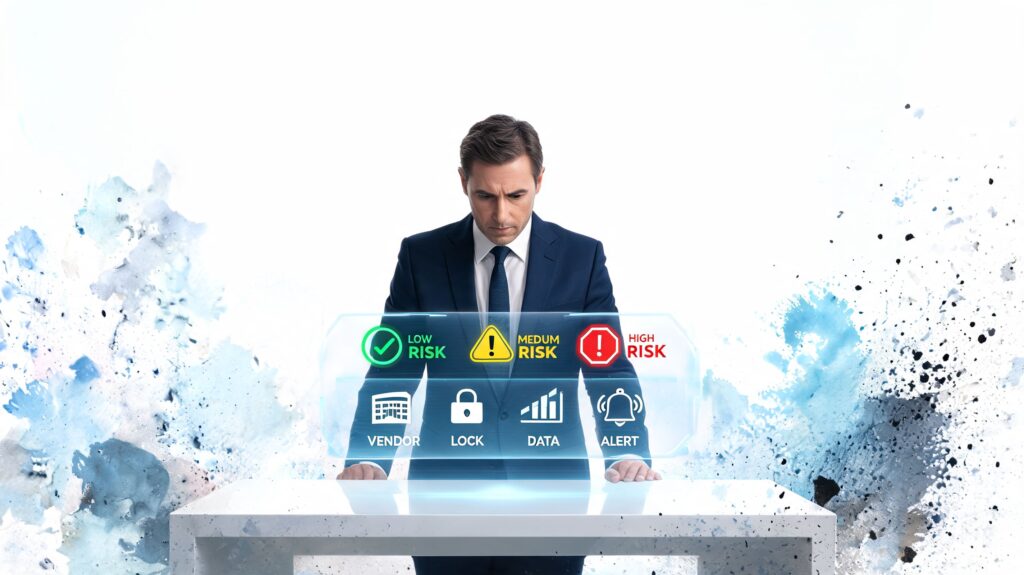
If you're in the boardroom and someone asks three basic questions, what are our biggest technology risks, who owns them, and what are we doing about them, the wrong answer isn't silence. It's a pile of technical detail that still doesn't tell leadership whether the business is exposed.
That's where many executives are right now. The reporting exists. The confidence doesn't. Cyber, vendor dependence, data handling, access sprawl, AI use, legacy systems. All of it is discussed. Very little of it is governed in a way that helps leaders make decisions quickly and defend them later.
This is the core issue with technology risk management for executives. It isn't a compliance exercise. It isn't an IT hygiene project. It's a leadership operating system for making sure technology doesn't become the thing that slows growth, weakens control, or creates public embarrassment.
Most companies don't need more frameworks. They need clearer decision rights, a tighter meeting cadence, and board-ready reporting that translates risk into business consequences.
Why Vague Answers on Tech Risk Are No Longer Defensible
You can spot the problem in about five minutes.
A board member asks about ransomware exposure. The CIO talks about endpoint tooling. Someone else asks about customer data. The response drifts into systems and architecture. A question comes up about vendor risk, and the room learns there isn't a single current list of critical vendors, what they access, or who reviews them. The meeting moves on, but nobody feels better.
That isn't a communication problem. It's a governance problem.

What leaders are actually feeling
Senior leaders usually aren't asking for technical perfection. They're asking for control.
They want to know whether a known weakness is being accepted on purpose or ignored by accident. They want to know whether an outside vendor can disrupt operations. They want to know whether a security incident would be handled with a practiced response or a late-night scramble.
When those answers stay vague, three business consequences show up fast:
- Board confidence drops because oversight starts to feel ceremonial rather than real.
- Execution slows because teams keep escalating the same unresolved risks without clear authority to decide.
- Liability rises because leaders can't show that risks were identified, assigned, and managed with discipline.
Practical rule: If your leadership team can't explain a material technology risk in plain business language, you don't have visibility yet.
This pressure is justified. Nearly 75% of enterprises experienced at least one critical risk event in the past year, and firms without board-level visibility into risk programs were 20% more likely to suffer six or more such events, according to Secureframe's summary of enterprise risk management findings.
Why this gets worse as organizations grow
At a smaller stage, a business can survive on trust, institutional memory, and a few strong operators. Growth breaks that model.
More systems get connected. More vendors touch sensitive data. More people need privileged access. More reporting depends on data moving correctly across tools that were never designed together. Then diligence, insurers, regulators, major customers, or the board start asking sharper questions.
That's when leadership learns an uncomfortable truth. The company doesn't lack effort. It lacks a decision system.
Vague reporting is often a symptom. The real disease is fuzzy ownership.
If you are the CEO, COO, board chair, or executive director, this is now your issue. Not because you need to become a security expert, but because unclear governance around technology risk turns into slower decisions, weaker resilience, and harder-to-defend oversight.
What Technology Risk Management Really Is
Technology risk management is executive work. It is the discipline of deciding where the business is exposed through systems, data, vendors, access, and day-to-day operations, then assigning ownership and forcing decisions before those exposures become incidents.
For a senior team, the core questions are straightforward:
- What could disrupt the business
- What matters most
- Who owns each risk
- What are we doing about it
- What are we choosing to tolerate
The fifth question is where real leadership shows up. Every company accepts some level of technology risk. The issue is whether that tolerance is explicit, documented, and tied to business priorities, or whether it is drifting by default.
Technology risk management operates on similar principles to capital allocation. Strong leaders set priorities, define decision rights, track results, and approve where controlled risk is acceptable. The same discipline belongs here.
Some exposures should be reduced because they threaten revenue, operations, customer trust, or deal velocity. Some can be transferred through insurance, contract terms, or vendor commitments. Some are acceptable for now because the cost to fix them exceeds the likely business impact. All three are valid choices. None should be invisible.
That is why this work belongs at the executive table.
According to the NCSU Poole College of Management report on top risks for boards and executives, executives rank cyber threats as the number one near-term operational risk. The implication is clear. Technology risk sits with the risks that can interrupt execution, weaken margins, and force leadership into reactive decisions.
What sits inside the category
Technology risk is wider than cybersecurity, and that distinction matters for governance.
It usually includes:
- Cybersecurity risk involving attacks, unauthorized access, and weak protection of systems
- Data risk involving privacy, quality, retention, and uncontrolled spread of sensitive information
- Vendor risk involving third parties that host systems, process data, or create single points of failure
- Operational technology risk involving outages, brittle integrations, legacy systems, and key-person dependence
- AI and automation risk involving unclear oversight, weak controls, or decisions no one can explain with confidence
Many leadership teams split these issues across IT, security, legal, compliance, finance, and operations, then assume the whole picture is covered. It usually is not. Risks fall between functions. Ownership gets blurred. Reporting turns descriptive instead of decisive.
This is the gap most framework-heavy guides miss. The fundamental operating system is governance: who decides, how often they review, what gets escalated, and what evidence supports the decision. If you do not have a dedicated risk team, that operating rhythm matters more than another policy set. A practical technology governance consulting approach for lean leadership teams should help you set those decision rights and cadences without creating bureaucracy.
The executive lens is different
Technical teams track findings, vulnerabilities, tool coverage, and remediation queues. Executives should ask different questions. What is the exposure? What is the business consequence? Who is accountable? How fast are we reducing material risk? Which risks are being accepted, and by whom?
Those are governance questions.
When executives ask for technology risk management, they are asking whether the company can make sound trade-offs under pressure and defend those choices later.
That is also the practical value behind outside support such as Risk advisory: Strengthen Your Business. Good advisory work does not just identify issues. It helps leadership turn scattered technical concerns into owned decisions, review routines, and a reporting structure the board can use.
A Simple Governance Model to Restore Control
Complex risk frameworks often fail in mid-market and scaling organizations for one simple reason. They assume dedicated infrastructure that many businesses don't have.
No chief risk officer. No mature GRC stack. No standing risk committee with deep internal support. Just a leadership team, a busy IT lead, a few operational owners, and a board that wants clearer answers.
That doesn't mean you need to stay informal. It means you need a minimum viable governance model.
The case for this is strong. A survey covered in MIT Sloan Management Review on whether leaders are flying blind on risk found that in over 40% of organizations with implemented ERM, the outputs are not used for strategic planning. That is the heart of the problem. Risk identification without operating rhythm changes very little.
Start with three governance moves
You do not need a giant program first. You need a system that leadership will use.
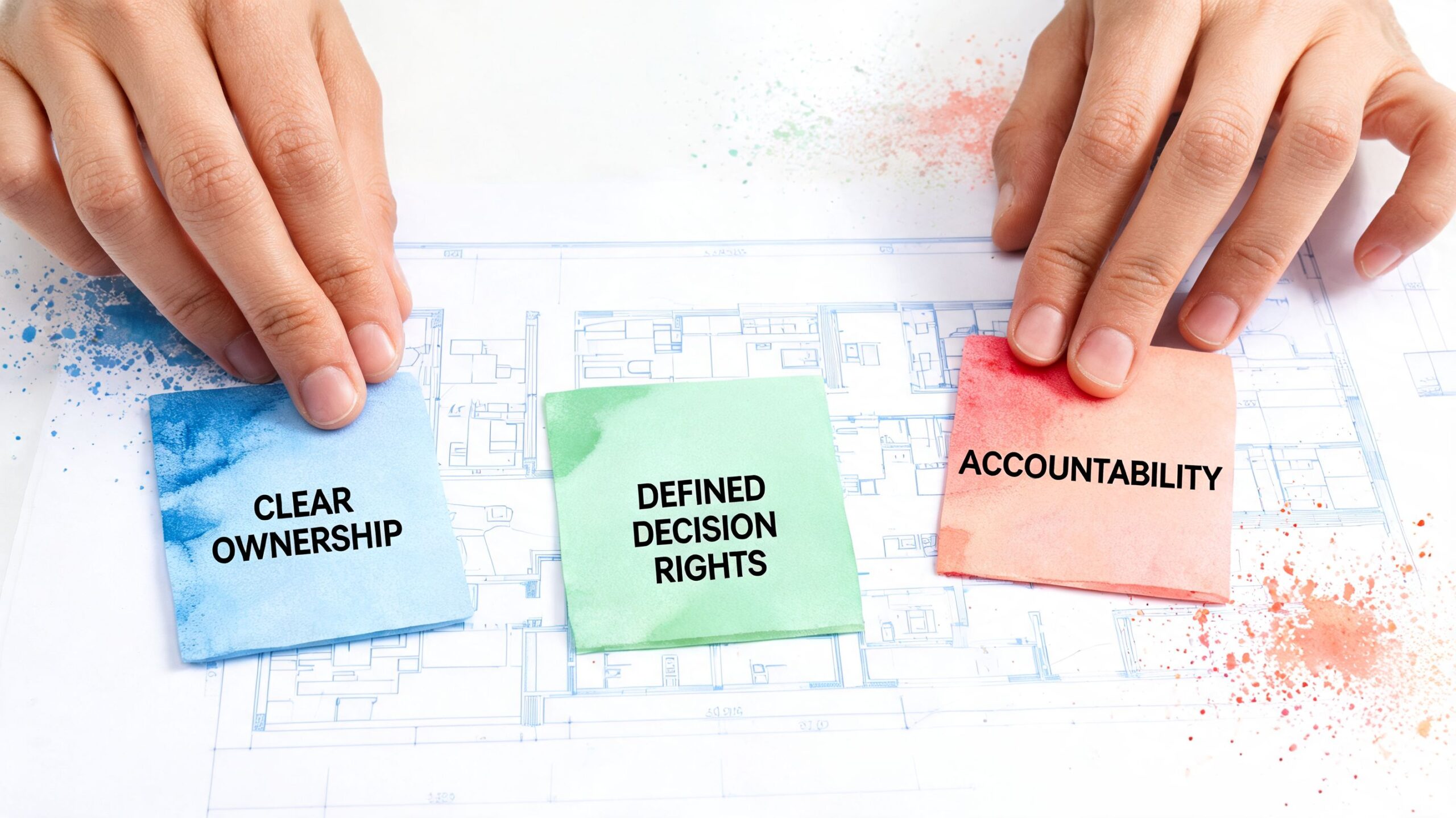
Name a single accountable owner for each major risk domain
Not ten people. Not "IT and compliance." One owner.
Vendor risk should have a named executive owner. Data governance should have a named owner. Identity and access should have a named owner. Incident readiness should have a named owner. That person can work cross-functionally, but accountability cannot be shared into invisibility.
If ownership is fuzzy, delays are predictable. Every exception sits in limbo. Every dependency becomes someone else's problem.
Define decision rights before the next exception appears
Many risk failures aren't failures of detection. They are failures of authority.
Who can approve a vendor exception? Who decides whether an unsupported system stays in production? Who signs off when a business unit wants a new AI tool that touches internal data? Who can accept temporary risk, and for how long?
Write that down. Keep it short. If a decision requires the COO, CFO, CIO, legal, and a committee every time, the business will drift into unmanaged risk because the path to a decision is too slow.
Clear decision rights reduce both chaos and politics. People stop arguing about process and start resolving exposure.
Establish a fixed review cadence
A weekly or bi-weekly risk review beats a quarterly presentation deck every time.
The meeting should be short. It should track open risks, aging actions, decisions needed, and blocked work. It should not become a technical status meeting. The point is to move risk into action.
A simple agenda works:
- Review top changes in the risk register or issue list
- Confirm overdue actions and who is accountable
- Escalate decisions that need executive approval
- Track incidents and near misses for patterns, not blame
- Close resolved items so the list stays credible
Keep the operating system lean
The best governance model for a growing company is the one leaders will maintain under pressure.
That usually means:
| Governance element | What good looks like |
|---|---|
| Risk owners | One named owner per major domain |
| Escalation path | Clear route from issue to executive decision |
| Meeting cadence | Weekly or bi-weekly review with action tracking |
| Reporting | Simple dashboard tied to business impact |
| Exceptions | Time-bound approvals with visible owners |
You do not need enterprise theater. You need inspectable control.
If your organization needs outside structure while this is being built, Risk advisory: Strengthen Your Business offers a useful external perspective on strengthening governance and resilience. For executive technology oversight specifically, technology governance consulting is the kind of support model that helps translate board concern into ownership, cadence, and follow-through.
What this changes in practice
With this model in place, risk stops being a topic that appears only when something goes wrong.
Leaders know who owns what. Teams know where to escalate. Exceptions don't disappear into email. The board receives fewer technical details and better decisions.
That's the point. Governance is not paperwork. It is the mechanism that turns visibility into action.
Four High-Impact Controls to Implement Now
Once governance is in place, you need a short list of controls that reduce exposure quickly. Not fifty initiatives. Four.
These are the controls I would push first in a business that wants stronger oversight without building a giant security bureaucracy.
Vendor risk control
Most organizations underestimate vendor risk because the cost is hidden until something breaks.
A critical SaaS platform goes down. A contractor retains access after the engagement ends. A vendor stores sensitive data in a way no one internally reviewed. Suddenly a third party is controlling your uptime, your data exposure, or both.
The first move is simple. Build a critical vendor list.
That list should identify which vendors matter to operations, which hold sensitive data, which have privileged access, and who inside the business owns the relationship. If no internal owner exists, that vendor is already a risk.
Use practical categories, not theory:
- Business critical vendors whose failure would disrupt core operations
- Data-handling vendors that store, process, or transmit sensitive information
- Privileged vendors with technical or administrative access
- Concentrated vendors where too much depends on one relationship
Then review contract terms, renewal dates, security obligations, and exit feasibility. Executives don't need every detail. They do need to know where the business is overexposed.
Identity and access control
Access sprawl is one of the fastest ways to lose control.
People change roles. Contractors come and go. Teams share accounts because it's convenient. Privileged access accumulates because nobody wants to break workflows. Over time, the business loses a basic truth: who can access what, and why.
Fixing this starts with a very blunt question. Which users have privileged access to critical systems, and is each case still justified?
A practical cleanup often starts with:
- Inventory privileged accounts across cloud platforms, finance systems, admin tools, and core business apps
- Remove stale access tied to departed staff, old vendors, or outdated roles
- Require stronger controls for high-impact access, especially where approvals or sensitive data are involved
- Assign business signoff so access isn't just an IT decision
Many executive teams often become complacent. They assume access is a technical housekeeping issue. It isn't. Access defines who can move money, view data, change configurations, and create operational damage.
A lot of security incidents are really governance failures around who was allowed to do what.
Data governance control
If you don't know where sensitive data lives, you don't control the business risk attached to it.
For many organizations, customer information, employee records, financial data, legal material, and operational reporting are spread across cloud drives, line-of-business apps, collaboration tools, and vendor platforms. Different teams create local workarounds. Copies multiply. Ownership fades.
The first goal is not elegance. It is visibility.
Start by identifying your most sensitive data categories and mapping where they live, who uses them, and who owns the rules around them. Keep the taxonomy tight. You are not building an academic model. You are trying to stop unmanaged spread.
Visibility changes prioritization. According to Trend Micro's executive guidance on managing cyber risk, enhanced visibility into critical assets and threats is the top priority for 25% of cyber defenders, and achieving 90% asset coverage can reduce breach costs by an estimated 30%. The executive lesson is straightforward. You cannot protect what you have not made visible.
Incident readiness control
Most companies say they have an incident response plan. Fewer have a response they could execute calmly on a bad day.
A real readiness posture means leaders know who makes which decisions when systems are down, data may be exposed, or a critical vendor is compromised. It means legal, communications, operations, and technology are aligned before the event.
Don't start with a giant document. Start with a tested one-page decision map.
That map should answer:
- Who declares an incident
- Who leads the response
- Who communicates internally and externally
- Who has authority to engage outside counsel, forensics, or insurers
- How the board is updated
Then run a tabletop exercise. Pick a realistic scenario and make the leaders talk through what they would do in sequence. You don't need theater. You need to expose confusion before a real event does.
Why these four first
These controls work because they tie directly to business exposure.
Vendor risk addresses hidden dependency. Identity and access addresses misuse and privilege drift. Data governance addresses uncontrolled spread of sensitive information. Incident readiness addresses decision failure under stress.
If you fix these four areas with discipline, you'll reduce a large share of the chaos that makes executive oversight feel fragile.
The Metrics That Matter for Board-Level Reporting
Most board reporting on cyber and technology risk is too detailed to guide a decision and too vague to reassure anyone.
Patch counts, alert volumes, blocked attempts, tool coverage, scan outputs. Those may help operators. They don't help directors or executives decide whether the organization is getting safer, where the concentration of risk sits, or whether management is acting with urgency.
Useful board-level reporting does three things. It shows exposure, it shows movement, and it shows business consequence.
Translate risk into business language
The most effective way to do that is to connect technical issues to financial and operational impact.
As explained in this discussion of financial cyber risk metrics and Annualized Loss Expectancy, boards respond to metrics that translate technical issues into business impact. The article points to frameworks like FAIR and notes that showing an unpatched critical vulnerability can raise Annualized Loss Expectancy by over $2 million for a mid-market firm changes the conversation. It stops being a ticket in a queue. It becomes a business decision.
That doesn't mean every board deck needs a dense quantitative model. It means your reporting should answer, "So what?"
Executive Dashboard for Technology Risk
A small dashboard is better than a crowded one. Keep it focused on indicators that leadership can understand and use.
| Key Risk Indicator (KRI) | What It Measures | Why It Matters to Executives | Target Example |
|---|---|---|---|
| Critical risk owner coverage | Whether each material risk has a named accountable owner | Shows whether oversight is real or still fuzzy | Every material risk has one owner |
| Aging of high-priority remediation items | How long important fixes or decisions remain open | Reveals drift, bottlenecks, and weak follow-through | No overdue high-priority items without escalation |
| Privileged access concentration | How many people and third parties hold elevated access | Indicates misuse risk and control discipline | Access is limited, reviewed, and justified |
| Critical vendor concentration | Where operations or sensitive data depend too heavily on a small set of vendors | Helps leadership see dependency and resilience exposure | Concentration is visible and contingency exists |
| Incident readiness status | Whether response roles, escalation paths, and communications are current and tested | Tells the board whether the business will respond calmly under pressure | Plan current and exercised |
| Annualized Loss Expectancy for top scenarios | Estimated annualized business impact of selected risk scenarios | Translates technical exposure into financial terms | Trending down after mitigation work |
The target examples are intentionally qualitative. The point is clarity, not fake precision.
If you need a practical model for shaping the presentation itself, this board-ready cybersecurity reporting template is the right type of structure. Keep it concise, trend-based, and tied to decisions.
What to stop reporting
Executives should push back on metrics that create motion without insight.
Common examples include:
- Raw vulnerability counts without context about asset criticality
- Security tool activity that doesn't connect to business exposure
- Long control checklists with no indication of what is at risk
- Incident tallies without severity, pattern, or operational consequence
Good reporting doesn't prove that teams are busy. It proves that leadership understands the exposure and is acting on it.
A better board conversation
A strong update sounds like this: Here are the top three risk scenarios, here is the business impact if they materialize, here is who owns them, here is what changed since last review, and here are the decisions needed now.
That is what directors can govern. Everything else belongs in supporting detail, not in the headline.
Your Actionable 30/90-Day Plan for Technology Risk
Most executive teams delay this work because it feels bigger than it is. It isn't.
You do not need to solve every technology risk in a quarter. You need to establish enough structure that the organization stops relying on guesswork, memory, and heroics.
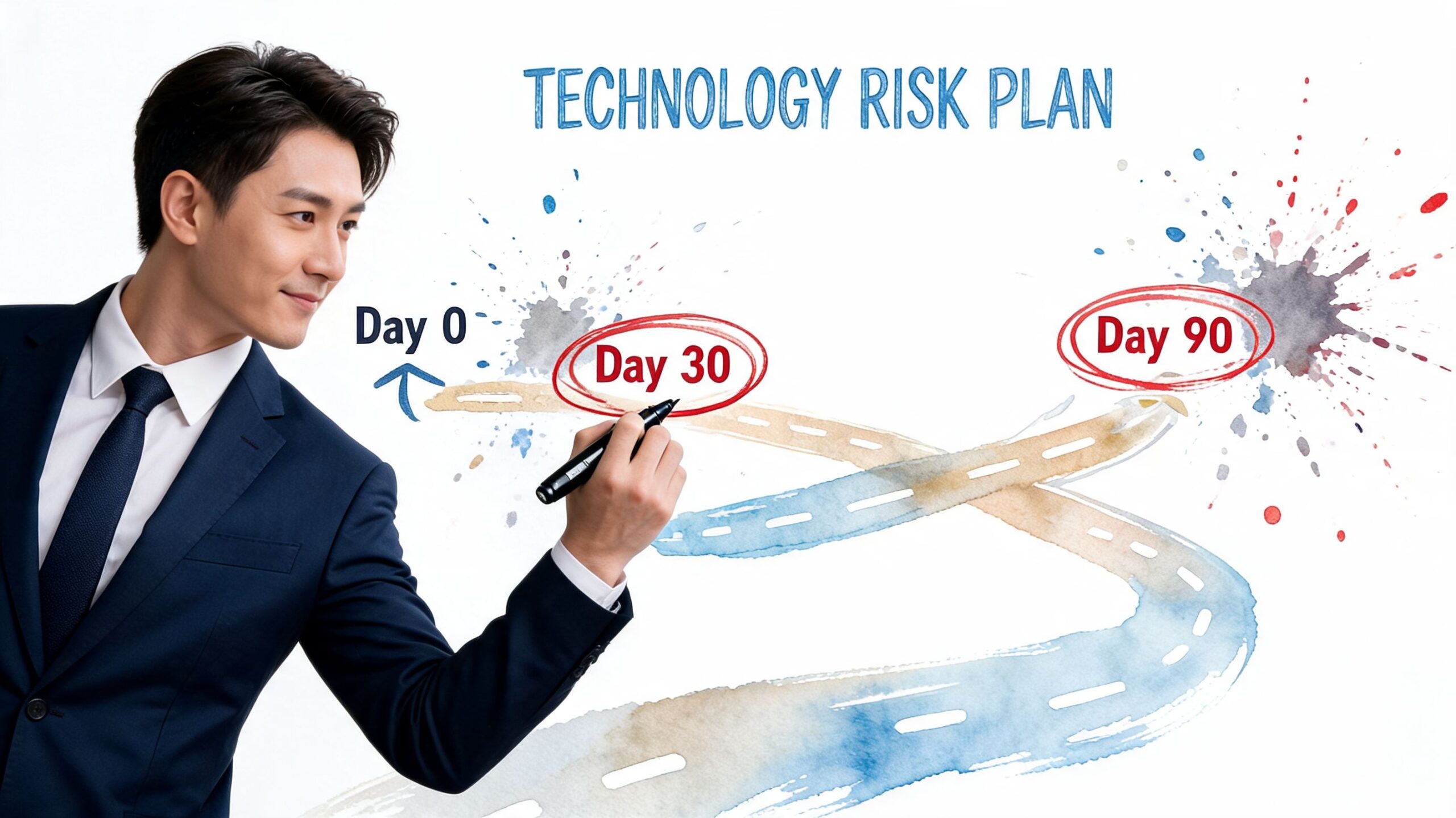
In the first 30 days
Focus on visibility and control.
Start by naming owners for the handful of risk domains that matter most in your environment. In many organizations that means vendor risk, data governance, access management, incident readiness, and one major operational platform dependency.
Then establish a standing risk review cadence. Weekly works well when the environment is messy. Bi-weekly can work if ownership is already fairly clear. Keep the attendee list tight and make decisions in the room.
Your first 30 days should also include a compact discovery effort:
- Build the critical vendor list and assign internal owners
- Identify systems that matter most to operations, revenue, reporting, or sensitive data
- Pull the current privileged access list for those systems
- Locate your incident response materials and confirm whether they are current, usable, and owned
- Document open exceptions that leadership has implicitly accepted without formal review
If this feels harder than it should, that's useful information. It tells you where visibility is weak. A more detailed guide to improving that view is in this article on technology risk visibility.
By day 90
Now you are embedding the operating rhythm.
Run your first tabletop exercise with leaders who would be involved in an incident. Review what broke in the exercise, not just what was written in the plan. Update roles and escalation paths based on real confusion, not assumptions.
Launch the first board-facing dashboard, even if it is still simple. Include named owners, top open issues, aging actions, and a small number of exposure indicators. Do not wait for perfect data. Build the habit first.
You should also complete at least one visible control improvement in each of these areas:
| Area | What done looks like by day 90 |
|---|---|
| Vendor risk | Critical vendor inventory is current and owned |
| Access control | A first privileged access cleanup is completed |
| Data governance | Sensitive data categories and owners are identified |
| Incident readiness | Tabletop exercise completed and actions assigned |
What to avoid during this phase
Leaders often derail the first quarter by overbuilding.
Avoid these traps:
- Buying a platform before you define ownership
- Delegating everything to IT when the core issues sit across operations, legal, finance, and business units
- Waiting for perfect inventory data before creating accountability
- Treating the board update as a presentation project instead of a management discipline
One option for organizations that need executive-level help setting this up is CTO Input, which provides fractional technology and security leadership focused on ownership, governance cadence, and board-defensible risk oversight. That kind of support is useful when the business needs control before it is ready for a full-time senior hire.
The goal at 90 days isn't maturity. It's traction. Leadership should know the main exposures, who owns them, how they're being reviewed, and which decisions can't be postponed.
What Calm and Defensible Oversight Looks Like
You know this is working when the conversation changes.
The board asks about technology risk and gets a crisp answer. Here are the top exposures. Here is the trend. Here is who owns each one. Here is what was done since the last review. Here is where management is accepting risk on purpose. Here is the next decision we need from you.
No jargon cloud. No status hunt. No false comfort.
The operating feel is different
Inside the business, the change is just as noticeable.
A vendor issue appears and the owner is clear. An access exception comes up and the approval path already exists. A near-miss occurs and leaders respond through a defined chain instead of improvising over text messages and late-night calls.
Teams stop spending so much time asking who decides. They spend more time reducing exposure.
Calm oversight isn't passive. It's structured enough that people can move quickly without creating new risk every week.
What leaders gain
When governance is working, executives regain three things that are usually in short supply.
- Speed because decisions no longer wait for informal consensus
- Confidence because reporting connects risk to business impact
- Defensibility because accepted risks, mitigation choices, and overdue actions are visible and owned
That doesn't mean incidents disappear. It means the organization stops being surprised by problems it should have seen coming.
The standard to aim for
You are not trying to create a perfect risk environment. You are trying to create one that is legible, governed, and resilient.
That is enough to improve board confidence, strengthen insurer and diligence conversations, and make day-to-day execution less fragile. It is also enough to reveal where the business has outgrown informal technology leadership.
If your answers on technology risk still feel too vague, don't ask for a better slide deck. Fix the operating system behind it.
If your team is tired of vague answers, repeated fire drills, and unclear ownership around technology and security, CTO Input can help you make the current reality legible and install a calmer operating rhythm. A clarity call is a practical next step if you need to see the top risks, the ownership gaps, and the first moves that would restore control.