

SEO title: A Technology Roadmap That Works
Meta description: A practical guide to building a technology roadmap that works by clarifying ownership, decision rights, and review cadence so execution becomes predictable.
Slug: technology-roadmap-that-works
Growth makes technology problems harder to hide.
You see it when every leadership meeting turns into a priority fight. One vendor is pitching a platform change. Another team wants automation. Security wants cleanup. Operations wants stability. Finance wants clearer answers on spend. Everyone has a point, and nothing feels settled.
That is usually the moment a senior leader asks for a technology roadmap.
Good instinct. Wrong first assumption.
What most companies need is not a prettier plan. They need an operating system for decisions. If ownership is fuzzy, if vendors shape priorities, and if nobody reviews progress in a disciplined way, the roadmap becomes a graphic that explains why work is late.
An effective technology roadmap does three things. It makes current reality visible. It creates a clear way to choose what matters. It installs a cadence so decisions stick and progress is inspectable.
Your Technology Plan Feels Like Hope with a Logo
You probably know the pattern.
The COO asks why a project slipped. The IT lead says another dependency moved. The finance lead asks who approved the extra software. A board member asks whether cyber risk is improving or just getting reported more often. The CEO hears three different versions of the same issue and still cannot get a straight answer on what happens next.

That is not a planning problem in the narrow sense. It is a control problem.
The symptoms are usually obvious:
- Everything is urgent: Teams treat incoming requests as equal because nobody trusts the priority list.
- Vendors drive the agenda: The roadmap starts to reflect whichever platform was sold most recently.
- Ownership is implied, not explicit: Work gets discussed in groups, but no single person can answer for outcome, timeline, and tradeoffs.
- Status takes too long to find: Leaders spend more time hunting for updates than removing blockers.
- Teams get stuck in rework: Decisions get revisited because they were never made cleanly the first time.
The cost shows up in business terms
This kind of mess slows growth.
It drags out launches, weakens reporting, and creates budget waste that leadership can feel even when they cannot yet quantify it precisely. It also erodes confidence. Once the board senses that technology spend is active but not governed, every update gets harder.
A lot of organizations try to respond with more planning sessions. That usually makes the situation worse.
More meetings do not create clarity when the same questions remain unanswered. Who owns this. Who decides this. What tradeoff are we making. What will be done by when. What risk comes down because of it.
A roadmap should reduce decision friction. If it creates more negotiation, it is not doing its job.
Why leaders feel trapped
Senior operators often end up carrying this personally.
They know the business cannot keep running on heroic effort. They also know they do not want to overcorrect with bureaucracy. So they tolerate an uncomfortable middle ground where technology is “managed” but never quite under control.
That is why so many roadmap efforts disappoint. The document looks organized. The operating reality does not.
Why Your Technology Roadmap Fails Before It Starts
Most roadmap efforts fail before the first milestone because leaders treat the roadmap like a project list.
It is not.
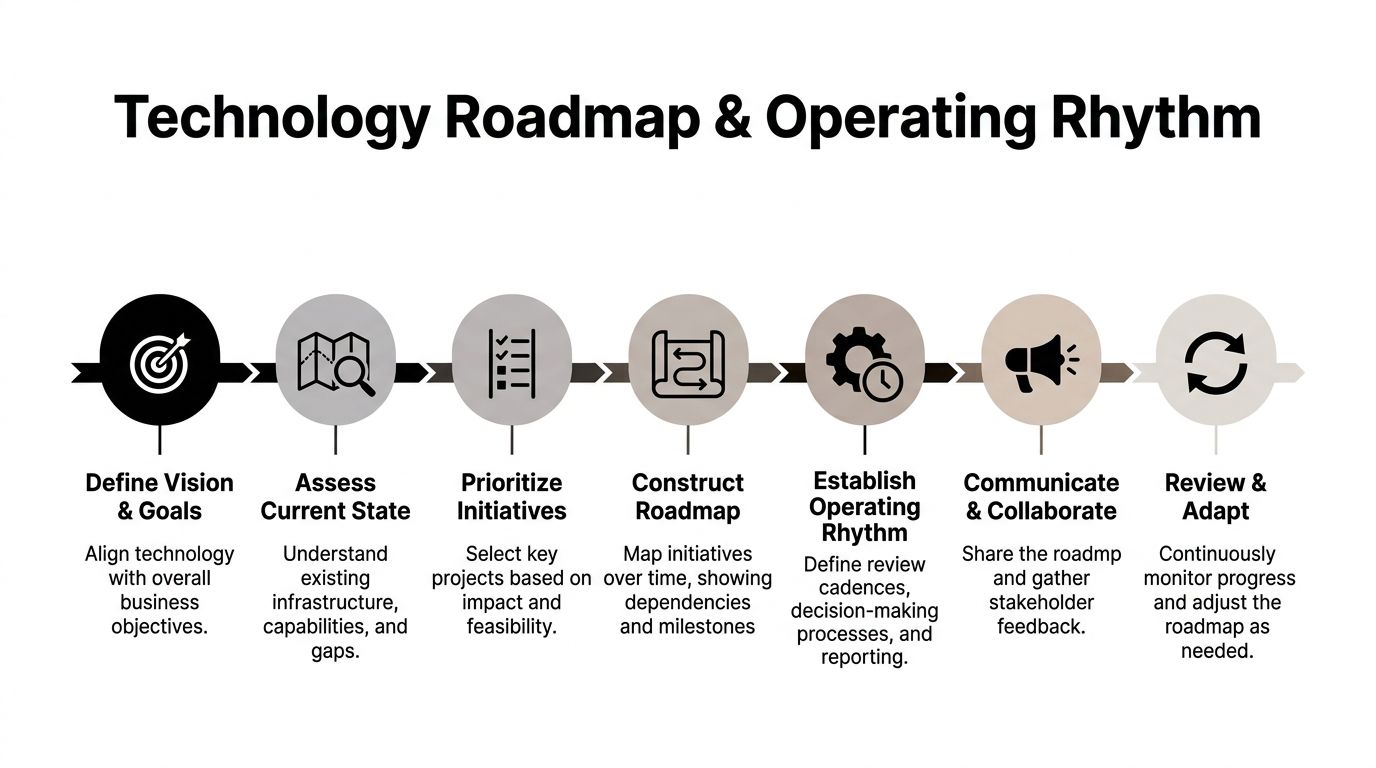
A real technology roadmap is part plan, part governance mechanism, and part operating rhythm. If you build only the document, but not the system around it, the plan dies the first time priorities collide.
The hidden failure is execution misalignment
The hard truth is that many technology problems are not really about the technology.
Practitioner experience shows 70% of tech projects fail not due to technology gaps but execution misalignment. Surveys indicate 62% of executives cite poor decision-making and ownership as top barriers to success (Gartner on information technology leadership issues).
That should change how you think about a technology roadmap.
If ownership is vague, work stalls between teams.
If decision rights are unclear, every tradeoff becomes political.
If there is no rhythm for review, the roadmap goes stale almost immediately.
Static plans fail in dynamic businesses
A roadmap built as a one-time artifact usually contains some version of these mistakes:
- It confuses activity with progress: Long lists of initiatives create motion without proving business value.
- It locks dates too early: Teams commit to timing before dependencies, staffing, or risk are clear.
- It ignores who decides: Initiatives are listed, but nobody documents which leader can approve, defer, or stop them.
- It skips vendor discipline: Software renewals, implementation partners, and platform dependencies sit outside the roadmap, even though they shape delivery.
- It has no review cadence: By the time leadership revisits the plan, side decisions have already rewritten it.
The missing layer is the operating system
Most roadmap advice gets this part wrong.
It focuses on categories, timelines, and graphics. Fine. Those help. But they do not solve the core operational problem. A roadmap sticks when it includes three things:
| Element | What it does | What happens without it |
|---|---|---|
| Clear ownership | Gives one person accountability for outcome | Work floats across teams |
| Decision rights | Makes tradeoffs fast and explicit | Meetings replace decisions |
| Operating cadence | Keeps the roadmap current and inspectable | Firefighting takes over |
A senior leader should be able to look at the roadmap and answer five questions quickly:
- What are we doing now
- What is next
- What are we intentionally not doing yet
- Who owns each item
- When do we review and adjust
If those answers are fuzzy, the roadmap is decoration.
The document matters less than the discipline around it.
That is why strong technology leadership spends less time polishing the roadmap and more time designing the conditions under which it can survive contact with reality.
First Make Reality Legible
Before you set priorities, make the current state visible.
Not “visible” in the usual technical sense. I mean visible to leadership. A CEO or COO should be able to see which systems matter, who owns them, what vendors are involved, and where decisions are made.
That starts with an As-Is audit.
A proven 6-phase methodology for crafting a technology roadmap begins with a candid 'As-Is' audit to map current systems and identify sources of chaos like fuzzy ownership. Organizations that skip this phase see initiative failure rates as high as 70-95% (Dart on fixing a failing IT strategy roadmap).
Start with business-critical systems
Do not begin with architecture diagrams. Begin with the business.
List the systems that directly support revenue, operations, customer service, reporting, security, and compliance. For most organizations that means some mix of Microsoft 365, Google Workspace, Salesforce, HubSpot, NetSuite, QuickBooks, Jira, Asana, Azure, AWS, payroll systems, HR platforms, identity tools, endpoint management, and backup or recovery platforms.
For each one, document:
- What business process it supports
- Who uses it
- Which team depends on it most
- Who pays for it
- Which vendor or partner influences it
This is not glamorous work. It is foundational.
Name the owner, not just the user
A lot of companies confuse heavy use with ownership.
The sales team may live in Salesforce. That does not answer who owns roadmap decisions around integrations, data quality, admin controls, contract terms, or process design. The same problem appears with finance systems, collaboration platforms, and security tooling.
Use a simple ownership lens:
- Business owner: The leader accountable for the business outcome the system supports
- Technical owner: The person accountable for uptime, changes, integrations, and risk
- Budget owner: The person who approves spend and renewals
- Decision owner: The person who can break a tie when priorities conflict
Sometimes one person holds several of these roles. Often nobody clearly holds the last one. That is where roadmap friction starts.
Document how decisions occur
Ask questions like these:
- When a team wants a new tool, who approves it
- When two departments want conflicting changes, who decides
- When a vendor contract renews, who reviews whether it still fits
- When an incident hits, who has authority to change priorities
- When a project slips, who owns recovery
The answers are often inconsistent. Good. That is useful. You are trying to expose where the operating model leaks.
If decisions happen through side conversations, your roadmap will always lose to whoever escalates fastest.
Build one usable source of truth
You do not need fancy software for this first pass.
A structured spreadsheet, a Notion workspace, a Confluence page, or a lightweight Airtable can work if the information is current and owned. The tool matters far less than the discipline of maintaining one shared record.
A practical audit sheet usually includes:
| Field | Why it matters |
|---|---|
| System or vendor name | Creates a full inventory |
| Business function served | Ties tech to business value |
| Primary owner | Makes accountability visible |
| Critical dependencies | Surfaces delivery risk |
| Renewal or review point | Prevents passive vendor drift |
| Current pain points | Captures operational friction |
| Decision notes | Shows where ambiguity exists |
What this changes immediately
An As-Is audit does not solve the roadmap by itself.
It does something more important first. It turns confusion into a map. Once leaders can see where ownership is missing, where vendors have too much influence, and where systems overlap, they can stop arguing in abstractions.
That is the moment your technology roadmap starts to become real.
Install a Framework for Clear Decisions
Once reality is legible, the next trap appears fast. Every discovered issue looks important.
At this point, most leadership teams relapse into politics. The loudest department argues for urgency. A recent outage distorts judgment. A vendor creates artificial deadlines. A founder pushes a pet project. The roadmap fills up again.
You need a decision framework that can survive pressure.
Effective roadmaps use a weighted prioritization matrix (e.g., strategic fit 30%, ROI 30%, risk inverse 20%, adoption 20%) to track initiatives. Following this rigor, organizations see a 30% higher rate of on-time business objective delivery, according to Gartner (Softjourn on crafting a thorough software development roadmap).
Use one scoring lens across all requests
The weighted model above works because it forces tradeoffs into the open.
Here is the practical version:
Strategic fit at 30%
Does this initiative directly support a stated business goal, not just a local preference?Value or ROI at 30%
Will this improve margin, reduce wasted effort, strengthen customer experience, or avoid meaningful cost?Risk inverse at 20%
Lower complexity and lower implementation risk should score better. Difficult work is not bad, but it should earn its place.Adoption or operational impact at 20%
Will people use it, and will it remove friction from day-to-day work?
This is not about pretending scoring is perfect. It is about making decisions consistent.
A simple prioritization matrix
Use the weighted score first. Then pressure-test the result with a plain-language matrix leadership can understand in one glance.
| Category | Description | Action |
|---|---|---|
| Quick Wins | High value, lower delivery risk | Do now |
| Strategic Bets | High value, higher complexity | Plan carefully and stage |
| Incremental Improvements | Useful but not decisive | Batch or schedule later |
| Time Sinks | Low value, high friction | Decline or stop |
Here, a lot of unproductive work gets exposed.
Some initiatives look attractive because they are visible, not because they matter. A dashboard redesign, a platform migration with no business case, or a duplicate tool expansion may sound productive. When evaluated objectively, they often slide into “not now” or “no.”
For leaders dealing with constant tradeoff pressure, a clear decision-making framework is often more valuable than another planning template.
How to make saying no easier
Most organizations do not struggle because they cannot identify good ideas.
They struggle because nobody wants to reject requests cleanly. So instead, they defer them vaguely. That creates false hope, political churn, and a roadmap stuffed with soft commitments.
Use these rules:
- Reject with criteria, not personality: “This does not rank high enough against current strategic priorities” lands better than “we do not like it.”
- Separate revisit from approval: “Review next quarter” is not the same as “yes.”
- Score vendor proposals the same way as internal ideas: A polished sales process should not bypass governance.
- Keep a parking lot, not a graveyard: Preserve ideas worth revisiting, but mark them clearly as inactive.
A roadmap gets stronger every time leadership says a clear no to work that does not belong.
Watch for false urgency
A final warning.
Not every risk item is urgent, and not every urgent request is strategic. Teams often confuse recency with importance. One disruption can flood the roadmap with reactionary work.
The scoring framework gives you a calmer response. It lets you act decisively without treating every interruption like strategy.
That discipline is what turns a technology roadmap into a leadership tool instead of a negotiation surface.
Design the Roadmap and Its Operating Rhythm
Now build the roadmap itself.
Keep it simple enough for executives to use and structured enough for teams to operate from. If the roadmap only makes sense after a long verbal explanation, it is too complicated.
A standard structure works for a reason. A standard technology roadmap divides work into short-term (0-6 months), mid-term (6-18 months), and long-term (18+ months) horizons. This structure helps deliver quantifiable outcomes, with 80% of Fortune 500 firms adopting similar practices (CTOx on technology roadmap design).
Build around three horizons
The three-horizon model works because it separates immediate execution from medium-term coordination and long-term direction.
Short term for relief and control
Use the 0-6 month horizon for work that reduces pain quickly.
That usually includes simplification, risk reduction, key ownership fixes, renewal decisions, access cleanup, reporting improvements, and a few delivery items that remove obvious operational drag. This horizon demonstrates the roadmap's practicality.
A short-term item should answer:
- what changes
- who owns it
- what dependency matters most
- how leadership will know it is done
Mid term for integration and capability
Use the 6-18 month horizon for work that needs planning across teams.
This might include system integrations, workflow redesign, major vendor transitions, security control maturity, reporting redesign, or platform standardization. These are the initiatives that often fail when leaders skip decision rights and cadence.
Long term for direction, not fantasy
Use the 18+ month horizon carefully.
This is for strategic direction, capability bets, and major architecture or operating model shifts. Keep this section lighter. Over-detailing the far future gives people false confidence and creates rigidity.
Put ownership directly on the roadmap
Do not keep accountability in a separate spreadsheet nobody reads.
Every roadmap item should show, at minimum:
| Roadmap field | What to include |
|---|---|
| Initiative | Plain-English name |
| Business outcome | What improves for the business |
| Primary owner | One accountable person |
| Supporting teams | Who must help |
| Time horizon | Short, mid, or long term |
| Decision point | What leadership must approve next |
| Status | Not started, active, blocked, complete |
A simple RACI model also helps when cross-functional work gets messy:
- Responsible means the person or team doing the work
- Accountable means the single owner who answers for the outcome
- Consulted means people whose input is needed before decisions
- Informed means people who need updates but do not decide
If you skip the “Accountable” role, shared ownership will become no ownership.
Install the operating rhythm
This is the part that keeps the roadmap alive.
Without cadence, the roadmap becomes historical fiction. Teams make side decisions, urgent work slips in, and leadership discovers the true plan only after deadlines move.
Weekly tactical review
This is for operators, delivery leads, and owners.
The meeting should be short and disciplined. Review active items, blockers, dependencies, and near-term decisions. Do not let it become a general status theater session. If a conversation needs problem-solving, assign it offline with an owner and due date.
A good weekly review answers:
- what moved this week
- what is blocked
- what decision is needed
- what risk increased
- what changed in next steps
Quarterly strategic review
This is for senior leadership.
Step back from task activity and ask whether the roadmap still reflects business priorities. Review vendor posture, spend concentration, delivery confidence, risk exposure, and whether any initiative should stop, accelerate, or change owner.
This is also where the long-term horizon gets updated.
A roadmap review is not a ceremony. It is where leadership proves that priorities are governed, not guessed.
Use one roadmap, not competing versions
Different audiences can see different levels of detail. They should not see different truths.
The board version should be simpler than the delivery version. The executive version should emphasize outcomes, risks, and decisions. The operating version should include task-level movement. But all of them should come from one underlying roadmap.
If you are using a dedicated tool, fine. If you are using slides backed by a tracker, also fine. Some organizations use Smartsheet, Jira, Monday.com, Airtable, or Notion. Others use a practical 12-month planning template, including the technology roadmap resources published by CTO Input, as a starting structure for allocating money, time, and leadership attention.
The tool is not the system.
The rhythm is the system.
Create Momentum and Board-Defensible Reporting
A roadmap becomes credible when people can feel the difference.
The first signs are operational, not cosmetic. Fewer priority fights. Cleaner ownership. Faster answers. Less vendor drift. Teams stop reopening settled decisions. Leaders spend less time chasing status.
That early momentum matters because it gives the roadmap political durability.
Ship a few visible wins first
Do not wait for a large transformation to prove the model.
Pick a small number of actions that reduce friction or risk quickly. Examples include consolidating overlapping tools, assigning formal ownership to a neglected system, cleaning up approval paths for new software, tightening one recurring reporting process, or resolving a long-delayed vendor decision.
These moves matter because they show that the roadmap is changing how the business runs, not just how it talks.
Translate activity into board language
Boards do not need a technical diary.
They need a concise view of whether risk is falling, whether major dependencies are understood, whether spend is governed, and whether the organization is delivering against stated priorities.
A useful board-facing roadmap report usually includes:
- Top initiatives and current status
- Material decisions made since the last review
- Key risks and whether they are rising or falling
- Owner accountability for delayed or blocked items
- Vendor or concentration concerns that need oversight
- What leadership expects next quarter
Here, a defined reporting cadence matters. If you need a cleaner structure for board-level communication, this guide on board and risk committee cyber reporting cadence is a useful companion.
Why shared timelines change outcomes
Industry-scale roadmaps show what happens when shared direction and disciplined coordination are taken seriously.
The International Technology Roadmap for Semiconductors, launched in 1998, drove over 70% of global semiconductor revenue growth by aligning thousands of experts on shared timelines, demonstrating a roadmap's power to de-risk development and coordinate an entire industry (IEEE guide to technology roadmaps).
Your organization is not the semiconductor industry. The lesson still applies.
When people work from shared timelines, shared assumptions, and explicit milestones, execution gets less fragile. Risk becomes easier to see earlier. Leaders can intervene before drift turns into failure.
What good reporting feels like
When the system is working, board conversations get shorter and better.
Instead of “Can someone explain what is happening in IT,” the discussion becomes “We approved these priorities, these owners are accountable, these risks are moving in the right direction, and these are the next decisions.”
That shift is bigger than it sounds.
It means technology stops being a source of narrative confusion and starts becoming a governed part of operating the business.
The board does not want more detail. It wants cleaner evidence that the business is in control.
Move from Chaos to a Calm Execution System
A technology roadmap is not the slide. It is not the Gantt chart. It is not the annual planning workshop.
It is a management system.
When it works, current reality is legible. Ownership is explicit. Decisions follow a clear lens. Reviews happen on purpose. Reporting reflects business outcomes, not technical noise.
That is what senior leaders want.
They want to know who owns the work, which decisions are made, what changed, what slipped, what risk came down, and what needs leadership attention next. They want fewer surprises and less dependency on heroics.
If your current technology roadmap feels vague, overstuffed, or detached from execution, the answer is not to redesign the document again. The answer is to tighten the operating system around it.
That means auditing the current state, setting decision rights, scoring initiatives objectively, and installing a review cadence that people respect.
For leaders working through growth, scrutiny, or operational drag, that shift is often the difference between constant coordination tax and a calmer business. If you want a broader lens on how this fits into leadership and execution, this piece on technology strategy is the next logical read.
If your roadmap still feels like hope with a logo, CTO Input can help you make the work, the owners, and the next decisions legible so execution becomes calmer and easier to trust.