
A technology roadmap for a civil rights organization isn't just a technical document; it's a plan to move your operations from reactive chaos to a calm, mission-aligned strategy. It’s about pinpointing the real bottlenecks in your daily work—like client intake or funder reporting—and building a believable path to modernize your systems, secure sensitive data, and give your staff back their time.
Moving from Constant Fire Drills to a Coherent Strategy
It’s the start of another week, and a familiar, frantic call echoes through the office. A critical funder report is due, but the program data is scattered across three different spreadsheets and an old case management system nobody trusts. Your team is now burning hours manually pulling and cleaning numbers—time that should be spent on the front lines with advocates and clients.

This recurring chaos is a tough reality for leaders in many justice-focused organizations. Your mission has grown, but the systems propping it up haven't kept pace. Most have grown fast on top of fragile systems, and the operational burden has become a quiet source of stress for everyone.
This guide is a practical field memo for leaders who need to build a calm, believable modernization path. We’ll show you how to create a simple plan that turns your technology from a constant risk into a reliable backbone that supports advocates, protects vulnerable communities, and provides clear evidence of your impact. It all starts by diagnosing the real chokepoints in your daily work.
Key Takeaways for Your Technology Roadmap
- Start with Your Mission, Not Tools: A roadmap must directly solve operational pain points—client intake nightmares, broken referral handoffs, reporting fire drills—that get in the way of your mission.
- Prioritize People-Centered Wins: Every tech initiative should aim to reduce confusion, prevent missed deadlines, or stop harmful outcomes for the very people navigating the justice system.
- Build a Defensible Plan: Create a one-to-three-year modernization path you can confidently present to your board, funders, and community partners.
- Focus on Governance and Discipline: Your plan must establish clear decision-making roles, simple metrics, and an unwavering commitment to data quality and privacy-by-design.
The Pillars of a Mission-First Technology Roadmap
Before diving into building a technology roadmap, let's get on the same page about what a good one actually is. For a civil rights organization, this isn't some shiny shopping list for new software. It's a thoughtful, disciplined plan that weaves your systems, data, and security directly into the fabric of your mission—serving and protecting vulnerable communities.
The whole point is to smooth out the operational bumps in the road, lock down sensitive information, and ultimately, give your frontline partners more leverage to make a difference. This kind of roadmap comes from understanding how the work actually gets done. It means pinpointing the real-world bottlenecks—those painful processes like client intake, partner referral handoffs, or the dreaded grant reporting—and then rolling out practical, sequenced fixes.
A smart roadmap starts with quick wins to build momentum and earn your team's trust. From there, you can lay out a credible 12 to 24-month modernization plan that your board and funders will feel confident backing.
A critical piece of this puzzle is establishing solid cybersecurity risk assessment frameworks to safeguard the very people you're fighting for. The table below breaks down the essential pillars that hold this entire strategic approach together.
Pillars of a Mission-Driven Technology Roadmap
This table breaks down the core components of a strategic technology roadmap, outlining the key focus, critical activities, and desired outcome for each pillar.
| Pillar | Focus Area | Key Activities | Desired Outcome |
|---|---|---|---|
| Stakeholder Discovery | Understanding user needs and operational friction. | Interviews, surveys, workflow mapping, and journey mapping with staff, clients, and partners. | A clear, human-centered picture of daily challenges and opportunities. |
| Risk & Privacy Assessment | Protecting sensitive constituent and operational data. | Threat modeling, data audits, and reviewing privacy policies against legal standards. | A prioritized list of security gaps and a concrete data governance plan. |
| Goals & KPIs | Defining what success looks like in measurable terms. | Linking tech improvements to strategic goals (e.g., "reduce intake time by 25%"). | Clear, quantifiable targets that prove the ROI of technology investments. |
| Prioritized Initiatives | Sequencing projects based on impact, effort, and mission alignment. | Backlog grooming, creating a 90-day plan, and developing a 12-24 month roadmap. | A realistic, phased implementation plan that builds momentum over time. |
| Budget & Staffing | Allocating the necessary resources for success. | Total Cost of Ownership (TCO) analysis, skills gap assessment, and funding proposals. | A fully-funded and adequately staffed plan supported by leadership. |
| Measurement & Governance | Ensuring the roadmap stays relevant and on track. | Quarterly reviews, KPI tracking, and establishing a tech steering committee. | A living roadmap that adapts to the organization's evolving needs. |
By building your roadmap on these foundational pillars, you move technology from a background cost center to a core engine for your mission. It becomes a strategic asset that directly fuels your ability to advocate, protect, and empower.
Uncovering Your Real-World Operational Needs
A powerful technology roadmap doesn't start with a shopping list of software. It starts with listening. Before you can chart a credible path forward, you need an honest, unvarnished map of where your organization stands right now. This isn't a sterile technical audit; it’s about understanding the lived experiences of your staff, your partners, and the communities you exist to serve.

The first step is to map out your most critical workflows from a human perspective. Don’t ask, “What software do we use for intake?” Ask, “How does a person in crisis actually find us, and what is every single step they go through?”
Get small, cross-functional groups of staff together in a room with a whiteboard. I'm talking about paralegals, program coordinators, and administrative assistants—the people in the trenches, not just department heads. Your goal is to surface all the unwritten rules and unofficial workarounds that have become daily practice.
Finding the Real Bottlenecks
What you're really looking for are the friction points—the operational snags that create drag on your mission. These are the places where things consistently break down, leading to staff burnout and, worse, negative outcomes for the people you’re trying to help.
Get the conversation started with questions like these:
- Intake & Triage: Where do potential clients get stuck or just give up? How much time is wasted manually re-entering the same information into three different spreadsheets?
- Referral Handoffs: When you pass a case to a partner, what does that "warm handoff" actually look like? Where does client information get lost or delayed along the way?
- Documentation Burden: How many clicks, logins, and folders does it take for a case manager to see a client's complete file? Are critical documents living in personal email inboxes or insecure cloud drives?
- Reporting Fire Drills: What specific data points are the absolute worst to pull for your most important grant reports? How many hours of manual work does it take to prove your impact?
This exercise will give you a clear-eyed inventory of your systems, your data silos, and your operational weaknesses. More importantly, it shines a bright light on the real-world privacy and security risks you're carrying every day.
This isn't just about efficiency. It's about risk. When a staff member uses their personal email to send a sensitive client document because the official system is too clunky, that's not a training problem—it's a systems problem that exposes your organization and your clients to significant harm.
This is especially true for groups handling sensitive data related to immigration status, incarceration records, or youth advocacy. Civil rights organizations are prime targets for bad actors, making strong encryption not just a "best practice," but an essential shield for your staff and the communities you defend. Often, making this shift means bringing in outside expertise. For many civil rights groups, partnering with managed IT services for nonprofits provides the structure and proactive support needed to finally move past the "fire drills" and adopt a more strategic approach.
From Discovery to Diagnosis
The output of this whole process shouldn't be a long report that collects dust on a shelf. It should be a prioritized list of specific, named problems, grounded in the daily reality of your team. This diagnosis is the foundation for your entire technology roadmap for your civil rights organization.
For example, a vague goal like "improve data management" becomes a concrete problem statement: "Our inability to share client updates securely with pro bono attorneys delays case progress by an average of two weeks and creates unacceptable privacy risks."
With that kind of clarity, you can stop talking about abstract "tech solutions" and start building a plan to solve the real problems holding your mission back. This is how you move from a state of quiet operational stress to one of reliable, mission-aligned strength.
How to Prioritize Initiatives and Secure Quick Wins
Once you’ve done the hard work of diagnosing your operational pain points, the urge to fix everything at once can be overwhelming. Don't fall into that trap. Trying to boil the ocean is a classic recipe for burnout and a roadmap that goes nowhere. The real key to building momentum is to sequence your initiatives so you can deliver real, measurable value—fast.
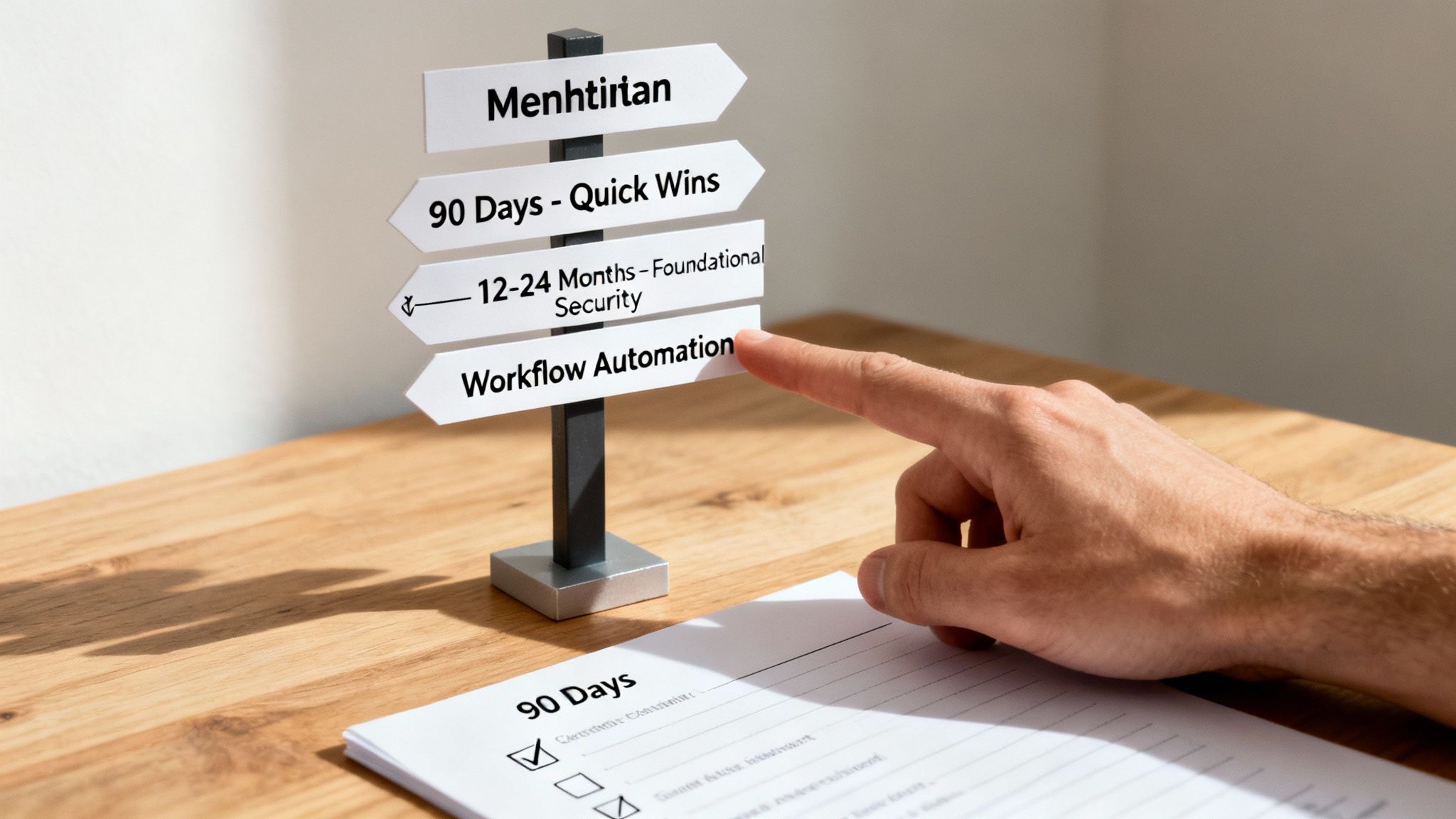
The first 90 days are critical. They should be laser-focused on "quick wins." These are small, tangible improvements that reduce immediate risks and, most importantly, free up your staff's time.
The Power of the First 90 Days
Think of these initial victories as building credibility for the bigger plan. They aren't about massive tech overhauls; they're about proving that change is possible and that this roadmap is grounded in reality, not just wishful thinking.
Here are a few examples of powerful quick wins I’ve seen work:
- Standardize Secure File Sharing: Get sensitive client documents out of personal email inboxes. Pick one secure file-sharing tool, train everyone on it, and make it policy. This single step immediately lowers a major security risk.
- Deploy a Password Manager: This is a no-brainer. Rolling out an organization-wide password manager is a low-cost, high-impact way to strengthen your security posture overnight.
- Clean One Critical Dataset: Instead of trying to fix all your data, pick the one dataset that matters most right now—like the one for your big upcoming funder report. Getting that one report right is a huge win.
These early successes generate the political capital and staff buy-in you'll absolutely need for the more complex projects down the line. They show everyone that the technology roadmap for civil rights organizations is a practical tool, not just an abstract exercise.
Structuring Your 12-24 Month Plan
With some momentum from your quick wins, you can start grouping larger initiatives into strategic themes for the next one to two years. This helps organize the work and makes it much easier to explain the plan’s logic to your board and funders.
A well-structured roadmap groups individual projects into larger, mission-aligned themes. This shifts the conversation from "Are we buying a new CRM?" to "How are we strengthening our data integrity to better serve our community?"
For justice-focused organizations, these themes often fall into a few common buckets:
- Foundational Security: This moves beyond the quick wins into more structural improvements. Think about things like implementing multi-factor authentication (MFA) across all systems or conducting your first formal cybersecurity risk assessment.
- Data Integrity and Centralization: This is where the big projects live. It could be standardizing your case management system or building a central data warehouse to finally get a single source of truth for your program outcomes.
- Workflow Automation: The focus here is on killing repetitive, manual tasks. A fantastic starting point is often client intake—automating data entry and initial eligibility screening can free up staff for more complex, human-centered work.
- Digital Accessibility: This involves a commitment to ensuring all your public-facing digital properties, from your website to client portals, are genuinely usable by people with disabilities. This isn't just a compliance box to check; it’s a core equity principle.
Accessibility, in particular, cannot be an afterthought, especially given the digital divide. Consider that 25% of Hispanics and 22% of American Indians and Alaska Natives rely solely on smartphones for internet access. If your client portal doesn't work well on a phone or with a screen reader, you are unintentionally shutting out the very communities you exist to serve. The Leadership Conference on Civil and Human Rights' website has more great data on how tech access impacts equity.
Defining Success in Plain Language
For every single initiative, big or small, you have to define what success looks like in simple, human terms. Ditch the technical jargon. Instead of saying you're "deploying an RPA solution," frame it as a direct benefit to your team and mission.
This simple practice makes the entire roadmap tangible and defensible. When you can state your goals clearly, you build a powerful case for investment and change.
For instance, success could be defined as:
- "Staff will spend 5 fewer hours per week on manual data entry for grant reporting."
- "Our client intake process will be fully accessible via screen reader and navigable by keyboard alone."
- "We will reduce the time it takes to securely share a case file with a partner agency from 24 hours to 10 minutes."
Bringing Your Plan to Life with Execution and Governance
A great roadmap is more than a wish list. It’s a commitment, and that commitment needs a real plan to back it up. This is the part where strategy gets its hands dirty, demanding a practical look at budgeting, staffing, and, most critically, how you'll keep the plan on track over time.

Without this discipline, even the most thoughtful roadmap ends up collecting dust on a shelf—a monument to good intentions instead of a tool for driving change. The real goal here is to build your organization's muscle for managing technology strategically, not just lurching from one crisis to the next.
Budgeting Beyond the Sticker Price
Crafting a realistic budget means looking far beyond the initial software license fee. For every single initiative on your roadmap, you have to dig into the total cost of ownership.
Think about it in these buckets:
- One-Time Implementation Costs: This is what you'll pay for outside help with setup, migrating data from old systems, and getting your team trained. Be honest with yourself here—moving off a creaky old database almost always requires specialized skills you don't have on staff.
- Ongoing Subscription Fees: These are your predictable, recurring costs for cloud-based software (SaaS). Simple enough, but they add up.
- Internal Staff Time: This is the hidden cost everyone forgets. Your team's hours spent managing, maintaining, and supporting a new system are a very real expense. Don't leave it out.
A budget that breaks down these costs is far more credible when you take it to your board or a funder. It proves you've considered the long-term commitment, not just the upfront price tag.
Assigning Ownership That Actually Works
Tech projects die on the vine when no one truly owns them. The key here is that the owner shouldn't automatically be your IT manager or the one person who "knows computers." Ownership has to be tied to the mission outcome.
The person who should own the new case management system is the program director whose team relies on it every single day. The technology is there to serve the program, so the program leader needs the authority to make the calls.
This logic applies everywhere. Your communications director should own the website accessibility project. Your development director is the natural owner for the fundraising platform upgrade. This setup keeps decisions grounded in the real-world needs of your staff. If you don't have a senior tech leader to coach these owners, bringing in a fractional CTO for mentorship can be a game-changer. For a deeper look at this structure, check out our guide on IT strategy and governance consulting.
Setting Up a Simple Governance Rhythm
Finally, your roadmap needs a simple, consistent process to keep it alive and relevant. This is your defense against the "shiny new toy" syndrome and the endless stream of requests that feel urgent but aren't actually important.
Pull together a small technology steering committee with key department heads—the same project owners you just identified. This group should meet monthly with a no-nonsense agenda:
- Check progress against the roadmap’s goals. Are we on track?
- Clear any roadblocks holding up active projects.
- Confirm priorities for the next quarter.
This regular meeting creates accountability. It turns the roadmap from a static document into a living, breathing management tool. This disciplined approach is especially crucial for civil rights work. A solid governance process ensures every tech decision you make helps close justice gaps, not make them wider.
Measuring What Matters to Adapt and Improve
So you’ve built your roadmap. Great. But a roadmap isn't something you frame and hang on the wall—it's a living document, a compass you have to recalibrate constantly. Its real value comes from measuring your progress against the goals you set and having the courage to adapt when the data tells a different story.
This isn't about chasing vanity metrics. It's about drawing a straight line from every dollar and hour you invest in technology back to the real-world problems you identified in the first place.
If the biggest issue was staff burnout from mind-numbing grant reporting, your most important metric is simple: a reduction in the hours spent preparing funder reports. If your top concern was the constant threat of exposing sensitive client data, you should be tracking the percentage of staff who have completed mandatory security training and are actively using a password manager.
Turning Evidence into Action
These metrics become your new source of truth. You have to track them consistently—monthly or quarterly works well—and share them openly with leadership, the board, and especially your staff. This isn't just about accountability; it’s about building trust.
When your team sees that a new system genuinely saved them ten hours during the last reporting cycle, you earn the credibility you'll need for the next big project on the roadmap. For more on this, check out our guide on improving funder reporting for legal nonprofits.
This data-driven approach also acts as your early warning system. It tells you when something is off track long before it becomes a crisis.
- Is that new case management tool failing to get traction? The adoption numbers will tell you.
- Is a redesigned workflow not saving the time you projected? The metrics will force a conversation about why.
This feedback loop completely changes the nature of conversations about technology. They shift from being based on opinions and anecdotes to being grounded in cold, hard evidence.
Your metrics answer the most important question your board and funders will ever ask: "Is this investment making a difference?" When you can show a 40% reduction in time spent on administrative tasks, you're not just talking about efficiency; you're talking about giving hundreds of staff hours back to the mission itself.
Aligning Metrics with Mission Outcomes
Choosing what to measure is an art. The trick is to avoid getting bogged down in purely technical data like server uptime or page load speed. Sure, those things matter to your IT vendor, but they mean very little to a program director or a foundation officer.
Your scoreboard should directly reflect the operational headaches you set out to solve.
| Problem Statement | What to Measure (KPI) | Why It Matters |
|---|---|---|
| "Our client intake process is a major bottleneck." | Average time from initial contact to the first meaningful action (e.g., caseworker assignment). | This directly measures your organization's responsiveness and the client's experience. |
| "We risk data breaches due to inconsistent security practices." | Percentage of devices with encryption enabled; number of failed phishing tests. | This provides a concrete, measurable indicator of how much stronger your security posture is. |
| "Referral handoffs to partners are slow and unreliable." | Average time to confirm a partner agency has received and accepted a referral. | This quantifies the friction in your ecosystem and shows where you can improve coordination. |
This kind of discipline ensures your systems are always evolving to better support the work you do. It’s the same forward-thinking approach we're seeing in the public sector. Government bodies are using new tech like AI and cloud analytics to achieve huge gains—including 80% faster service delivery by using tools like ChatGPT with strict security guardrails in place.
As detailed in this snapshot on AI and civil rights, a focused technology plan with the right metrics can produce truly substantial results.
Ultimately, a well-measured roadmap gives you the confidence to adapt, the evidence to justify investment, and the clarity to keep moving forward.
Frequently Asked Questions
When it comes to building a technology roadmap, the same questions pop up time and again from leaders at civil rights organizations. Let's tackle the big ones head-on: budget, staffing, and getting everyone on board.
"We Have No Budget for This. What Do We Do?"
This is, without a doubt, the most common and understandable hurdle. The trick is to stop thinking of this as "a new cost" and start talking about it as "an investment to stop a bigger loss."
The truth is, your organization is already paying a steep price for inefficient systems. It's a "chaos tax" paid in wasted staff time, missed funding opportunities from messy data, and the ever-present risk of a security incident.
Start small by showing what that chaos is costing you right now.
- Calculate the cost of one recurring fire drill. Think about the last big funder report. How many staff hours went into pulling those numbers? Multiply those hours by your average staff cost. That's a real, tangible number you can point to.
- Frame your first ask around reducing risk. A small, one-time investment in a password manager and some security training is infinitely cheaper than the financial and reputational cost of a single data breach involving sensitive community information.
When you present the problem in terms of current losses and future risks, it becomes clear that doing nothing is actually the most expensive option. The goal isn't to find a massive new budget overnight. It's to justify a modest, targeted investment that pays for itself by cutting out waste and protecting your mission.
"Our Team Is Already Overwhelmed. How Can We Add This?"
You can't. And you shouldn't.
A successful roadmap has to reduce the burden on your team, not add to it. The entire point of this process is to free up capacity by getting rid of the frustrating, manual work that leads directly to burnout.
Your plan absolutely must begin with initiatives that give time back to your staff, ideally within the first 90 days.
A roadmap that asks a burned-out team to do more work is a roadmap that's already failed. The first step must be to create breathing room. Focus on a quick win that automates one painful, recurring task to prove that this effort will make their lives easier, not harder.
This could be as simple as automating a data-entry task or standardizing a document template that everyone struggles with. By delivering a tangible win that makes someone's week less stressful, you build the trust and energy needed for the bigger changes ahead. This isn't "one more thing"; it's the beginning of a calmer, more effective way of working.
"How Do I Get My Board and Leadership to Buy In?"
Board members and executive leaders respond to clear, defensible plans that connect directly to the mission and the organization's financial stability. You'll want to avoid getting bogged down in technical jargon. Instead, present this roadmap as a core part of your strategy for managing risk and ensuring sustainable impact.
I've found it helps to structure your presentation around three key themes:
- Mission Enablement: Show a direct line from a technology improvement to your mission. For example, explain how a better intake system directly translates to serving more people or cutting down harmful delays for clients.
- Risk Mitigation: Quantify the risks you're currently carrying, but use plain language. "We have sensitive client data stored in insecure locations, which exposes both our organization and our community to significant harm."
- Financial Prudence: Frame the budget as an investment with a clear return, not just an expense. "This investment will save an estimated 400 staff hours per year currently lost to manual reporting, allowing us to redirect that capacity to program delivery."
A well-framed argument shows that a technology roadmap for civil rights organizations isn’t just an IT project. It’s a fundamental pillar of modern, responsible leadership.
At CTO Input, we act as your fractional technology and cybersecurity leadership partner. We help mission-driven organizations move from recurring chaos to a calm, believable strategy that reduces risk, frees up staff, and proves your impact. If you're ready to build a roadmap you can defend to your board, funders, and community, let's start the conversation. Learn more about our approach.