

A technology roadmap template helps you map where your tech money, time, and attention will go over the next 12 months. A 12-month technology roadmap is simply a one-year plan for where your tech money, time, and attention will go, much like an enterprise IT roadmap. This technology roadmap connects projects and vendors to the defined Business Goals your board actually cares about: growth, margins, risk, and cash.
For mid-market CEOs, COOs, and founders, this roadmap is not a “nice to have.” It is how you stop random projects, vendor noise, and unplanned cyber spend from running the show over the next 12 months. Finance and operations need to see, in plain language, what you are funding and why.
Think of this guide as a working 12 month technology roadmap template, not theory. You can sketch your own version on a single page as you read, then refine it with your team.
The aim is simple: link technology investments to business goals, risk, and Cash Flow Projections, across four quarters, in a way your leadership team and board can support and defend. This roadmap creates a strategic plan everyone can rally behind.
What Is a 12-Month Technology Roadmap and Why Your Business Needs One
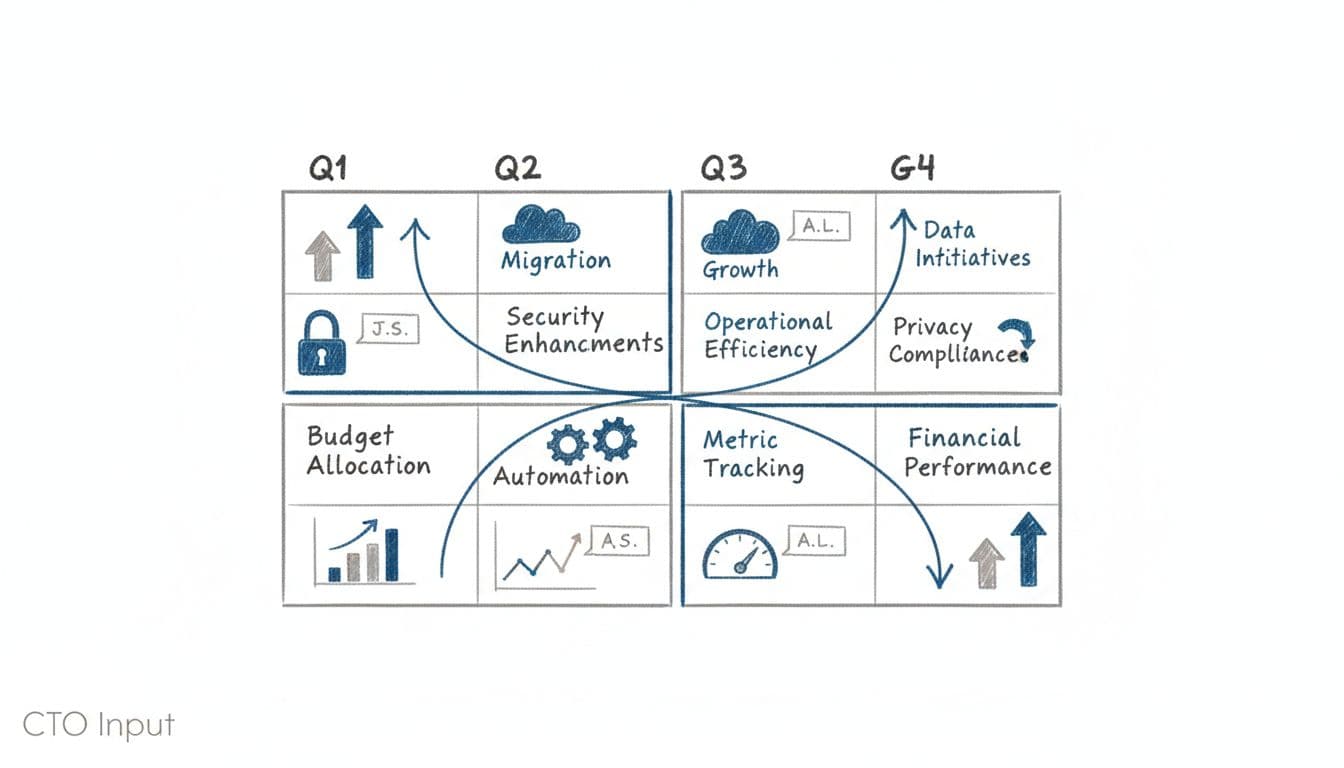
A 12-month technology roadmap is a concise one-page view, shorter than traditional long-term timeframes, of your key tech, data, and cyber initiatives for the next year. This IT roadmap shows what will happen, when it will happen, why it matters to the business, and roughly what it will cost. Easily generated using simple visual tools or displayed as a PowerPoint slide, it keeps everything accessible.
It is not a wish list. It is not your IT ticket queue. This focused project roadmap cuts through the noise and highlights the 8 to 12 initiatives that actually move revenue, margin, risk, and customer experience.
Done well, it sits beside your annual operating plan and budget. It becomes the story you tell to your board, lenders, and leadership team about how technology will support the growth plan and protect the business. For context on how structured roadmaps are used in product and tech teams, resources like Reforge’s product roadmap guide highlight the value of clear themes and timelines.
You can treat this article as a 12-month technology roadmap template. Work through it quarter by quarter and you will have a draft that fits on one page and can stand up to finance-level questions.
How a roadmap turns tech chaos into a clear story for your board
Right now, many boards hear about tech through scattered updates: a security incident here, an AI pilot there, a new SaaS contract somewhere else. It feels random.
A roadmap turns that chaos into a single story that aligns key stakeholders. On one page, your board can see:
- The main initiatives across cloud, AI, core systems, and cybersecurity
- When they land by quarter
- The business goal each item supports
- Rough spend and ownership
That makes conversations about cyber risk, AI use, and platform upgrades much easier. You are no longer reacting to the last incident. You are walking the board through a clear plan and tradeoffs that match your cash and capacity.
The key parts of a simple 12-month technology roadmap template
Keep the structure simple. The core building blocks are:
- Business goals for the year, 3 to 5 at most.
- Themes or streams, such as growth, efficiency, or risk and compliance.
- Major initiatives, not tasks, that sit under each theme.
- Timing and timeline by quarter, so everyone sees sequencing and dependencies. This project implementation timeline helps leaders anticipate resource needs.
- Budget level and ownership, who is on the hook and rough cost.
- Success metrics, 1 or 2 signals that show if it worked.
The rest of this guide walks through how to fill in each of these boxes in a way your team can actually deliver.
Step-by-Step: How to Build a 12-Month Technology Roadmap Your Team Can Deliver
The goal here is not a pretty picture. It is an effective Implementation Roadmap that finance, operations, and your IT leaders all believe.
Step 1: Tie technology work to 3 to 5 business goals for the year
Start with your core Strategic Plan, not with tools.
Pick 3 to 5 clear goals that matter this year. For example:
- Enter two new regional markets
- Improve customer retention by 5 percent
- Reduce unplanned downtime by 40 percent
- Pass a SOC 2 or ISO compliance audit
- Take 5 percent out of operating expense without hurting service
Write each goal in plain language that your CFO and COO would sign off on. No jargon, just outcomes.
Every item on your roadmap must support at least one of these goals. If it does not, you have three options: cut it, move it to a “parking lot,” or turn it into a small experiment with a tiny budget. This single filter stops pet projects and vendor-driven work before they get oxygen.
Step 2: Take inventory of current systems, risks, and quick wins
Next, conduct a review of your Organization Environment Roadmap assessment to take a fast, honest look at where you stand.
Sit with your IT lead and key business owners and list:
- Core systems and platforms you rely on
- Top vendors and contracts
- Known pain points, like outages or slow manual steps
- Cyber and compliance gaps
- Areas where people copy data into spreadsheets or work around systems
Keep this tight. One table or slide is enough. For a deeper view of how tech roadmaps often start from Organization Environment Roadmap reviews and system assessments, you can compare your approach with guides like Relevant Software’s technology roadmap overview.
From that list, highlight quick wins in the first 90 days, such as:
- Cancel unused SaaS licenses
- Fix the top cause of downtime
- Clean up access rights for high-risk systems
- Automate one painful manual report
These early wins free up cash and trust, which you will need for bigger moves later in the year.
Step 3: Choose 3 to 4 themes to organize your roadmap
Now you connect goals and reality into a simple structure.
Choose 3 or 4 themes such as:
- Revenue and customer experience
- Operational efficiency and automation (including AI where it is practical), Business Process Management
- Cybersecurity and resilience
- Data and reporting
These Business Process Management initiatives form the basis of a BPM Implementation Roadmap. Every initiative on your roadmap should sit under one of these themes. That way leaders can see tradeoffs. If you add an AI-based automation project or Business Process Management effort to the efficiency theme, you may need to delay a data quality project under the data theme as part of your BPM Implementation Roadmap.
In 2025, mid-market companies are concentrating on security, AI, and data as a bundle. Many are also shifting more workloads to SaaS, using low-code tools, and tightening patching and compliance. Your themes should reflect where your business is headed, not the latest tool your vendors are pitching.
Step 4: Select and sequence your top 8 to 12 initiatives for the next 12 months
Here is where focus matters.
Given your goals, inventory, and themes, list the possible initiatives for the year as part of the overall Development Process. Examples:
- Migrate a key on-prem system to a managed cloud platform as part of your Architecture Roadmap
- Roll out MFA and conditional access across the company
- Implement a basic data warehouse and standard reporting layer
- Introduce an AI-supported helpdesk or internal knowledge assistant
- Replace a brittle legacy billing or ERP module
- Formalize and document your AI and security policies
Score each one on impact (revenue, cost, risk, customer trust), effort, and timing as part of the Development Process. A simple high/medium/low scale is enough.
Then cap the list at 8 to 12 initiatives, depending on your size and capacity. More than that, and your team will thrash. Many product leaders use similar discipline when setting roadmaps, as shown in guides like Whatfix’s overview of product roadmap types and examples.
Sequence work by quarter on your Project Implementation Timeline:
- Q1: assessment, inventory, and quick wins
- Q2 and Q3: heavy lifts such as cloud migrations, core system upgrades, and main security projects
- Q4: stabilization, training, hardening, and planning the next cycle
Place each initiative in a primary quarter at key Milestones, then note the Timeline where prep or follow-up spills into other quarters. This gives finance and operations a view of the Timeline for when major spend and change will hit the business.
Step 5: Add owners, budget ranges, and simple success metrics
A roadmap without owners and money is just a wish.
For each initiative, add three simple fields:
- Owner: one accountable executive, not a committee
- Budget range: for example, “$50k–$100k,” “$100k–$250k,” or “internal time only”
- Success metrics: 1 or 2 clear signals
Examples of metrics:
- Unplanned downtime reduced by 30 percent
- New hire onboarding time cut from 10 days to 5
- Manual work hours in a key process reduced by 50 percent
- Passed SOC 2 Type 2 audit with no major findings
- Support response time reduced by 20 percent
The first version can be managed in Excel, and that is fine. It just has to be specific enough that finance and operations can push back, ask questions, and refine it into a PowerPoint presentation. If you want a different angle on how templates handle ownership and metrics in a PowerPoint format, resources like Cleffex’s technology roadmap template guide can offer extra context.
Once this is in place, you have a working 12 month technology roadmap template tailored to your company, not a generic slide.
How to Use and Update Your 12-Month Roadmap Without Losing Focus
Your Implementation Roadmap only helps if you use it. The goal is to keep the roadmap alive without turning it into a heavy project management system.
Turn the roadmap into a simple operating rhythm with your leadership team
Build a light, predictable cadence around the roadmap:
- Monthly leadership check-in: 30 to 45 minutes to review status on the top initiatives, highlight risks, and confirm no one is sneaking in new projects during this monthly leadership check-in.
- Quarterly deep review: 90 minutes to confirm what shipped, what slipped, what moved, and where budgets or timing need to change, ensuring alignment for all key internal stakeholders.
Use one shared view of the roadmap in leadership and board meetings, such as a simple PowerPoint summary. When the board asks about cyber risk, AI, or tech debt, you can point to where each concern sits on the page, instead of spinning up ad hoc responses.
When to adjust the roadmap and when to say no
New ideas and emergencies will show up. Unlike a Half Yearly Roadmap, your 12 Months plan should flex like an Agile Roadmap, but not collapse.
When someone proposes a change, run a short checklist:
- Does this support this year’s agreed business goals?
- Can we staff it with the team we have?
- What will we delay or stop to make room?
- What is the impact on risk and cash flow this quarter and this year?
If the answers are strong, you may swap it into the roadmap and move a lower-impact initiative to the parking lot, even if it involves specialized departmental plans such as a Digital Marketing Roadmap. If not, the answer is “not this year.”
This is how you protect focus and keep technology work aligned to strategy, instead of being pulled in every direction by vendors, internal politics, or fear, while staying committed to the roadmap.
Conclusion
A 12-month technology roadmap is a simple, living IT Roadmap that connects strategy, technology, cost, and risk on a single page. This highly effective framework uses simple Visual Tools for cross-functional communication. Treated as a practical 12 month technology roadmap template, it helps you move from scattered projects to a clear, sequenced Project Roadmap your board and lenders can understand.
Use the steps in this guide to build your first version with a structured Timeline, then refine it with your leadership team over time. The payoff is less chaos, fewer surprises, and more confidence that every dollar of tech and cyber spend supports the growth plan Timeline.
If you want experienced help turning this into a plan your board will trust, visit https://www.ctoinput.com to explore fractional CTO, CIO, and CISO support. You can also go deeper on roadmap and strategy topics on the CTO Input blog at https://blog.ctoinput.com.