

Technology strategy for CEOs usually gets framed as vision, innovation, and transformation. That’s not the problem most CEOs are living with.
The underlying problem is simpler and more painful. You’re spending money, still chasing status, and still getting vague answers to basic questions. Who owns this system? Why are two vendors doing overlapping work? Why does every important project seem one meeting away from clarity and three months away from completion?
If that sounds familiar, your issue probably isn’t a lack of ambition or budget. It’s that technology has become hard to inspect. Decisions don’t stick. Ownership is implied instead of explicit. Vendors fill the gaps. The business pays for the confusion in slower execution, weaker reporting, and more leadership time lost to preventable friction.
A good technology strategy for CEOs restores control. It makes the current mess legible, assigns real ownership, and creates a rhythm where work finishes and risk is visible.
Why Technology Feels Chaotic and Expensive
Growth often exposes technology problems that were easy to ignore when the company was smaller.
At first, people make it work. A few smart operators know the shortcuts. One vendor handles more than they should. A spreadsheet bridges two systems that don’t talk to each other. Everyone tells themselves they’ll clean it up later.
Then the business grows. The cracks become operating issues.
A CEO starts hearing the same pattern from different angles. Sales says systems are slowing follow-up. Finance doesn’t fully trust the numbers. Operations says every change triggers three side effects. Security concerns surface late. The board asks reasonable questions, but the answers come back fragmented and defensive.
What chaos looks like in practice
This is the pattern I see most often:
- Everything is urgent: Teams are busy all week, but key initiatives keep slipping.
- No one owns the whole outcome: People own tasks, but not the cross-functional result.
- Vendors shape decisions: The roadmap starts reflecting whoever got there first, not what the business needs.
- Reporting turns into a hunt: Leaders spend too much time piecing together updates from different people and tools.
- Cost rises without confidence: Spend increases, but control doesn’t.
If you’re trying to trim waste, practical resources like Top AWS Cost Savings Recommendations can help you spot obvious infrastructure inefficiencies. But cost work alone won’t fix the deeper operating problem if ownership and decision rights are still fuzzy.
You can’t run a growing company on tribal knowledge, workaround spreadsheets, and vendor promises.
A lot of CEO content misses this. It talks about transformation at a high level and skips the operational drag underneath. One of the clearest explanations of that gap is the overlooked coordination tax, where decisions don’t stick and vendor influence grows. The same analysis argues that 70-80% of digital transformations fail due to poor governance and accountability, not the tech itself, and notes that AI is likely to amplify vendor dependency in 2026 rather than simplify it, according to this technology strategy framework discussion.
Why this gets mislabeled as a tech problem
Leaders often assume the answer is a new platform, a senior hire, or another round of spending. Sometimes those moves are necessary.
But when the business lacks a clear operating model for technology, each new investment lands in the same confusion. You don’t gain the intended benefit. You get another moving part.
That’s usually the point where companies realize they don’t just have an IT problem. They have a leadership gap. If that’s where you are, this piece on the technology leadership gap is worth reading because it names the difference between having people who keep systems running and having someone who creates decision clarity.
The Real Problem Is Not Technology It Is Coordination

Most technology chaos is not caused by weak tools. It’s caused by weak coordination.
That distinction matters. If you misdiagnose the problem, you’ll spend more and still feel stuck.
A company can have capable engineers, decent systems, and serious budget, yet still move slowly because nobody has made the work legible. Handoffs leak. Priorities shift without closure. Two teams assume the other owns the decision. A vendor becomes the unofficial architect because no one inside the business is holding the line.
The coordination tax shows up in business terms
You won’t usually see it labeled on a budget. You’ll see it in symptoms:
- Delayed delivery: Projects stall while teams wait for approvals, clarifications, or hidden dependencies.
- Rework: People solve around systems instead of through them.
- Weak accountability: Meetings end with activity, not ownership.
- Risk concentration: One person or one supplier becomes the quiet single point of failure.
Practical rule: If a decision affects revenue, customer experience, compliance, or reporting, it needs a named business owner and a named technology owner.
This is why more spending by itself doesn’t fix the problem. Gartner’s survey of nearly 2,400 executives found IT budgets were projected to grow 3.6% in 2022, the fastest rate in a decade, while a third of CEOs ranked IT among their top concerns. The same analysis argues for a CEO-led business-IT partnership that ties technology investment to outcomes like profitability and risk mitigation, rather than leaving strategy in a siloed function, as summarized in Hartman Advisors’ guide to IT strategy planning for CEOs.
What CEOs should change immediately
Treat technology as a strategic business portfolio, not a support bucket.
That means asking the same questions you’d ask about any serious investment:
| Question | What you’re really testing |
|---|---|
| What business outcome does this support | Whether spend is tied to growth, resilience, or control |
| Who owns delivery | Whether accountability is explicit |
| What depends on it | Whether hidden coordination risk exists |
| How will we know it’s working | Whether reporting is inspectable |
A CEO doesn’t need to become technical to lead this well. But the CEO does need to insist on a standard of clarity that many technology functions never impose on themselves.
If you don’t, the business will keep paying the coordination tax. Insidiously. Repeatedly. Expensively.
How to Map Your Current Reality and Find the Bottlenecks

You do not need a six-month strategy exercise to understand where the mess is coming from.
You need a disciplined snapshot of reality. Not the org chart version. The lived version.
The fastest way to do that is a short assessment that maps four things at once: the work, the systems, the vendors, and the decision rights. A strategic technology assessment starts with stakeholder interviews and dependency mapping, and that process often surfaces that 40% of project delays stem from fuzzy ownership, shadow IT exists in 50% of organizations, and vendor lock-in is common in 70% of contracts, according to STG Consulting’s guide on untangling tech mess for CEOs.
Map the work that matters most
Start with business-critical workstreams.
Not every system deserves executive attention. Focus on the flows that affect revenue collection, customer delivery, reporting, regulated data, and executive visibility. If a failure in that area would create board attention, customer pain, or cash disruption, it belongs on the map.
Use a simple list like this:
- Revenue flow: Lead capture, quoting, contracting, billing, renewal
- Operating flow: Service delivery, scheduling, fulfillment, support
- Control flow: Financial reporting, access approvals, incident response, audit evidence
You’re not documenting everything. You’re identifying where the business depends on technology to perform.
Map systems vendors and decision rights together
Most assessments go wrong by inventorying tools but skipping control.
For each critical workstream, capture:
- Core systems: CRM, ERP, ticketing, identity, file storage, finance stack, data tools
- Key vendors: Who hosts it, supports it, configures it, or influences future choices
- Decision rights: Who can approve changes, sign contracts, accept risk, and set priorities
- Dependency points: What breaks if one system, one person, or one supplier fails
If you can’t answer who can say yes, who can say no, and who carries the risk, you do not yet have a controlled environment.
A whiteboard can work. So can Miro, Lucidchart, or even a spreadsheet if the thinking is sharp enough. The tool is not the point. Clarity is.
Find the few bottlenecks that create most of the pain
Once the map exists, the bottlenecks usually become obvious.
Look for patterns such as:
One person knows how it works
That’s not expertise. That’s concentration risk.A vendor owns both the implementation story and the roadmap story
That’s how companies lose their strategic position without noticing.Teams built side systems to compensate for weak core systems
That’s often where reporting and privacy start drifting.Projects cross functions but have no single executive sponsor
That’s where initiatives stay busy and unfinished.
A short diagnostic like this doesn’t need to be elaborate. It needs to be honest. If you run it well, you’ll usually identify the top three to five bottlenecks that explain most of the drag.
That is enough to start making better decisions.
Installing Clear Ownership for Decisions and Risk
Once the bottlenecks are visible, the next move is not another workshop. It’s ownership.
Clear ownership is the difference between a company that debates technology endlessly and one that makes decisions, absorbs the tradeoffs, and moves. Most businesses don’t have a technology problem as much as an ownership vacuum. That vacuum gets filled by default behavior, strongest personalities, or outside vendors.
What real ownership looks like
Ownership is not “keeping an eye on it.” It is not “being involved.” It is not “supporting the team.”
Ownership means one named person is accountable for the outcome, the decision path, and the escalation when things go wrong.
Use a simple decision lens:
- Business owner: Who is accountable for the business result
- Technology owner: Who is accountable for system integrity, change control, and technical execution
- Risk owner: Who accepts the operational, compliance, or security exposure
- Vendor owner: Who manages performance, scope, renewals, and dependency
If one person holds more than one of those roles, fine. But don’t leave any of them blank.
Strong companies don’t remove all ambiguity. They remove ambiguity from decisions that matter.
Analysis of the world’s 2,660 largest companies found that only 5.9% of CEOs have tech work experience and 3.2% have held technical roles, yet tech-driven CEOs treat technology as a growth engine and personally push unified strategies that break silos. The same analysis notes that 49% of effective tech leaders report directly to the CEO and 83% of CIOs say their roles are now more strategic, according to MIT Sloan Management Review’s analysis of tech-driven CEOs.
Don’t let vendors become your strategy
At this point, many CEOs lose control without realizing it.
A vendor should inform options, not define direction. If your roadmap sounds like a sequence of vendor proposals, you do not have a technology strategy for CEOs. You have outsourced judgment.
That’s one reason some companies use an interim advisor or an outsourced CIO model during periods of growth, transition, or cleanup. The value isn’t just technical guidance. It’s having someone inside the leadership cadence who can define ownership, challenge vendor narratives, and translate decisions into business terms.
If you’re trying to make those lines explicit, this guide to business technology strategy is useful because it ties governance directly to execution instead of treating strategy as a slide deck.
The standard to hold
Ask your team these questions and don’t accept soft answers:
| Area | Question |
|---|---|
| Priorities | Who decides what gets done first |
| Systems | Who owns uptime, change approval, and fit for purpose |
| Risk | Who can accept the exposure if a control is weak |
| Vendors | Who owns the relationship after the contract is signed |
If nobody can answer crisply, the work is still ungoverned.
Building a Practical Roadmap With Quick Wins
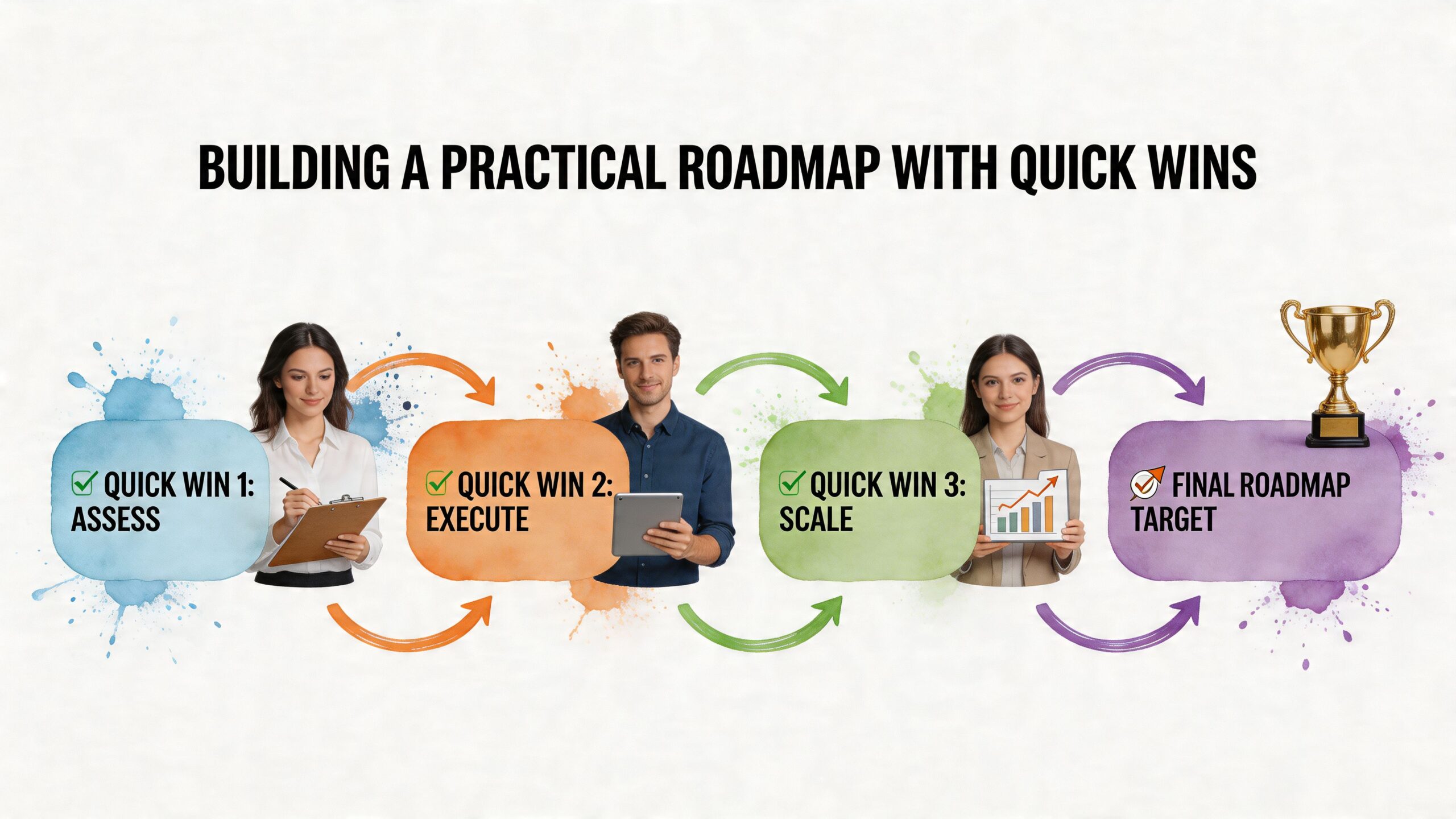
A roadmap is only useful if it changes what gets done next week.
Most technology roadmaps fail because they try to look all-encompassing instead of executable. They become long lists of worthy projects with weak sequencing and no visible tradeoffs. The result is familiar. The business approves a plan, but the operating reality stays noisy.
The better approach is narrower. Decide what must change first to restore control, reduce drag, and create momentum.
Use a structured sequence
The IDC IT Strategy Framework lays out a six-step method that starts with understanding business goals and ends with a phased execution plan. One of its most important steps is a gap analysis that prioritizes fixes by ROI and risk. That matters because analysis cited in the same summary says 70-80% of issues often stem from fuzzy ownership and siloed systems, and firms using structured approaches see 2-3x faster growth than peers using ad-hoc methods, based on CIO.com’s summary of the six-step IT strategy framework.
That tells you something important. Don’t start with a giant transformation program. Start with the gaps that are creating operational friction now.
What belongs in the first wave
Your first wave should include a mix of simplification, control, and relief.
Good early candidates include:
Vendor consolidation where overlap is obvious
If two tools do nearly the same thing, remove one. Fewer moving parts makes ownership clearer.Access and approval cleanup for critical systems
This improves control and reduces surprise changes.Reporting fixes around one core business flow
Pick the reporting path the executive team depends on most and make it trustworthy.One decision-rights reset
Clarify who approves system changes, new tools, and exceptions. Many organizations wait too long to formalize this.
A useful roadmap doesn’t promise everything. It protects the few moves that matter enough to finish.
Build around visible cadence
A roadmap without cadence is wishful thinking.
Break work into short phases. Give each initiative a named owner, a business reason, a risk note, and a visible due date. Review it weekly with a bias for clarity, not theater.
One practical option for companies that need executive-level help but not a full-time hire is fractional leadership. Services like CTO Input provide fractional or interim CTO, CIO, and CISO support to map current reality, install ownership, and move the first risk reduction and simplification actions into execution.
A practical roadmap should answer four questions fast:
- What are we fixing first?
- Why does it matter to the business?
- Who owns it?
- What will be different when it’s done?
If your roadmap can’t answer those questions, it’s still a document. It isn’t yet a management tool.
Your First 90 Days to a Calmer Technology Operation
A calmer technology operation doesn’t come from one big decision. It comes from a sequence of smaller decisions that create control.
The first month should focus on legibility. The next phase should focus on ownership and execution rhythm. By the end of the first quarter, you want fewer surprises, cleaner accountability, and a short list of visible improvements the leadership team can inspect.
The first move is not hiring
Many CEOs jump straight to the org chart. Sometimes that’s right. Often it’s premature.
If the current state is still murky, a new hire inherits confusion instead of solving it. You’re better off making the environment inspectable first, then deciding whether you need a permanent CTO, stronger CIO leadership, interim support, or a tighter operating model around the leaders already in place.
For many teams, this article on executive technology leadership helps frame that decision because it separates leadership work from pure technical administration.
A simple 30 and 90 day plan
| Timeframe | Key Action | Primary Goal |
|---|---|---|
| First 30 days | Map core workstreams, systems, vendors, and decision rights | Make the current reality legible |
| First 30 days | Identify the top bottlenecks and top trust risks | Narrow executive attention to what matters most |
| First 30 days | Name interim owners for key systems and decisions | Stop ownership drift |
| By 90 days | Establish a weekly operating cadence for priorities, blockers, and risk | Make progress inspectable |
| By 90 days | Launch a small set of simplification and risk reduction actions | Create operational relief |
| By 90 days | Build board-ready reporting on progress, ownership, and open exposure | Replace status hunting with visible control |
What better looks like
You know the strategy is working when technology stops behaving like a mystery.
The leadership team can explain what matters, who owns it, and what is moving. Vendors support the plan instead of writing it. Teams spend less time on status reconciliation and more time finishing useful work. Board and insurer questions get answered with evidence, not scramble.
That is what a solid technology strategy for CEOs should produce. Not more activity. Not prettier slides. Control.
When technology is governed well, it becomes boring in the best possible way. Work moves. Risk is visible. Leadership time comes back.
If you’re in the middle of tech chaos, don’t ask for a grand transformation plan first. Ask for a clean picture of reality, explicit ownership, and a short sequence of decisions that will make the next ninety days calmer than the last ninety.
If technology is slowing growth, weakening visibility, or creating avoidable risk, a conversation with CTO Input can help surface the top bottlenecks, clarify ownership, and outline the first practical moves to restore control.