
You’re running a justice-focused organization with a powerful mission, but the technology holding it all together feels fragile. It’s a common story. You’ve grown fast, driven by purpose, but your systems haven’t kept up. Case data is scattered across tools that don’t talk. Grant reporting is a recurring fire drill. And the risk of a data breach involving sensitive community information is a constant, quiet worry.
This isn’t a sign of failure. It’s the natural result of moving forward without a senior technology leader to build a solid foundation. The role of the CIO are about bridging that exact gap—turning technology from a source of stress into the reliable backbone your critical work deserves.
The Strategic Partner Your Mission is Missing
Does this sound familiar? Your staff spends too much time wrestling with spreadsheets and manual work, and not enough time supporting the advocates and partners on the front lines. You may have an IT vendor who fixes laptops or a systems manager who knows the database, but you don’t have a trusted senior leader who understands both your mission and your digital risk.
This isn’t just an IT problem; it’s a mission problem. Every hour your team loses to inefficient technology is an hour stolen from the communities you serve.
What you’re missing is a strategic partner—someone who starts with your mission, listens to how work really happens, and then helps you build a simple, believable modernization path you can defend to your board, funders, and community.
That is the essence of a modern Chief Information Officer, or CIO. Their job is to ensure technology actively accelerates your impact, protects your constituents, and brings clarity to your operations.
Moving Beyond the “IT Guy”
Let’s be clear: the old-school image of an IT leader as the person who just keeps the computers running is long gone. A modern CIO is a true executive strategist. They don’t just manage systems; they align those systems with your mission, your budget, and what the board needs to see.
This isn’t just a niche idea; it’s a major shift in how effective organizations operate. In fact, over 70% of CIOs now say their roles are far more focused on driving strategic initiatives than just managing the IT department. As this research on the evolving perception of CIOs shows, these leaders have become essential drivers of organizational change.
For your organization, that means having someone who can confidently answer the tough questions:
- How can we use our data to prove our impact to funders without burning out our staff with manual reporting?
- What’s the most responsible and effective way to shield sensitive client information from ever-growing digital threats?
- Which technology investments will actually give our team the most time back to focus on advocacy and community work?
Getting these answers right takes more than just technical skill. It demands a genuine understanding of the unique pressures and purpose behind your work. This guide will demystify the key roles of the CIO and show you how to find the right strategic leadership to finally turn your technology from a hidden liability into a powerful asset for justice.
The Four Hats a Modern CIO Wears
To understand the roles of the CIO, stop thinking of it as a single job. Instead, picture a leader who wears four distinct hats, switching between them depending on what your mission needs most. This simple framework cuts through the jargon and gives you a clear mental model for what real technology leadership looks like.
This is the fundamental difference between high-level, strategic leadership and the day-to-day work of keeping the lights on.
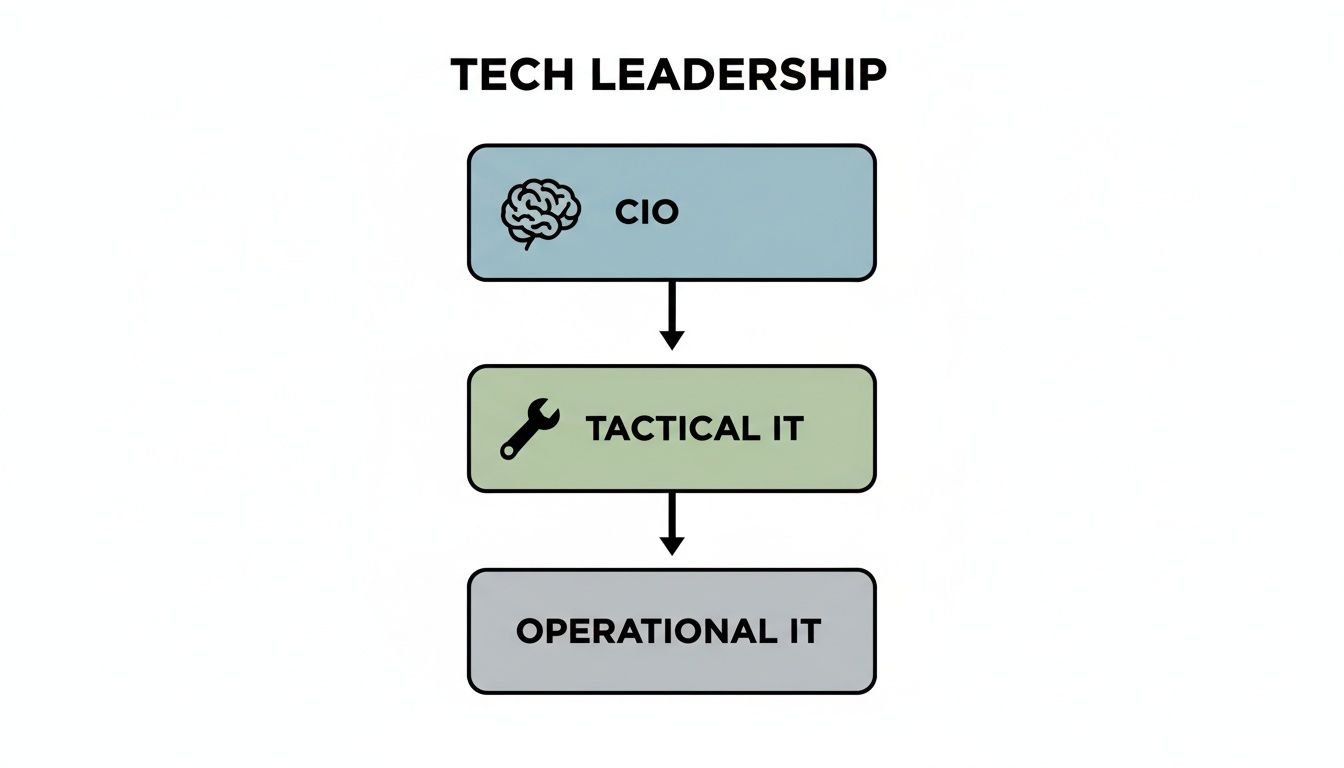
A CIO operates at the strategic level, guiding the “why” and setting the direction. The tactical and operational IT teams focus on the “how,” making sure the systems actually work.
The Strategist
First and foremost, a CIO is The Strategist. This is the person who sits with you, your COO, and your CFO, making sure every dollar spent on technology directly pushes your mission forward. They don’t start conversations by asking, “What software do you want?” They ask, “What outcome are we trying to achieve for the communities we serve?”
The Strategist translates your three-year vision into a practical, defensible technology roadmap. They build the business case for new investments and ensure the tech plan fits your budget, grant obligations, and core priorities.
The Builder
Next, the CIO wears the hat of The Builder. This role is about the nuts and bolts of your organization’s infrastructure. The Builder’s job is to ensure your core systems—from case management software to donor databases—are stable, reliable, and make your team’s life easier.
They are the architect behind the scenes, ensuring scattered data can flow into a single source of truth. Success for The Builder means fewer system outages, faster access to information, and a technical foundation solid enough to support your growth without cracking under pressure.
The Guardian
In a world of constant digital threats, The Guardian is perhaps the most critical role a CIO plays, especially where immigration, incarceration, or youth are involved. This is their cybersecurity and risk management function. They are ultimately responsible for protecting the sensitive information your community trusts you with.
The Guardian establishes security policies, navigates compliance with regulations, and prepares your organization to respond effectively if a breach ever happens. Given the high stakes in justice-focused work, this hat is non-negotiable.
This intense focus on protection isn’t just a hunch; it’s a top priority for technology leaders everywhere. Cybersecurity, data analytics, and demonstrating value from AI are the top functional priorities for CIOs today. Gartner’s 2025 agenda shows that over 80% of CIOs plan to increase their investment in cybersecurity, making it their most critical priority for the fourth year in a row. You can dig deeper into these key CIO priorities and trends on Evanta’s site.
The Coach
Finally, a great CIO is The Coach. Technology doesn’t run itself; it requires skilled people and strong partnerships. The Coach mentors your internal tech talent—whether that’s a single systems manager or a de facto “tech person”—helping them grow their skills and connect their work to the bigger mission.
At the same time, they manage your key technology vendors, holding them accountable for both performance and cost. The Coach ensures you have the right people and partners in place to execute the strategic plan, turning your technology vision into a daily reality.
Here’s a quick summary of how these four roles directly impact your organization’s ability to deliver on its mission.
The Four CIO Roles and Their Impact on Your Mission
| CIO Role (The Hat) | Core Focus | What Success Looks Like for You |
|---|---|---|
| The Strategist | Aligning technology investments with your long-term mission and goals. | Your tech budget directly supports strategic priorities, not just keeping the lights on. |
| The Builder | Creating a stable, scalable, and reliable technology foundation. | Staff has reliable access to data, systems don’t crash, and you can grow without breaking things. |
| The Guardian | Protecting sensitive data and ensuring regulatory compliance. | Reduced risk of data breaches, protected client trust, and a clear incident response plan. |
| The Coach | Developing internal talent and managing external vendor relationships. | You have a capable tech team and vendors who are true partners in achieving your goals. |
Understanding these distinct hats helps you see that a CIO isn’t just an IT manager with a fancier title. They are a multi-faceted leader essential for any modern organization that wants to use technology as a lever for meaningful change.
From Tactical Fixer to Strategic Partner
Of the four hats a CIO wears, The Strategist is the most critical—and often, the most misunderstood. This is where you see the real power of executive technology leadership. It’s the leap from simply keeping the lights on to actively using technology to advance your mission.
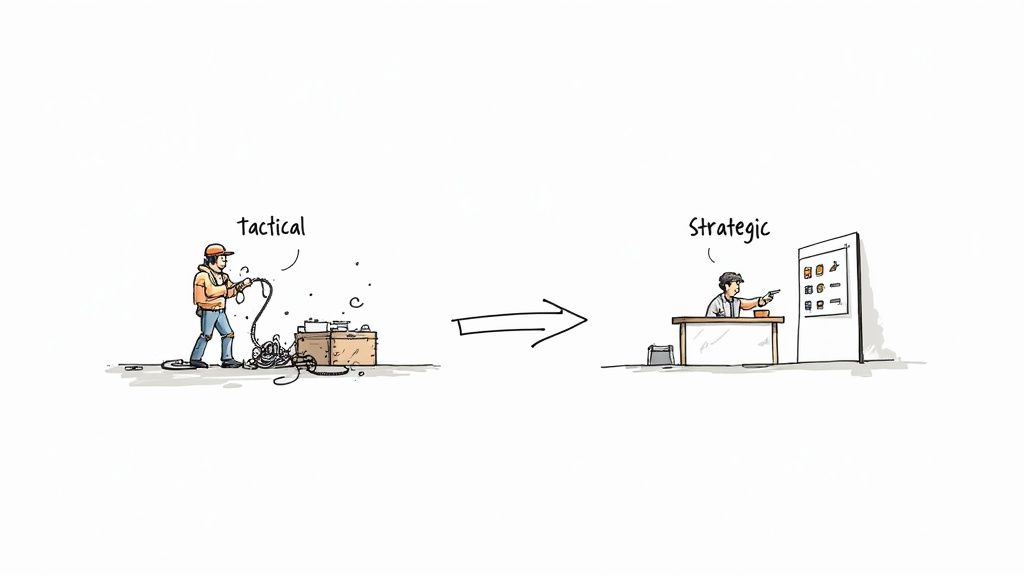
The difference is night and day. A tactical IT manager, faced with a problem, asks, “What software do you want me to buy?” A strategic CIO starts from a completely different place, asking, “What outcome are we trying to achieve, and how can technology get us there faster?”
This isn’t just a different way of talking; it’s a fundamental change in mindset. The best CIOs see technology not as the end goal, but as the engine for achieving specific, measurable mission results.
From Cost Center to Impact Driver
In too many organizations, the IT department is treated like a utility bill—a necessary expense to be minimized. This perspective traps you in a reactive, break-fix cycle. You only spend money when something breaks, and your “tech person” is perpetually stuck in firefighting mode.
A strategic CIO flips this script. They don’t just ask for a budget; they build a business case. They partner with the CFO to frame technology investments in terms of mission ROI. They work alongside the COO to find efficiencies that give staff more time for high-value work. They sit with the Executive Director to present a clear, defensible technology roadmap to the board.
“If you want to transform your business, it starts with processes and not with IT. IT is a means to get to an outcome, but you need to start from a business lens.”
– Benni Blau, Chief Process and Information Officer at SAP
This gets to the heart of the matter. A leader focused on the strategic roles of the CIO doesn’t lead with technology. They lead with your mission, your process, and your people—then align technology to serve them.
Is Your Tech Leadership Truly Strategic?
So, how can you tell if your current tech leadership is tactical or strategic? It comes down to the kinds of conversations you’re having. A strategic technology partner helps you answer questions like these:
- Financial Alignment: Instead of “Can you get a cheaper price on this software license?” the conversation becomes, “How can we structure our technology budget to directly support our three-year strategic plan?”
- Operational Efficiency: Instead of “Why is the server slow today?” the focus shifts to, “Which manual reporting processes are burning out our staff, and how can we automate them to free up 20 hours a week for client-facing work?”
- Risk Management: Instead of “Did you install the latest security patch?” the question is, “What is our plan for a data breach, and how does it protect our clients’ trust and our legal obligations?”
If your technology conversations are stuck on the first half of those pairings, you have a tactical fixer. They are essential for day-to-day operations but can’t provide the executive guidance needed to turn your systems into a true strategic asset. A CIO elevates the discussion, ensuring every technical decision is ultimately a mission decision.
Using Modern Tools and AI to Supercharge Your Mission
The buzz around artificial intelligence can be overwhelming. A seasoned CIO’s real job is to cut through that hype and connect every tech decision back to what truly matters—your mission. It’s not about chasing the latest shiny object; it’s about building a solid, reliable tech foundation that makes smart innovation possible.
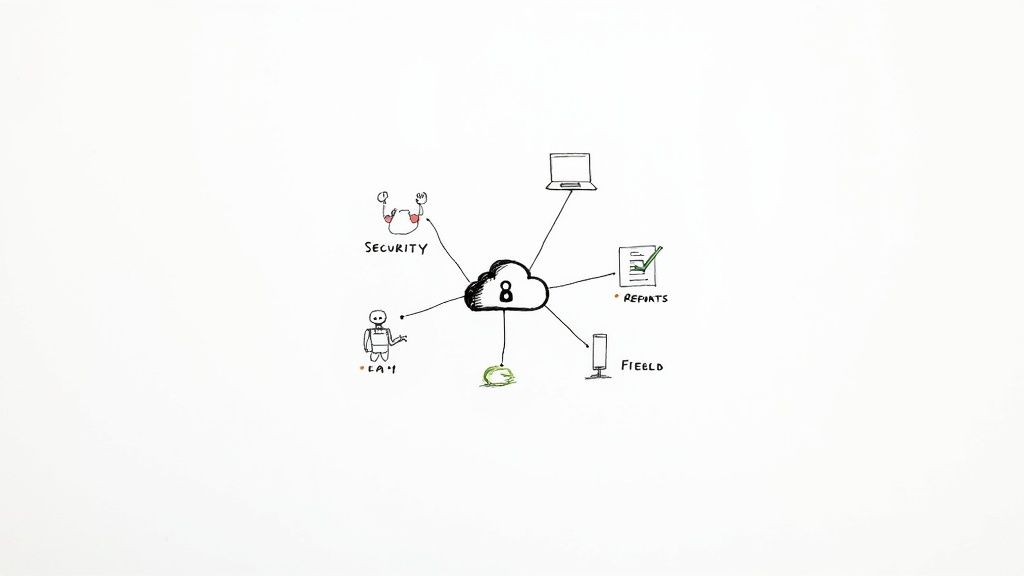
This means asking practical questions. Could an AI tool take the soul-crushing parts out of grant reporting, giving your team more time for advocacy? Can a modern cloud setup let caseworkers securely pull up critical client data from the field, right when it’s needed? This is the heart of a CIO’s role: to carefully vet, plan, and roll out new technology that actually helps.
A Sane Approach to Modernization
For any leader wary of the costs and headaches of new tech, a good CIO brings a sense of calm and a clear plan. They won’t walk in with a sales pitch for a specific platform. Instead, they’ll start by digging into your team’s daily workflows to pinpoint the exact bottlenecks slowing you down.
From there, they build a rock-solid business case you can confidently take to your board or funders. This process usually involves:
- Vetting vendors responsibly to make sure their products and values align with your mission and security standards.
- Running small, low-cost pilot programs to test if a tool delivers real value before you sink a major investment into it.
- Ensuring ethical use, which is non-negotiable when you’re handling sensitive community data. This includes thinking deeply about aligning technology with racial justice and equity, something we explore further in another guide.
It’s All About Real-World Results
This deliberate, measured approach is what separates effective tech leaders from the rest. It’s no surprise that a recent global CIO survey on IT shifts found that AI and machine learning are top of mind. In fact, 86% of CIOs are pushing AI projects to make internal work faster and improve how they serve their communities. And 36% of CIOs see modernizing their cloud infrastructure as the key to making it all happen.
The bottom line: A CIO’s job isn’t to bring you every new gadget. It’s to find the right tools and implement them the right way to solve the concrete problems that are holding your mission back today.
This focus completely changes the conversation. It moves from a vague “Should we look at AI?” to a specific, practical “How can this tool give our team back five hours a week?” That shift from abstract ideas to tangible wins is where a great CIO proves their worth, making sure technology serves your mission, not the other way around.
Finding the Right CIO Leadership for Your Organization
You see the value a CIO brings to the table. But the real challenge is figuring out how to bring that level of strategic leadership into your organization without blowing up your budget. For most justice-focused nonprofits and mid-size organizations, this decision usually comes down to three paths.
Each option has its own mix of costs, integration with your team, and speed to results. The best choice depends on where your organization is right now—its size, its complexity, and its ambitions for growth.
The Three Paths to CIO Leadership
Making the right call here demands an honest look at what your organization truly needs. This isn’t just about finding a tech expert; it’s about finding a strategic partner who understands the stakes.
Here are the primary models to consider:
-
Hire a Full-Time CIO: This is the classic approach for larger, more established organizations. A full-time CIO lives and breathes your culture and strategy, offering dedicated leadership every day. You get the highest level of integration, but it also comes with an executive salary and benefits package. For many, that cost is a non-starter.
-
Promote from Within: If you have a sharp IT director or systems manager who shows a knack for the big picture, you can groom them for the role. This is a fantastic move for morale, but it’s not a quick fix. This path requires a serious investment in coaching and training to help them shift from a tactical, hands-on mindset to a strategic, executive one.
-
Engage a Fractional CIO: This model gives you access to a seasoned, executive-level strategist for a fraction of the cost of a full-time hire. A fractional CIO partners with your leadership team for a set number of days each month, focusing entirely on high-level strategy, risk management, and building your technology roadmap. It’s the perfect solution for organizations that need CIO-level thinking but don’t need—or can’t afford—another full-time executive.
For many growing organizations, the fractional model is the sweet spot. It delivers the strategic guidance needed to get your systems in order and build a clear plan for the future, without the financial weight of another C-suite salary. You can dig deeper into how this works by exploring the benefits of a fractional CIO engagement.
Key Questions to Ask Any CIO Candidate
No matter which path you take, the interview process needs to be less about technical certifications and more about strategic thinking and cultural fit. You’re not hiring another IT manager; you’re looking for an executive partner.
Your goal is to find a leader who asks better questions than you do—someone who pushes you to think about technology not as a cost center, but as a direct driver of your mission’s success.
Here are a few questions that will help you cut through the jargon and find a true strategist:
- “Tell me about a time you built a technology roadmap. How did you make sure it aligned with the organization’s goals and budget realities?”
- “Imagine our program data is a mess, scattered across three different systems. What would you do in your first 90 days to get your arms around the problem and propose a path forward?”
- “How would you explain a major cybersecurity risk to our board of directors—who are not tech people—in a way that helps them make a clear, confident decision?”
Their answers will reveal everything you need to know about their ability to fill the true roles of the CIO. You’ll see if they can move beyond just fixing things and provide the calm, forward-thinking leadership your organization needs.
The Path From Technology Chaos to Mission Clarity
You’re at a crossroads. One path is to stick with the status quo—the cost of doing nothing. The other leads to a future where your technology is guided by a clear, strategic hand.
Sticking with what you know means accepting the constant fire drills. It means living with persistent security risks that put your community on the line and watching your staff burn out from the weight of endless manual work. This is the quiet tax on your mission, paid daily in lost time and missed opportunities. It feels familiar, but it’s a trap that keeps you in a reactive cycle, constantly patching holes instead of building a stronger foundation.
A Vision for Success
The other path? That’s where technology becomes your most dependable ally.
Picture walking into a board meeting feeling calm and confident, presenting clear data that powerfully demonstrates your impact. Imagine your team, finally free from the chaos of spreadsheets, with the time and energy to focus on serving your advocates and partners. Most importantly, envision rock-solid, secure systems that protect the vulnerable people you serve, earning and keeping their trust.
This is the future a CIO helps you build. It’s not about buying flashy, expensive tools. It’s about making deliberate, smart choices that build stability, bring clarity, and expand your capacity to do good. It’s about creating an environment where technology empowers your team instead of getting in their way. For instance, some organizations have successfully used technology to match pro bono lawyers with clients faster, turning a logistical nightmare into a simple process that directly serves their mission.
This isn’t theory. It’s a practical shift from seeing technology as a frustrating cost center to recognizing it as the reliable backbone that supports your most critical work. The right leadership makes that transformation happen.
This future isn’t a far-off dream, and you don’t have to get there alone. It can start with a simple conversation—a chance to map out your challenges, identify your biggest risks, and create a realistic plan for a more stable, impactful future. The roles of the cio are specifically designed to guide you on this exact journey, bringing clarity to the chaos.
Common Questions About the CIO Role
Leaders in justice-focused organizations often reach a point where scattered data and agonizing manual reporting just aren’t sustainable anymore. When that happens, these are the questions that usually come up.
What’s the Real Difference Between an IT Director and a CIO?
Think of an IT Director as the master of the “how” and “what.” They are focused on the here and now: keeping the lights on, managing your existing systems, squashing support tickets, and wrangling vendors. Their job is all about operational stability and executing today’s tasks.
A CIO, on the other hand, is a strategic executive who owns the “why.” They don’t just manage technology; they connect it directly to your organization’s mission. Their focus is on the future—managing digital risk, planning for growth, and ensuring every single technology investment pushes your mission forward. This distinction is one of the most fundamental aspects of the roles of the CIO.
My Organization Is Small. Do We Really Need a CIO?
You might not need a full-time, six-figure CIO on your payroll, but you absolutely need CIO-level thinking. Ignoring strategic technology planning, data governance, and cybersecurity isn’t a cost-saving measure—it’s a risk, especially when you’re responsible for sensitive community data.
This is where a fractional CIO is a game-changer for smaller organizations. You get the executive-level strategic guidance, risk management, and long-term roadmap you need, but for just a few days a month. It’s the perfect way to access top-tier expertise without the full-time cost.
How Does a CIO Actually Help with Fundraising and Grant Reporting?
A strategic CIO makes your data reliable and accessible. They work to connect your disparate systems—your CRM, program management tools, and financial software—so everything speaks the same language. This turns grant reporting from a frantic, spreadsheet-fueled nightmare into a simple, often automated process that pulls from one accurate source.
When you can produce clear, timely data that proves your impact, you build a much stronger case for funding. A CIO helps you show your board, donors, and community partners exactly what you’ve accomplished, building trust and opening up new funding opportunities.
Feeling bogged down by technology chaos? The path to clarity starts with a simple conversation. CTO Input provides fractional CIO leadership to align your technology with your mission, reduce risk, and free your team to focus on the work that truly matters. Schedule a no-pressure discovery call and let’s map out your path forward.