

You look at your monthly spend and see a growing wall of SaaS subscriptions, “must‑have” security tools, and point solutions. Yet outages keep happening, access requests drag on, and the board is asking sharper questions about cyber risk and resilience.
On paper, you have more tools than ever. In practice, you have less confidence.
Tool Sprawl Is a Governance Problem in Disguise means this: the real issue is not the number of tools, it is the lack of clear decision rights, standards, and ownership for technology and risk. When governance is weak, every department fills the gap with its own apps, workflows, and vendors.
This post shows how to read tool sprawl as a warning signal, not a purchasing mistake, and outlines a practical, non‑technical path mid‑market leaders can use to bring cost, risk, and growth back into alignment.
What Tool Sprawl Really Tells You About Your Governance
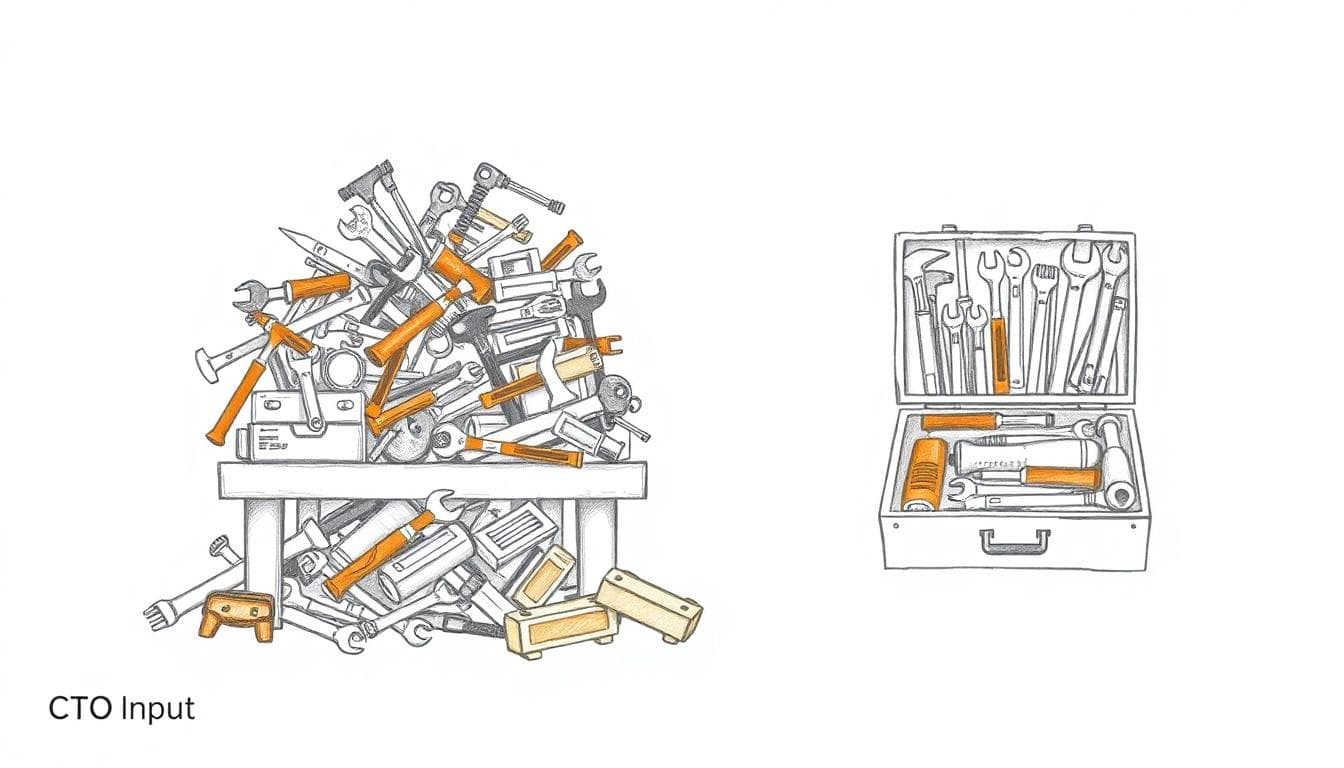
Image created with AI
Picture a kitchen where everyone buys their own gadgets. Three blenders, four sets of knives, two air fryers. Nothing is in the same drawer, nobody knows which appliance is safe to use, and every new recipe needs another device.
That is tool sprawl. Not broken equipment, but a messy, unplanned collection that slows everyone down.
In most mid‑market companies, technology now looks a lot like that kitchen. Recent data shows that mid‑sized firms use around 100 SaaS apps on average, with a large share underused or unmanaged. Studies on SaaS sprawl as a rising concern for IT link this directly to weak visibility and poor governance.
The important insight: buying “one platform to rule them all” will not solve a governance problem. It only gives you a bigger kitchen island to clutter.
Simple definition of tool sprawl for non‑technical leaders
Here is a definition you can repeat to your board:
Tool sprawl is when different teams keep adding their own software and security tools without shared rules, so costs, risk, and confusion quietly pile up.
A simple example:
- Sales picks its own CRM plug‑ins.
- Marketing signs up for separate campaign tools.
- Operations adopts its own project and messaging tools.
- Security buys point solutions to plug gaps after the fact.
Each decision makes sense in the moment. Together, they create overlapping tools, inconsistent workflows, and a long list of vendors nobody fully owns.
The business impact is real:
- Confusion over “which tool we use for what”
- Friction for staff who must jump between systems
- Hidden cost in licenses, manual work, and integration
When you explain it at that level, your board understands this is not an IT complaint. It is a management issue.
Why “too many tools” is really a governance red flag
Tool sprawl is a symptom that your governance engine is misfiring. It usually points to gaps like:
- No standard list of approved or preferred tools
- No single executive owner for technology and cyber risk
- Weak or ad‑hoc vendor review
- Departments making one‑off tech decisions in isolation
If governance were strong, teams could still move fast, but inside clear guardrails. Marketing could test new tools, for example, but within a defined process that checks security, data use, and integration with core systems.
Research on software sprawl as a growth killer highlights the pattern: where there is no shared spine of systems and standards, local convenience always beats global discipline.
So when you see tool sprawl, do not start with: “Which tools should we cut?”
Start with: “Who decides, what are the rules, and who owns the risk?”
How Tool Sprawl Hurts Cost, Risk, and Trust in Your Business
Once you see tool sprawl as a governance signal, the consequences snap into focus. It is not just “too many apps.” It is a drag on cost, risk, and trust at the leadership table.
Hidden costs: duplicate tools, low adoption, and extra headcount
Most mid‑market companies underestimate the true cost of tool sprawl. Studies on SaaS usage show that a large share of licenses are inactive or barely touched, and that mid‑market firms often spend thousands of dollars per employee on software.
The waste shows up in three places:
- Duplicate tools for the same job, like three project tools or multiple file‑sharing platforms
- Low adoption, where only a fraction of licensed users log in each month
- Extra headcount, to stitch tools together and “keep the lights on”
Subscription price is only the starting point. The real number is total cost of ownership: licenses, integrations, manual work, training, audits, and incident response when something goes wrong.
In a healthy governance model, every tool has an owner, a place on the roadmap, and a success metric tied to business value. Anything that does not clear that bar gets retired or replaced, not quietly renewed.
Security and compliance: more tools, more doors to guard
Every extra tool is another door into your business. Another login, another admin panel, another data store.
When 80 percent or more of apps are outside formal IT management, which some studies on SaaS and identity sprawl suggest, your attack surface grows faster than your defenses. Each unsanctioned or lightly reviewed tool can:
- Store customer or financial data without proper controls
- Reuse passwords or weak authentication
- Fall out of sync with your offboarding process
That makes board or lender questions harder to answer. “Where does our sensitive data live?” or “Which vendors are critical to operations?” should be simple questions. Under tool sprawl, they are not.
Governance should decide:
- Which categories of tools may hold sensitive data
- How access is granted, reviewed, and removed
- How vendors are vetted and monitored
Without that, security teams are stuck playing whack‑a‑mole with tools instead of managing risk at the system level.
Fragmented data and slow decisions at the leadership table
Tool sprawl also fractures your view of the business. Finance reports one set of numbers from its systems. Sales, operations, and product show different figures from their own dashboards.
Meetings become debates about “whose data is right” instead of “what decision we will make.”
This is not just a data problem. It is a governance problem:
- No agreed list of systems that drive official reporting
- No owner for cross‑system data quality
- No rule that new tools must integrate with the core data spine
Articles on SaaS sprawl control and governance make the same point. Tools that sit off to the side create shadow datasets and slow every strategic conversation.
Your leadership team needs one source of truth. Tool sprawl, left unchecked, guarantees the opposite.
Turning Tool Sprawl Into a Governance Fix, Not a One‑Off Cleanup
The temptation is to launch a “tool rationalization project” and start cutting. That might save some money in the short term, but without governance changes, the sprawl will quietly return.
You do not need a massive transformation program. You need a handful of light‑touch moves that reset ownership and rules, so tools support your growth plan instead of fighting it.
Step 1: Get a clear inventory and name an accountable owner
Start with a simple, honest inventory. Not every tiny app, but the core tools that run your business:
- What is the tool and what job does it do?
- Who owns it?
- What does it cost, including add‑ons and services?
- What data does it hold?
You can use patterns from SMB and mid‑market research on tool sprawl as a reference for typical categories.
Then make one clear decision: name a single executive owner for technology and cyber risk. That may be a fractional CTO, CIO, or CISO, but the key is accountability, not job title.
Hands‑on work can stay with IT, vendors, or internal teams. The owner’s role is to connect tools, cost, and risk to your strategy, and to give the board a consistent story.
Step 2: Set basic guardrails for buying and using tools
Next, introduce light but firm guardrails. Not a committee that blocks progress, but rules that align autonomy with risk. For example:
- Teams can pick their own tools below a spend or risk threshold
- Above that, new tools go through a short review for security, data use, and fit
- Any tool holding customer, payment, or health data must meet stricter checks
- New tools must connect to your agreed “spine” of systems where possible
Write this down in plain language. Share it with managers. Make it part of onboarding for new leaders.
Guardrails like these keep speed, but make sure each new tool strengthens the system instead of adding noise.
Step 3: Build a simple roadmap that ties tools to your growth plan
Finally, move from one‑off cleanups to a simple 12 to 24 month roadmap. The question is not “Which tools do we like?” It is “Which tools move revenue, customer experience, and risk in the right direction?”
Focus on a small number of high‑impact moves:
- Retire a few legacy or duplicate tools with low adoption
- Consolidate where it clearly improves cost, security, and data quality
- Close one or two obvious risk gaps, such as access control or backup
This is where a neutral, senior advisor can help the most. Someone who is not tied to a specific vendor, and who can sit on your side of the table to sort signal from noise and align technology, cost, and risk with your growth story.
Conclusion: Treat Tool Sprawl As A Signal, Not Just A Mess
Tool Sprawl Is a Governance Problem in Disguise, not a shopping error. When you treat it as a signal, you get the chance to reset how technology decisions are made, who owns risk, and how tools support your strategy.
Tightening governance in a practical way reduces cost, shrinks your attack surface, and lowers noise for your team and your board at the same time. It turns a source of anxiety into a source of clarity.
If you are feeling the drag of tool sprawl, do not just cut licenses. Step back, reassign ownership, set guardrails, and build a simple roadmap that ties your tools to growth.
To see how fractional CTO, CIO, and CISO leadership can bring order and alignment to your tools and governance, visit CTO Input and explore advisory support and success stories. For ongoing, practical guidance on turning technology into a real advantage, keep reading the CTO Input blog.