
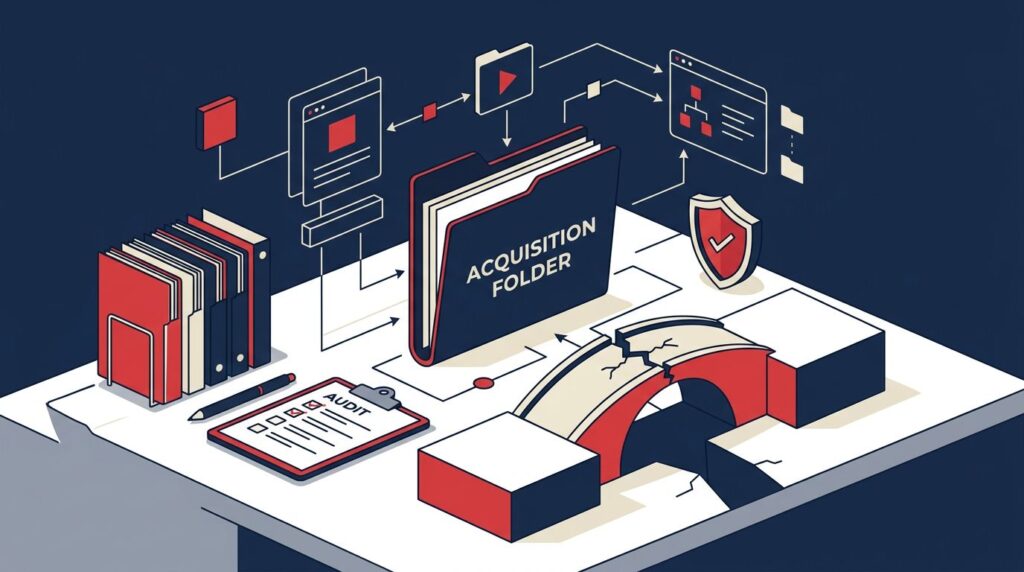
Trust Debt M&A: What Acquirers See First
A deal can look healthy until the buyer starts asking for evidence. That is where trust debt M&A becomes expensive.
Trust debt is the gap between what leadership says about technology and what the systems, contracts, reports, and operating habits can prove. Acquirers don’t expect perfection. They do expect honest answers, clear ownership, and a credible plan for the issues that remain.
When those answers are slow, inconsistent, or dependent on one person, the buyer sees more than technical debt. They see execution risk, integration cost, and a management team that may not have a reliable grip on the business.
Key takeaways
- Trust debt is not an accounting line item. It is accumulated uncertainty around systems, people, vendors, risk, and decisions.
- Acquirers test whether the technology can support the deal thesis, not whether every tool is modern.
- Weak evidence can affect price, deal structure, timelines, and post-close obligations.
- Acquisition readiness starts before a buyer arrives, with clear ownership, reliable reporting, and a short technology roadmap.
Why trust debt M&A kills deal confidence
Trust debt builds through small decisions that never receive proper follow-through.
A system is poorly documented. A vendor owns critical knowledge. Security exceptions stay open. Backups exist but haven’t been tested. The technology budget grows without a clear connection to revenue, margin, or customer experience. Leadership keeps approving work without deciding what should stop.
None of these issues automatically kills a deal. Together, they create a pattern. The buyer starts asking whether the business is being managed with facts or optimism.
That distinction matters because an acquirer is buying future performance, not only current revenue. They need to know whether the target can scale, integrate, protect customer data, support reporting, and keep operating when key people leave.
Two executives review a technology dashboard on a large screen in a minimalist boardroom.

The buyer’s team may compare leadership interviews with architecture diagrams, vendor contracts, invoices, access records, incident history, and development activity. If those sources tell different stories, confidence drops quickly.
Black Duck’s explanation of the business risks of technical debt in M&A makes the same practical point. Technical debt becomes a transaction concern when it creates costs or constraints the buyer did not include in the original investment case.
Acquirers can tolerate problems they can see. They struggle with problems your team cannot explain, measure, or assign to an owner.
That is the heart of trust debt M&A. The issue is not that your business has flaws. Every operating company does. The issue is whether the buyer can trust your view of those flaws.
What acquirers inspect during technology due diligence
The strongest buyers begin with the investment thesis. Are they buying the company for faster growth, better margins, new customers, a stronger product, or an easier route into a market?
Technology due diligence then tests whether the target can support that promise. A useful acquisition technology due diligence review connects systems and technical decisions to the commercial reason for the deal.
The review usually reaches beyond software code. Acquirers may examine:
- The systems inventory, architecture, integrations, and data flows.
- Technical debt, release discipline, testing practices, and key-person dependency.
- Customer data, data quality, privacy obligations, and the data governance framework.
- Vendor contracts, renewal dates, termination rights, service levels, and vendor offboarding.
- Identity controls, privileged access, security incidents, recovery capability, and cyber insurance.
- Intellectual property ownership, employee agreements, contractor access, and open-source exposure.
- The technology budget, capitalized development, implementation costs, and recurring operating spend.
A technology assessment for acquisition also looks at practical integration questions. Can the systems exchange data? Are identity models compatible? Will reporting survive the combination? Which platforms should remain, and which need application portfolio rationalization?
Vaultinum’s overview of technology due diligence identifies related areas such as scalability, cybersecurity, technical debt, and intellectual property. Those issues matter because post-merger technology integration rarely follows the neat timeline presented in an early deal model.
If AI is part of the target’s product or growth story, the review becomes wider. The buyer may ask about model ownership, training data rights, AI vendor due diligence, privacy, usage controls, and AI governance. A polished AI adoption strategy doesn’t replace evidence that the system can be maintained and governed.
Where trust debt becomes a price problem
Trust debt M&A usually becomes visible in four parts of the deal story.
The financial story
Technology spend must connect to the financial statements and the operating plan. Buyers may examine whether development costs were capitalized consistently, whether implementation expenses are recurring, and whether claimed savings can be traced to actual decisions.
They may also ask how engineering efficiency affects margin goals, including the treatment of stock-based compensation and non-GAAP measures such as Adjusted EBITDA. You don’t need to present technology as a cost center. You do need to show what the spending buys.
A large technology budget is not automatically a problem. Unexplained technology spend is.
The operating story
Acquirers look for signs that work depends on heroics. Projects repeatedly slip. A founder approves every major decision. One engineer understands the integrations. Vendors make roadmap choices because internal ownership is weak.
That pattern raises questions about scalability. If the target needs a major systems change after close, the buyer wants to know who can lead it and whether the team has enough capacity.
The risk story
Cybersecurity due diligence often exposes trust debt quickly. Weak access controls, untested backups, vague incident response, missing vendor risk management, and unclear recovery objectives turn technical concerns into business exposure.
A buyer may also ask whether business continuity planning and disaster recovery planning match the systems that actually support revenue. Board-ready cybersecurity reporting should show risk appetite, owners, open decisions, and expected business impact. A list of security tools won’t answer those questions.
The integration story
The buyer needs a realistic view of the first 90 days and the first year. That requires more than a board-ready tech roadmap. It requires a practical CTO transition plan, named owners, vendor dependencies, data decisions, and a 12-month technology roadmap that reflects available capacity.
You can find a useful set of technology due diligence questions by starting with the deal thesis instead of the tool catalog.
How to reduce trust debt before a buyer asks
You don’t reduce trust debt by creating a larger binder. You reduce it by making the operating reality easier to understand and defend.
Start with a short, evidence-based review.
- Build one source of truth. Create a current systems inventory, vendor list, architecture view, data map, security risk register, and technology spend summary. Mark what is confirmed, assumed, missing, or owned by an outside party.
- Tie technology to the deal thesis. Your business-aligned technology strategy should answer which systems support growth, which risks could block the transaction, and which investments belong before close. A one-page technology strategy is often more useful than a long document no executive reads.
- Assign decisions to people. Create a decision rights map for architecture, vendors, security, data, budget, and integration. Acquirers notice when responsibility is shared by everyone and owned by no one.
- Make the next 90 days credible. Name the work that must happen before close, the work that can wait, and the evidence required for each item. Include vendor incident response plans, recovery testing, access reviews, contract gaps, and material technical debt.
Your reporting should help leadership act. A monthly technology operating rhythm can cover delivery, spend, risk, vendor performance, and decisions needed from the executive team. It should not become another status meeting.
The best technology due diligence review for finding deal risks before close gives leadership a prioritized view of what affects price, timing, integration, and ownership.
Who should own the work?
Your internal IT team may be working hard. That doesn’t mean the company has executive technology leadership.
A fractional CTO fits when you need ongoing judgment, technology strategy, vendor oversight, and board-ready reporting, but the business isn’t ready for a full-time hire. Fractional CTO services can help close a technology leadership gap while you prepare for acquisition or decide what the permanent role should become.
An interim CTO fits a different situation. Interim CTO services are usually appropriate when the seat is vacant, trust has broken down, or the business needs stabilization during a leadership transition. A part-time CTO, virtual CTO, or outsourced CTO may provide continuing support when the need is strategic but the role can operate on a flexible schedule.
If cybersecurity is the main concern, a fractional CISO, virtual CISO, or interim CISO may be the better fit. The title matters less than the ownership the deal requires.
If your leadership team cannot explain what is slowing the transaction, Get an Executive Technology Clarity Check can help identify whether the real problem is technical debt, weak reporting, vendor dependence, unclear decision rights, or missing executive ownership.
Conclusion
Trust debt doesn’t appear on the balance sheet, but it affects what a buyer believes the business is worth.
When your systems, spend, risks, vendors, and decisions tell a consistent story, problems become manageable. When they conflict, the buyer prices uncertainty into the deal.
The practical next step is not to promise that everything is fixed. It is to show what is known, what is not, who owns each issue, and what will happen next. That is how you replace trust debt with evidence buyers can use.
Frequently asked questions
Is trust debt a formal accounting term?
No. Trust debt is a practical way to describe accumulated uncertainty around technology, ownership, risk, and evidence. It can affect a transaction even though it isn’t recorded as a separate liability.
How is technical due diligence different from a technology audit?
A technology audit may focus on controls, systems, or compliance. Technical due diligence tests whether the technology can support the investment thesis, integration plan, valuation, and expected operating results. It connects findings to deal consequences.
When should you bring in a fractional CTO or interim CTO?
Bring in a fractional CTO when you need continuing executive technology leadership without a permanent seat. An interim CTO is usually better when the leadership position is open, the business needs stabilization, or a transition requires immediate ownership. A technology assessment for acquisition can help you decide which model fits before you hire.