
A CFO can see a budget variance quickly. It takes longer to see whether leadership still trusts the technology story. Trust debt is the accumulated cost of missed commitments, unclear ownership, weak reporting, unresolved risk, and decisions that keep getting reopened.
If you want to know how to measure trust debt, start with operating evidence, not a vague confidence survey. Look at how long decisions take, whether delivery matches commitments, where technology spend goes, how risk is reported, and what people do when they stop believing the official picture.
The goal is not to create another score for the board pack. It is to give you a clearer view of whether technology is helping the business move or creating drag.
Key takeaways for measuring trust debt
- Trust debt is a management construct, not an accounting liability.
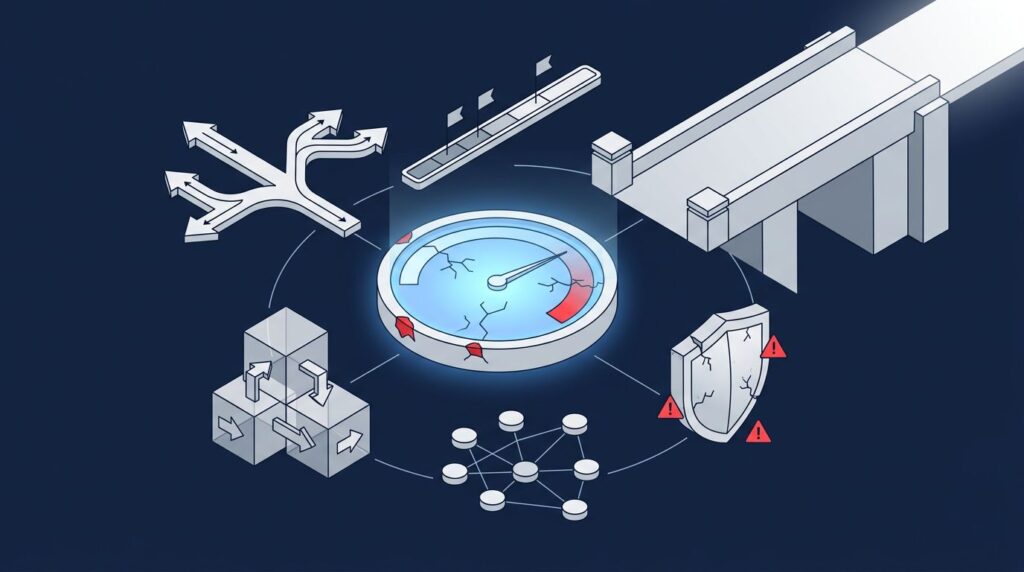
- Track five indicators: decision speed, delivery reliability, spend traceability, risk visibility, and stakeholder confidence.
- Use quarterly trends instead of reacting to one bad month.
- Every material issue needs an owner, a decision date, and a stated business consequence.
- Falling trust usually points to a leadership, reporting, or accountability problem before it points to a tool problem.
How to measure trust debt each quarter
There is no universal trust debt formula. You need a consistent internal scorecard that shows whether confidence is improving or eroding.
Start with a baseline quarter. Record the current state, the prior-quarter result, the target, and the owner. Use simple status markers if needed, but keep the underlying measures visible. A green status without evidence will create more debt.
Your quarterly review should connect technology to revenue, margin, execution, customer experience, resilience, and risk. It should also show what leadership needs to decide next.

1. Decision latency and ownership
Measure the median number of business days between raising a material technology issue and making a decision.
Also track:
- The percentage of major decisions with one named owner.
- The number of decisions reopened within the same quarter.
- The number of unresolved decisions past their target date.
- The number of exceptions approved without a documented rationale.
This applies to software purchases, vendor renewals, security exceptions, data decisions, roadmap tradeoffs, and technology investments. Routine support tickets don’t belong in this measure.
A growing decision backlog usually means the business has a technology leadership gap. The issue may not be a lack of intelligence or effort. It may be unclear authority between the CEO, COO, CFO, board, technical team, and vendors.
A clear decision rights map helps. So does a technology operating rhythm that brings the right decisions to the right meeting. Good technology governance for CEOs and technology governance for boards should improve decision quality without turning directors into daily IT managers.
When decisions move slowly, trust debt rises because people begin working around the formal process. That is when founder-led technology decisions, shadow approvals, and side conversations start replacing accountable leadership.
2. Delivery reliability and roadmap variance
Technology earns trust when commitments are predictable. Track the percentage of material milestones delivered by the promised quarter, along with scope changes, blocked work, budget variance, and the number of initiatives that lack a measurable business outcome.
A technology roadmap should show more than project names. Your 12-month technology roadmap should connect each priority to a business result, owner, cost, dependency, and consequence if delayed.
A simple technology roadmap template can help organize information, but it won’t solve weak prioritization. The real test is whether leadership can answer four questions:
- What is the business outcome?
- Who owns delivery?
- What will it cost?
- What happens if you wait?
A board-ready tech roadmap should make those tradeoffs visible. It should not present an attractive list of activity while critical dependencies remain hidden.
Watch for repeated patterns. If projects are regularly re-scoped after approval, deadlines move without a clear explanation, or teams report progress that doesn’t translate into outcomes, your trust debt is growing. The answer may require better strategic technology planning, technical debt management, or stronger stakeholder alignment.
3. Spend traceability and technology ROI
This is where the CFO has the strongest direct influence. Map material technology spend to a business outcome, an executive owner, and a review date.
Track budget-to-actual performance, forecast accuracy, unused licenses, vendor renewals, implementation costs, capitalized development, and cost-per-outcome reporting. Include internal labor where it affects the investment decision.
Technology ROI doesn’t always mean immediate revenue. It may mean lower cost to serve, faster delivery, fewer errors, stronger customer retention, or reduced expected loss. The claim still needs evidence.
Don’t promise savings you cannot trace. Tool sprawl, duplicate platforms, and shadow IT often hide across departmental budgets. Application portfolio rationalization and disciplined software platform evaluation can expose waste, but only if someone owns the decision after the review.
Spend also affects the financial story. Implementation costs and capitalized development can influence Adjusted EBITDA and how investors interpret engineering efficiency. For companies approaching acquisition readiness or an IPO, technology due diligence should connect spend, ownership, priorities, and audited financial statements.
A useful CFO guide to financial risk management can help frame technology investment as part of the broader financial control environment.

4. Risk visibility and remediation
Risk creates trust debt when leaders suspect the exposure is larger than the report suggests.
Track the number of high risks, overdue remediation items, untested controls, unresolved vendor exceptions, critical access issues, and incidents without completed follow-up. Include recovery testing, incident response readiness, and material dependencies on one provider.
Your risk view should cover more than cybersecurity. Include business continuity planning, disaster recovery planning, data privacy, data quality, information governance, and third-party risk management.
For cyber, the CFO should see risk in financial and operational terms. That includes cyber risk appetite, likely business impact, recovery assumptions, insurance requirements, and the cost of reducing exposure. Cyber risk quantification guidance provides a useful way to connect security decisions to expected financial loss.
Board cybersecurity reporting should be short and decision-focused. A board-ready risk summary can show the few risks that matter most, the executive owner, the current treatment, and the decision required. Technical detail belongs behind the summary.
If a vendor handles sensitive data, track vendor due diligence, contract protections, vendor offboarding, and the vendor incident response plan. A clean vendor management process reduces the chance that third parties become invisible sources of trust debt.
5. Stakeholder confidence and workarounds
Confidence matters, but a survey alone is weak evidence. Pair a quarterly pulse with observable behavior.
Ask leaders to rate three statements from one to five:
- I understand the current technology priorities.
- I trust the status being reported.
- I know which decisions require my involvement.
Then compare those scores with escalations, rework, executive overrides, late board questions, unapproved tools, and recurring workarounds. An increase in shadow IT or manual spreadsheets often reveals a trust problem before someone reports low confidence.
Look at who bypasses the process and why. A sales team may buy a tool because delivery is too slow. Finance may create a separate report because data quality is poor. Operations may keep a manual process because the core system cannot support the work.
These behaviors are not proof that employees are careless. They are evidence that the official system or decision process isn’t meeting a business need. Trust debt falls when leadership fixes the cause, not when it tells people to stop working around the problem.
Turn the five indicators into a quarterly operating rhythm
Review the indicators monthly with management and quarterly with the board. Keep the board version concise. It should show material initiatives, delivery status, business outcomes, committed money, key risks, vendor exposure, and decisions that need director input.
A useful technology dashboard should include the current quarter, prior quarter, trend, threshold, owner, and next action. Don’t combine everything into one mysterious trust score. A single number can hide the difference between a delivery issue and a serious risk disclosure problem.
Your quarterly conversation should end with decisions, not observations. For each red or deteriorating indicator, record what will change, who owns it, and when leadership will review the result.
If you already have technical managers or outside vendors but still lack clear ownership, executive technology oversight can help establish stronger reporting, decision rights, vendor control, and business alignment.
When trust debt points to a leadership gap
Reporting won’t repair trust debt if nobody has authority to act.
A fractional CTO, part-time CTO, virtual CTO, or outsourced CTO can provide continuing executive judgment when you need technology leadership but not a permanent hire. This is the usual shape of fractional technology leadership for growth-stage and mid-market companies.
An interim CTO and interim CTO services make more sense when the seat is open, trust has broken down, or the business needs stabilization quickly. A fractional CIO may fit when enterprise systems, data, and operations are the larger concern. A fractional CISO, virtual CISO, or interim CISO may be appropriate when cybersecurity oversight is the immediate pressure point.
The choice is not only fractional CTO vs full-time CTO. It is also fractional CTO vs IT consultant. A consultant may deliver a defined recommendation. An executive leader stays close enough to own the operating picture, decision process, and follow-through.
Before deciding how to hire a CTO, identify the problem. Is it weak reporting, vendor dependence, stalled delivery, technical debt, or unclear ownership? If the answer is still scattered, fractional CTO services may help you establish the facts before making a permanent decision.
Frequently asked questions
Is trust debt an accounting liability?
No. Trust debt is not a GAAP liability or a line item on the balance sheet. It is a management measure for the business cost of weak confidence, unclear ownership, poor delivery, and hidden risk.
How often should a CFO measure trust debt?
Review the underlying indicators monthly and conduct a formal quarterly review. Monthly data helps you act sooner. Quarterly reporting helps you identify trends and provide useful board technology reporting.
What should you do when the indicators conflict?
Look for the cause rather than averaging the results. Strong delivery with weak risk visibility needs a different response than strong spend control with slow decisions. The right next step may be a technology assessment, technology audit, technology health check, or 90-day technology plan.
Conclusion
Trust debt grows when the business can no longer rely on the technology story it is being told. You can measure it through decision latency, delivery reliability, spend traceability, risk visibility, and stakeholder behavior.
The strongest quarterly review doesn’t create false precision. It gives you honest visibility, clear ownership, and a short list of decisions that matter now. If the picture remains unclear, Get an Executive Technology Clarity Check and start with the facts.